





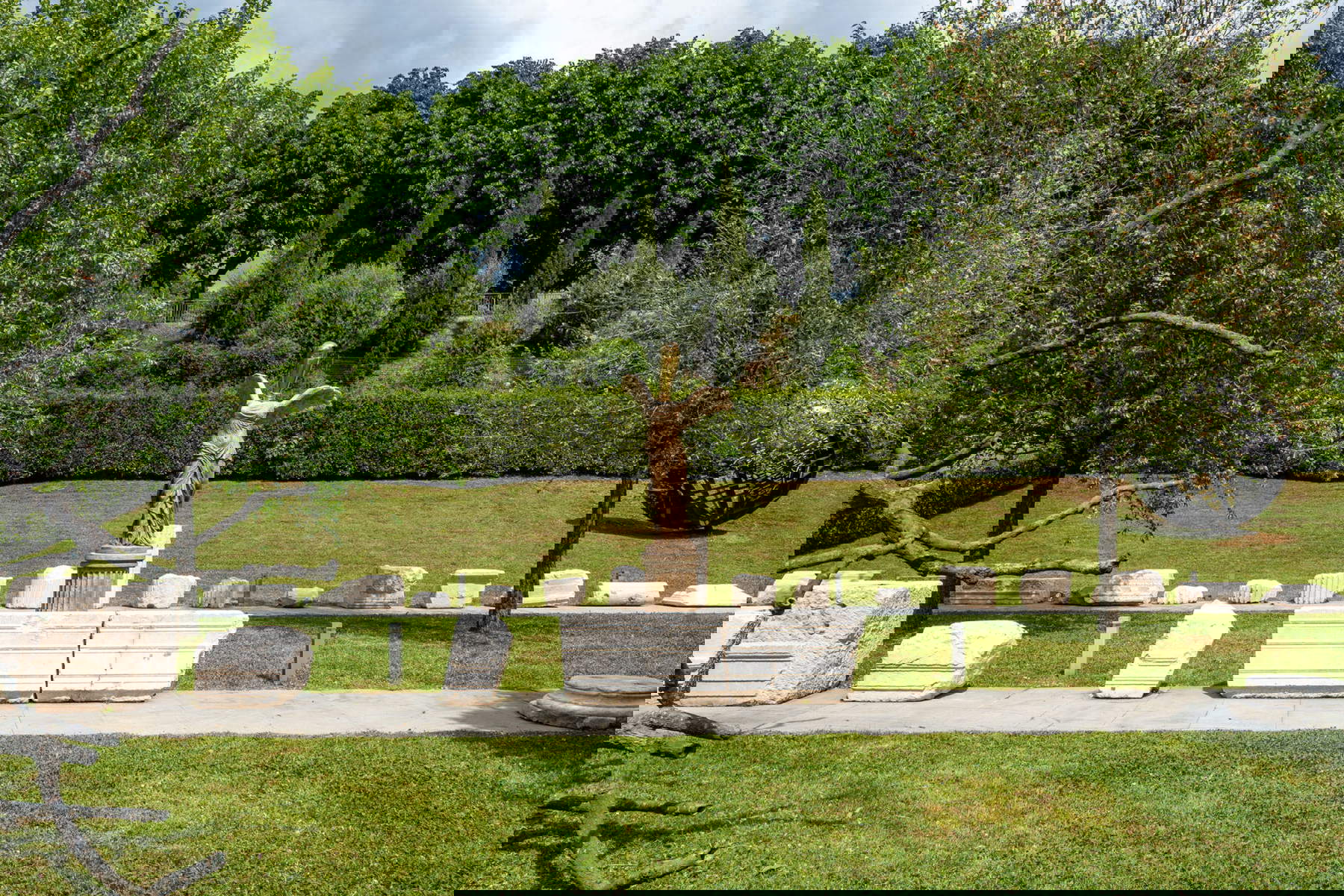
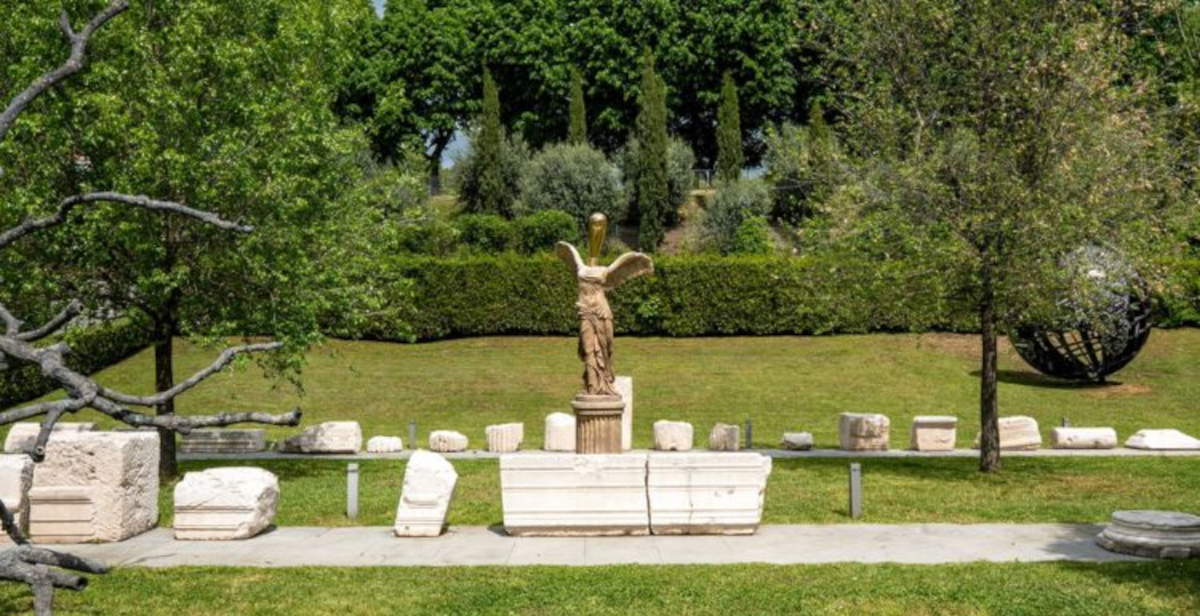
On Thursday, April 23, 2026, in the Viridarium of the Santa Giulia Museum in Brescia, Francesco Vezzoli’s Nike Metafisica was installed, a work that becomes a permanent part of the contemporary sculpture park’s itinerary. The intervention is part of the activities promoted by Fondazione Brescia Musei, oriented toward the relationship between historical-archaeological heritage and contemporary artistic practices.
Vezzoli’s work takes the form of a reinterpretation of the Nike of Samothrace, reworked through a language that explicitly recalls 20th-century metaphysical painting. The reference to Giorgio de Chirico and Alberto Savinio is manifested in the construction of a suspended image, in which the classical figure is translocated into a dimension that alternates historical recognizability and formal discontinuity. The sculpture integrates elements reminiscent of mannequins and the rarefied atmospheres characteristic of the Metaphysical season, constructing a visual device that sits between archaeological memory and modern imagery.
Metaphysical Nike had already assumed a central role in the exhibition project Archaeological Stages. Curatorial interventions by Francesco Vezzoli, held in Brescia from June 11, 2021 to January 16, 2022. The project, promoted by Fondazione Brescia Musei, was presented as a site-specific intervention aimed at connecting the city’s archaeological heritage with some of the most recent experiences in contemporary art. The initiative had been funded under the Italian Council 2019 (7th edition) call for proposals, promoted by the Ministry of Culture’s General Directorate for Contemporary Creativity.
On that occasion Vezzoli had taken on a dual role as artist and curator, articulating an itinerary that included eight works placed in different spaces in the city, from the Archaeological Park of Roman Brixia to the museum complex of Santa Giulia. The project was also part of the celebrations for the return to the city of the Winged Victory, restored at the Opificio delle Pietre Dure in Florence and relocated to the Capitolium. The entire intervention had been recognized for its ability to build a dialogue between different historical stratifications, encouraging an integrated reading between archaeology, ancient art and contemporary production.
Following this path, Nike Metafisica became part of the Collections of the City of Brescia, now managed by Fondazione Brescia Musei thanks to the support of the Italian Council. With its placement in the Viridarium, the work becomes a permanent part of the Santa Giulia Museum’s contemporary sculpture park, where there are also works by Michelangelo Pistoletto, Ariel Schlesinger, Valerio Rocco Orlando and Emilio Isgrò.
In fact, the Viridarium’s itinerary includes Michelangelo Pistoletto’s Third Paradise (2015, made of stone and marble relics from the Roman and Renaissance periods and stainless steel), Ariel Schlesinger’s Untitled (2019, bronze, from the Massimo Minini Gallery and the artist’s depository), Formiamo Umanità by Valerio Rocco Orlando (2022, light sculpture outcome of the Vite Operose project curated by Caroline Corbetta and commissioned by Guido Berlucchi in collaboration with Fondazione Brescia Musei) and Mondo d’acciaio by Emilio Isgrò (2023, iron and paint, an installation donated to the city by the artist together with Feralpi Group and the Pasini family).
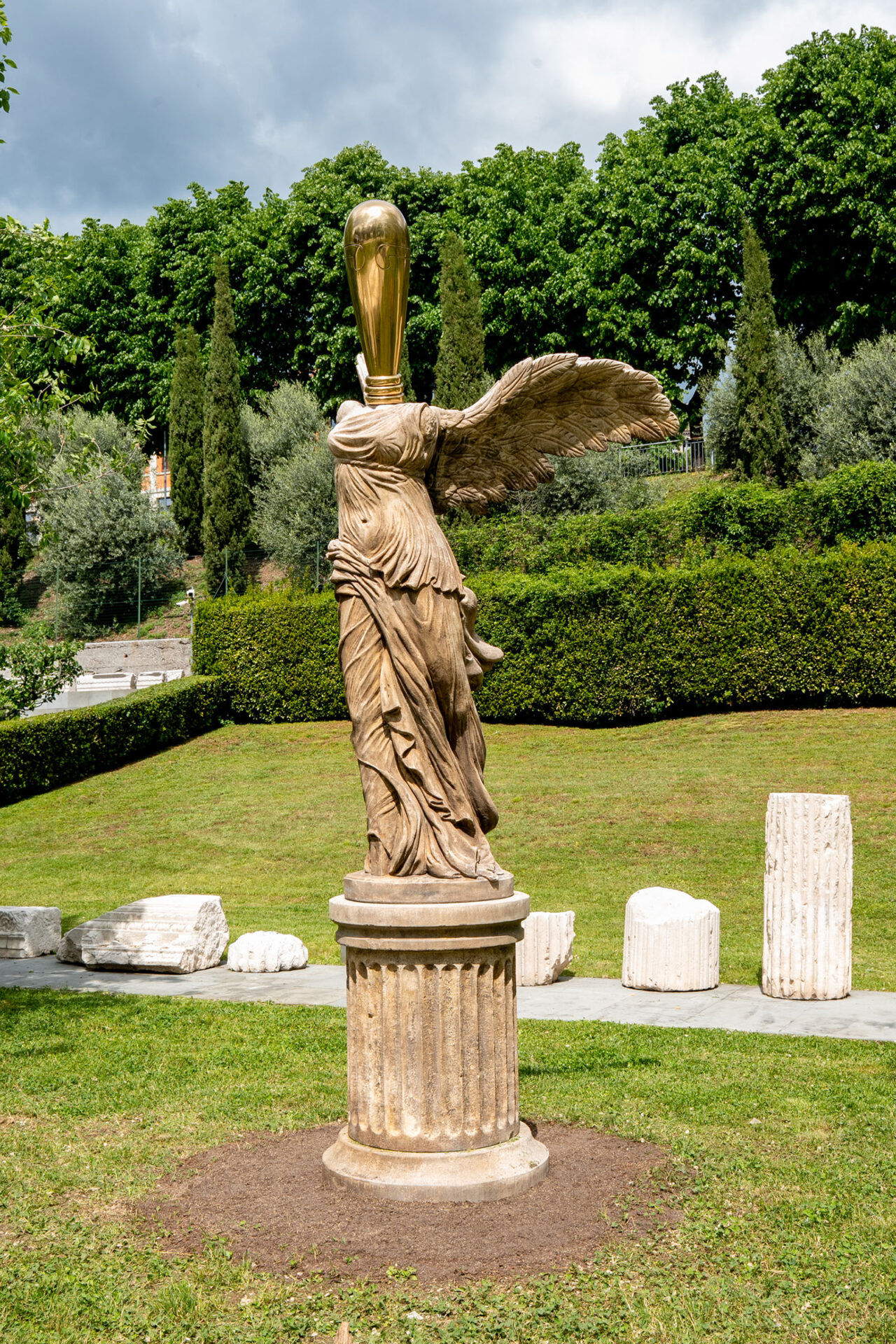
The presence of Nike Metafisica is part of Francesco Vezzoli’s research, characterized by a practice that crosses different languages and relates classical culture, pop culture and contemporary media dimensions. His works, often constructed through reworkings of ancient artifacts or references to antiquity, are part of a reflection on the cultural identity of Brescia, a city that combines a strong Roman archaeological stratification with a contemporary design in the artistic sphere.
Within the same context is also the project Victoria Mater. The Idol and the Icon, curated by Donatien Grau and on view at the Archaeological Park of Roman Brescia, in the Capitolium, until June 21, 2026. The intervention relates the Winged Victory and theIdol of Pesaro, from the National Archaeological Museum in Florence, proposing a comparison between two bronze sculptures from the classical period. The project is promoted by Fondazione Brescia Musei and the Municipality of Brescia, in collaboration with the General Directorate of Museums of the Ministry of Culture, the National Archaeological Museum of Florence, the Opificio delle Pietre Dure and with the contribution of Intesa Sanpaolo, as well as the patronage of the Ateneo di Brescia - Academy of Sciences, Letters and Arts.
The initiative is also part of the bicentennial celebrations of the discovery of the bronze deposit of Brescia’s Capitolium, proposing a reading that relates the archaeological dimension to the contemporary one. In the setting of the project, classical figures are reread as elements capable of activating new interpretative connections, in a dynamic involving the relationship between ancient originals, restorations and conceptual transpositions.
 |
| Vezzoli's Metaphysical Nike enters permanent exhibit at Santa Giulia Museum in Brescia |

Warning: the translation into English of the original Italian article was created using automatic tools. We undertake to review all articles, but we do not guarantee the total absence of inaccuracies in the translation due to the program. You can find the original by clicking on the ITA button. If you find any mistake,please contact us.


























 IT
IT FR
FR DE
DE ES
ES CN
CN


