



by Carlo Alberto Bucci 20/01/2026



Categories: Exhibition reviews / Disclaimer
An exhibition in Brescia unearths Matthias Stom, a Flemish painter influenced by Caravaggio: twelve works between sacred and genre, candleplay, uncertain attributions and a fragmentary biography that makes the master as fascinating as he is enigmatic. This is the first exhibition on Stom since 1999. Carlo Alberto Bucci's review.
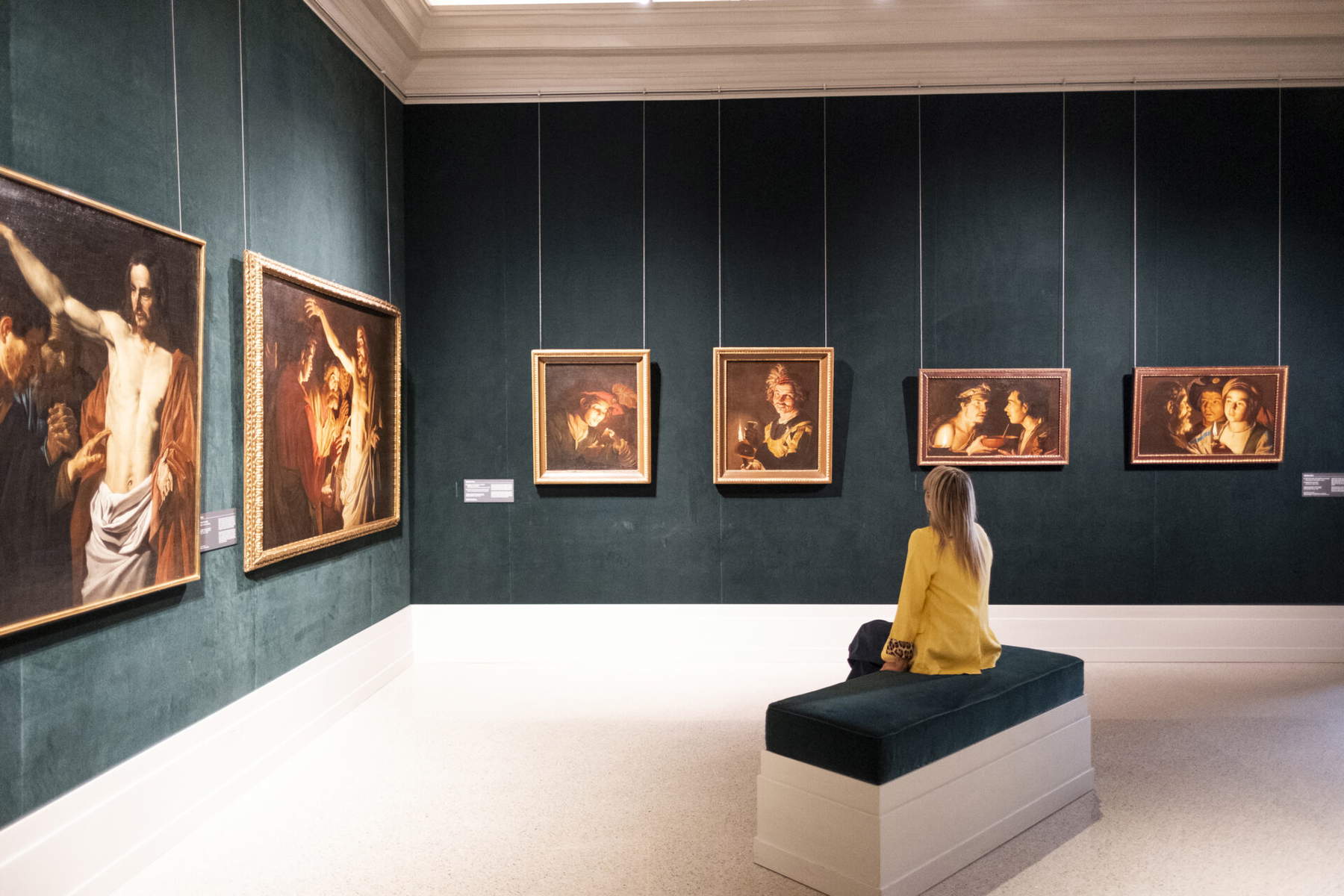
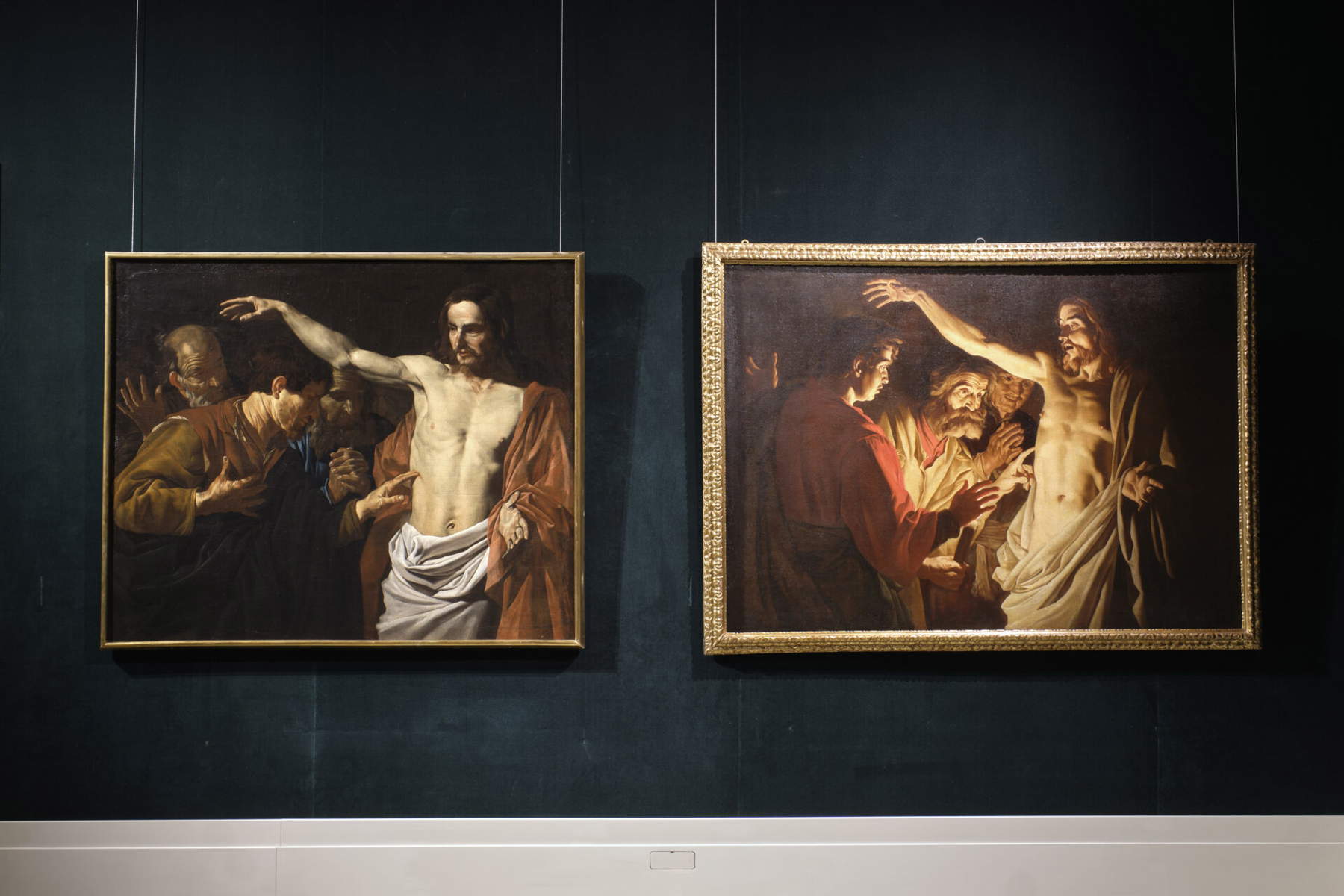
The lit candle and the color of the heat illuminating the hand, open to cover the flame in a gesture of protection and awe. The color play that adds artificial light to the light inside the painting. However, to make the spirituality of the image, the sacredness of the subject, more real and tangible. Thus, admiring the figure of the saint who wants to touch in order to believe, the viewer is almost prompted to repeat the gesture of the finger in Christ’s flesh. We are in front of TheIncredulity of St. Thomas attributed to Matthias Stom. The painting is one of the pieces that make up the exhibition devoted to the Flemish painter, long also known as Stomer, who was as prolific (some 250 works are ascribed to him) as he lacked sufficient support of dates and secure biographical data. The lighted candle that, in the luminous wake of the Dutchman Gerrit van Honthorst (Gherardo delle Notti), Stom often employed for both his sacred and profane compositions can thus be taken as a good omen for attempting to shed light on the activity and life of this important exponent of painting influenced by Caravaggio’s naturalism well after the death (1610) of Merisi himself. This is the hope of Gianni Papi, curator of the exhibition Matthias Stom, un caravaggesco nelle collezioni lombarde, which opened on Sept. 18 and can be visited until Feb. 15 at the Pinacoteca Tosio Martinengo in Brescia (Skira catalog, 208 pages). Awaiting a future monographic exhibition, never attempted after the anathema of Nicolson, who in 1977, after studying him, ruled, “To make a major exhibition of Stom would be a disaster.”
Six months open is a long time for an exhibition, but necessary in this case to celebrate the happy event of the acquisition, on loan “from a Brescian collector,” of two pendant canvases (both measuring 51 x 84 centimeters) by the museum in Piazza Moretto. The works(Esau Selling the Birthright to Jacob and The Denial of Peter) arrived in Bergamo in 1791: they had been sent by former canon Cristoforo Scotti, a member of a wealthy family of merchants documented in Rome since the 16th century, to his brother who had remained in Lombardy. And there are several pieces in the Brescia exhibition that certainly belonged to the Scotti in the past (yet none assigned to Stom in the collection’s eighteenth- and nineteenth-century inventories). Reason enough to set up a monographic exhibition, and one perimetered in the Lombard territory, despite the smallness of the paintings on display: twelve in all. Which is still more than the nine that in 1999, in Birmingham, constituted the last (indeed only) exhibition on Matthias Stom, centered around the Barber Institute of Fine Arts’Isaac Blessing Jacob . Hence the importance of the Brescia exhibition as a viaticum for new studies and further opportunities for comparison around the work of this painter originally from Flanders and documented (albeit from a small number of papers, in the manner of a master of the Middle Ages) in Rome, Naples, Palermo and Venice from 1630 to 1645. But then disappeared into thin air.


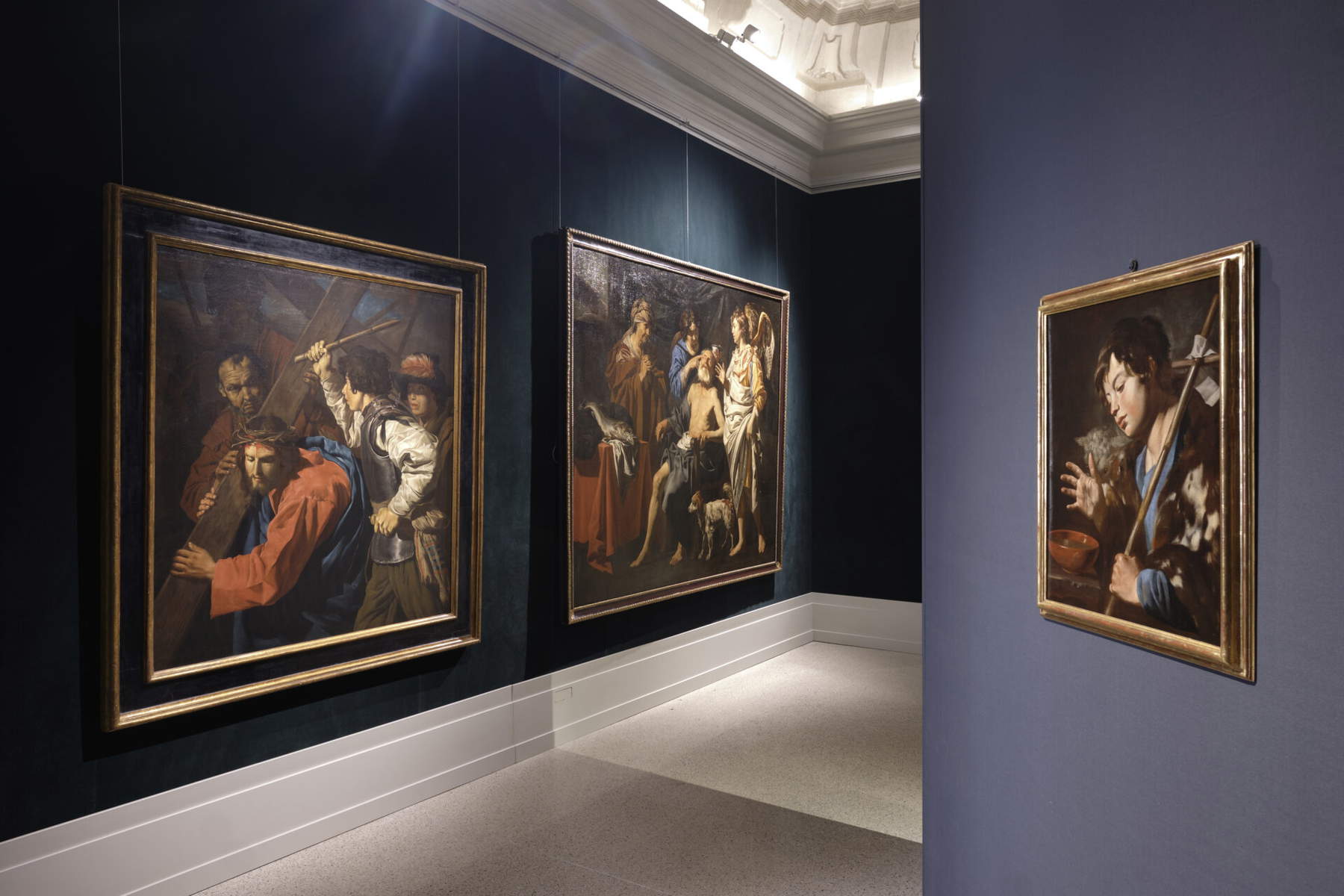
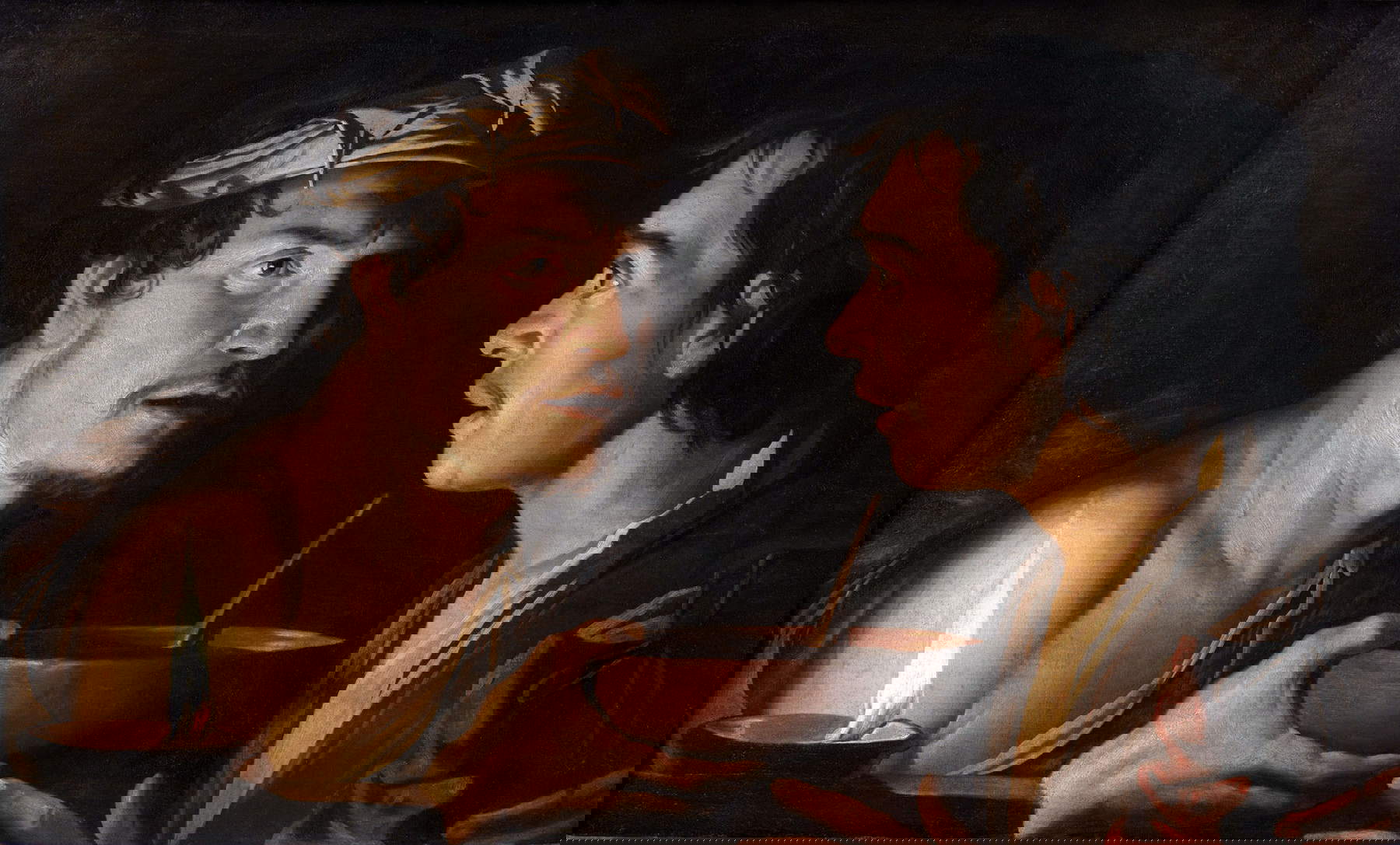
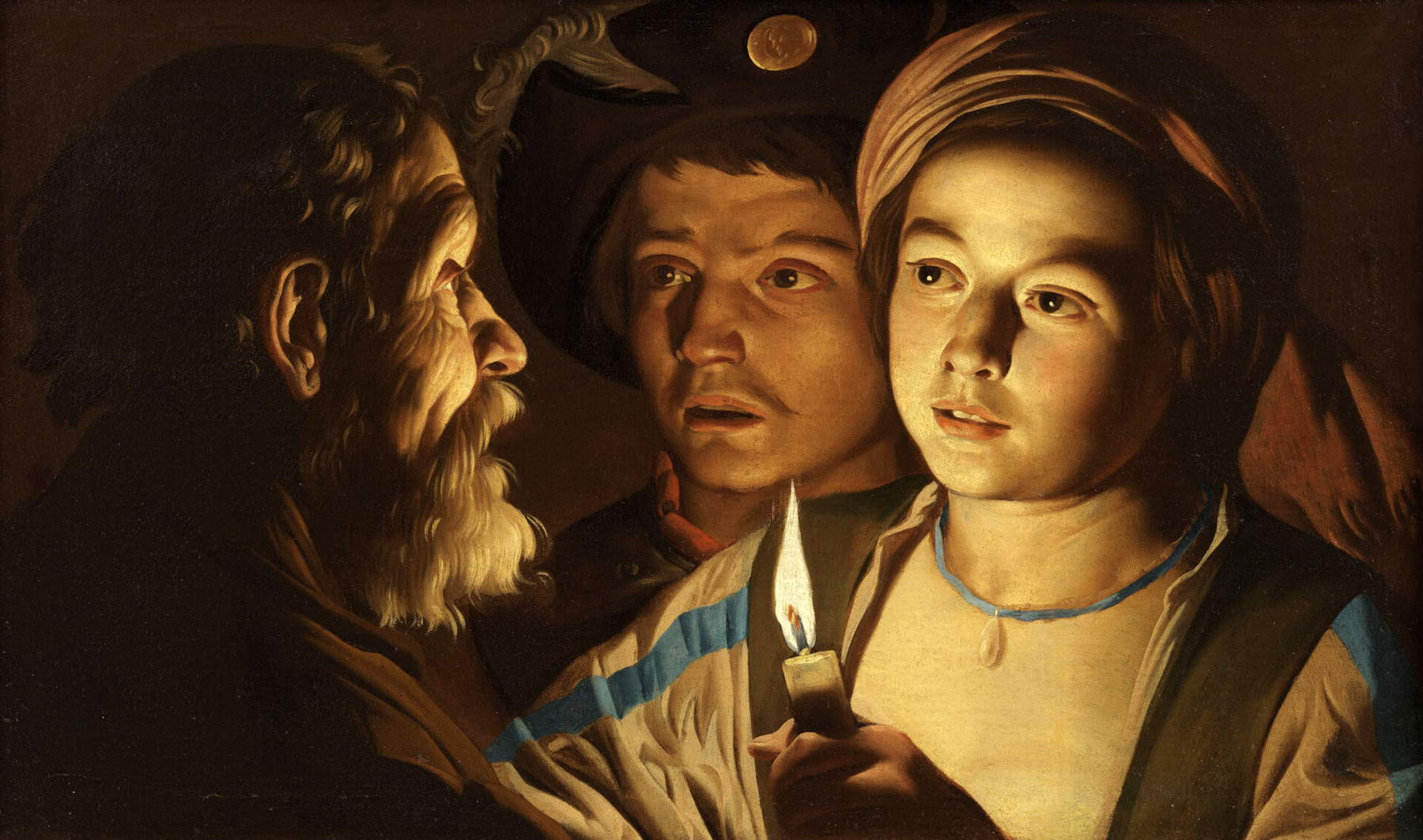
But back to the “diptych” with Esau and Peter. In the painting on the left, we do not know which is Jacob’s twin: whether the man with the headband handing the plate of lentils or the young man about to receive the meager, symbolic meal. What is certain is that, right Papi’s notation, thanks to the expedient of the almost life-size of the two heads and the limited cut precisely to the faces, the viewer is at the same height, as if dragged into the 17th century, as the biblical scene in which Isaac’s son sells his birthright for the proverbial plate of lentils. And on the other side of the composition, in the pendant painting, here is St. Peter giving in not to hunger but to fear before the girl who has recognized him, with candle in hand and a pearl pendant around his neck (a vexatious, genre-painting detail in the staging of a sacred drama), so much so that he, “the fisher of souls,” denies being a follower of Christ.
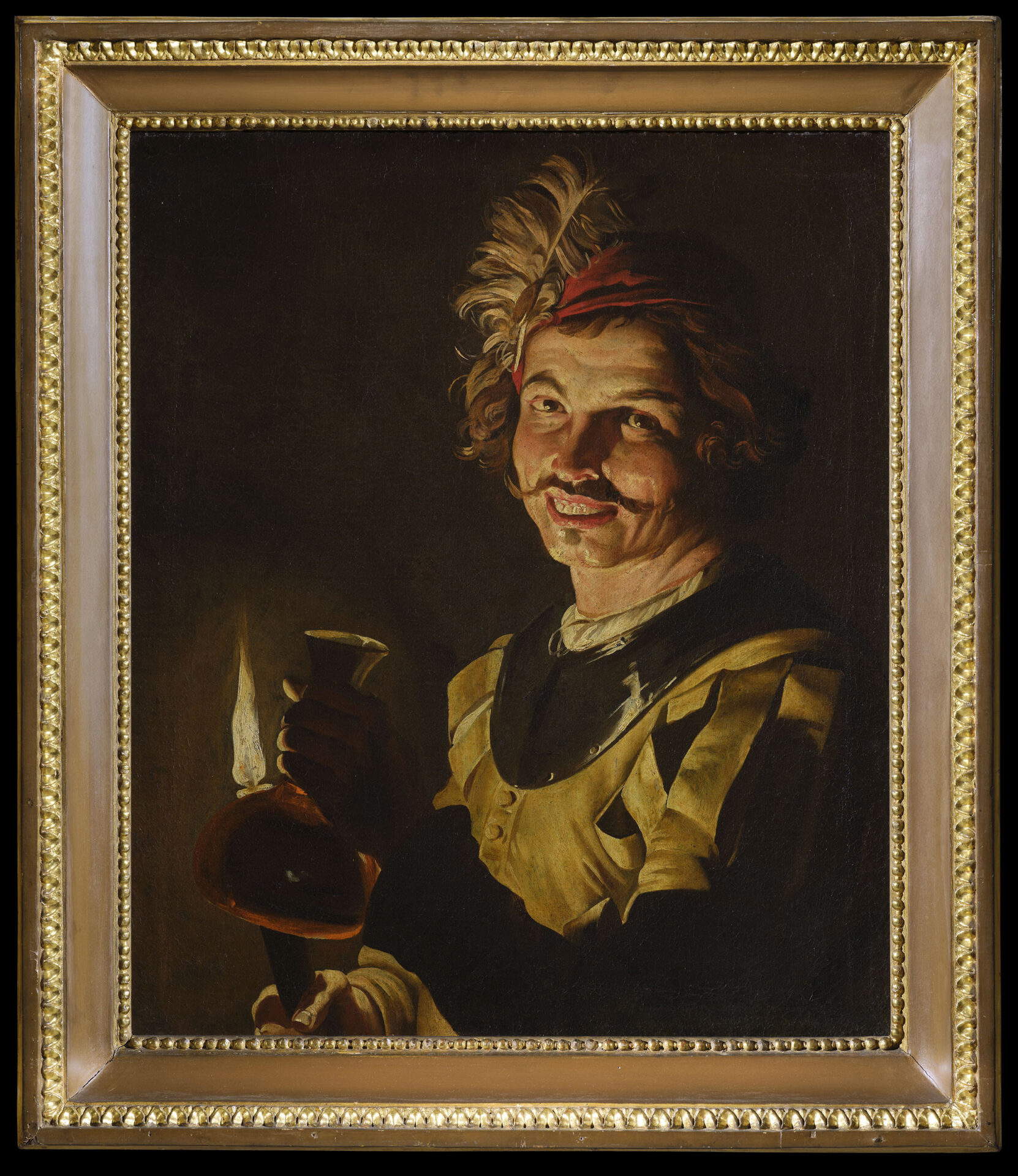
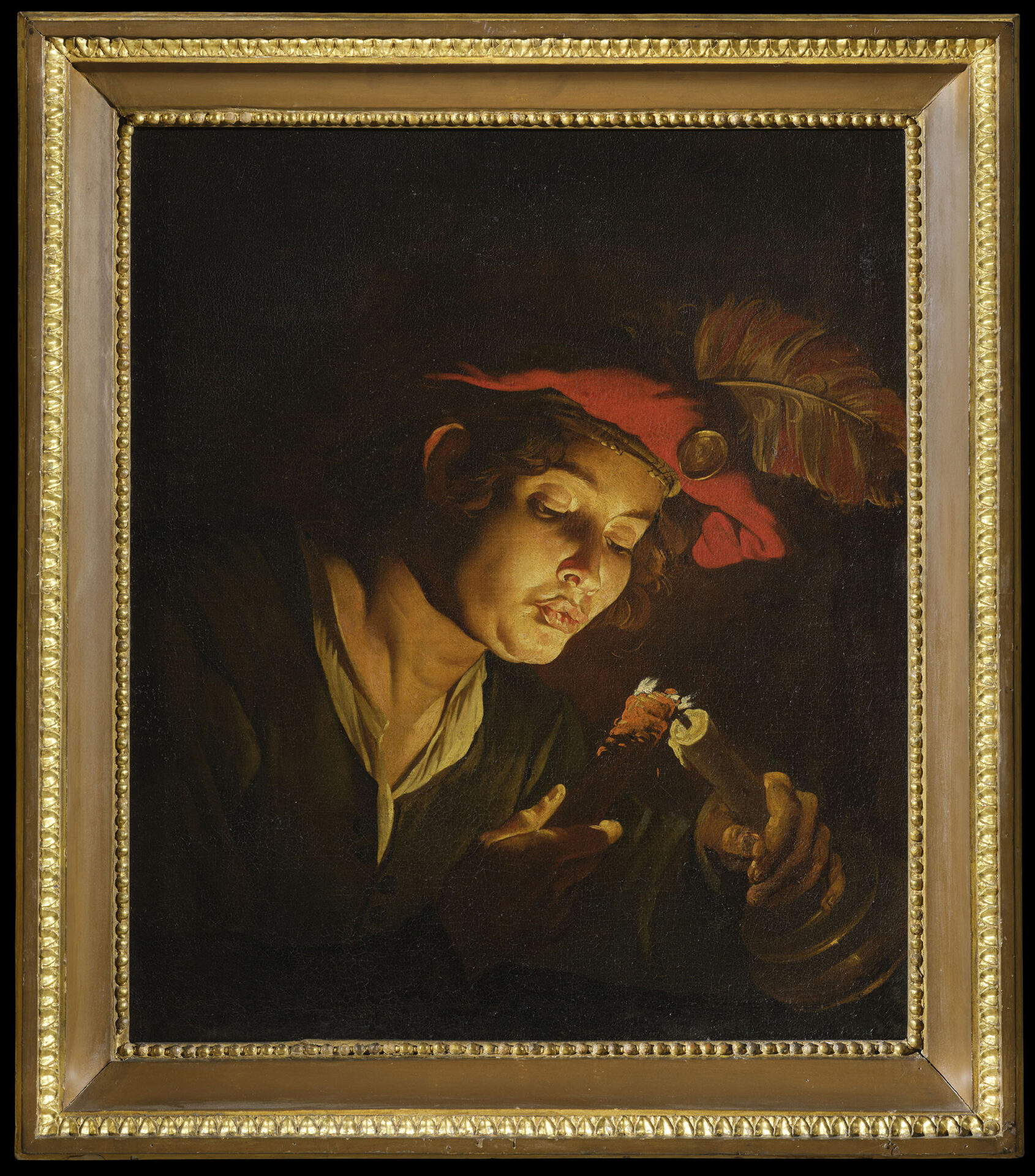
Behind the young woman (“sister” of the woman who in Caravaggio’s prototype, the New York Metropolitan’s masterpiece, explicitly points Peter out to the soldier engaged in rounding up the Messiah’s followers) there’is a young man, a thug, yes, but one with a reassuringly elegant appearance, wearing a feathered headdress on which is pinned an antique medal that also glows in the candlelight. And it is the same detail found on the hats of the protagonists of two other pendants in the Brescia exhibition. The title of the two paintings lent this time by the Accademia Carrara in Bergamo, and long attributed to the king of nocturnes, Gerrit van Honthorst, is modern and purely descriptive: Man with glass bowl by candlelight and Boy lighting a candle by blowing on a candle. Lacking the reference, i.e., the pretext, of the Holy Scriptures, the composition has the precise status of genre painting: Executed explicitly to highlight the artist’s talent and mimetic gifts in the eyes of his patrons and/or buyers, it highlights the gracefulness of the young man, with his flap-ear reddened by the flame, blowing on the candle-yard; but also the “vulgarity” of the man, with his handlebar mustache and prominent gums, who is about to guzzle the wine held in the jug.
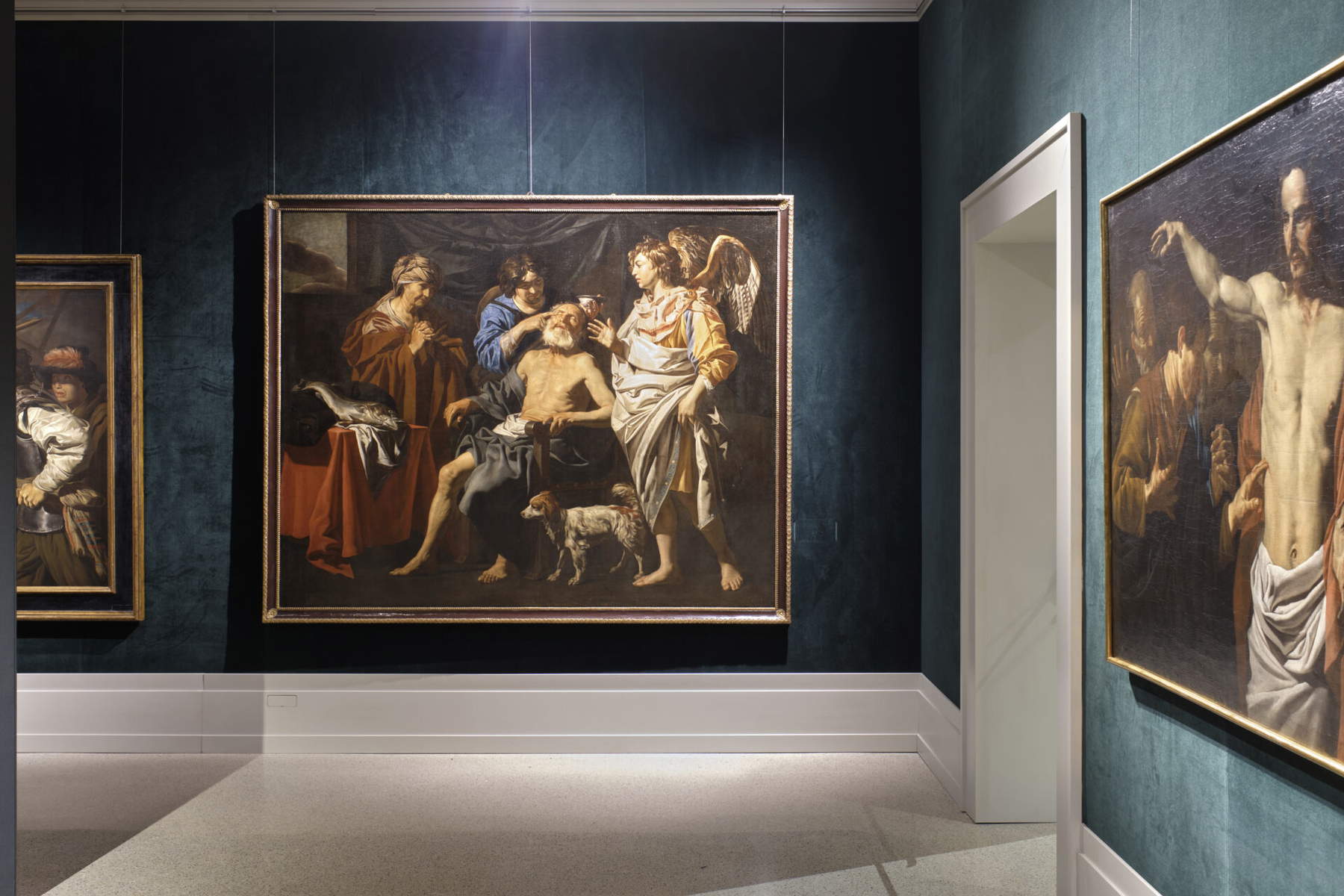
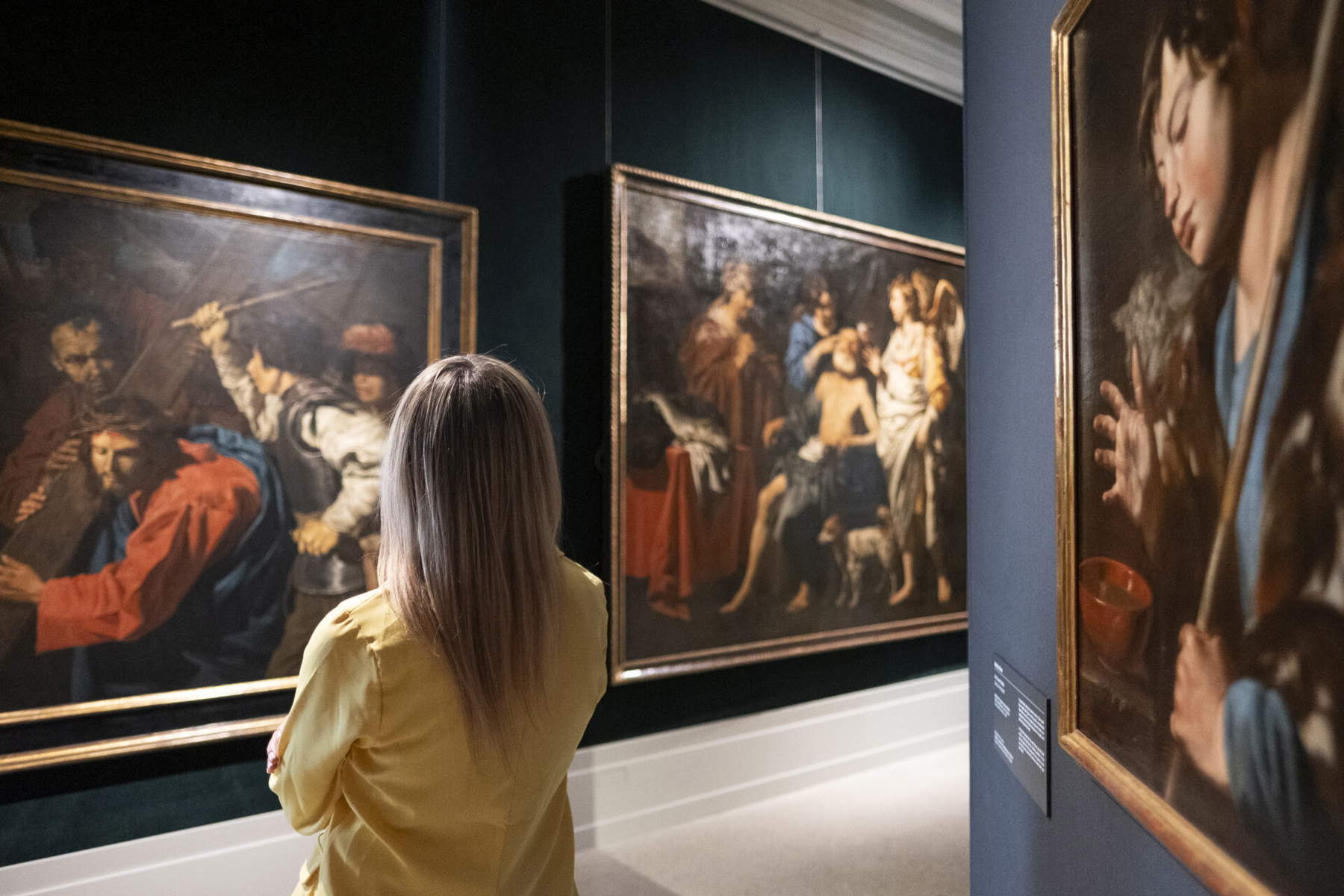
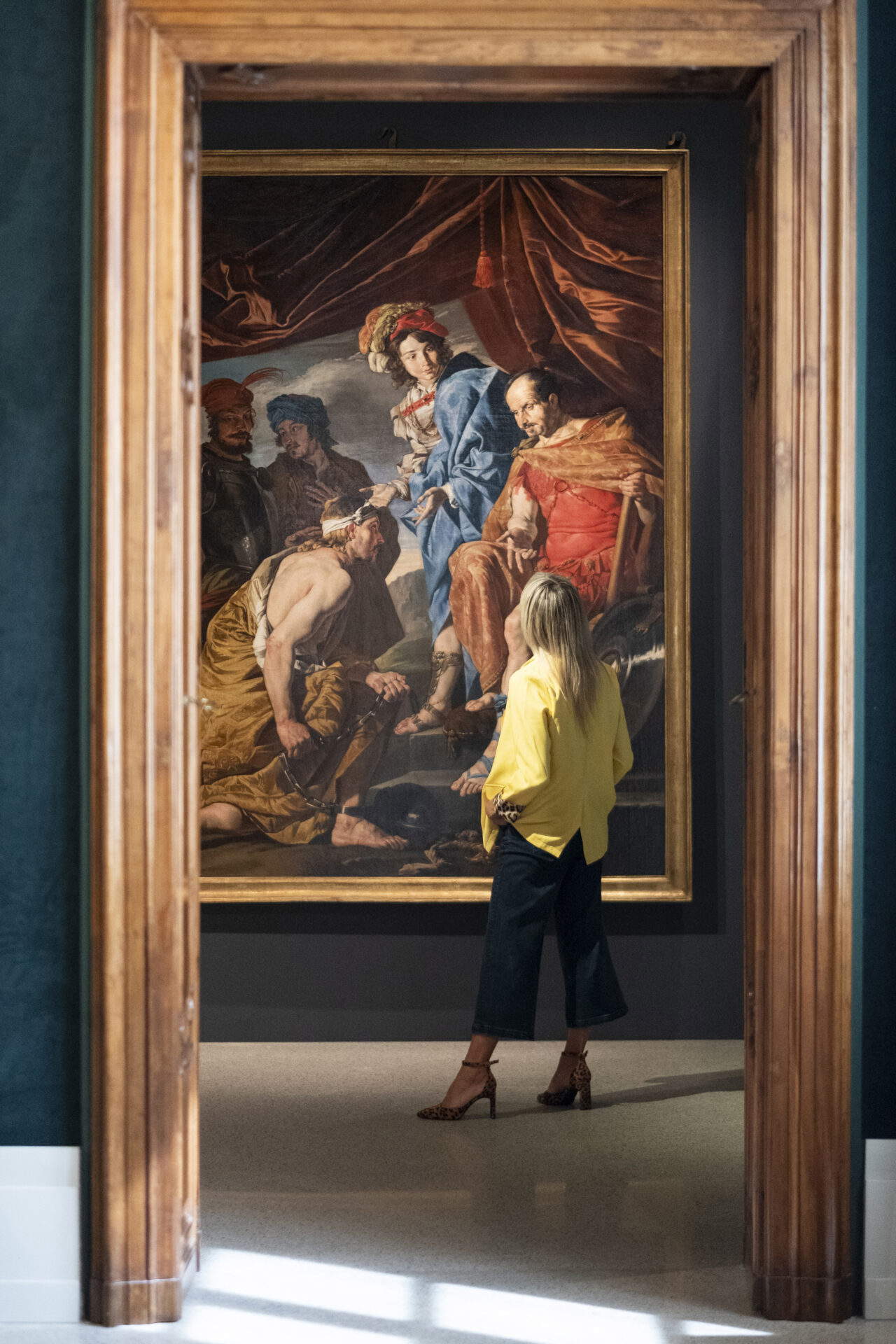
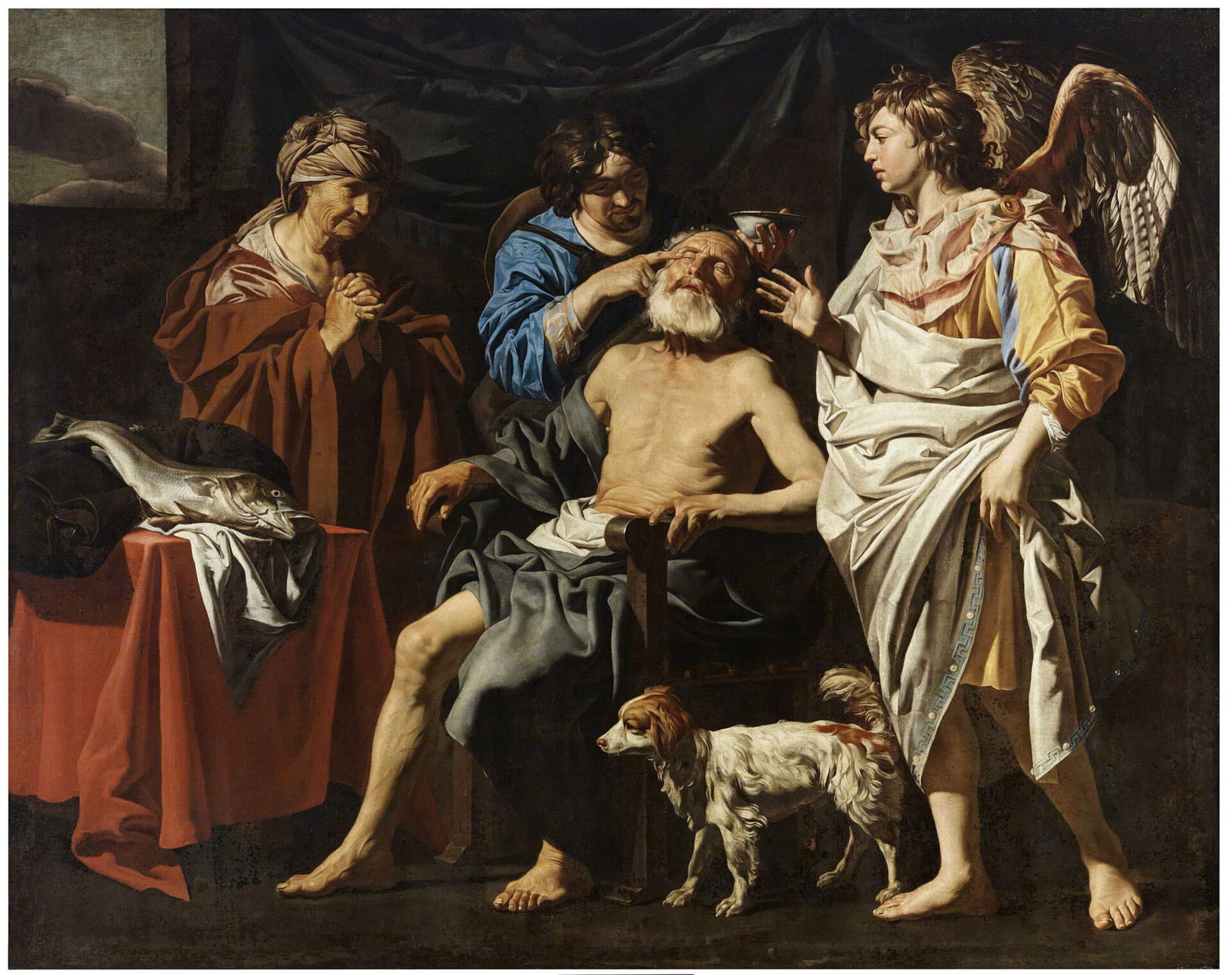
Pagan myth and Christian miracle, stories of fathers and sons, dominate instead two other large canvases, still of private use, lent for the Brescia exhibition by collectors who have remained anonymous and, at one time, both owned by Scotti in Bergamo, both moreover assigned to the French Caravaggesque Valentine de Boulogne. These are Daedalus Putting Wings on Icarus (the protagonists are half-naked, to emphasize the old age of the parent and the attractiveness, in Caravaggesque terms, but also the recklessness, of the young protagonist of the ill-fated flight); and The Healing of Tobias. In this second case, too, father and son are the primary actors in the scene, but it is the boy (guided by an archangel Raphael, he too capable of flight, wrapped in splendid drapery) who performs the miracle, thanks to the entrails of a fish, which restore sight to the old blind man. The canvas with Tobias is, according to Papi, “undoubtedly one of the Flemish painter’s highest masterpieces, as well as a fundamental work in defining the artist’s language during his stay in Rome.” And in this painting the scholar discerns some stylistic features present in Stom’s repertoire, influences variously from Valentin, Honthorst and Vouet, but also, for “the horizontal layout of the scene,” from fellow countryman Theodoor van Loon (“known perhaps already in his homeland, in Brussels, but perhaps also in Rome”).
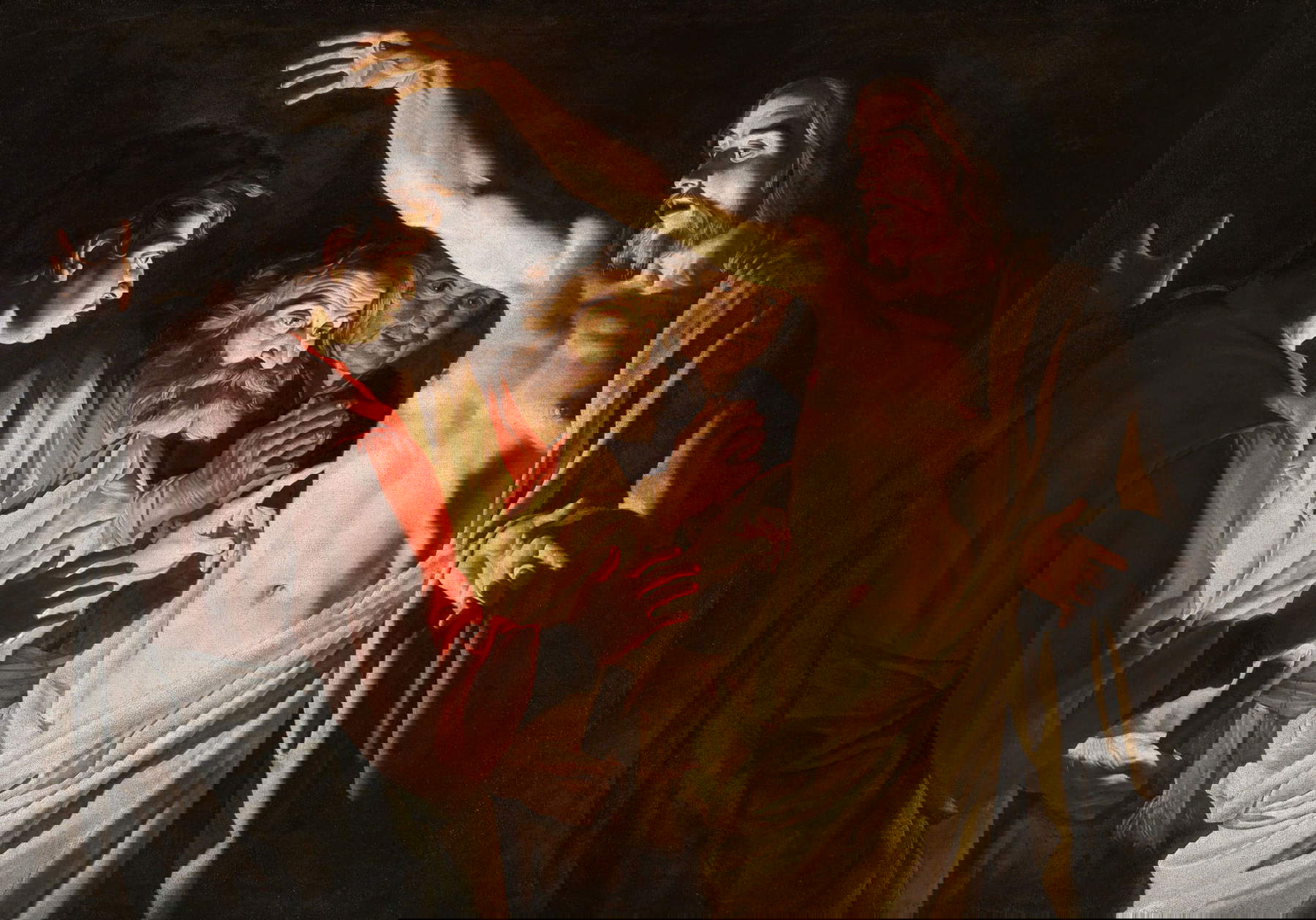
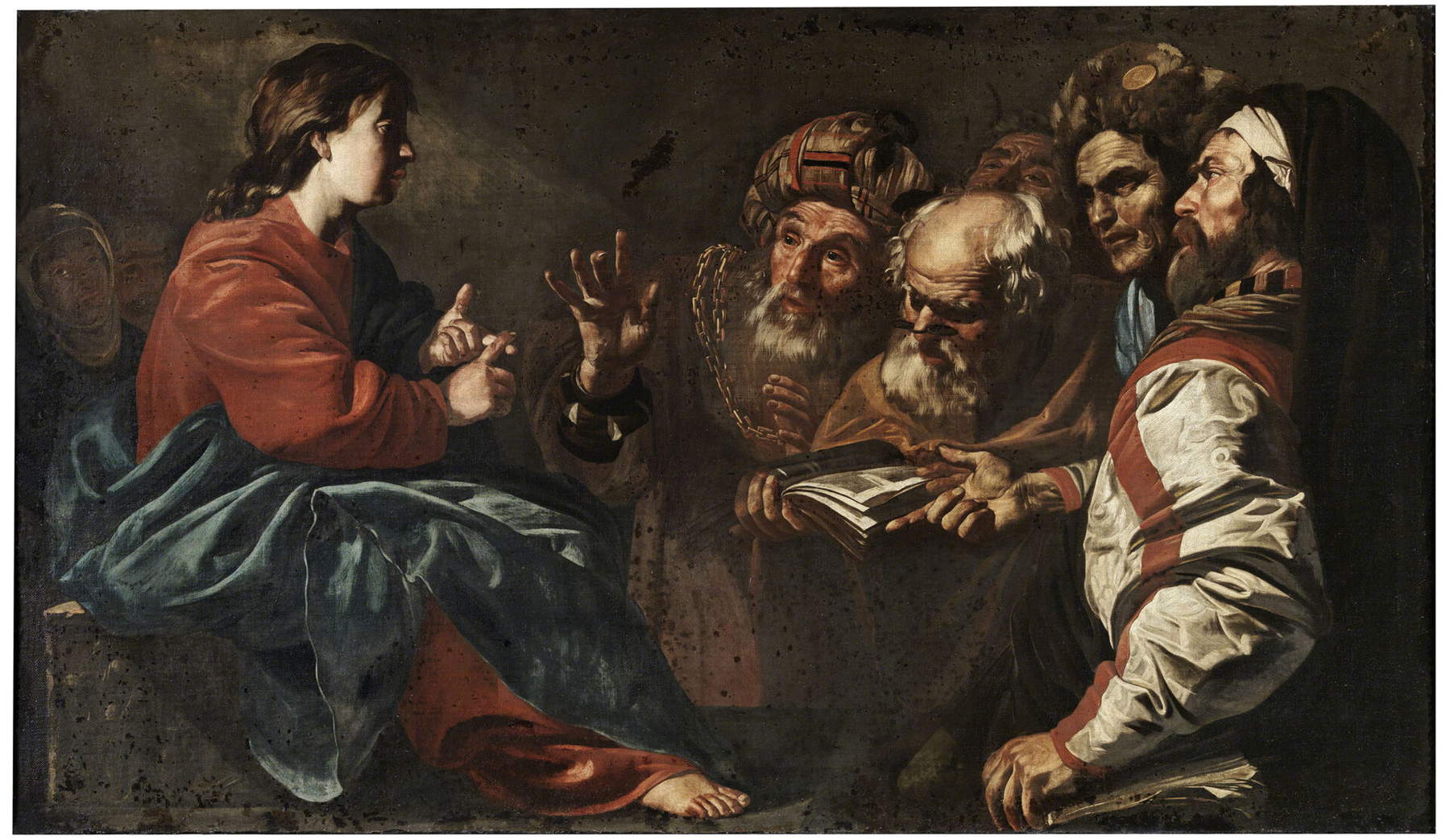
Other Caravaggesque painters to look to in (trying to) understand Matthias Stom’s training and art are, again according to the exhibition curator, the Lombard Cecco del Caravaggio (born Francesco Boneri), theDutchman Dirk van Baburen, the Spaniard Jusepe de Ribera, without forgetting, in his opinion, the Swiss Giovanni Serodine, pointed out in particular for Christ among the Doctors (another canvas of Scotti provenance now part of the exhibition at Tosio Martinengo) and which, really, for “the more frayed, more macerated brushstroke,” is very different from the other works “by Stom” in the same Bergamasque collection. To Serodine is assigned by many the other Incredulity of St. Thomas, also in the exhibition itinerary at the Pinacoteca di Brescia (where it has been on loan since 2010), which Papi instead traces back to the hand of Stom, noting, compared to theexemplar of identical subject already in the Scotti collection in Bergamo, “rough, hollowed-out physiognomies, constructed with non-mimetic brushstrokes” in which there remains “even a deep trace of the painter from Ascona.” A ductile and eclectic painter, then, the Flemish, albeit an elusive one.
To the dozen paintings currently concentrated in a single, articulated room of the Tosio Martinengo, the large canvas from the parish church of Chiuduno, in the Bergamo area, attributed to Stom but so large as to make transportation impossible, has been added to the catalog. And still necessary to ideally link Brescia to Bergamo, the two cities involved in the exhibition. A detour to Chiuduno, to visit the church dedicated to Santa Maria Assunta where the altarpiece of the same subject is located, is advisable because of the monumentality of the composition, the number and stylistic variety of the figures enacting the Marian dogma, the quality of the illuminated bodies in the very foreground and the penumbra that envelops the heads immersed in the background, for the possibility (but for Papi more than a hypothesis) that the painter depicted himself in the shoes of Sebastian, at the far left of the painting, immediately behind St. Charles Borromeo, as he looks, he alone, out of the canvas, thus bridging the viewer.
Another reason for the interest of the Chiuduno altarpiece, amplified by the critical text and the card drafted by the curator, is the web of influences and stylistic debts that, as with the other works in the exhibition, and more generally with the corpus of Stom’s work, have generated a complex, debated, plethora of alternating attributions. Suffice it to say that in 1652 the work is certified (in the letter written in Rome by Filippo Lupi to his cousin Troilo, rector of the church in Chiuduno where the canvas was originally located before ending up in 1710 in that of the Assumption) as being by Andrea Sacchi (1599-1661). And in the face of the unequivocal 1652 charter (combined with another of 1653) by the commissioners, twentieth-century critics, starting with Amadore Porcella in 1931, have traced the large canvas back to the Caravaggist Stom: by way of plausible stylistic considerations but also of reckless, incredible conjecture aimed at removing it from Sacchi’s brush.

The history of theAssumption in Chiuduno, which for Papi should be traced back to Stom’s Roman period “between about 1631 and 1632,” allows, in conclusion, for some remarks on the difficulty of having firm and certain points when talking about such an elusive painter on a documentary level, but also on the casual practice of international connoisseurship . Is it possible that, among the various stylistic references to the many, too many Caravaggists, one can insinuate the influence (and for some even the hand) of Cavalier d’Arpino - who was certainly not a Caravaggist - to justify the (ugly) face of St. Charles kneeling among the apostles present in the Assumption? Of the Flemish Stom (whose only work of certain date is the 1641 altarpiece, signed “Matthias Stom,” depicting The Miracle of St. Isidore Agricola and preserved in the mother church of Caccamo, Sicily, an island where the artist left many works) we know only that he is certainly in Rome in 1630 and 1632; that in 1635 instead he is certainly in Naples where he also turns up in 1637, when the Holy Office deals with him accusing him of “being a Protestant and proselytizing in his home,” and in 1638; before appearing in Palermo in 1640 when he has an illegitimate son to whom he will give (his) name Mattheus (to be his godfather, the painter Hyeronimus Gerards, Geronimo Gerardi, consul of the Flemish nation in Palermo). Finally, two more sparse papers, again private, but drawn up in Venice where the master leaves no other trace: on July 13, 1643 he baptizes the twins “Zuanna” and “Mattio” (the other son of the same name had died at only seven months in Palermo); and on March 6, 1645 he does the same with “Zuanni” he had, again out of wedlock, with “amicha” (perhaps the mother also of the twins) Vincenza de Petro. That’s all. And the curator of the exhibition also spends too much time in his text explaining that the hypothesis of the Flemish’s stay in Bergamo, thrown out there by Roberto Longhi in 1943 given the “repeated traces in several private collections in that city” (Papi explains that the only Bergamasque collection with paintings attributable to Stom is that of the Scotti family), has no confirmation.
In short, whether Lutheran or secret Reformation sympathizer, Stom still lived outside the sacrament of marriage. And yet he worked for Catholic patrons, painting mostly religious subjects, as well as abundantly, with paintings of Roman history, for the Sicilian nobility and its “instances of rebellion against the Spanish central government” (and here Papi cites the studies of Angheli Zalapì). Of Stom we know very little and unfortunately possess no portraits. The suggestive hypothesis that he depicted himself, moreover in the guise of a saint, as featured in theAssumption of Chiuduno, assuming that the altarpiece is really his, would need some additional supporting patches other than the evidence of his gaze outside the picture, a trick moreover enacted by painters of every age to link the painted scene to that of the bystanders, sometimes portraying the patron en travesti.
Warning: the translation into English of the original Italian article was created using automatic tools. We undertake to review all articles, but we do not guarantee the total absence of inaccuracies in the translation due to the program. You can find the original by clicking on the ITA button. If you find any mistake,please contact us.