




by Noemi Capoccia 01/04/2026



Categories: Exhibitions / Disclaimer
From April 1 to Sept. 30 at Casa Buonarroti an exhibition presents the restoration of Tiberio Titi's canvas dedicated to the placement of Michelangelo's bust on the tomb of Santa Croce. The exhibition reconstructs the celebratory program conceived by Michelangelo Buonarroti the Younger through documents, preparatory materials and scientific analysis.


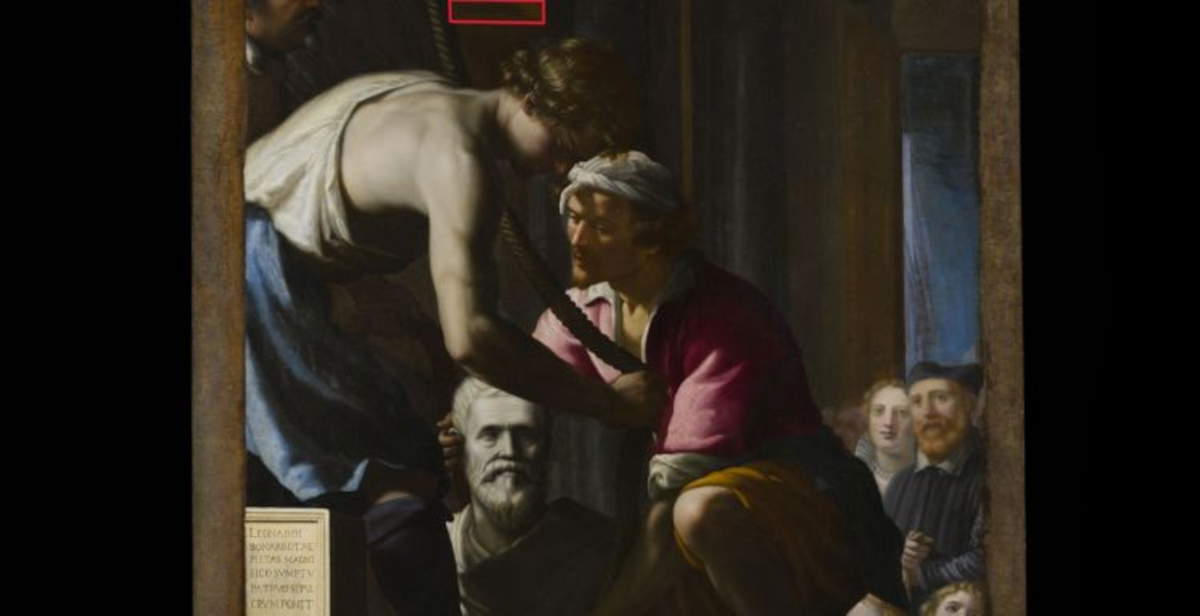
From April 1 to September 30, Casa Buonarroti in Florence is hosting the exhibition Michelangelo verso il mito. From restoration new light on Tiberio Titi, an exhibition project that brings to the public’s attention one of the most important paintings preserved in the house-museum’s Gallery after a major restoration. The initiative, promoted by the Fondazione Casa Buonarroti, focuses on the canvas Collocazione del busto di Michelangelo sulla tomba di Santa Croce, painted between 1618 and 1620 by Tiberio Titi (Florence, 1573 - 1627) and an integral part of the decorative program conceived by Michelangelo Buonarroti il Giovane to celebrate the memory of his famous ancestor.


The exhibition is produced by the Casa Buonarroti Foundation with Opera Laboratori, which also curated the installation. The scientific project is curated by Cristina Acidini, president of the Foundation, and Alessandro Cecchi, director of the Foundation. The restoration of the painting was supported by Friends of Florence thanks to the contribution of Donna Malin, while the conservation work was carried out by restorers Elizabeth Wicks and Lorenzo Conti. The graphic design of the exhibition was curated by Sillabe.


Tiberio Titi’s painting depicts a symbolic moment linked to the memory of Michelangelo Buonarroti: the placement of the artist’s marble bust on his tomb in the Basilica of Santa Croce in Florence in 1574. The scene depicts artisans intent on lifting the bust to place it on the tomb monument, while Leonardo Buonarroti and his family watch the ceremony. The composition unfolds around this central action and features intense contrasts between light and shadow, which recall Caravaggesque suggestions and help give the scene a strong dramatic tension. The work constitutes an important episode in early 17th-century Florentine painting.


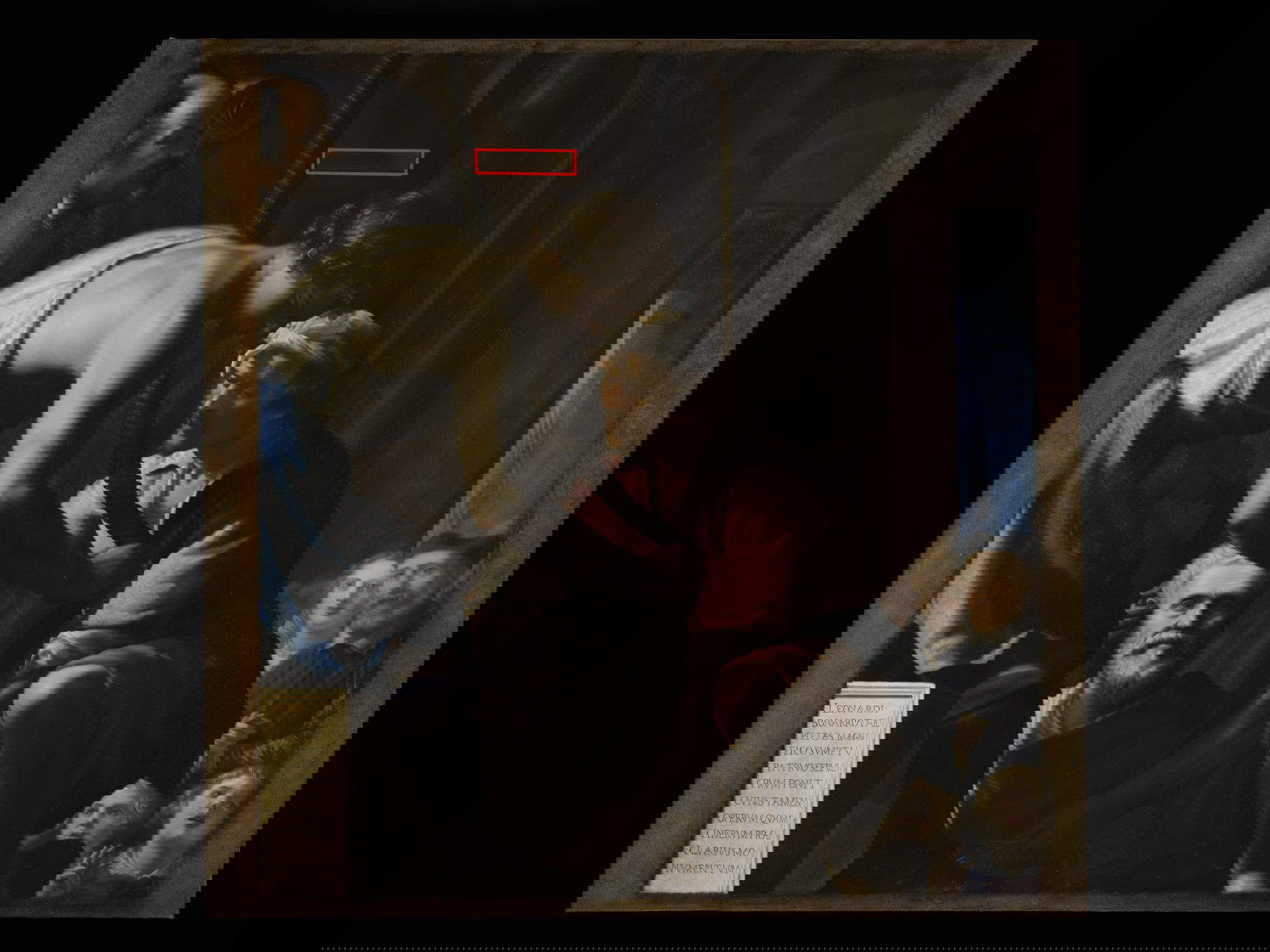
The making of the painting is documented in the notebooks of Michelangelo Buonarroti the Younger kept in the Buonarroti Archive. The payments recorded in the expense notes allow the execution of the work to be placed between August 14, 1618 and August 29, 1620. Archival sources also provide insight into the work process. On September 19, 1615, Tiberio Titi received from the client the canvas already mounted on a frame and prepared with the base for painting. On October 2, 1618, he was also given the ultramarine blue pigment made from lapis lazuli.
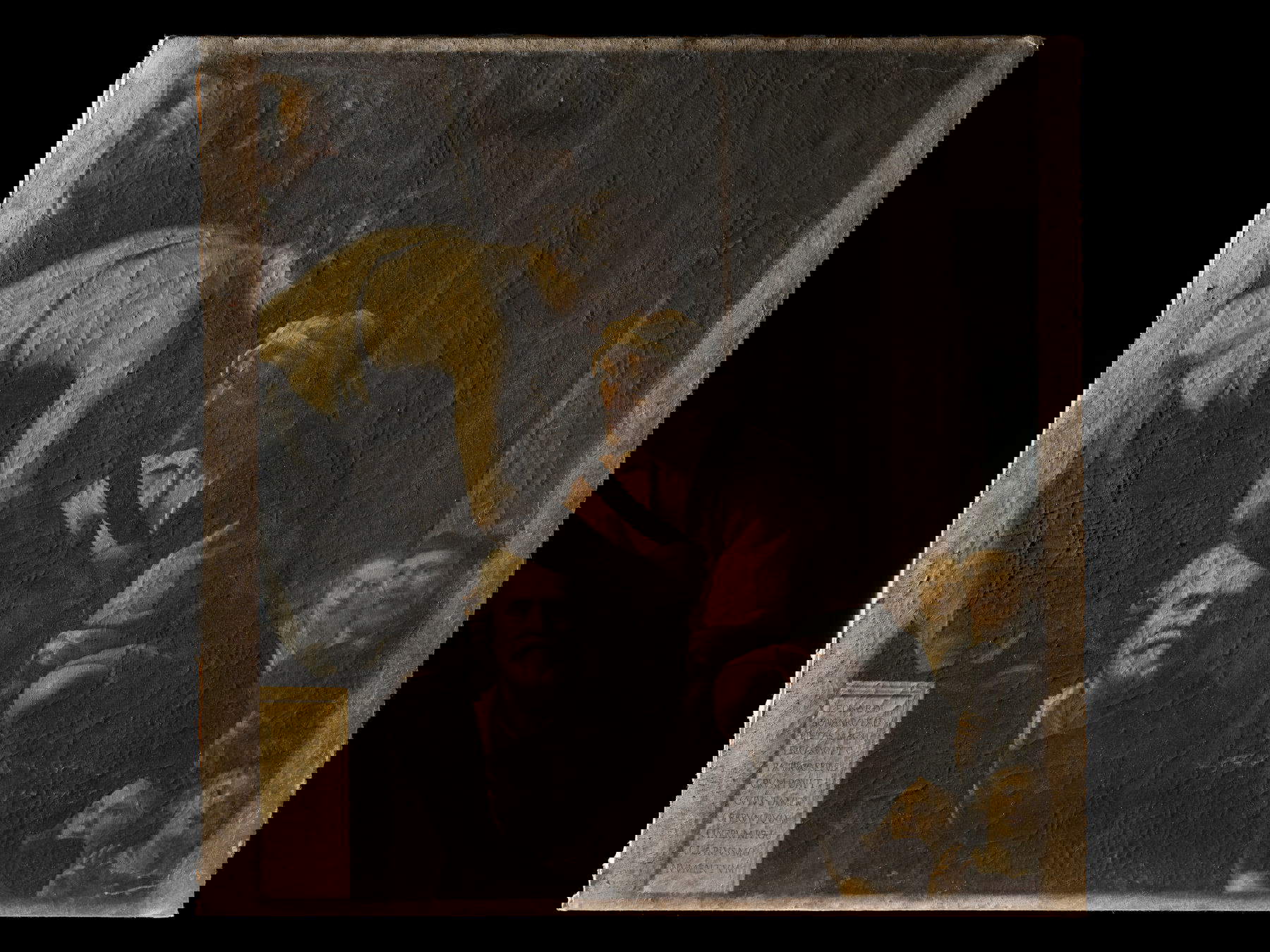
Recent restoration has made it possible to delve deeper into the artist’s painting technique and to recover the work’s legibility after centuries of being in its original position. For more than four hundred years, the canvas remained fixed to the ceiling of the Galleria di Casa Buonarroti with the pictorial surface facing downward. Over time, this placement caused deformation of the structure and numerous widespread cracks on the painted surface.
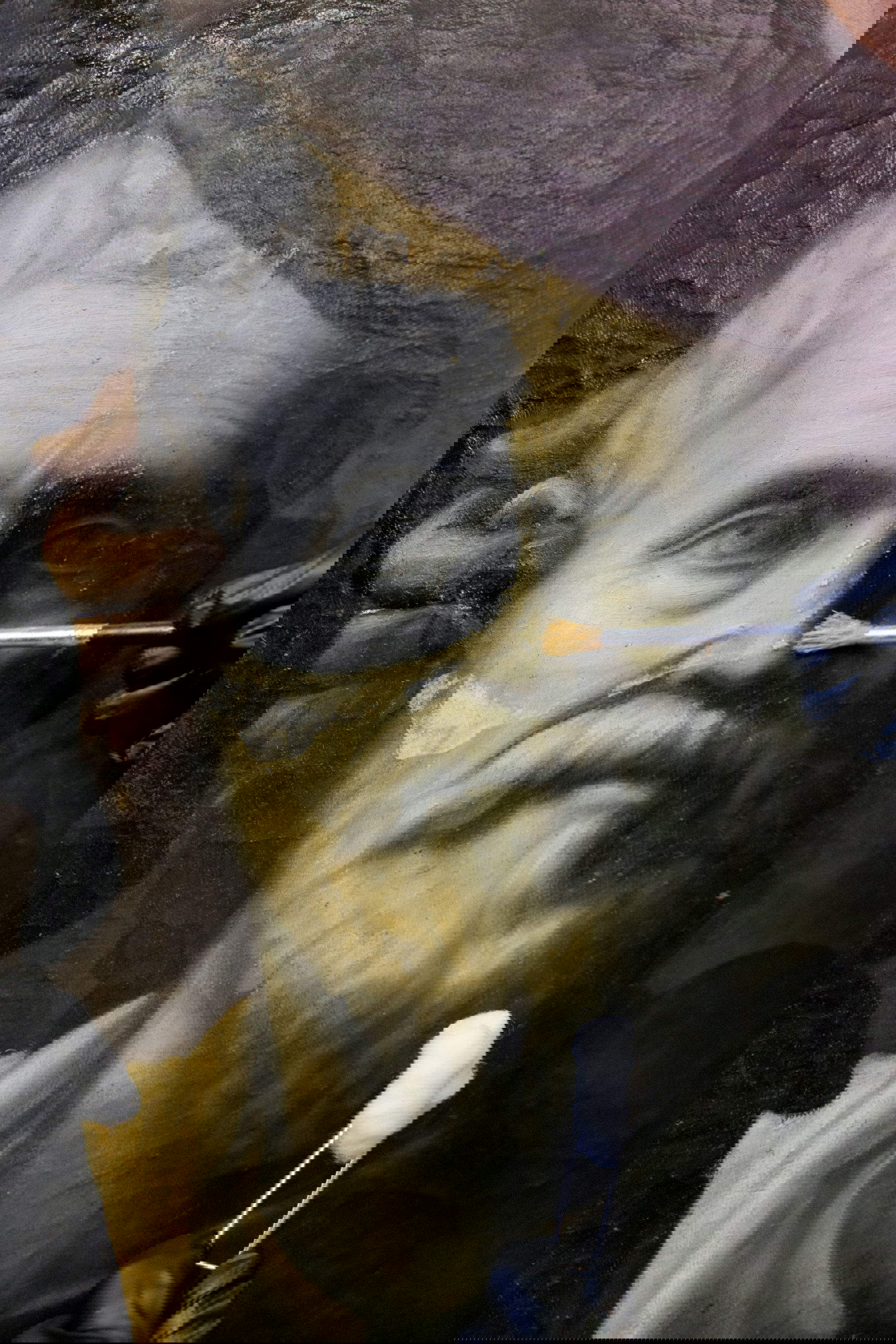
The conservation intervention first involved the removal of the yellowed varnishes and layers of dirt that had settled on the painting over time. This operation restored brilliance to the colors and brought to light details that were no longer legible, including the artist’s signature. The recovery of the palette made it possible to appreciate more clearly the chromatic complexity of the work and the quality of Titi’s painting. The restoration operations were accompanied by diagnostic investigations and scientific analysis of the pigments, which provided additional information on the materials used and the manner of execution of the painting. After cleaning and consolidation of the paint surface, the canvas was tensioned on an interim frame. The textile support was consolidated by the application of a natural adhesive obtained from a purified Japanese seaweed, used to re-aggregate the cellulose fibers and provide stability to the structure.
The exhibition also aims to reconstruct the cultural context in which the work was conceived. Indeed, the painting is part of the larger project promoted by Michelangelo Buonarroti the Younger, an intellectual and promoter of family memory, who transformed the house on Via Ghibellina into a space dedicated to the celebration of the figure of Michelangelo. Through the decoration of the Gallery and the organization of the rooms, Buonarroti the Younger intended to build a narrative path aimed at consolidating the myth of the artist and strengthening the prestige of the family.
The exhibition itinerary presents archival documents, paintings and preparatory materials that illustrate the different stages of the commission. Among them appears the sketch made by Tiberio Titi for the composition, purchased by the Casa Buonarroti Foundation on the antiques market in the late 20th century. Also on display alongside the sketch are autograph sheets that record the invention of the subject and notes on payments for the execution of the work.
The exhibition also includes an educational apparatus consisting of explanatory panels and a video documenting the various stages of the restoration work. This material makes it possible to follow the process of the work’s recovery and to understand the methodologies adopted by the restorers to address the canvas’ structural and conservation problems. The exhibition project thus restores a new reading of a central painting in the collection of Casa Buonarroti.
Statements
“For the first time,” comments curator Cristina Acidini, “thanks to the restoration by Elizabeth Wicks, a singular work with a unique subject can be observed up close: no painting, in fact, depicts the final arrangement of a funerary monument, in this case particularly illustrious because it is dedicated to Michelangelo Buonarroti. The restoration also makes it possible to highlight a little-known but very talented artist, such as Tiberio Titi. Also for this we are grateful to the Friends of Florence who supported the intervention.”
“After Artemisia Gentileschi, Francesco Bianchi Bonavita and Anastagio Fontebuoni, it is the turn now,” points out curator Alessandro Cecchi, “of the painting by Tiberio Titi as part of the restoration project that aims at the complete recovery of the works commissioned by Michelangelo Buonarroti the Younger for the Galleria Buonarrotiana.”
“Friends of Florence,” stresses Simonetta Brandolini d’Adda, President Friends of Florence, “is delighted to be part of the project to restore this interesting painting by Tiberio Titi for the Museo di Casa Buonarroti.Donor Donna Malin, with her special love of Florence and art, perfectly reflects the character of our Benefactors, and we are grateful to her for her unwavering commitment to supporting our artistic heritage.We thank the Casa Buonarroti Foundation, President Cristina Acidini and Director Alessandro Cecchi, and are grateful to restorers Elizabeth Wicks and Lorenzo Conti for their excellent work.”
Notes on the artist
Tiberio Titi, second son of the painter and architect Santi di Tito, was initiated into an artistic career together with his brother Orazio within his father’s workshop. When his father died in 1603, he inherited his father’s business, which had produced numerous paintings of religious subjects characterized by a naturalistic language in accordance with the principles promoted by the Council of Trent. The inheritance also included many unfinished works and over seven hundred drawings. After collaborating with his father on the creation of scenery and ephemeral apparatus for the Medici court’s festivities in 1589 and 1598, Titi established himself primarily as a court portraitist, assuming the role of painter to the Medici family. However, his activity in this sphere experienced a downsizing beginning in 1620, with the arrival in Florence of the Flemish painter Justus Suttermans, who took his place from 1623. Works attributed to Titi include, in addition to the painting housed in the Casa Buonarroti Gallery, theSelf-Portrait in the Uffizi Galleries and several portraits of the Medici family and their relatives, including that of Vittoria della Rovere as a child, also in the Uffizi.
 |
| Florence, restoration of Tiberio Titi painting unearths celebratory project on Michelangelo |
Warning: the translation into English of the original Italian article was created using automatic tools. We undertake to review all articles, but we do not guarantee the total absence of inaccuracies in the translation due to the program. You can find the original by clicking on the ITA button. If you find any mistake,please contact us.