





The Royal Museums of Turin are dedicating a new appointment to the genius of Leonardo da Vinci (Vinci, 1452 - Amboise, 1519) with the exhibition of the autograph drawing Three Views of a Manly Head with Beard, preserved at the Royal Library. The work will be on view from March 20 to June 28, 2026 in the Spazio Leonardo, on the second floor of the Galleria Sabauda, inside the museum complex located at Piazzetta Reale 1. The initiative is part of the project A tu per tu con Leonardo, which each year presents to the public one of the master’s graphic masterpieces kept in Turin’s collections. The exhibition includes the presentation of the work in an armored and air-conditioned showcase, designed to ensure ideal conservation conditions for a sheet of extraordinary delicacy and historical value.
The new chapter of the initiative is curated by Simone Facchinetti and Arturo Galansino, who have been called upon to lead the in-depth scientific study of one of the most fascinating drawings preserved in the Royal Library’s collection. The exhibition is part of the program to enhance Leonardo’s works promoted by the Royal Museums of Turin under the general direction of Paola D’Agostino. The sheet on display, dated around 1502, is made in red stone on paper and measures 110 by 283 millimeters: nevertheless, despite its relatively small size, the drawing represents one of the most significant examples of Leonardo’s capacity for observation and physiognomic analysis.
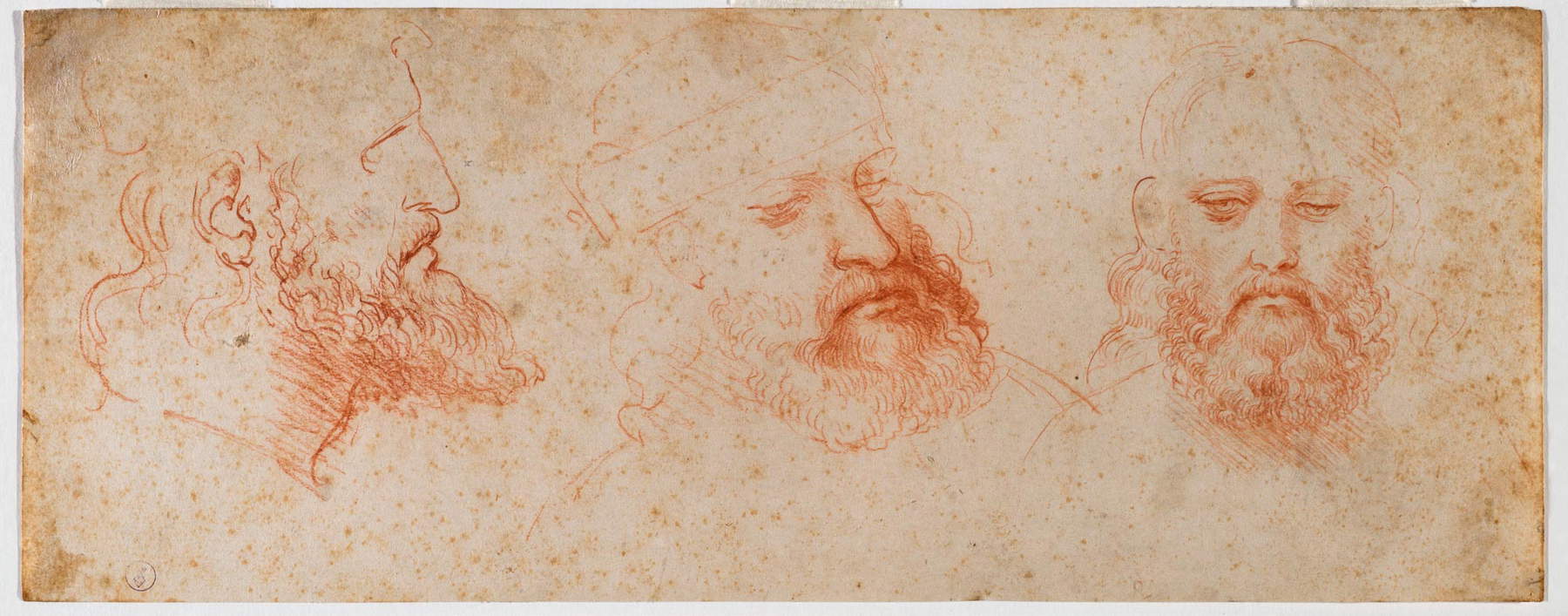
The sheet features three depictions of the same male figure, portrayed from different angles. The man is depicted frontally, three-quarter view, and in profile, according to a viewing scheme that allows the features of the face to be grasped from different points of view. The subject is a man with a medium-length beard and long hair flowing down to his shoulders. The repetition of the same face in three different positions suggests an analytical approach typical of Leonardo’s working method. Indeed, Leonardo uses drawing as an investigative tool, studying the structure of the face and its variations depending on the angle of the gaze.
Scholars have interpreted the sheet as a preparatory study probably intended for the design of a sculpture. In Renaissance artistic practice, the depiction of a subject in the three canonical poses (frontal, three-quarter view, and profile) was in fact the basis for the volumetric definition of forms, allowing the two-dimensional drawing to be translated into a possible three-dimensional realization. This method allowed artists to precisely analyze the relationships between the different parts of the face and imagine the plastic rendering of the final work. In this sense, the sheet testifies to Leonardo’s interest in sculpture and the study of form in space, areas that constantly accompanied his artistic research.
Alongside questions related to the function of the drawing, another issue that has fueled debate among scholars concerns the identity of the character depicted. The best-known hypothesis was put forward in 1930 by art historian Wilhelm Reinhold Valentiner, who proposed identifying the face with that of Cesare Borgia. According to this interpretation, the drawing could be a preparatory study for a portrait of the famous leader and politician, a central figure in Italian history in the late 15th and early 16th centuries. Valentiner’s idea has found some consensus among scholars over time, but it has not been unanimously accepted. Prominent among the critical voices is that of art historian Carlo Pedretti, one of Leonardo’s leading experts, who has proposed a different reading of the sheet. According to Pedretti, the face depicted may not be that of a famous personage, but rather that of a man Leonardo met occasionally and chose as his subject because of his particularly interesting somatic features.
Regardless of the character’s identity, the sheet is a valuable testimony to Leonardo’s extraordinary ability to capture the complexity of human expression. Through a few skillful strokes, the artist manages to render the structure of the face, the texture of the beard and hair, and the psychological depth of the subject. The exhibition at the Galleria Sabauda thus offers the public an opportunity to take a close look at one of the most significant drawings in the Turin collection and to come into direct contact with Leonardo’s creative process.
|
| Leonardo da Vinci, the Three Views of Manly Heads on display at the Royal Museums of Turin |

Warning: the translation into English of the original Italian article was created using automatic tools. We undertake to review all articles, but we do not guarantee the total absence of inaccuracies in the translation due to the program. You can find the original by clicking on the ITA button. If you find any mistake,please contact us.
























 IT
IT FR
FR DE
DE ES
ES CN
CN


