




by Redazione 18/04/2026



Categories: Exhibitions / Disclaimer
From May 9 to September 13, 2026, the Museum of Oriental Art in Venice is hosting Keita Miyazaki's solo exhibition, From Water To Form. The project is part of the 61st Biennale program and relates water, matter and traditions between Japan and Venice.

From May 9 to September 13, 2026, the Museum of Oriental Art in Venice, housed in the spaces of Ca’ Pesaro, presentsKeita Miyazaki ’s solo exhibition, entitledKeita Miyazaki - From Water To Form. The project is part of the program of the 61st Venice Biennale and is an investigation into the relationship between matter, memory and processes of transformation. The exhibition is curated by Pier Paolo Scelsi, Ilaria Cera and Riccardo Freddo, with scientific direction by Elisabetta Barisoni, Marta Boscolo Marchi, Daniele Ferrara and Stefania Portinari. The initiative is promoted by the Regional Directorate National Museums Veneto - Museum of Oriental Art, Rosenfeld Gallery and CREA Cantieri del contemporaneo, under the patronage of the Consulate General of Japan in Milan and the Japan Foundation.
After a previous move to Rome, at the Museo Nazionale Etrusco di Villa Giulia, Miyazaki’s research lands in Venice as a continuation of aninvestigation centered on water. The lagoon city is taken as a context consistent with this trajectory, as a space defined by a constant balance between natural elements and human intervention. In Keita Miyazaki - From Water To Form, water assumes the role of original principle and interpretive device, understood as an element capable of activating processes of destruction and regeneration, erosion and fertility, within a continuous cycle of dissolution and reconstruction. This dynamic is read in relation to both Japanese culture and the specific historical and urban identity of Venice.


The Museum of Oriental Art at Ca’ Pesaro provides the reference context for the exhibition, partly because of the presence of one of the most relevant European collections of Japanese art from the Edo period. The building, an integral part of Venetian cultural history, is interpreted as a space in which historical stratifications and international openings overlap. In this framework, Venice is also considered as a natural curatorial device, as a city built on a hydraulic system that has historically fostered exchanges between Europe and Asia, resulting in processes of circulation of techniques, materials and visual languages. Water, in this perspective is a constant presence that helps to define the reading of the works.
The exhibition project is developed as a site-specific intervention and is structured around a conception of craftsmanship understood as a ritual practice. Gesture, time and technique are considered interdependent elements within a process of knowledge involving the transformation of matter. Miyazaki’s works establish a direct confrontation with the museum’s permanent collections, activating a dialogue between ancient and contemporary Japan. This confrontation is based on the continuity and discontinuity of craft knowledge, highlighting the relationship between tradition and new expressive possibilities. The worked material thus becomes a shared language between different eras, in which the process takes on a value similar to that of the finished work. In this context, artistic practice is brought back to a dimension in which time settles into the material, without implying a celebratory reading of the creative gesture. The set of works fits into the museum itinerary as an element of comparison with the existing collection, helping to redefine relationships between historical objects and contemporary productions.
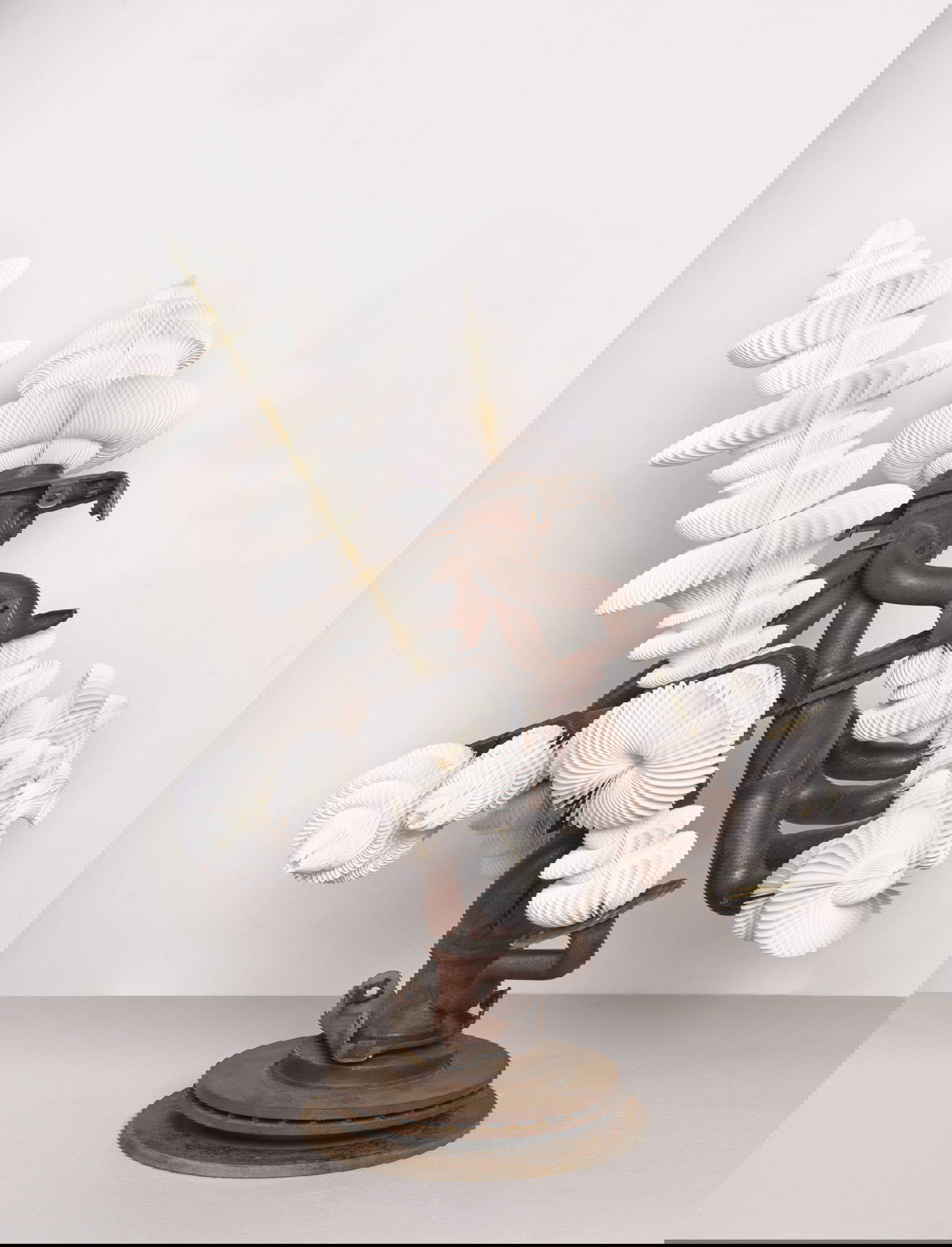
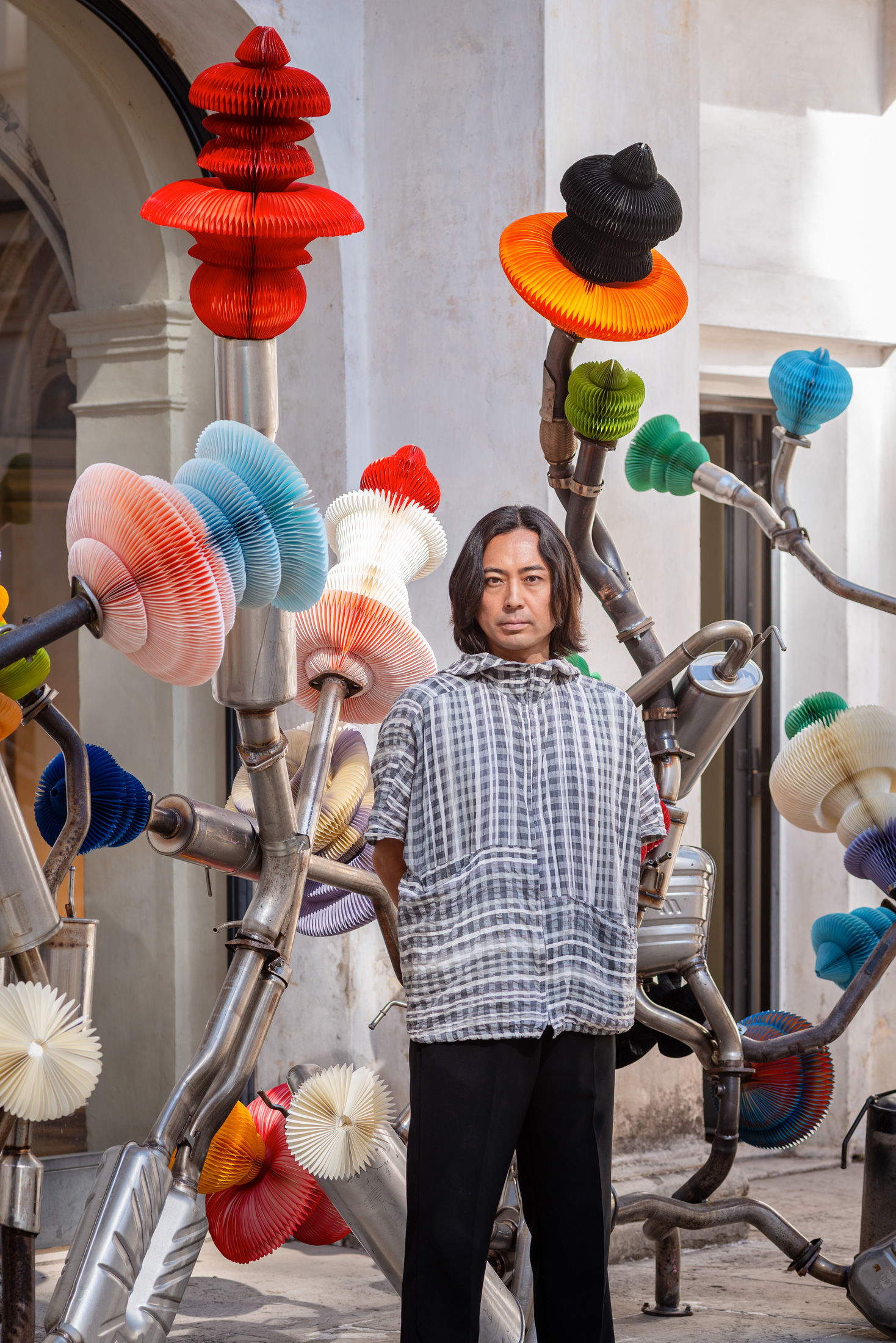
Parallel to the museum project, the exhibition extends beyond Ca’ Pesaro through a public art intervention at Crea Cantieri del Contemporaneo on Giudecca Island. The initiative, also curated by Pier Paolo Scelsi, Ilaria Cera and Riccardo Freddo, involves the creation of a site-specific modular sculpture by Miyazaki. The work is part of a research path developed by the artist over the years, focusing on modularity and the relationship between form and space.
The modular structure had already been presented in different configurations in the Imperial Gardens of the Emperor of Japan and at the Nymphaeum of the National Etruscan Museum of Villa Giulia, where Miyazaki was the first artist invited to create a site-specific sculptural intervention. In Venice, the modules are reworked and recomposed in a new configuration, conceived in relation to the productive and symbolic context of the Giudecca shipyards.
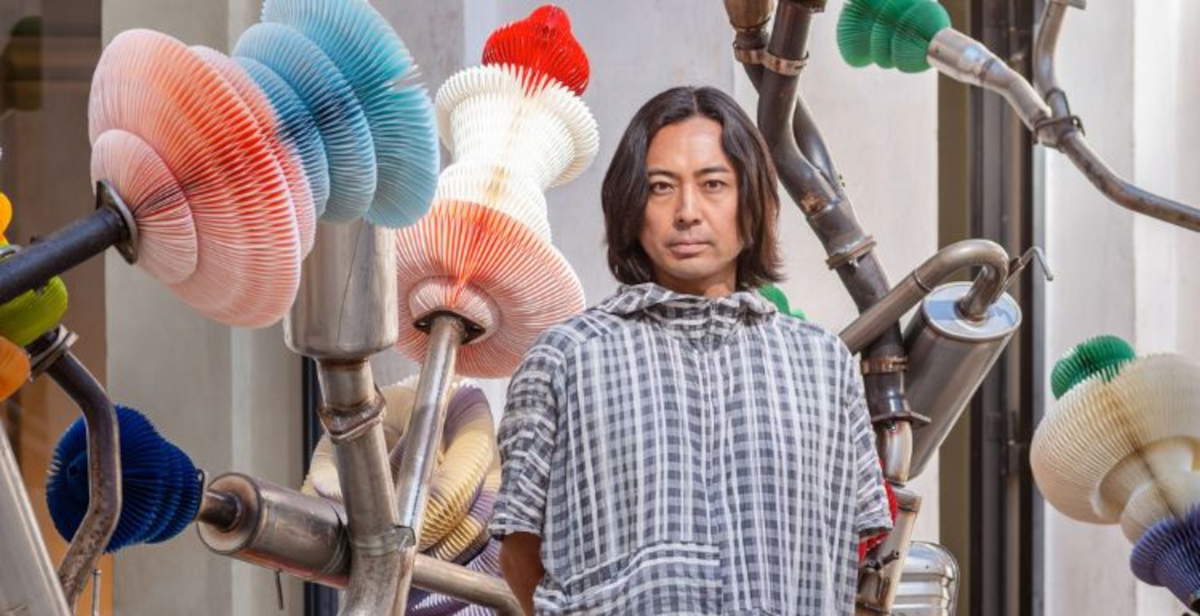 |
| Venice, Keita Miyazaki's solo exhibition at Ca' Pesaro puts Japan and lagoon cities in dialogue |
Warning: the translation into English of the original Italian article was created using automatic tools. We undertake to review all articles, but we do not guarantee the total absence of inaccuracies in the translation due to the program. You can find the original by clicking on the ITA button. If you find any mistake,please contact us.