





With the birth of AStArte, the National Association of Art Historians, a new phase of discussion on the role of the profession within the Italian cultural system opens. In this interview, Silvia Mazza, an art historian, journalist, curator and president of AStArte in the transitional phase toward the National Congress, traces the reasons behind the initiative and the prospects for a category that, according to her analysis, needs structured and recognized representation today. The stated goal is to strengthen the profile of the art historian on an institutional, scientific and professional level, through shared instruments of protection, training and enhancement.
His training developed between the LUMSA University, where he obtained a specialization diploma in Medieval and Modern Art History, and a solid research path related to heritage conservation issues, with particular attention to the “Risk Map.” A journalist and essayist, Mazza has been a contributor to Finestre sull’Arte for many years, and has also written for some of Italy’s leading trade and generalist newspapers, including Il Giornale dell’ Arte, Il Giornale dell’Architettura and Gazzetta del Sud, flanking his publishing activity with an intense curatorial and conference activity in dialogue with state and regional institutions and universities.
During the interview, Mazza outlines the aims of AStArte starting with the association’s statute, which focuses on the promotion of scientific quality, professional ethics and public recognition of the figure of the art historian, along with the need to define shared standards and a more incisive role in decision-making processes in the cultural sector. Ample space is also devoted to the organizational structure of the association and its relationship with the current regulatory framework, in particular Law 4/2013. Reflection then extends to the critical issues of the profession, including precariousness, fragmentation of work and the lack of a unified system of representation, to the issue of training and public competitions, now at the center of a heated national debate. In this framework, AStArte is described as an attempt at recomposition and stable interlocution with institutions, with the ambition of filling a historical absence in the panorama of cultural heritage professions in Italy.

NC. What should be, today, the concrete role of a national association of art historians within the Italian cultural system?
MS. It should represent in every forum and enhance the profession of the art historian and the skills of its members, promote the quality, competence and ’professional ethics of the members, ensuring compliance with the rules of ethics, foster public and institutional recognition of the profession, protect the professional interests of the members, contribute to the protection, study and enhancement of the art-historical heritage, promote lifelong learning and professional updating, and promote the approach of the public to art history and the cultural and social function of the work of the art historian. These are all purposes identified in the Statute of the National Association of Art Historians, AStArte. To achieve these purposes, the Association carries out, by way of example, activities such as those of developing proposals on the rules, procedures, and scientific standards of the work of the art historian, working for the definition, promotion, and proposal of regulatory frameworks to protect the profession of the art historian’art, to collaborate and interrelate with the relevant ministries, universities, museums and sector institutions in order to promote and protect the interests of the category, to organize conventions, conferences, meetings, debates and discussion tables among all public and private subjects operating in Italy in the field of Art History. In addition, in coherence with Law 4/2013 (which regulates in Italy the professions not organized in orders or colleges), AStArte contributes to define and update the professional profiles of the art historian; to promote quality standards and good practices, adopt a Code of Conduct (Code of Ethics or deontology), supervise compliance with the association rules, ensure transparency towards users and clients, activating a special reference desk for the citizen-consumer under Art. 2, paragraph 4, of L. 4/2013, promotes access to the certification of skills, where provided for, guarantees the accessibility on its website of the list of members and their possession of the professional requirements required by Ministerial Decree 244/2019, Annex 7 (this is the regulation that concerns the procedure for the formation of national lists of art historians), and the other information elements provided for by Article 5 of L. 4/2013.
AStArte is presented as a new project on the Italian scene. But what really changes from previous attempts? What is the element that should avoid yet another shipwreck? Furthermore, you pointed out that archaeologists, archivists and librarians already possess recognized representative bodies. Why, in your opinion, have art historians in particular failed for decades to build a unified structure? Is it really “individualism,” as professionals in the field claim on social media?
AStArte was presented at the Palermo conference the day before the 20th anniversary celebrated in Rome by the National Association of Archaeologists. Not a coincidence. In fact, the most relevant novelty with respect to past attempts is that the “constituent” process of the new association was actively participated by ANA, in particular by Alessandro Garrisi, for two terms as national president and currently president of the Board of Arbitrators of the same association, who made available to the constituent phase of the new association the know-how accumulated over many years of service. This means that there was a desire to capitalize on the long experience gained by one of the most important professional associations among cultural heritage professionals in Italy. With ANA, moreover, I have shared several “battles” for cultural heritage in the past years. In particular, I want to recall the reform proposal for Sicilian archaeological parks delivered to the Proceedings of the 2022 Conference at the University of Messina, which I edited with the late Prof. Francesco La Torre. AStArte was born under the banner of this reciprocity. If archaeologists are on our side, one does not see then cui prodest for art historians to war with each other. And, in fact, I can tell you that we are already seeing encouraging consensus and support. I think in the past there has been a misunderstanding of Charles Darwin’s theory of evolution of the species and what should be meant by natural selection. To survive one must be strong, adapt to the environment, not self-sabotage! Condemning oneself to extinction is a paradox that is difficult to understand. The marginality at all levels of this category I believe is a result of the historical clash between the ministerial and academic spheres, descending from the very moment when the then Ministry of Cultural and Environmental Heritage was established by Giovanni Spadolini, which gathered together the competencies and functions in this area that were previously of the Ministry of Education (along with those of the Ministry of the Interior and the Presidency of the Council of Ministers). Clashes between different schools of academic thought probably also weighed in. But the art historian whom the new Association wants to protect and enhance is a specialist who does not have to belong to any parish to hope to carve out a space to be heard at all levels. Personalisms, Guelphs and Ghibellines do no credit to a profession of high intellectual content and considerable complexity, which is carried out both in public and private institutions and as self-employed.
Another new factor is the broad and transversalendersoment that already the set of speeches at the Palermo conference has shown to be accorded to AStArte, with the involvement of institutions, universities, public administrations, trade unions, the business world and the professions.
And the “front” also opens up to the representation of art historians of higher artistic education, already invited for the second moment of presentation of the Association in Rome, which will also coincide with the National Congress in which the governance bodies will be elected. The call remains open to all those who want to make a constructive contribution. Still, another element of novelty lies in the unprecedented goal of wanting to fill a significant gap: to date, there is no national association of art historians recognized by the Ministry of Business and Made in Italy under Law 4/2013. Currently, the accredited associations are those of archaeologists (ANA and CIA), librarians (AIB), archivists (ANAI) and demoethnoanthropologists (ANPIA). These professional associations, in fact, have recognition that allows representation before third parties, including in institutional settings. It is no coincidence that the professions with such a form of representation within the cultural heritage sector enjoy better health than the others.
Will AStArte also have a political function or will it remain primarily a cultural and scientific body?
AStArte is nonpartisan and nondenominational. It is a professional association representing the category of art historians, which, like the other non-ordering professions (with some hybrid exceptions such as restorers), is not regulated. Having obtained the recognition I mentioned earlier, it will be able to present itself as an interlocutor vis-à-vis the Ministry of Culture and local authorities. Consider that in the places deputed to professional policies, as for example we can consider the ministerial commission established under Article 10 of Ministerial Decree 244/2019, art historians are represented by ministerials, in the absence of a professional association. This seems to me a vulnus that needs to be healed. Even in Sicily in Commission V - Culture of the ARS, the Sicilian Parliament, there is an absence of hearings of an entity representing art historians. In 2021 in the front that managed to stop, precisely from a series of articles I signed in this magazine, the infamous “Catania Charter,” the decree by which the then regional councillor for the branch Albero Samonà [ed: today the director of Villa Adriana and Villa d’Este in Tivoli] wanted to grant the cultural assets of the museum repositories to be used by private individuals for a fee, giants of the world of culture such as Salvatore Settis, academics, Associations in defense of cultural heritage from Legambiente to Italia Nostra, from Assotecnici to Icom, to the Mi riconosci. movement, joined compactly. Once again, the voice of art historians was missing.
By the way, the birth of the association takes place precisely in Sicily, a territory with an immense heritage but also with historical criticalities in cultural management. Is this a geographical coincidence or do you think that it is precisely from Sicily that a new national model for the protection and enhancement of the cultural professions can start?
Thank you for the question because there is a kind of distrust of this primogeniture. Apart from the fact that one does not understand why any initiative that connotes itself as national should only be held in the capital, each region has its own propositional dignity, especially since Sicily is historically known as the “laboratory of Italy,” and if this laboratory sometimes produces something positive, it is not a bad thing. Above all, does one realize what regional cultural heritage we are talking about? The study conducted last year by THEA Group shows that Sicily is the first region in Southern Italy and the seventh in Italy in terms of the number of cultural institutions, with 188 theaters and art facilities, 139 museums and galleries, 40 monumental complexes and 32 archaeological parks, as well as 7 UNESCO World Heritage sites and 2 UNESCO-recognized intangible assets. So far the pars costruens, but let me remind you that this is also the Region in which a public competition turned into one of the bleakest pages of an all-Sicilian scandal. I am referring to the one announced in 2000: the winners, who were hyper-qualified, instead of being placed in management roles, found themselves to this day subordinate to graduate officials who were placed, instead, by mere seniority, in management roles. With a nice pay inequality, whereby specialists with so much Ph.D. and Postgraduate degrees find themselves effectively exploited on a par with colleagues who do not work for a public body. The question, however, is not whether a new model for the protection and enhancement of the cultural professions will be able to start from Sicily, but whether the new Association with a national vocation will be able to champion it. Again, there is already the proposal that emerged during the Palermo conference to initiate conventions or memoranda of understanding with auction houses and the Carabinieri Command for the Protection of Cultural Heritage, which for their activities need specialists in the different branches of art history. AStArte would become a subject of reference and mediation to activate at its members a kind of “act of interpellation.”
The profession of art historian is already regulated by requirements defined by the Ministry of Culture and the MIC professional lists. Within this framework, how does AstArte fit into the existing regulatory system?
As I mentioned earlier, the Association represents cultural heritage professionals who, together with archaeologists, archivists, librarians, demoethnoanthropologists, physical anthropologists, experts in diagnostics and applied science and technology for cultural heritage, fall into the category of regulated (non-professional) training. A training that, according to the current requirements, is specifically oriented to the practice of a particular profession and consists of a course of study completed, if necessary, by professional training, professional internship, or professional practice, in accordance with the procedures established by law (Ministerial Decree 244/2019). Once the recognition under Law 4/2013 I mentioned above is obtained, like the other professional associations, AStArte will also be able to play an important role in maintaining the lists of professionals in collaboration with the Ministry of Culture, because it it will be able to issue a certificate of possession of the requirements for registration to a specific profile and band (the list of each profile is divided into three bands I, II and III, corresponding to the levels of the European Qualifications Framework EQF 8, 7, 6).
In recent weeks, the issue has returned to the center of the debate after protests by CISDA - Comitato Idonei Storici dell’Arte (Committee of Art Historians) against the possible forfeiture of the ranking list (deadline May 30, 2026) of the MiC 518 competition for art historian officials, in a context marked by a severe shortage of specialized personnel. What is AStArte’s position on these issues?
The ranking list was allowed to lapse at the end of May 2026. Today, 204 eligible applicants literally find themselves hanging on the communication of the MiC’s relevant bodies of a 90-unit ranking slip. It is a situation that makes the weakness of this category palpable, if we consider that unlike all the other professional figures recruited through the same competition, the art historians’ ranking list remains the only one that has not been exhausted and a new competition has been announced for the other figures. AStArte is close to CISDA and has wanted, since the presentation conference in Palermo, to share these claims and the pointing out that this non-extension has nothing to do with the practice of public administration, with the principles of economy and good performance, representing an unjustifiable waste of public resources and a further weakening of the state’s ability to protect its cultural heritage. This is the first ranking list to expire as a result of the 2023 civil service reform, including for a public competition announced in 2022. CISDA has hailed as necessary the creation of a professional association, which aims to regulate the profession of art historians. And if seeing a ranking lapse in a chronically understaffed ministry is an undigested paradox, I mentioned earlier that there are also those who have even been waiting 26 years for a competition. So many years have passed since the last one announced by the Sicilian Region, where the provinces of Trapani, Syracuse, Ragusa and Caltanissetta do not even have an art historian in the Superintendency. Also lacking art historians are the two important research institutes that belong to the Regional Department of Cultural Heritage - Regional Center for Design and Restoration and for Natural and Applied Sciences for Cultural Heritage (CRPR) and the Regional Center for Inventory, Cataloguing and Documentation (CRICD). Only two regional museums are headed by art historians, in Palermo: Palazzo Abatellis and RISO, a museum of contemporary art. The others are entrusted to technicians from other cultural heritage and noncultural heritage professions. And the list of critical issues does not stop there. To mention a few more, at the time of the allocation of organizational positions within the regional administration, only two historians
of art were granted this progression, compared to surveyors, engineers and architects
who in most cases have had it; while there remains the lack of definition of professional
technical professionals in the department. Last December, at last, a regional call for applications aimed at recruiting into the roles of the non-management sector various professional profiles also covered 10 units of cultural heritage professionals. These are archaeologists, moreover, absolutely insufficient. Not contemplated, however, and inexplicably, are the other profiles, including not even to mention art historians. Again, the attention given to archaeologists is due to the action of a strong association such as the ANA. And since the National Capacity for Cohesion Program 2021-2027 envisages for the Sicilian Region the recruitment of other units, it is evident that AStArte, although in its first steps, can also carve out a role of moral suasion with the political interlocutor as well as with the relevant Departments.
Many recent controversies have concerned MIC’s public competitions and the equalization of very different educational paths: master’s degrees, graduate schools, doctorates. Does AStArte intend to take action on these issues as well? In what ways could it take action?
Against the abolition of the circular that removed the requirement of a Postgraduate School, PhD or two-year Master’s degree in order to participate in competitions for MiC civil servants, archaeologists Andrea Carandini and Giuliano Volpe spoke out strongly. The latter pointed out that if “the circular had not been annulled, a MiC official would have found himself directing an activity of protection, research, and valorization, coordinating professionals with academic degrees greater than his own.” ANA was at the forefront of the “counteroffensive” that achieved the annulment of the circular. It will be no coincidence that we are still talking about archaeologists as a bulwark of interests that coincide with those of other categories of cultural heritage professionals. In one of the meetings with Alessandro Garrisi for the constitution of AStArte, he recalled how the proposed law of recognition (Law 110/2014) had been formulated to include in a participatory process all the representations of the cultural heritage professions: archaeologists, archivists, librarians, art historians, anthropologists, diagnosticians, restorers. He took part in countless meetings in those years to confront these representations, including those of art historians, united in a small but combative association called “Startim” - Art Historians in Motion. He quickly realized that he had before him the representation of one of the least structured professions on the scene. This condition descended from a specific reason: all cultural heritage professions were in fact fully represented (albeit to varying quantitative and qualitative degrees) within the MIC and MUR, Culture and University, but looking at the development of the same professions in the private sector, there was (and is) a big difference between strongly structured and therefore “strong” professions (e.g., archaeologists and archivists) and totally unstructured and consequently “weak” professions (such as art historians, anthropologists, and diagnosticians). More than a decade after the victory of that mobilization, with the approval of recognition and the enactment of Law 110 of 2014, that weakness persists and, as far as art historians are concerned, has been reflected to date in the absence of an authoritative professional association.
What day-to-day problems of Italian art historians do you think AStArte can finally address effectively? Many art historians today work in extremely fragmented conditions: precarious, occasional assignments, external collaborations, freelancing, contested competitions.
The Association intends to put at the center of its program the establishment of policy lines of support first and foremost for workers in the private sector, who suffer shortages of professional outlets on par with other professions in the sector. In the latter, there is a picture of absolute deregulation, with severely underpaid work performance, as also revealed by the 2019 survey “Culture, Contracts and Working Conditions,” carried out by the Mi Riconosci movement, and from which it emerged that 80 percent of participants earned less than 15 thousand euros per year and with wages of less than 8 euros per hour declared by half of the respondents. A survey that I had also brought to the attention of the sector audience in Sicily, at the Messina Regional Museum “Accascina” . I was impressed by how he stigmatized those wages not by a trade unionist, but by the then president of Confindustria Messina, Ivo Blandina, calling them “wages from the caporalato of the Sibari plain.” While the then director of the museum, Orazio Micali, pointed out precisely how “the most common hourly pay in private contracts in the sector, between 8 and 12 euros, is also reflected in the contracts that the Sicilian Region applied to those competition winners (of 2000).”
Another hot topic concerns the relationship between merit and access to the profession. What will be the criteria for joining AStArte? Scientific publications, academic degrees, field experience, museum activities? And how to avoid the risk of creating new exclusions?
It sounds trite and obvious, but only art historians can join an association of art historians. It is good to see consensus around this representation project, but it is clear that requests such as those from architects, but also from archaeologists themselves, which are also received, cannot be evaluated. The art historian who can apply for membership must meet the legal requirements. The categories provided are those of: Ordinary Members (art historians in possession of the qualifications stipulated in M.D. 244/2019, All.7, paras. 1.3, 2.3.), Participating Members (art historians in possession of the qualifications stipulated in M.D. 244/2019, All.7, paras. 3.3.), Student Members (undergraduate students enrolled in degree programs stipulated in M.D. 244/2019, All.7, paras. 3.3.). They correspond to the MiC brackets, in addition to the category of students, who it is very advisable to start organizing themselves early to understand how the profession they will really practice after their training, whatever its duration. Let us also clarify that one does not have to be included in the ministerial bands to register with the Association: if anything, the opposite is true, that is, the Association will be the one to issue the certificate of possession of the requirements to register in the national lists. Finally, there is also the category of Honorary Members, scholars and personalities of clear reputation (not necessarily art historians) who have expended themselves publicly for the promotion and development of the arts, their study and related professions.
One of the criticisms that has emerged concerns the risk that AStArte could turn into a kind of “cultural corporation.” How do you respond to those who fear the emergence of a closed system capable of determining who can call themselves art historians and who cannot?
As I just clarified, we are not dealing with questionable assessments, but regulated by law. Ministerial Decree 244/2019 is a milestone, having identified the requirements necessary to practice the cultural heritage professions, including that of art historian. There is no question of creating guilds, but there is certainly a need for art historians to develop a category consciousness as soon as possible, one that transcends the fences of “safe” spheres (academy, ministry, etc...) and truly becomes “the home of all and sundry art historians.”
As some critics on social media point out, the association will not be a professional order. This means that anyone will be able to continue to speak publicly in the field of attributions, discoveries or art dissemination. So what will be the concrete boundary between certified expertise and self-declaration?
This is a misplaced question: the art historian does not self-declare himself as such, but is so by virtue of the qualifications he has earned, as per the legislation I have repeatedly referred to. To quote ANA again, the Twentieth Anniversary was an occasion in which archaeologists also set themselves the goal of regulating the profession through a professional order. Except that without an intermediate organization such as an association like the one that has just been formed for art historians the question for “us” could not arise except in the medium to long term, but only after the profession has had a chance to reason about it, confront it and decide that that is the right thing to do. Today, perhaps, it is still early, and we would only end up saying what each of us individually likes: returning, therefore, to the pattern that in the past has made it impossible to create a solid and lasting representative body. At the risk of contradicting what I have just said, but being a member of a professional body, as I am also a journalist, I personally believe that professional bodies need deep reflection on efficiency, costs and the need for modernization. After all, one should ask why Italy is an anomaly in Europe because of the high number of registers. Numerous activities for which registration in one of the professional registers is compulsory in our country, after passing a state exam, possessing specific qualifications, taking an oath of observance of a deontology, overseeing respect for the decorum of the profession, etc., are instead completely free in the rest of the European Union, with differentiations from state to state for individual activities. Take Germany, one can join the Verein Deutscher Ingenieure (VDI), the Association of German Engineers, the largest in Western Europe: it is not an order, but it supports, promotes, and represents engineers, and there is no mandatory membership, nor are there state exams.
Finally, what would have to change on a cultural, even before institutional, level for AStArte not to repeat the fate of other failed association attempts and really succeed in building a solid network among art historians?
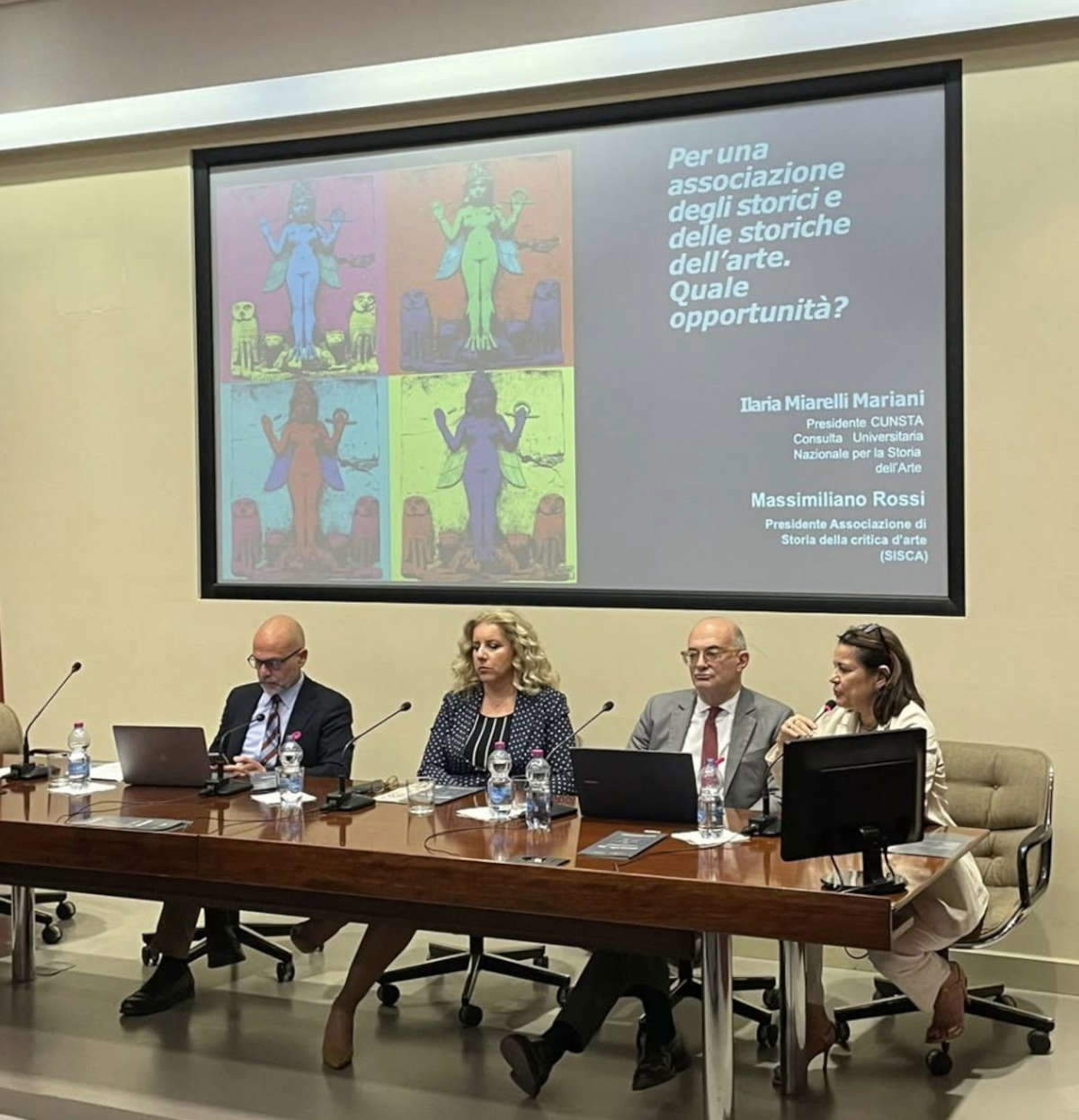
One must succeed in building around AStArte a broad and transversal network capable of involving institutions, universities, public administrations, the business world and the professions. The goal is the protection and enhancement of the professionalism of the category of art historians, for whom we want to define a new framework of recognition for their role in the national cultural system. And this is regardless of their contractual status, the role they play, and the entity for which they practice, whether in the public or private sector. Leaving aside the obvious and abused argument of the quantitative and qualitative nature of the country’s cultural heritage, strengthening the professional sector of art historians, both those in the private sector and those in the public sector, means gaining the country, at last, the representation of a profession that certainly has enormous scope for development. It is, therefore, an investment not only in the cultural growth of the country, but also in the economic growth of a labor sector with great scope for development. A final word I would like to devote to the choice of acronym. AStArte seems particularly pertinent both in terms of iconography and cultural references with Sicily, the region that hosted the founding event of the new Association. Astarte, in fact, recalls a deity of Semitic culture, deeply rooted in the Mediterranean, widely known among specialists and historically documented, associated with a rich iconography and meanings related to femininity, fertility, fecundity, eros, revenge and war. In particular, the most prominent character of the Phoenician deity Astarte was that of the mother goddess, linked to a naturistic conception: she is the mother earth, the common progenitor of all living things, plants, animals and humans. For this characteristic it is possible to associate her with the Greek goddess Demeter, whose cult was particularly widespread in Sicily. A name, then, whose evocative power lends itself to rise as a metaphor for the goals of the new Association, the achievement of which will also require considerable determination on the part of those willing to carve out an active role.


The author of this article: Noemi Capoccia
Originaria di Lecce, classe 1995, ha conseguito la laurea presso l'Accademia di Belle Arti di Carrara nel 2021. Le sue passioni sono l'arte antica e l'archeologia. Dal 2024 lavora in Finestre sull'Arte.Warning: the translation into English of the original Italian article was created using automatic tools. We undertake to review all articles, but we do not guarantee the total absence of inaccuracies in the translation due to the program. You can find the original by clicking on the ITA button. If you find any mistake,please contact us.


























 IT
IT FR
FR DE
DE ES
ES CN
CN


