





Milan is preparing to host a major event for the antiques market and scholars of the applied arts. On Thursday, March 26, 2026, at 3 p.m., in the spaces of 22 Via San Marco, Cambi Casa d’Aste, in collaboration with Stadion Casa d’Aste, will in fact present the sale that will lead to the dispersal of the Leopoldo Conforti Collection, one of the most important European collections dedicated to the art of the key, lock and forged iron. The sale will take place in a single round and represents the outcome of more than fifty years of research, study and passion matured within the Conforti family.
The auction brings together an extraordinarily coherent nucleus of artifacts spanning some ten centuries. Keys, locks, padlocks, chests and caskets tell a long story from the Middle Ages to the nineteenth century, returning an articulate and representative panorama of European production. The works presented come from different geographic areas, with significant presences from the Germanic, French, Italian and Mediterranean spheres, thus offering a broad and comparative reading of the technical and formal evolution of the art of manufacture.
The proposed selection bears witness to how objects created for everyday use were able, over the centuries, to reach such levels of executive quality and refinement as to be recognized as authentic artistic expressions. Keys and locks, functional tools par excellence, are also revealed here as artifacts capable of synthesizing technical ingenuity, aesthetic research and mastery of materials. In this sense, the Conforti collection restores historical and cultural dignity to a type often relegated to the margins of art history. The public will be able to get close to the lots during the exhibition preceding the sale, scheduled for Friday, March 20, Saturday, March 21, Monday, March 23 and Tuesday, March 24, with extended hours from 10 a.m. to 7 p.m., while Wednesday, March 25 and Thursday, March 26, the hours will be reduced from 10 a.m. to 1 p.m. An opportunity to take a closer look at the variety and quality of pieces collected over decades.
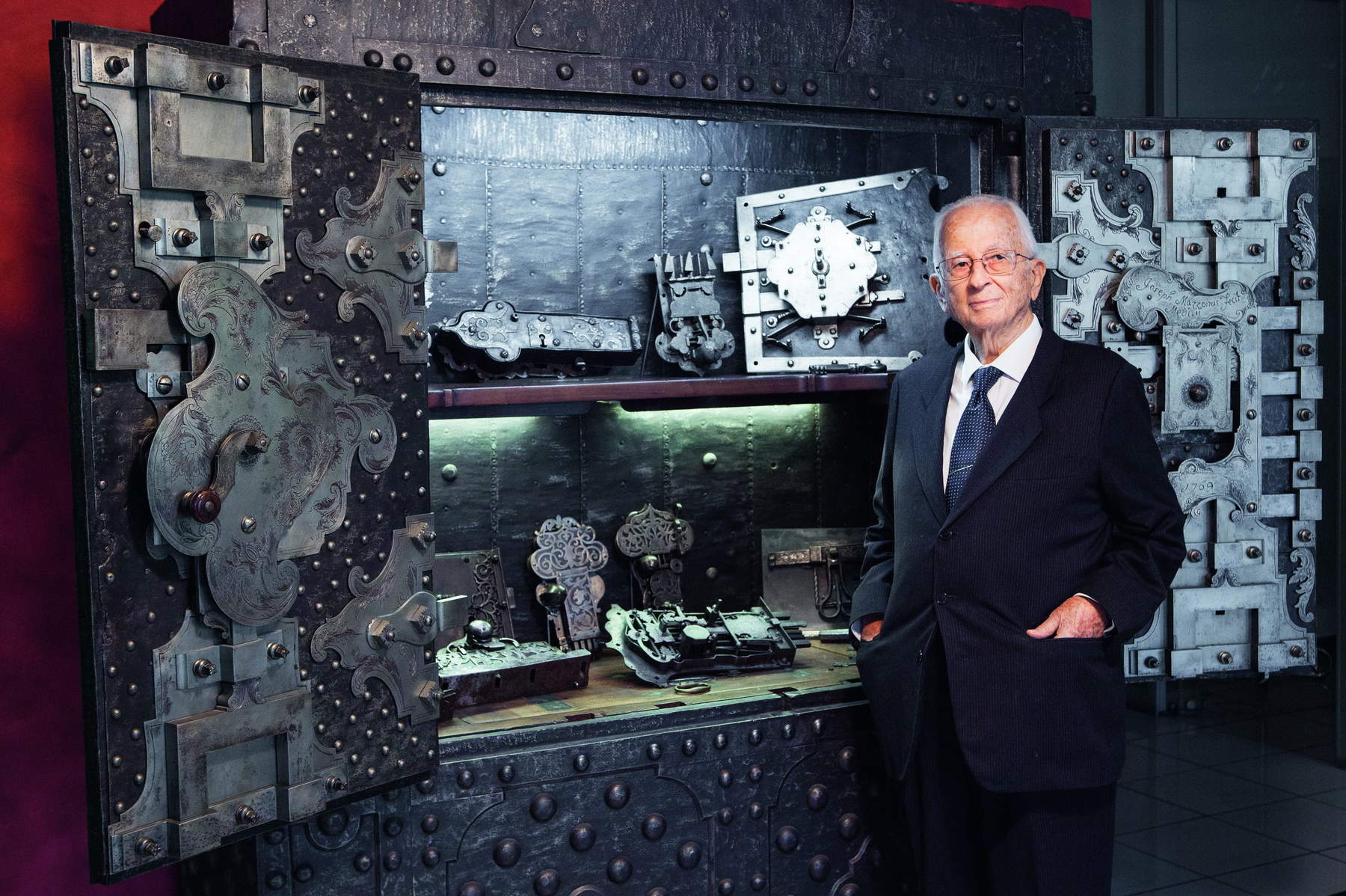
At the origin of the collection is a story that weaves together chance and family roots. In the 1970s, Leopoldo Conforti (1926 - 2024), an entrepreneur at the helm of thefamily business specializing in the production of safes and security systems, came across an antique key that ignited his interest. That initial purchase marked the start of a path that was destined to develop for more than half a century.
From that moment on, technical curiosity and an attraction to the formal quality of these objects fueled a constant activity of research and investigation. It was not a simple accumulation, but a progressive work of study, comparison and selection, which transformed a private passion into a collection of European significance. The family’s industrial activity, founded on principles of mechanical innovation, precision construction and safety culture, provided the ideal context for the development of this interest, fostering a continuous dialogue between contemporary practice and historical tradition.
For Leopoldo Conforti, understanding theevolution of locks and observing ancient mechanisms up close was not just a scholarly exercise, but a natural extension of his own professional identity. The study of forging and ironworking techniques thus became part of a coherent path, in which the technical knowledge of the present found its roots in the craftsmanship of the past.
Over the decades, the collection expanded to include hundreds of specimens, selected not only for their rarity or antiquity, but above all for their quality of execution, technical complexity and elegance of formal solutions. This approach has resulted in a collection built according to typological and chronological criteria, the result of systematic study supported by a specialized library that is among the most comprehensive in the field.
Over time, the collection has taken on a dimension that exceeds that of a simple private collection, configuring itself as a true business museum. The vault that guarded it was conceived not only as a storage space, but also as a place of storytelling and transmission, capable of restoring the historical and cultural value of the objects. In this context, the collection is now presented as an articulate testimony to the evolution of the art of lock and key, highlighting how these artifacts have known outcomes of the highest artistic level.
The different periods are represented through emblematic specimens. Early medieval keys were generally simple, with long, thin shafts and circular or oval handles, characterized by limited decoration. Beginning in the centuries after the year 1000, with the progress of metallurgy, these objects began to be profoundly transformed. The handle, the only part not directly involved in the mechanism, became the favored site for decorative invention. Between the 13th and 14th centuries, especially in France, Gothic keys appeared with pierced and shaped handles, often inspired by Gothic architecture, with trefoil, cloverleaf, and rosette motifs. Over time, these forms were enriched until they became true miniature sculptures, capable of combining function and ornament.
With the Renaissance, the art of manufacture was also invested by the innovative spirit of the age. European workshops began to experiment with new solutions, both technical and decorative. From the second half of the 16th century, craftsmen developed the ability to shape iron in the round, creating elaborate handles depicting fantastic figures such as chimeras, dragons, griffins, mermaids, and masks. These wrenches were often made as “heads of work,” evidence needed to obtain the title of master and enter the guilds. The result is objects in which mechanical precision coexists with extraordinary figurative freedom.
Among the finest models are the so-called rosette keys, probably developed in Venice in the late 15th century. In these specimens the openwork handle, enclosed in a circular or elliptical frame, recalls the rose windows of Gothic cathedrals. From this central element develop elaborate piccagnoli, trefoil reeds, and complex wits, sometimes organized in labyrinthine forms. These were not just functional instruments, but objects of prestige, often used to demonstrate technical skill. They were so successful that they spread to many European regions, from Lombardy to the Iberian Peninsula to the north of the continent.
Between the 17th and 18th centuries a particularly scenic type, known as the “lantern” key, became established in France. In these specimens the handle takes on a complex three-dimensional structure, resembling a small Gothic architecture, with a truncated pyramid resting on a decorative rosette. The surface is embellished with fretwork, masks and plant motifs, and the workmanship requires extreme precision and long processing times. Some pieces even bear the craftsman’s signature, a testament to the value placed on these creations.
Along with keys, the collection includes locks, caskets and chests that document the evolution of security systems over the centuries. In the Middle Ages, locks were often placed on the outside of doors, where they could display elaborate decorations. As time went on, they were gradually moved inside, increasing the protection of the mechanisms without sacrificing technical complexity.
Particularly significant are 16th-century German chests equipped with sophisticated multiple-bolt locking systems. In these devices, a single key movement is capable of simultaneously operating numerous shackles distributed on the sides of the lid. The operation of these mechanisms, based on coordinated springs, countersprings and returns, represents one of the most advanced expressions of craft engineering in the modern age.
“The dispersal at auction of such an organically constructed collection represents not only a market moment, but a passing of the baton,” the catalog reads. “Each object, carefully selected over the course of half a century, carries with it not only the trace of its own historical time, but also the gaze and sensibility of those who chose, studied, catalogued and treasured it. This sale therefore aims to celebrate not only the technical and formal excellence of the artifacts presented, but also the figure of the collector and the family that made their birth and growth possible. At a time when industrial production tends toward standardization, the Clavis Collection is a reminder of how the art of wrought iron and lockmaking has been, for centuries, a privileged ground for creativity, invention and virtuosity. Through this catalog, the story of an entrepreneurial family and that of a passionate collector are interwoven with the broader story of European craftsmanship, which, thanks to study and dedication, proves to be extraordinarily alive and relevant today.”
|
| Milan, Conforti collection goes up for auction: 1,000 years of keys and locks |

Warning: the translation into English of the original Italian article was created using automatic tools. We undertake to review all articles, but we do not guarantee the total absence of inaccuracies in the translation due to the program. You can find the original by clicking on the ITA button. If you find any mistake,please contact us.

























 IT
IT FR
FR DE
DE ES
ES CN
CN


