




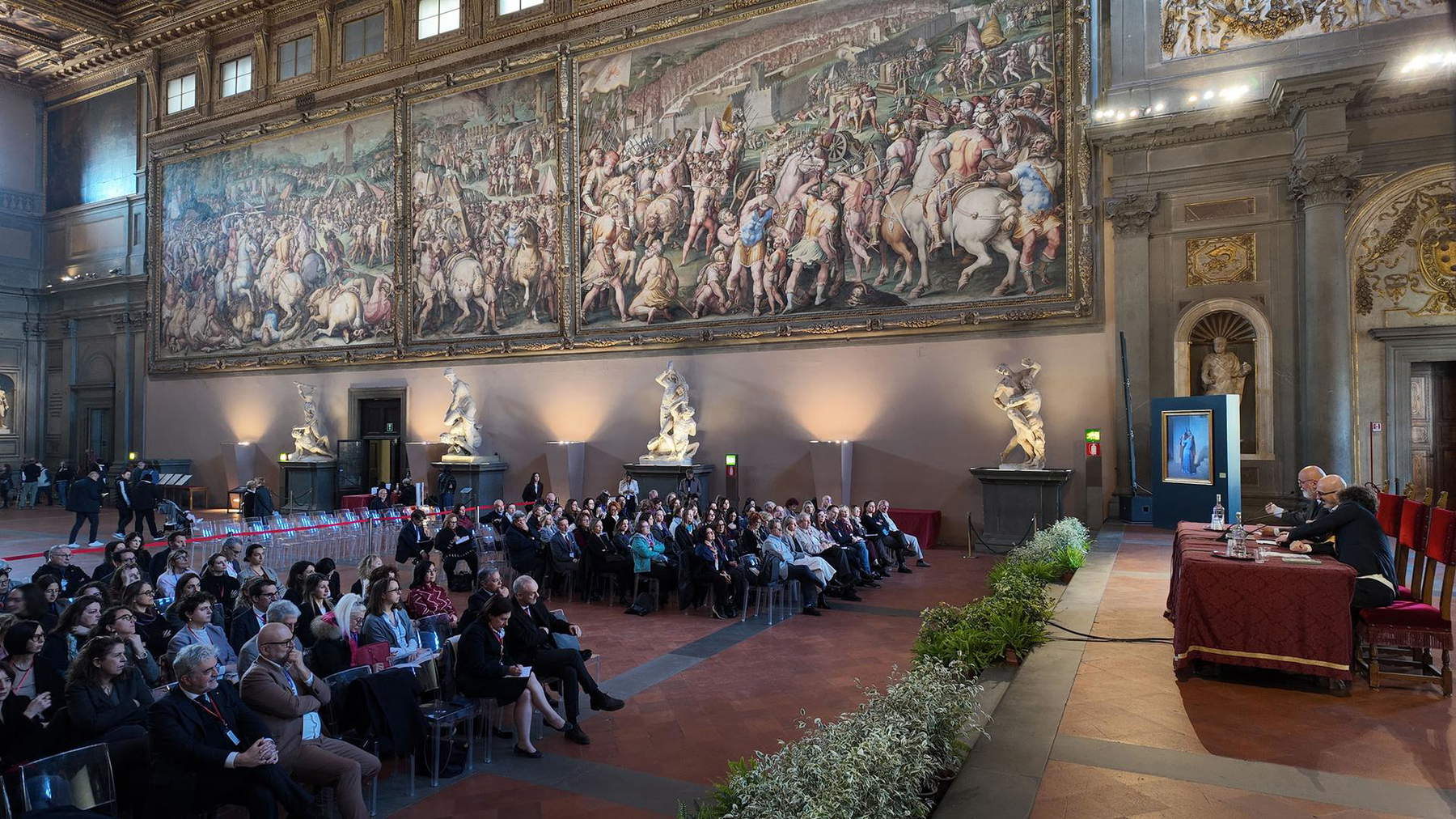
The first permanent Observatory on Cultural Heritage Loans, a project promoted by Save The Artistic Heritage and the Florentine Civic Museums with the scientific curatorship of Professor Guido Guerzoni and developed in collaboration with the company Formules S.r.l., was presented in Florence, in the Salone dei Cinquecento of Palazzo Vecchio. This is the first Italian research entirely dedicated to the national and international circulation of works of art for exhibition purposes and related best practices, with the aim of defining shared guidelines, improving enhancement strategies and strengthening collaborations between institutions.
The initiative took shape through a year of studies, the results of which were illustrated at a conference followed by a round table discussion moderated by Carlo Francini, director of the Florentine Civic Museums. Prominent representatives of the Italian cultural scene took part in the discussion, including Andrea Carignani of the Vatican Museums, Gianpietro Bonaldi of the Accademia Carrara in Bergamo, Mattia Agnetti of the Fondazione Musei Civici Venezia, Antonella Pinna, president of ICOM Italia, Angelo Crespi, director general of Grande Brera, and Gianluca De Felice, secretary general of the Opera della Primaziale Pisana.
The focus of the survey was the management of loans of works for temporary exhibitions, a structural component of Italian museum life but still lacking an organic and systematic reading. The research involved 60 Italian and international museums through an online survey, with the aim of analyzing strategies, organizational models, administrative procedures and decision-making processes related to incoming and outgoing loan requests.
One of the most striking elements that emerged from the study concerns the size gap between Italian and foreign institutions. The Italian museums involved are on average medium to large in size, with about 50 employees and an average budget of 4.14 million euros. In contrast, international realities present significantly higher numbers, with an average of 298 staff members and economic resources of 39.7 million euros.
Differences are also recorded in terms of the policies and instruments adopted. Almost all institutions, both in Italy and abroad, report having guidelines for loan management, but their accessibility varies significantly. Only one in five of those in Italy makes these guidelines searchable, while in international contexts the proportion rises to about one in three museums.
Procedurally, foreign facilities show greater uniformity and formalization of processes. They all declare the adoption of protocols for handling loan requests, while among Italian institutions the percentage stands at 86.8 percent. In addition, international museums tend more frequently to set precise deadlines for the evaluation of applications, helping to make the decision-making process more predictable and transparent.
On the other hand, processing times are comparable: up to four months for Italian institutions and about five months for foreign ones. However, further differences emerge on the organizational level. Only 44 percent of Italian museums have a department specifically dedicated to loan management, with an average of 2.6 staff. In international realities, a similar structure is present in 73.7 percent of cases and has an average of 3.8 staff. As a proportion of total staff, however, the share of human resources engaged in these activities is slightly higher in Italian museums.
Another relevant aspect concerns the economic valorization of loans. In Italy, the average annual revenue from these activities is around 28,000 euros, while abroad it exceeds 95,000 euros, with peaks reaching 300,000 euros and one million euros, respectively. According to the Observatory’s estimates, a systematic and structured evaluation of loans could significantly increase the income of Italian institutions, up to fivefold.
Operationally, Italian museums handle an average of 30 outgoing and 32 incoming loans per year, mostly domestically. By contrast, international institutions record much higher volumes, with an average of 161 outgoing and 100 incoming loans, a sign, according to the Observatory, of greater integration into global exhibition circuits. Significant differences also remain in the economic policies adopted. In Italy, free loans are still widespread, while abroad it is more common to cover administrative costs orcharge a fee, indicative of a greater attention to the economic optimization of these activities.
The issue of transparency is another distinguishing feature. In international museums, 84.2 percent of institutions include the number of loans in their budgets and reports, while in Italy this practice concerns 57.9 percent of cases, highlighting a less systematic reporting.
The Observatory aims to fill these gaps through ongoing data collection and analysis work, which will include legislative, economic, legal, quantitative and qualitative aspects, both nationally and internationally. The results will feed into an annual report that will be presented at conferences and events in Italy and abroad.
The aim is to help strengthen the positioning of Italian institutions in the global context, promoting increasingly high standards in the management of loans and fostering greater awareness of the strategic role that the circulation of works of art plays in the contemporary museum system.
“The presentation, in the Salone dei Cinquecento, of the first report of the Permanent Observatory on Loans is a reason for great satisfaction for Florence,” said City of Florence Councillor for Culture Giovanni Bettarini. “The data confirm the role of the circulation of works of art as a strategic lever of cultural diplomacy and scientific growth for the Civic Museums and for the entire national system. Florence, also in collaboration with qualified partners, intends to play a leading role, promoting a sustainable management of loans, capable of generating value and resources to be reinvested in heritage protection and innovation.”
“The mobility of collections,” said Professor Guido Guerzoni, curator of the Permanent Observatory on Cultural Heritage Loans, “and the circulation of cultural heritage-at a historical stage attentive to the most critical aspects of mobility and the search for sincerely sustainable approaches-are two fundamental tools of cultural diplomacy, through which institutions build relationships, strengthen positionings, produce knowledge, develop expertise, gather resources and broaden their audiences. Nevertheless, available information on this phenomenon remains surprisingly fragmented, uneven and almost incomparable.”
“With the Loan Observatory,” stressed Mario Cristiani, president of Save The Artistic Heritage, “we want to help build greater awareness around the circulation of works and the role of museums today. Our commitment is to support cultural institutions, curators and conservators of artistic heritage with concrete tools capable of combining protection, innovation and sustainability. Certified digital editions represent an answer in this sense: not copies, but controlled editions of the work, which preserve its integrity and strengthen the relationship between the artist, his original work and the public, countering the drifts of a system increasingly exposed to manipulation and loss of value.”
“This Observatory,” said Carlo Francini, director of the Florentine Civic Museums, born out of the valuable discussion at Palazzo Vecchio, “shows that lending is not just the movement of works, but a complex system of skills that needs shared rules. Our goal is to enhance this invisible work in order to transform every exchange into a transparent and sustainable growth opportunity for the entire Italian museum system.”
|
| Permanent observatory on cultural property lending established |

Warning: the translation into English of the original Italian article was created using automatic tools. We undertake to review all articles, but we do not guarantee the total absence of inaccuracies in the translation due to the program. You can find the original by clicking on the ITA button. If you find any mistake,please contact us.























 IT
IT FR
FR DE
DE ES
ES CN
CN