





Another brings Antonello da Messina (Messina, c. 1430 - 1479), a pivotal figure of the Italian Renaissance, back into the spotlight, following the recent return of his Ecce Homo to the market and the subsequent purchase of the panel by the Italian state. Now, another unpublished panel attributed to the Sicilian master will be presented for the first time on the market on June 16, 2026 by the French auction house Ader at theHôtel Drouot in Paris, with an estimate between €1 million and €2 million. So we are far from the 12.6 million euros the state spent to acquireEcce Homo, which denotes that the market considers this new discovery to be a work of inferior quality (not to mention thatEcce Homo has a much better documented history), but it is still a respectable figure.
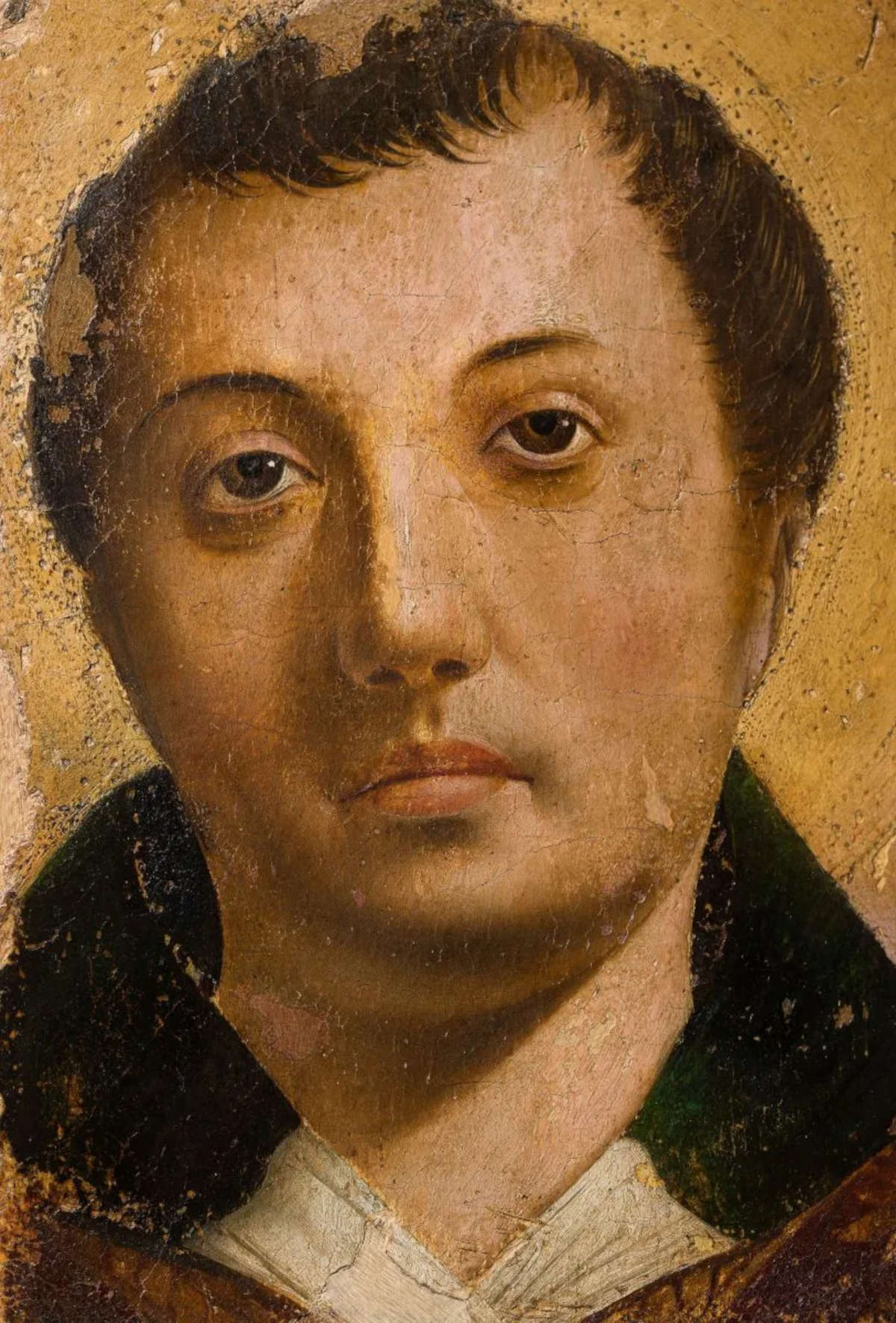
The work, which the Hôtel Drouot website itself gives news of, is the Head of a Young Saint, a painting on pine panel, made on a single board, small in size (30 by 21.5 centimeters) and dated around 1476-1477, a period after the artist’s return to Sicily after his Venetian sojourn. Formulating the attribution is one of Antonello’s leading specialists, scholar Mauro Lucco. Its importance is linked not only to its pictorial quality but also to its rarity: in fact, Antonello’s catalog counts about forty surviving works, including about fifteen portraits and about twenty religious subjects. The appearance of this painting thus represents a significant addition to an extremely limited corpus, comparable in number and relevance to that of masters such as Leonardo da Vinci or Johannes Vermeer. Antonello is considered the artist who introduced the technique of oil painting to Italy, bridging the gap between the Flemish tradition, represented by Jan van Eyck and Petrus Christus, and the nascent Italian Renaissance.
His ability to assimilate diverse influences is one of the hallmarks of his production: from the Florentine spatial construction to the soft light of Piero della Francesca, to his dialogue with Giovanni Bellini during his stay in Venice. A combination of elements that makes his work a particularly advanced synthesis of 15th-century art, just before the innovations introduced by Leonardo.
The recently resurfaced panel shows features consistent with this language: the face is constructed as an ovoid volume, with a frontal pose barely animated by a slight rotation that emphasizes the features. The gold background and punched workmanship of the halo find comparisons with works preserved in Sicily, such as the Child of the Polyptych of San Gregorio, now in the Regional Museum of Messina. References to masterpieces of the Venetian period are also evident, starting with the San Cassiano Altarpiece in Vienna, where the faces seem to emerge with a presence almost superimposed on the pictorial space. In the absence of specific iconographic attributes, the identity of the subject remains uncertain: it could be a saint or at any rate a religious figure. According to Lucco, it could be the central portion of a processional banner made for a Sicilian church, probably in Catania.
The history of the work contributes to its fascination. Its existence was known only to art historian Michel Laclotte, former director of the Louvre, who saw it about twenty-five years ago without a photographic record ever being made. The painting may have come from the chateau in La Barben, Provence, once owned by the Forbin family, and was more recently held in a private collection, from which it resurfaced thanks to the work of a collector known for unearthing important masterpieces.
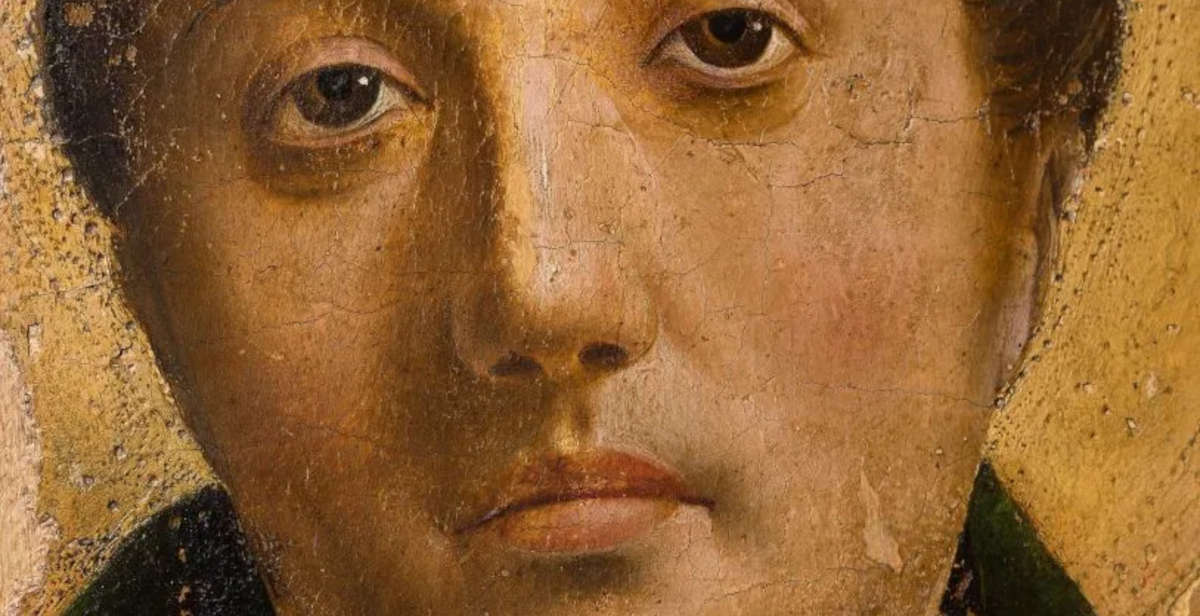
The work of analysis and restoration played a decisive role in the reading of the work. A thorough cleaning was necessary to understand the state of conservation and the presence of numerous remakes, particularly on the background and the halo, which had been partly repainted to fill gaps. Some original gold leaf passages are still visible, however, especially on the right side of the nimbus. The removal of the oxidized paint substantially altered the perception of the face, restoring its brightness and chromatic complexity. The cheeks have recovered their shades, the bridge of the nose appears more defined, and the contour of the lips, previously flattened, now emerges with greater clarity and pinker tones. The contrast between complexion and dress is also more legible, bringing to light visual values that had been compromised over time.
From a chronological point of view, if some stylistic affinities might suggest an earlier dating, around the early 1470s, the most accredited hypothesis, supported by Lucco, places the painting in Sicily between 1476 and 1477, after the artist’s return from Venice and the journey between Milan and Messina. Several elements support this geographical attribution. These include the presence of a collar with greenish highlights, visible only after cleaning, which could reflect a practice typical of the Sicilian context: the use of decorative bands detached from the main robe and applied as autonomous elements. The wooden support, made of coniferous wood and worked on three sides, also differs from Venetian customs, suggesting a specific destination. The lightness of the support, in fact, indicates that the work was probably designed to be carried during religious processions, following a Sicilian tradition of using wooden panels instead of the more common fabric banners. The frontality of the face and some archaizing elements, such as the gold background, are consistent with this function.
Archival documents also attest that when Antonello died in 1479, his son Jacobello undertook to complete a gonfalon intended for a confraternity in Catania, a sign of significant production in this area. Antonello himself had expanded the traditional iconographic repertoire, introducing subjects other than the usual Virgin and Child, thus contributing to greater thematic variety.
Beyond the historical and technical aspects, what is most striking is the expressive force of the painting. Some details, such as the rendering of the eyelids or the back of the nose, reveal a dense and sensitive, almost tangible pictorial matter. Particularly significant is the mouth, characterized by marked sensuality and defined structure, with a clear Cupid’s bow and a precise nasolabial groove.
The overall impact of the work, however, eludes purely analytical description. As is often the case with 15th-century masterpieces, its strength lies in its presence, its ability to impose itself in space and establish a direct relationship with the viewer. Beyond its original dating or function, the painting restores the quality that continues to make Antonello da Messina a central figure in art history: a painting that does not merely represent, but acts, generating an immediate visual and emotional experience. Its reemergence on the international market thus represents not only a major collecting event, but also an opportunity for study and in-depth study for the scientific community, called upon to confront, a very short distance from the return ofEcce Homo, a new testimony of one of the absolute protagonists of the European Renaissance.
 |
| Another Antonello da Messina rediscovered: rare 15th-century painting at auction |

Warning: the translation into English of the original Italian article was created using automatic tools. We undertake to review all articles, but we do not guarantee the total absence of inaccuracies in the translation due to the program. You can find the original by clicking on the ITA button. If you find any mistake,please contact us.


























 IT
IT FR
FR DE
DE ES
ES CN
CN


