








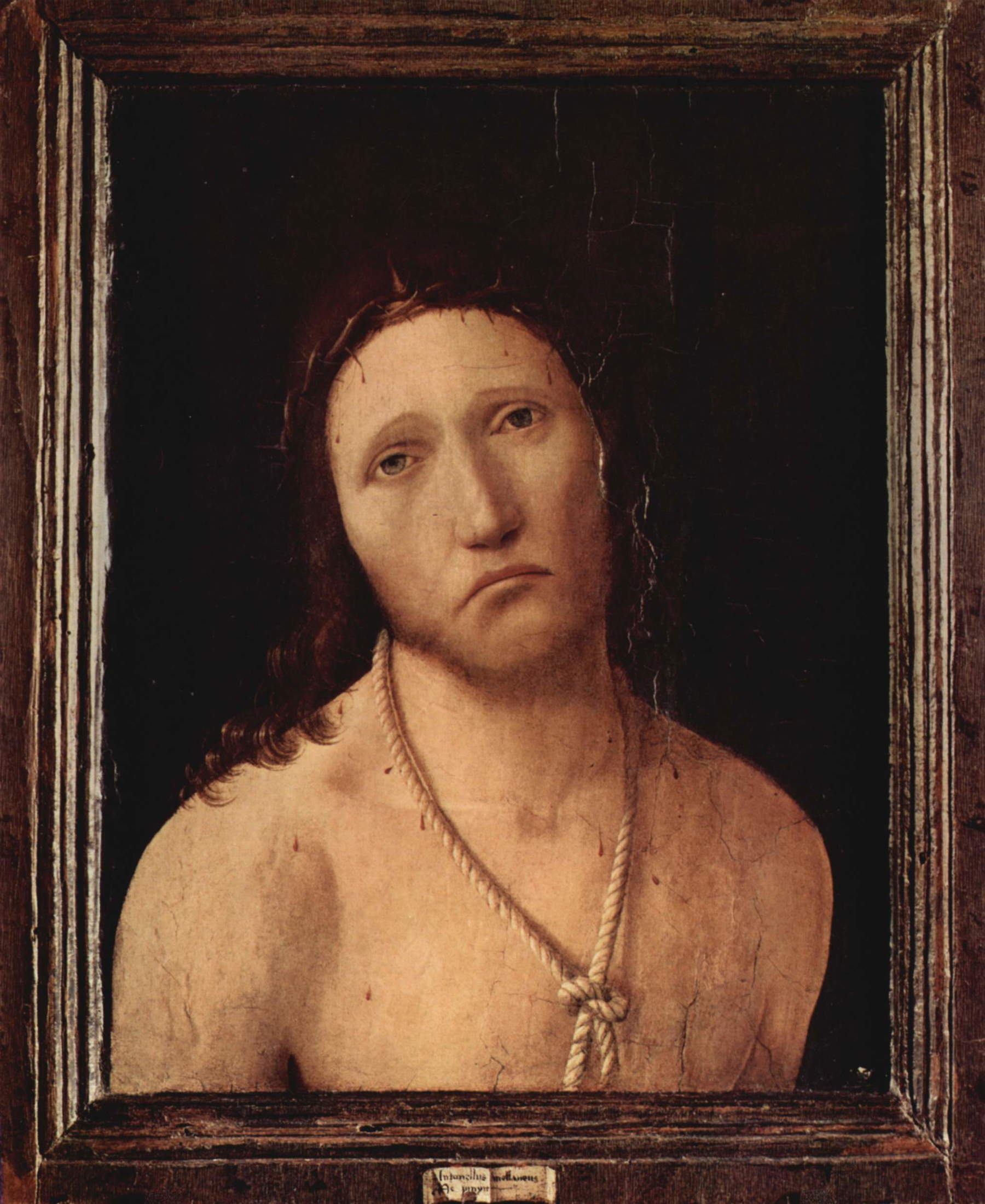
It is sure to be one of the most important auctions of the year: an Ecce Homo by Antonello da Mess ina (Messina, c. 1430 - 1479) will go on sale at Sotheby ’s in New York on February 5, with an estimate of €10-15 million. This is a rare sale that already promises to be one of the most important of this 2026, for two reasons: first, very few works by Antonello da Messina, one of the most important painters of the Renaissance, come to market. The second, this is a famous work, exhibited several times (most recently in 2019 at the Antonello da Messina exhibition in Milan, Palazzo Reale), with a very long bibliography, and also presented in 1981 by Federico Zeri. An artist of remarkable originality, Antonello fused Flemish descriptive realism with an all-Italian focus on emotional expression, a synthesis particularly evident in the psychological immediacy with which the Christ of his Ecce Homo stands before the viewer. Antonello had revolutionized the devotional imagery ofEcce Homo, humanizing a sacred subject through a direct and intimate approach that invites emotional identification and spiritual involvement.
Antonello’s career is only fragmentarily documented, and the precise means by which he mastered the painting techniques typical of the Flemish masters remain the subject of academic debate. Born in Messina, Antonello probably trained in the workshop of Niccolò Colantonio in Naples, a city with strong artistic and commercial ties to northern Europe. The collection of King Alfonso of Aragon, for example, included paintings by Jan van Eyck and Rogier van der Weyden, which Antonello may have met directly or experienced indirectly through Colantonio. Giorgio Vasari later attributed the introduction of oil painting in Italy to Antonello, although this claim is debated (probably an exaggeration by Vasari). The beginnings of Antonello’s career were in all likelihood itinerant: perhaps the artist traveled to Provence and other regions, although the absence of archival documents makes this hypothesis still unreliable. In 1457 he returned to southern Italy, where he was commissioned by the confraternity of San Michele dei Gerbini in Reggio Calabria to paint a processional banner. In January 1461 he settled in Messina, where he probably made the painting that now goes on sale at Sotheby’s and where he likely remained for most of the decade.
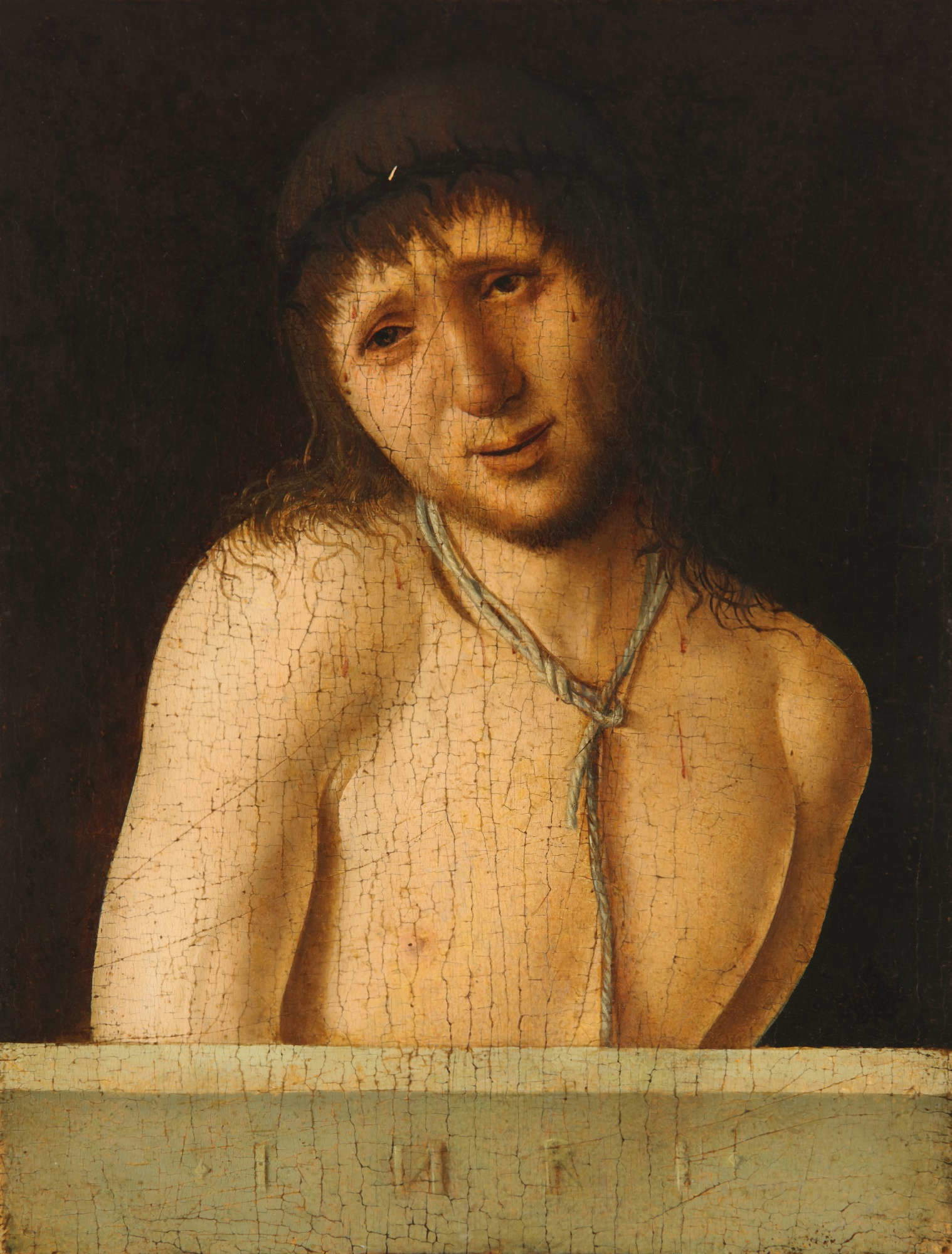
On the recto of the panel, Antonello paints a half-length Christ behind a parapet, looking unblinking at the viewer. The expression is one of great pathos: Christ’s red, swollen eyes narrow in pain, his lips part slightly, and drops of blood from the crown of thorns run down his forehead and chest. He has a thin rope tied around his neck and his face emerges brightly from the surrounding darkness, a stark contrast that accentuates the slight twisting of his body, caused most obviously by his hands being tied behind his back. Antonello includes in his painting the Nordic motif of a fictive parapet with the raised inscription “INRI” (“Jesus of Nazareth, King of the Jews”), suggesting an awareness of Flemish portraiture conventions.
The panel is also painted on the verso: here, Antonello creates a Saint Jerome in a meticulously rendered landscape. Situated at the bottom of a gorge opening onto a calm body of water, through which a fortified castle can be glimpsed and a small boat glides, the saint genuflects before a small crucifix while beating his chest with a stone. The inclusion of a codex, an open book, and an inkwell identifies Jerome as the author of the Vulgate, the Latin translation of the Holy Scriptures, while the austere setting emphasizes his asceticism. The self-inflicted physical suffering of the penitent saint echoes Christ’s sacrifice, establishing a theological mirroring between the two sides of the panel that reflects the influence of modern devotio , drawing inspiration from Thomas of Kempis’Imitatio Christi of c. 1418-1427.
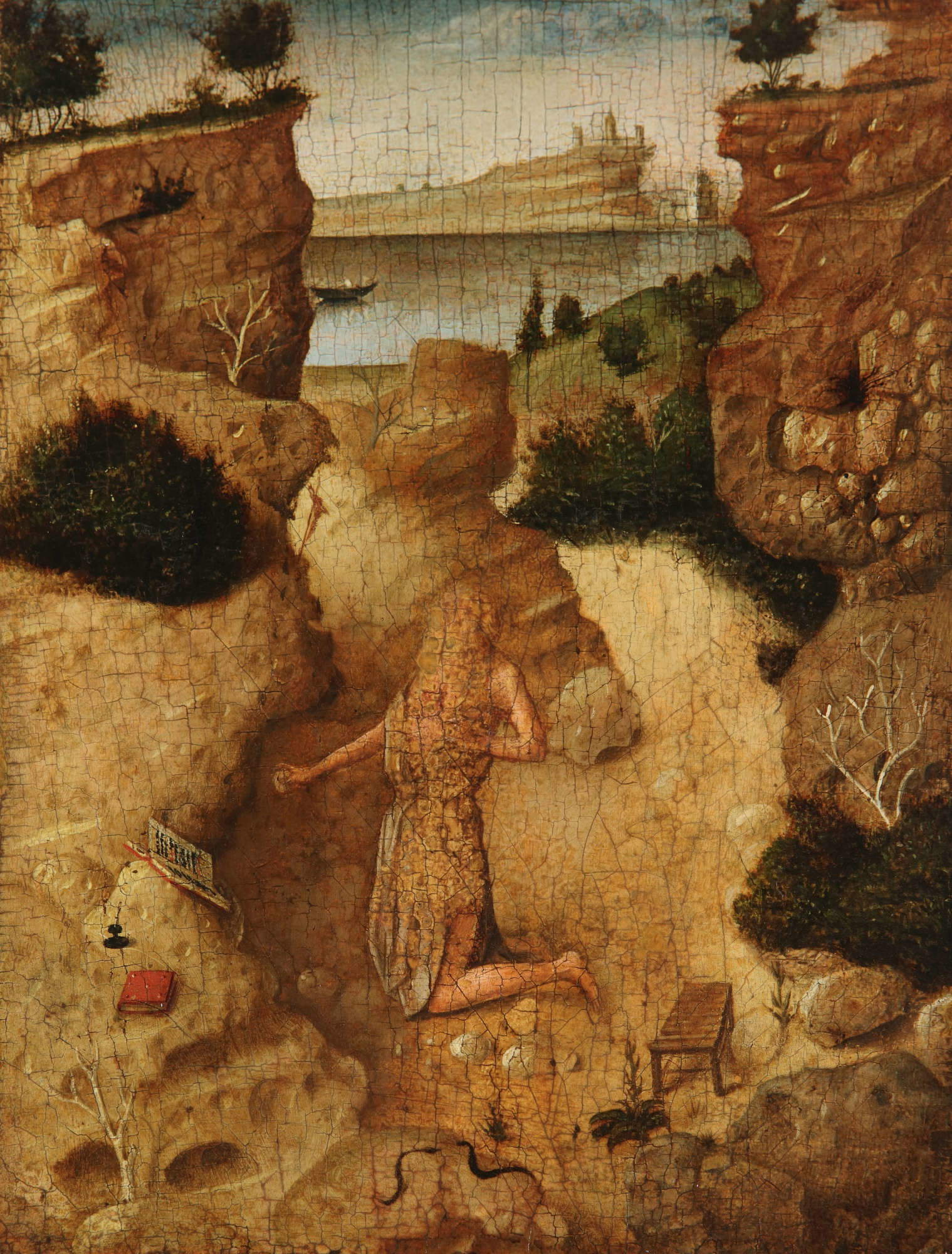
The intimate dimension of the painting prompted Federico Zeri, who first presented the work to the public at a conference in Messina in 1981 (and published it six years later), to hypothesize that the opisthograph panel (painted on two sides) was a small portable object for private devotion, probably kept in a leather bag, intended to guide the viewer in prayer and meditation: the image in fact encouraged empathetic contemplation and imitative piety. Consequently, as such, it would be touched, caressed, and even kissed, acts that allowed the devotee to make contact with the image both spiritually and physically.
Conceptually, Antonello’sEcce Homo falls between the genre of theAndachtsbild, in which the sacred figures are completely separated from the narrative context, and a narrative representation of a biblical event. Although Christ is shown here in isolation, the presence of the crown of thorns and the rope places the image at a specific narrative juncture: after Christ’s scourging and mockery by Roman soldiers, but before his ascent to Calvary. This typological convergence elicits a powerful emotional response.
Antonello’s distinctive achievement, both in this work and throughout his career, lies in the dissolution of boundaries between pictorial genres. Here, he not only loads an Andachtsbild with narrative allusions, but also imbues the image of Christ with portrait elements, creating a face-to-face encounter between the image and the viewer. In Antonello’s almost contemporary Portrait of a Man preserved at the Mandralisca Museum in Cefalù, the painter similarly conveys a sense of individuality through subtlety of expression, suggesting the inner life of his character. This fusion of genres is further underscored by the parapet, a device commonly employed in Dutch portraiture to serve as both a visual boundary and a tangible link between the observer’s physical world and the model’s fictional space.
Antonello’s ongoing engagement with theEcce Homo theme spanned more than a decade, and the work in question marks his first (and only) known opisthograph elaboration of the subject. This painting establishes the basic expressive and formal parameters that would shape Antonello’s four known versions ofEcce Homo. Although each differs in detail-the tilt of the head, the rotation of the torso, the presence or absence of the rope and column, and the inclusion or exclusion of the parapet and tag-they all elicit a strong reaction in the viewer.
According to Sotheby’s, the painting for sale would be the first in the series. An Ecce Homo recorded in 1653 in the collection of Don Giulio Alliata (or Agliata) of Palermo, and now in the Metropolitan Museum of Art, is probably Antonello’s later elaboration of the subject. Painted in oil, possibly on tempera, the work is signed “Antonellus messane / [us] / me pinxit” and was once dated 1470 (according to Giovanni Battista Cavalcaselle, who saw the panel in the 1850s in a Neapolitan collection). Although Antonello omits the rope, reduces the visibility of Christ’s torso and the degree of twisting, the expressive emphasis remains the same: slightly parted lips, drooping eyelids and sunken eyes emphasize Christ’s suffering.
An undated version, the one preserved in the Galleria Nazionale della Liguria at Palazzo Spinola in Genoa, most likely painted after the Metropolitan version, but perhaps just before or contemporaneous with the latter, marks an emotional recalibration. The grimace evident in the work for sale and in the Metropolitan version gives way to a calmer expression of grief and acceptance. No railing separates Christ from the viewer; instead, the work is signed on a tag painted on the frame, the only surviving original. Antonello reintroduces the rope, reinforcing the penitential character of the image.
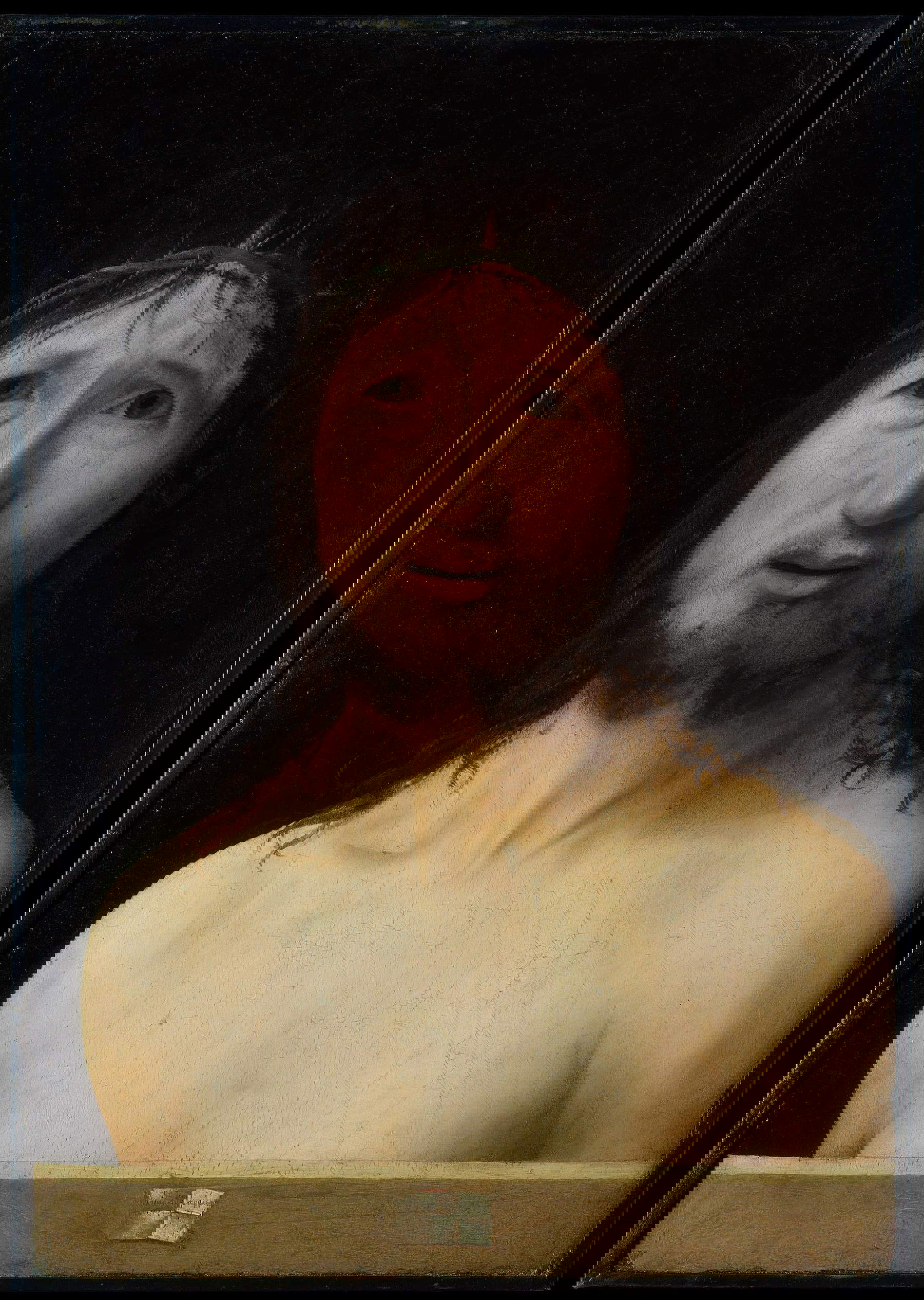
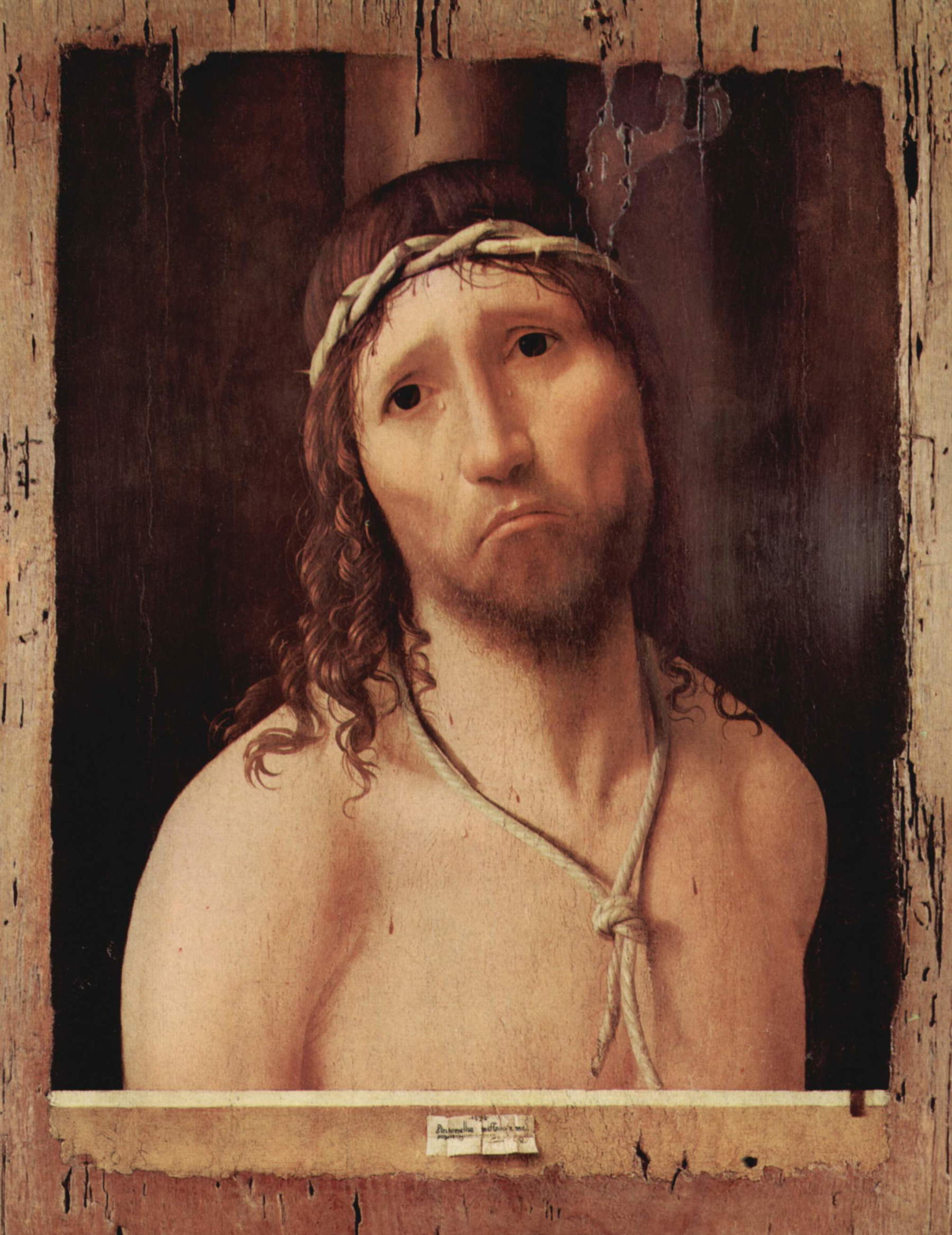
In 1473 Antonello made his largest panel of the group: an Ecce Homo signed and dated, now at the Alberoni College in Piacenza. The image includes both the rope and the fictitious parapet (to which the signed and dated tag is affixed) and introduces a column behind the figure of Christ. The new architectural element places the image more explicitly within the Passion narrative, aligning it with the moment of the Flagellation. The following year Antonello painted his last Ecce Homo, once held in the Ostrowski collection and now known only through photographs (in an image taken in 1931, when the painting was in Vienna for restoration, the date “1474” is legible). Here, the column is retained, but the rope is omitted and the parapet considerably reduced.
The earliest known record of the work for sale at Sotheby’s is circa 1900, when the work is in a Spanish private collection. It was then acquired by Wildenstein & Co. in 1967, and then purchased through private sale at Sotheby’s by Italian antiquarian Fabrizio Moretti, who eventually sold it to the current owner. This Ecce Homo has a relevant recent exhibition history: the last exhibition to feature it was the 2019 exhibition on Antonello da Messina at the Palazzo Reale, where it was painting number 2 in the catalog. Before that, it was shown at the Antonello exhibition at the Scuderie del Quirinale in Rome (2006), at the Metropolitan Museum’s 2005-2006 monographic exhibition, and at the Renaissance in the Mediterranean exhibition held in 2001 at the Museo Thyssen-Bornemisza and the Museu de Bellas Arts in Valencia.
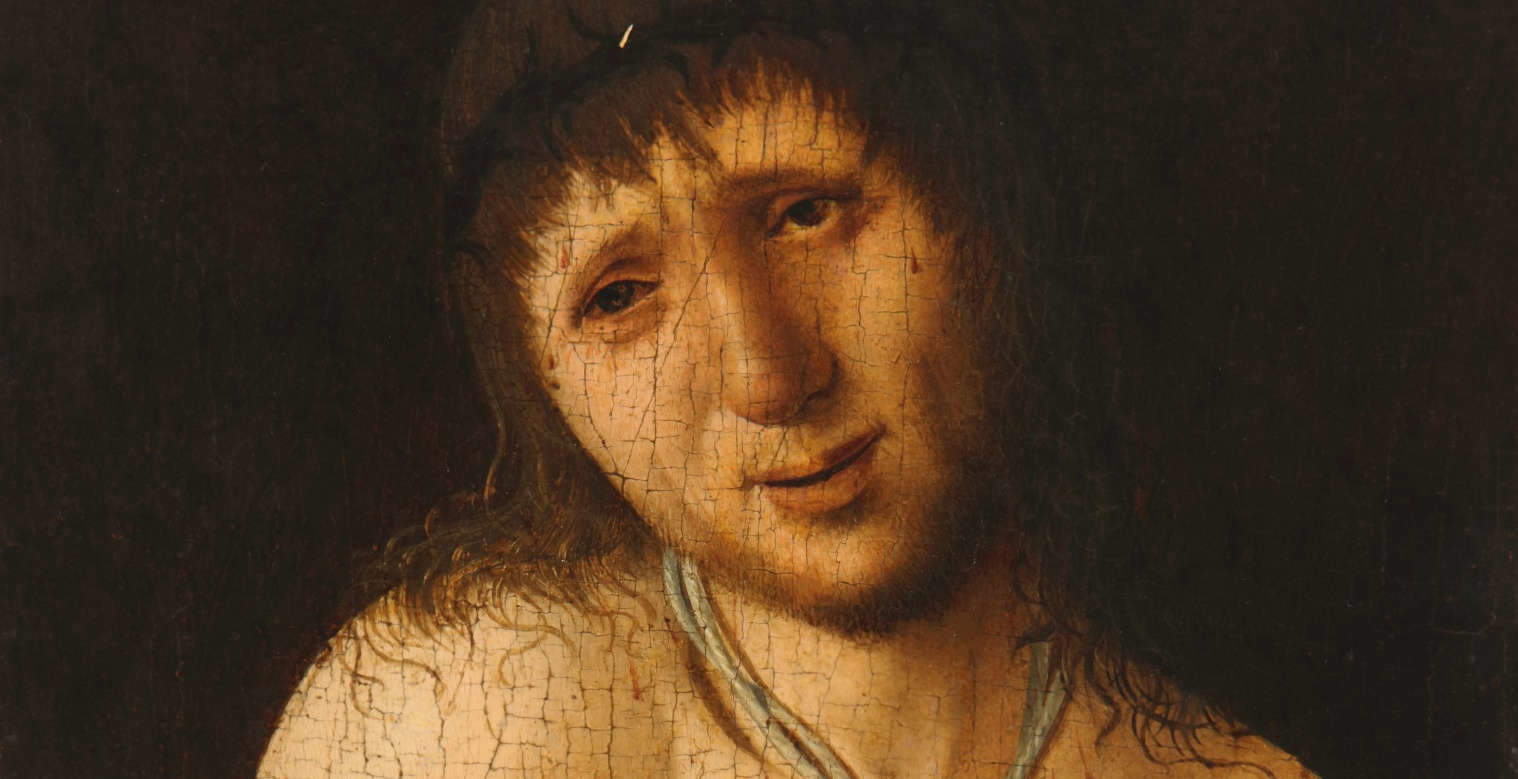 |
| A famous Ecce Homo by Antonello da Messina at auction at Sotheby's: estimate of 15 million |

Warning: the translation into English of the original Italian article was created using automatic tools. We undertake to review all articles, but we do not guarantee the total absence of inaccuracies in the translation due to the program. You can find the original by clicking on the ITA button. If you find any mistake,please contact us.
















 IT
IT FR
FR DE
DE ES
ES CN
CN