





The Klesch Collection, a major British private collection, has announced the acquisition of the Madonna and Child Enthroned by Sandro Botticelli (Florence, 1445 - 1510), an important early work datable to between 1465 and 1470: the work will be on public display for the first time in more than eighty years at theAshmolean Museum in Oxford, a fact that therefore consolidates the artist’s presence in British collections. The announcement, released on April 29, 2026 in London, comes in the wake of an export freeze imposed in 2025 by the British government on the painting, which is considered to be of significant national cultural interest. The work had been sold the previous year at Sotheby ’s in London for £9.96 million from the Loyd Collection, and British institutions had until Aug. 8, 2025, to raise the necessary sum to keep the work in the country. The Klesch Collection’s intervention made it possible to keep the painting in the UK while ensuring its public enjoyment.
A. Gary and Anita Klesch, owners of the collection, expressed satisfaction with the acquisition: “We are delighted to share our painting with a wider audience: it is one of the very few early Botticelli works in this country. We feel that the Ashmolean Museum is the most appropriate venue to display the painting, and we thank them for welcoming such an important work.” The museum’s director, Xa Sturgis, highlighted the importance of the work’s arrival, “The Ashmolean warmly welcomes the acquisition of a painting by one of the most important artists in the Western tradition and we are delighted that it will remain in the UK. We recognize the value of the Klesch Collection’s commitment to lending works to public institutions, and the Ashmolean is honored to have been chosen as the first venue to exhibit the painting, where it can be admired and studied by a wide audience.”
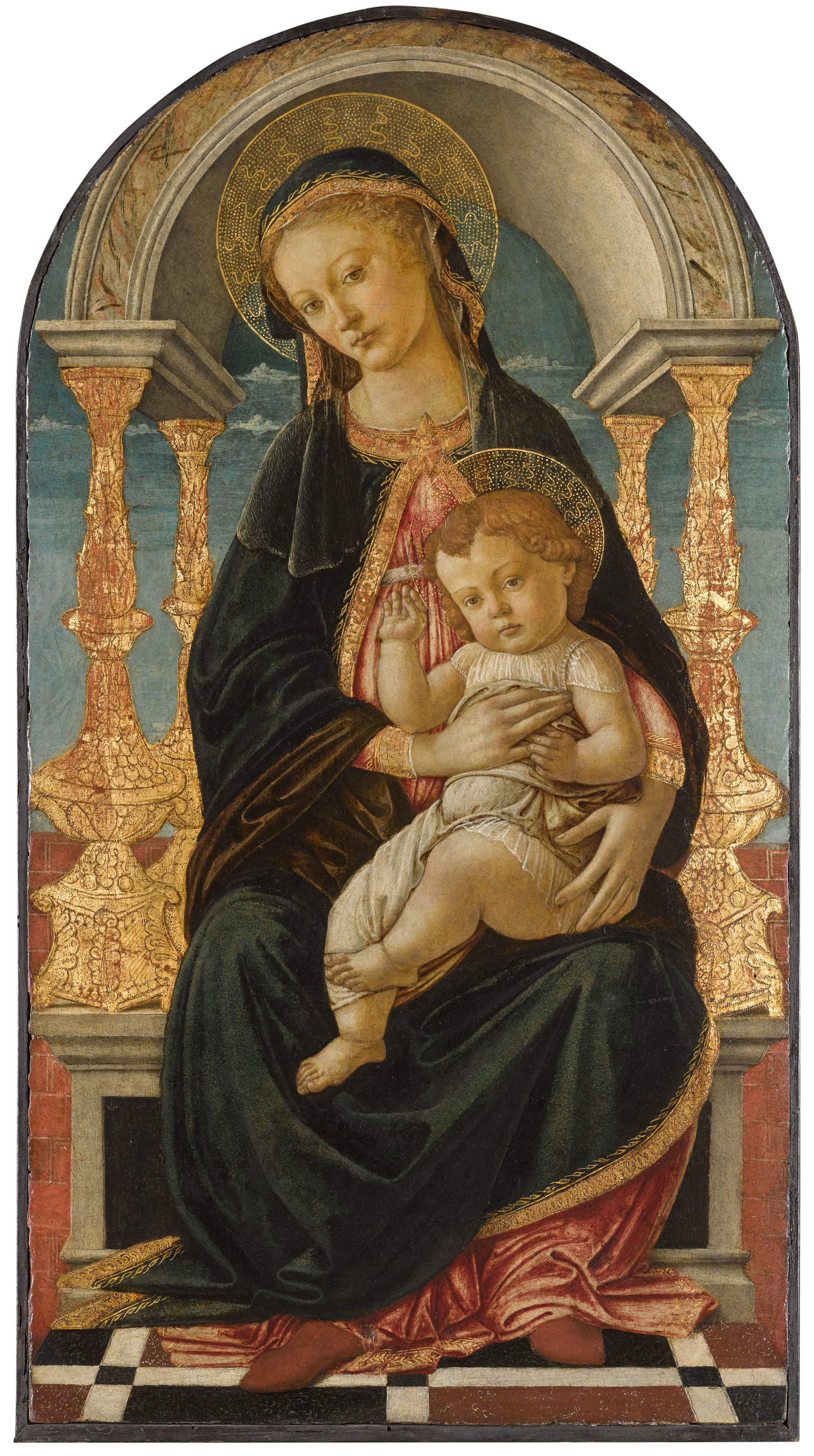
The work, also known as the Wantage Madonna from its former location in the Wantage Collection, has long been little studied and known mainly through black-and-white photographs. For years its location was misreported, and the painting was often overlooked in critical literature, sometimes attributed to the artist’s workshop rather than to Botticelli himself. Only in recent times, thanks to new technical analysis and critical reinterpretation, has the hypothesis of a direct attribution to the master been consolidated.
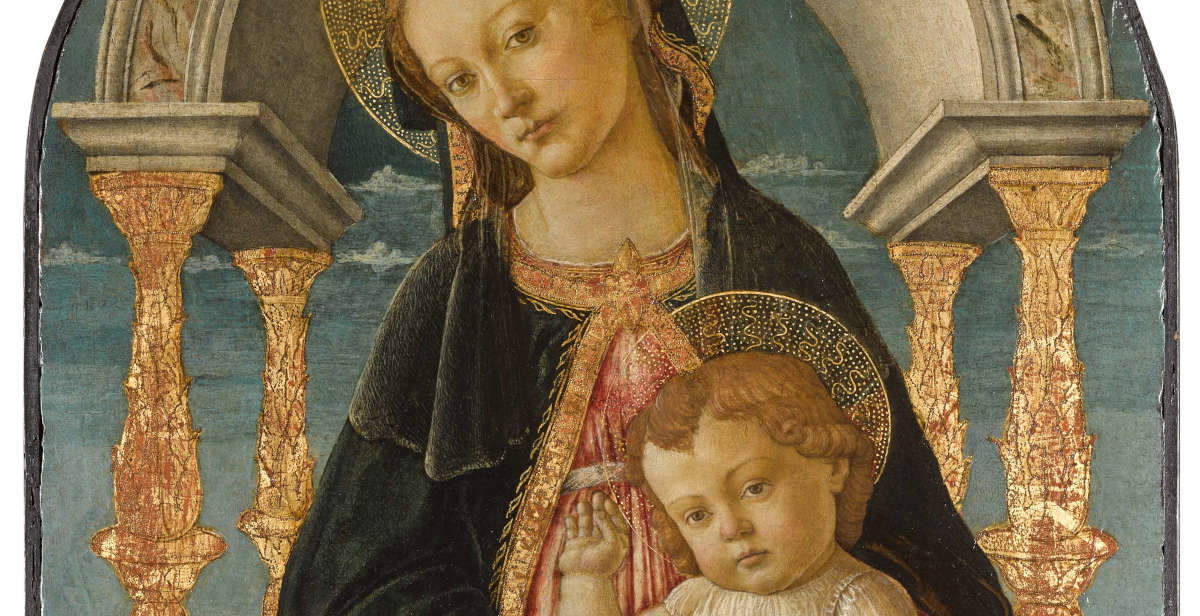
The painting depicts the Virgin seated on a throne with the Child on her knees, set in an architectural structure characterized by an arched canopy of polychrome marble, supported by four gilded candelabra-like columns. In the background is a blue sky shaded with light clouds, while the marble floor follows a perspective centered on the Virgin’s chest. The Child raises his right hand in blessing and with his left grasps the little finger of his mother, who supports him with both hands, wrapping him in a white cloth.
Executive refinement emerges in the rendering of the faces and the modeling of the figures, elements that have contributed to the work’s reassessment as autograph. The Virgin wears a blue mantle edged in gold and a red robe, while her head is covered by a transparent veil that allows a glimpse of her wavy hair. The gilded details, made using mission gilding techniques and punch decoration, recall the artistic milieu of Andrea del Verrocchio, at whom Botticelli trained.
Stylistically, the painting bears strong similarities to works of the artist’s contemporaries, particularly the St. Ambrose altarpiece preserved in the Uffizi Galleries. While recalling its general composition, the Wantage Madonna introduces significant variations in the posture and expression of the figures, suggesting an autonomous reinterpretation of the model. The Virgin, for example, presents an upward rather than downward gaze, while the Child has more compact proportions than the version in the altarpiece.
Technical investigations, including infrared reflectography and radiography, revealed a complex preparatory phase, with underlying drawings, engravings, and perspective lines testifying to a complex creative process. Numerous alterations made during execution also emerged, confirming a typical Botticelli practice characterized by continuous adjustments to the drawing.
The quality of the work and its technical characteristics have led several scholars to reconsider its attribution. As early as the early 20th century, art historian Wilhelm von Bode recognized its hand of the master, while later the painting was often relegated to workshop production. More recent studies, including those by Nicoletta Pons and Christopher Daly, have instead strengthened the hypothesis of direct authorship, placing the work around 1470, at a stage when Botticelli was still working without a large team of assistants.
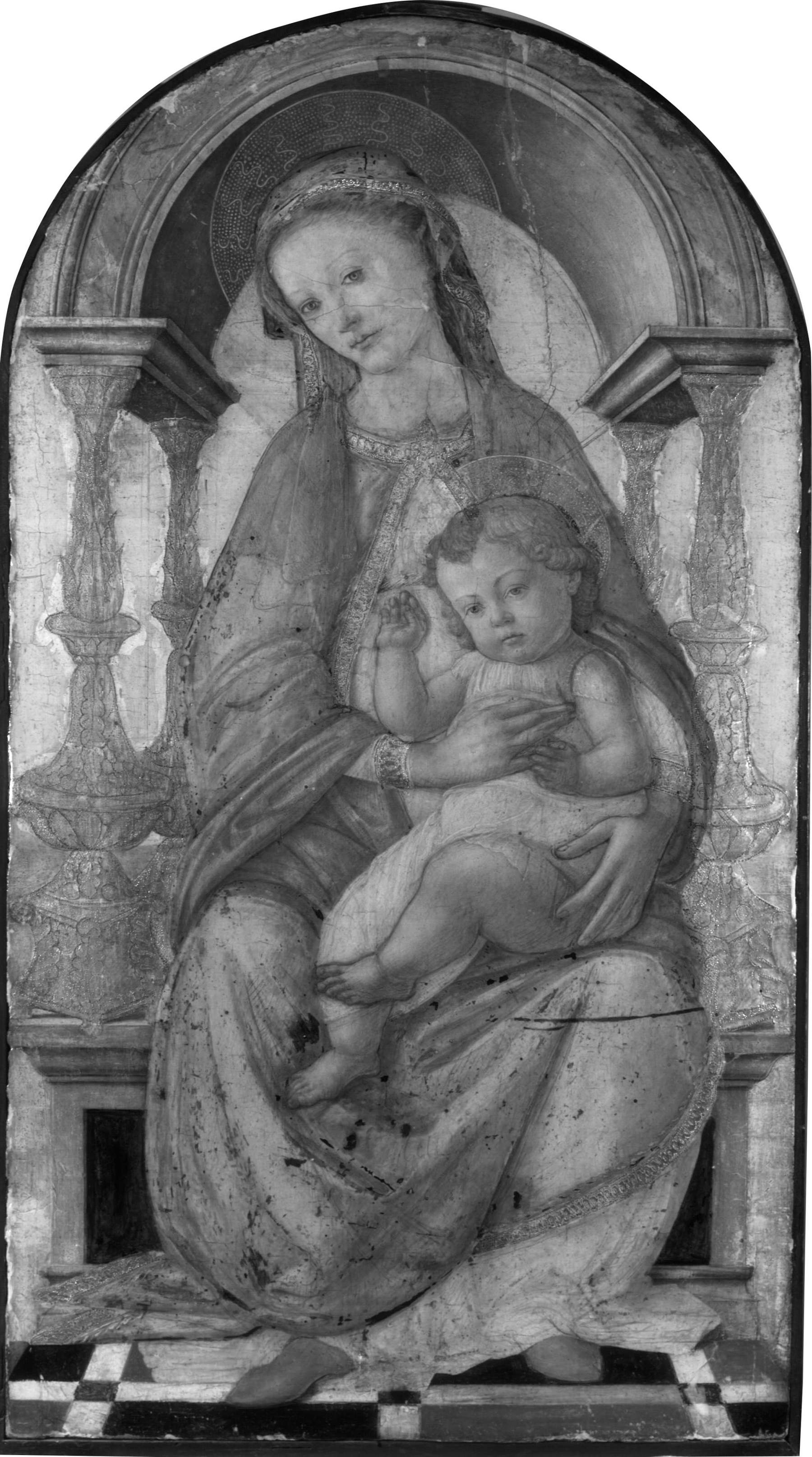
Comparative analyses with other early works, such as the Fortress in the Uffizi and several Madonnas preserved in international museums, reveal common elements in the construction of the figures and use of space, as well as some experimentation in architectural rendering. Some imperfections, especially in the secondary parts, are interpreted as indicating an early stage in the artist’s career or possible marginal intervention by collaborators.
The painting’s provenance also helps to delineate its history. In the mid-19th century, if not earlier, the painting was in the Oratory of San Giuliano in the Convent of San Giuliano on Via Faenza in Florence. The property was later purchased and rebuilt by the Calasanz order, founded by St. Joseph Calasanz, a Spanish Catholic priest and promoter of free education for the poor in the late 16th and early 17th centuries. Federico Fantozzi, in his guidebook of Florence and its environs, published in 1842, describes in Via Faenza the home of the Colzi family, which together with the adjacent Oratory constituted the Convent of San Giuliano, whose foundation dated back to the mid-14th century. Following its suppression in 1808, it was reduced to its present state. In the Oratory Fantozzi lists a Crucifixion by Andrea del Castagno and two anonymous works, one of which Lightbown identifies as the present painting, placed on the right altar in place of an altarpiece by Mariotto Albertinelli. It is not yet known on what date the painting was moved out of Florence by the Calasanz order to their convalescent home for sick brethren, about thirty kilometers southeast of the city, but we learn from its previous owner Giovanni Magherini Graziani that it was once venerated there.
A letter in the possession of the Loyd family, dated February 5, 1905, from Magherini Graziani to Lady Wantage, who had purchased the painting the previous year, sheds light on its provenance: Magherini Graziani reports that in ancient times the panel was venerated in the small chapel attached to a group of farmhouses called Comezzano, near the village of Vaggio, about 4 kilometers from Figline Valdarno, his birthplace in the province of Florence. He goes on to explain that in Comezzano there was in ancient times a convalescent home for sick brethren of the Calasanz order and the Scuole Pie of Florence. The property, including the chapel and the painting, later passed to the family of Magherini Graziani. The painting was removed from the altar and another was put in its place when the chapel was restored. This, according to his description, happened in recent times, presumably not long before 1903, when he sold the Virgin and Child Enthroned to art dealer Elia Volpi in Florence.
A man of deep culture, Magherini Graziani had a keen interest in art history and local historical research. In his letter to Lady Wantage, Magherini Graziani adds that the painting was held in great veneration because two metal crowns adorning it were still kept in the family home. This explains the presence, in an old undated black-and-white photograph of the painting preserved in the Deutsche Digitale Bibliothek, of visible fixing holes around the heads of the Virgin and Child. The photograph, which probably dates from around 1900, also shows how the painting was once in a rectangular frame, the vertical sides shaped like classicizing pillars with leafy capitals and with a winged putto in each of the spandrels. It is likely that the work was re-framed and skillfully restored before its sale to Lady Wantage in 1904. More recently, following careful technical examination of the painting, surface dirt was removed from the varnished paint and gilding, greatly improving its overall legibility.
The recovery of the work and its future public exhibition thus mark a significant step not only for the Klesch Collection but also for the British museum scene. The possibility of directly observing the painting will allow further investigation and may help to definitively clarify still open attributive and chronological questions.
 |
| Klesch Collection acquires early masterpiece by Sandro Botticelli |

Warning: the translation into English of the original Italian article was created using automatic tools. We undertake to review all articles, but we do not guarantee the total absence of inaccuracies in the translation due to the program. You can find the original by clicking on the ITA button. If you find any mistake,please contact us.





















 IT
IT FR
FR DE
DE ES
ES CN
CN


