





There is a precise moment in the history of twentieth-century visual culture when photographic documentation ceases to be mere supportive reporting and turns into pure interpretation, itself becoming a critical act of the highest profile. This boundary is decisively crossed in the intense relationship, founded on deep artistic and human affinities, that indissolubly linked Ugo Mulas (Pozzolengo, 1928 - Milan, 1973) to Jasper Johns (Augsburg, 1930).Confirming the relevance of the intellectual partnership, the volume UGO MULAS / JASPER JOHNS - Photography as Critical Act, Photographyas Critical Act by Flavio Fergonzi and published by Dario Cimorelli Editore (192 pages, 34 euros, ISBN 9791255610885), traces the collaboration between the two artists through more than two thousand negatives and related contact specimens, now carefully preserved and ordered at theUgo Mulas Archive. It is an integral and unprecedented documentation, unparalleled in the history of the relationship between an Italian photographer and an exponent of the American avant-garde.
Thanks to careful documentation and analysis, Fergonzi, an art historian and professor of Contemporary Art History at the Scuola Normale, as well as a past member of the scientific committees of the Museo del Novecento in Milan, the Galleria Nazionale d’Arte Moderna in Rome, the Muséand Rodin in Paris and the Center for Italian Modern Art in New York, he takes us on a journey of discovery in which Mulas dedicates a series of shots to the American artist that investigate his work, his creative method, his most intimate everyday life and the physical, often reserved spaces in which Johns operated and transformed painting into concept.
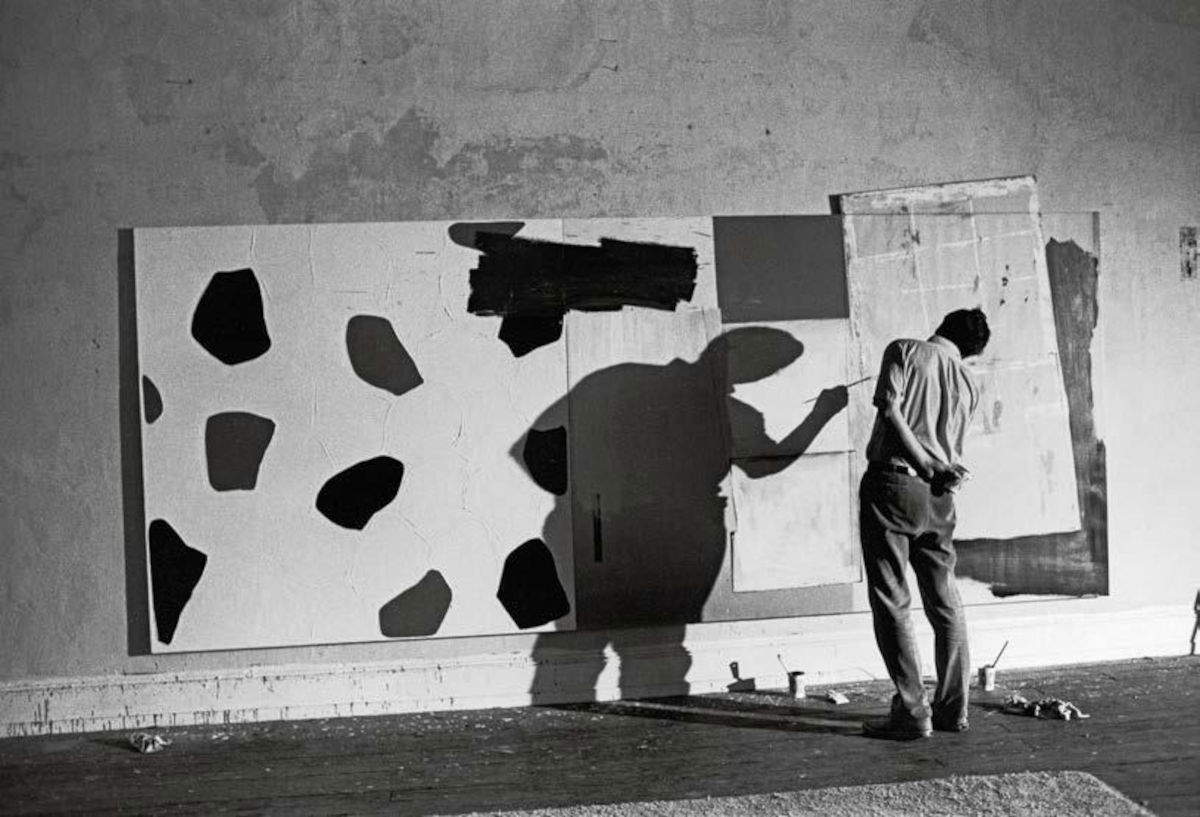
These shots are placed, in their near totality, in correspondence with the three key stays that Mulas made in the United States between 1964, 1965 and 1967. Interestingly, these trips always occurred at the same time of year, between the months of October and December, as if to establish a ritual cadence in the attendance of Johns’ studio. What ensues is one of the densest episodes of dialogue that has occurred in the past century between a photographer and an artist. Leo Castelli, the Triestine art dealer who was the international driving force behind New Dada and Pop Art and who made the meeting between the two possible, recalled years later the uniqueness of that understanding described as “extraordinary.”
According to Castelli’s testimony, this exceptionality was evident precisely in direct comparison with the photographs Mulas dedicated to other giants of the time such as Robert Rauschenberg, Jim Dine, George Segal or Roy Lichtenstein during the same American sojourns. If those reportages had already marked a clear break with the established tradition of the representation of the artist in his atelier, the intimacy and naturalness achieved with Johns represent an isolated and superior case. Mulas was not acting as an outside observer or a scene photographer, he had in fact become an integral part of that mental process, that feeling and thinking that preceded the drafting of color or the choice of the object to be included in the painting.
Never before had Jasper Johns agreed to offer himself to the gaze of a lens with such patient and methodical continuity. At the same time, Ugo Mulas, who by the mid-1960s already enjoyed a well-established international reputation as a witness of excellence on the art scene, had never before gone to such a meticulous interpretive cut, characterized by an almost symbiotic sharing of spaces and vital rhythms. The result appears surprising today, especially considering Johns’ notoriously shy and reserved nature, an artist who systematically fled media exposure and reporter curiosity despite overwhelming commercial and critical success. In a New York that had initially attracted Mulas for its monumental scale, vitality of events, and the collective rituals of the modern art world, the photographer deliberately chose to narrow his field of vision. He sought the heart of the creative process in the silence and rigor of the studio, isolating the artist from the noise of the metropolis to lay bare his intellectual procedure.
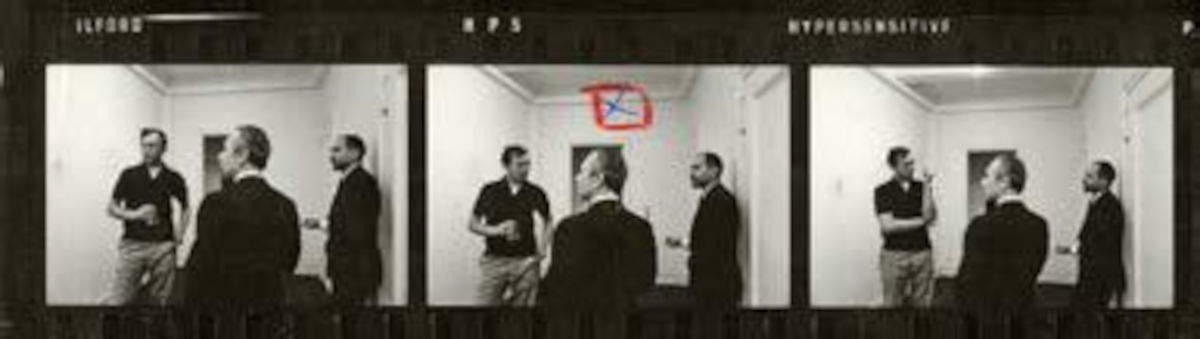
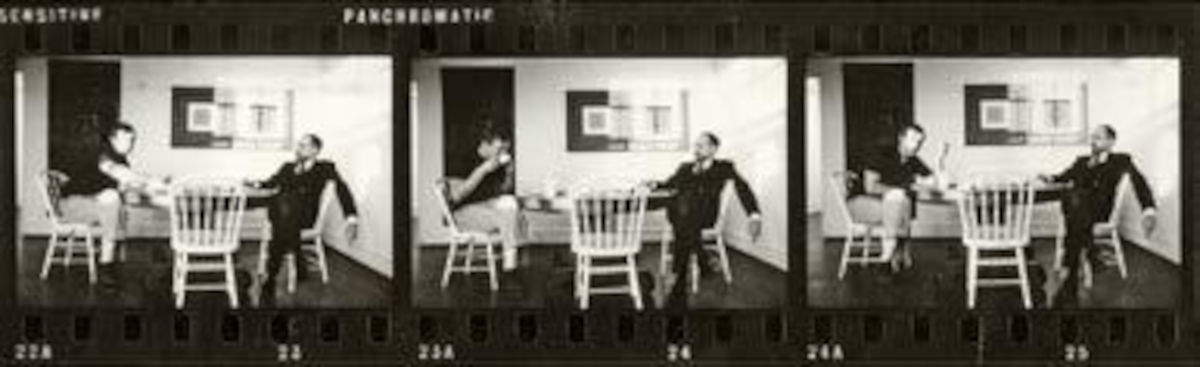
To fully understand the revolutionary scope of this operation, it is necessary to compare Mulas’ work with that of the photographers who had preceded him in portraying Johns. Until 1964, those who had aimed their lenses at the artist, names such as Dan Budnick, Walt Silver, Ben Martin, or David Gahr, had primarily strived to visually translate the psychological impenetrability of the subject. Johns was often stared at in static, almost hypnotic poses in front of his works while looking into the camera with an enigmatic expression in a kind of suspended stasis. These were images that deliberately nurtured the aura of mystery surrounding the creator, almost a theater constructed for the benefit of the camera, although it must be acknowledged that Johns was not playing a part, as even the private shots taken by Rauschenberg or Kay Harris in the 1950s show. Mulas, on the contrary, chooses a radically different path, also influenced by the turn toward a freer pictorial stroke taken by Johns with works such as False Start.
The Italian photographer’s attention gradually shifted to gesture and working procedure. If Paul Katz in 1963 had stopped the artist grappling with rulers and brushes to document the continuity between studio space and work, and Hans Namuth had captured the physical intimacy of lithographic work, Mulas is the first to violate the purely private sphere, seeking to capture a Johns outside the protected confines of the easel. In Italy, the perception of the American artist had been strongly conditioned by Edward Meneeley ’s snapshot published in Metro magazine, which portrayed him laughing and vital. That image had become the symbol of a new generation of American artists in antithesis to the existential torments and political anger that shone through in the portraits of Emilio Vedova or the melancholy of Lucio Fontana and Alberto Burri. That sunny and seemingly integrated iconography in contemporary society had deeply influenced artists such as Michelangelo Pistoletto and Giulio Paolini. Mulas therefore felt the need to go beyond this laughing surface to investigate the deeper reasons for an art that seemed to dialogue with the values of consumer society but concealed a tight investigation of the limits of pictorial language.
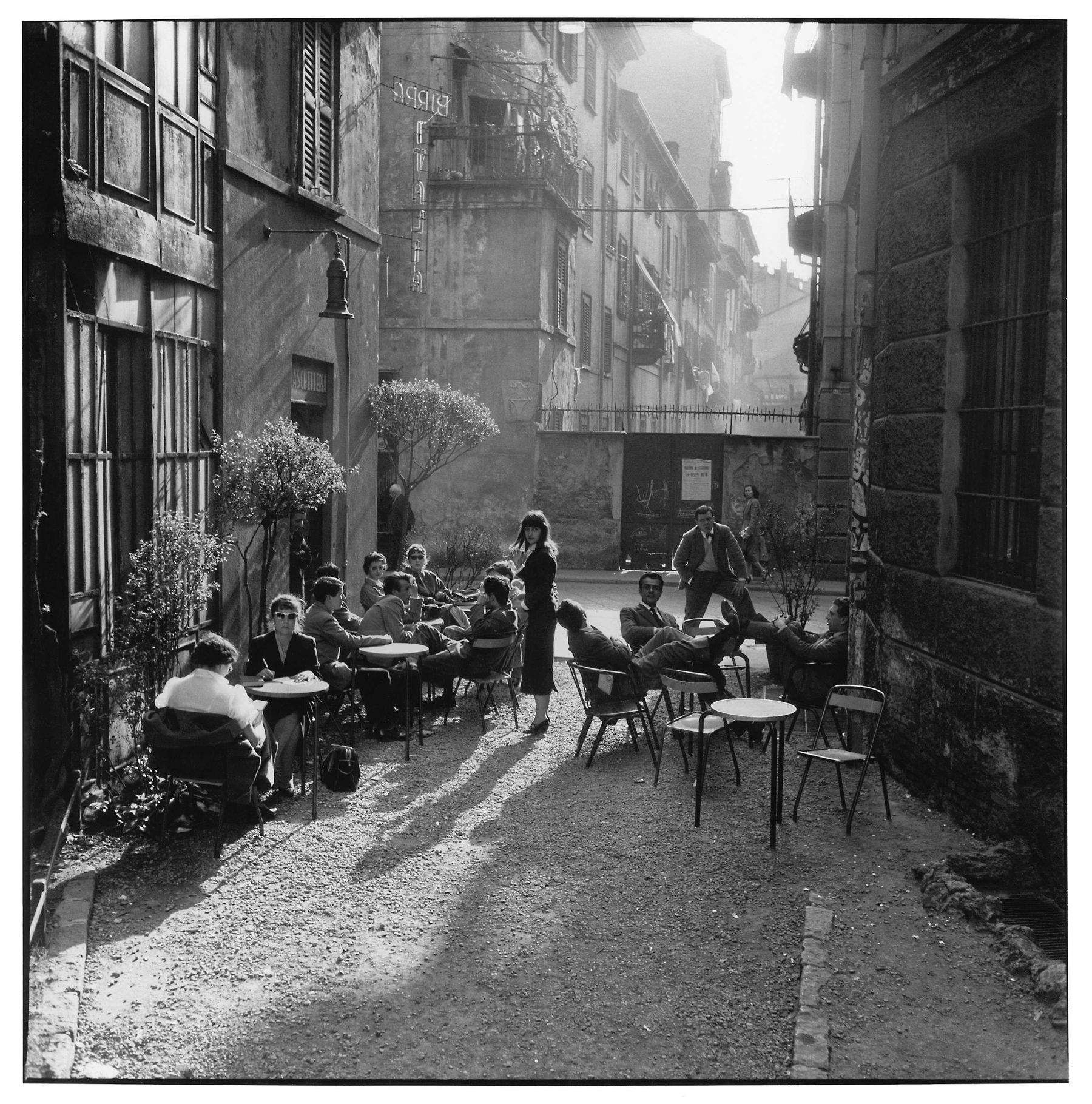
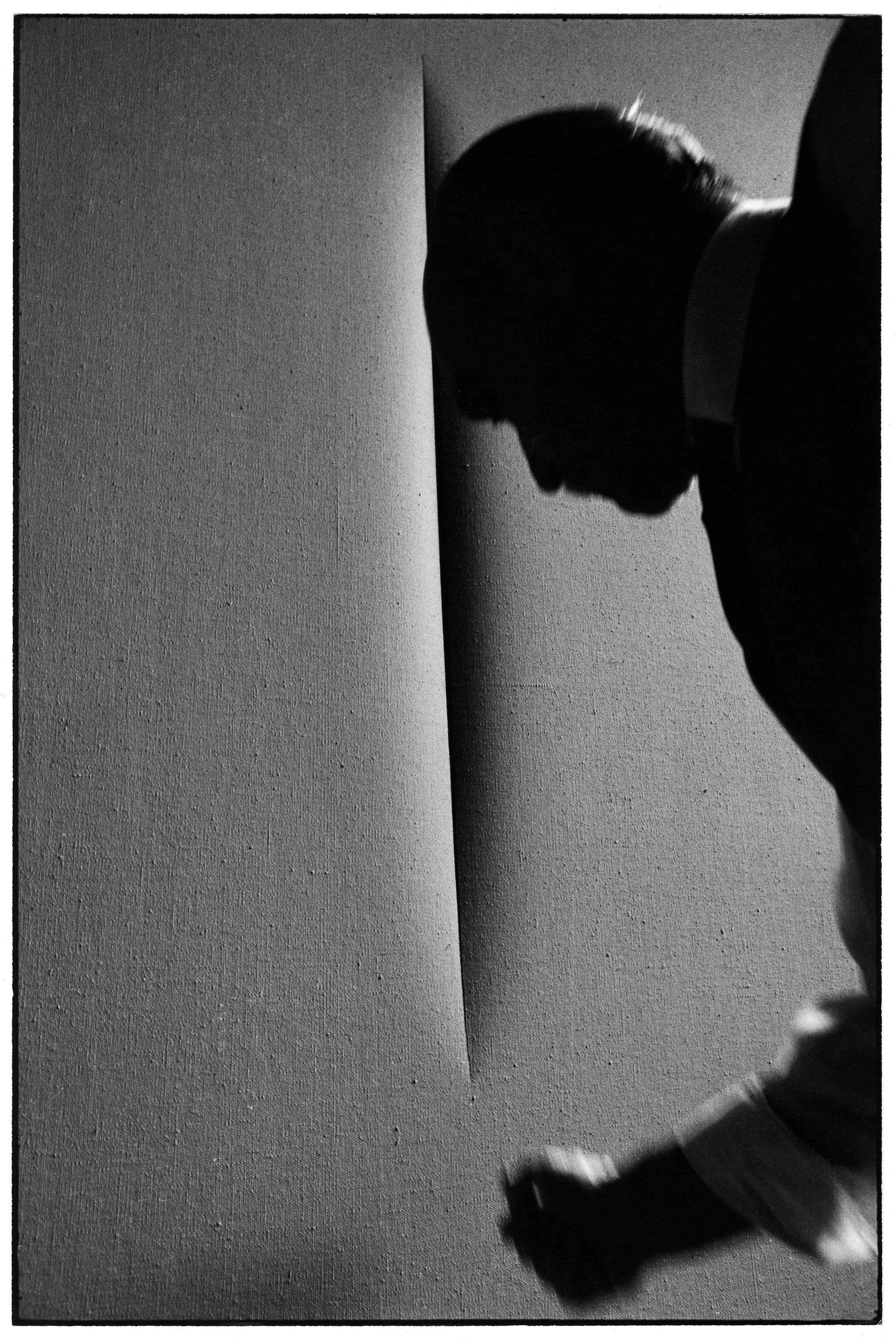
Mulas’ path toward this critical awareness had begun far from New York, in the postwar Milanese climate. In 1954, after interrupting his law studies due to existential restlessness, he had begun frequenting Bar Jamaica, the center of Milan’s artistic and literary bohemian scene. His early photographs had a slant we might call social anthropology, veined with a mournful neorealist sensibility. Public places such as cafes and private ones such as ateliers were portrayed to restore an emotional climate, declaring the photographer’s adherence to the subjects’ condition of marginality. Only later, with his systematic attendance at the Venice Biennials, would Mulas understand the value of documentation as an event and as a means of access to the inner circle of international art. If at the 1954 Biennial his was still a photojournalistic practice linked to the pleasure of the encounter and the picturesque disorder of the installations, he was already glimpsing a superior formal research, made of sharp cuts and intense blacks, that elevated the shot to a document endowed with autonomous visual rigor.
At the 1958 Biennial, Mulas seemed almost oblivious to Johns’ three masterpieces(Flag, Green Target and Gray Alphabets) displayed in the central pavilion. The apparent distraction is understandable when one considers that the photographer’s tastes at the time were still calibrated to existential realism and European abstraction. Moreover, the collective rooms of that edition were cramped and lacked the monographic unity that Mulas sought to establish an incisive visual relationship between the work and its author. It was the fateful 1964 Biennale that marked the definitive break and the birth of interest in American art. In the pavilion curated by Alan Solomon, Mulas stopped seeking the ironic or anecdotal short-circuit between the public and the work. Instead, he begins to treat the canvases as symbols of contemporaneity, highlighting their dialogue with the pervasive civilization of the image. However, precisely in Venice, Mulas encounters a difficulty in focusing on the work of Johns, who unlike Rauschenberg was not present for the opening. Indeed, Johns’s works required slow and concentrated reading times, difficult to render in the excited hustle and bustle of a varnish.
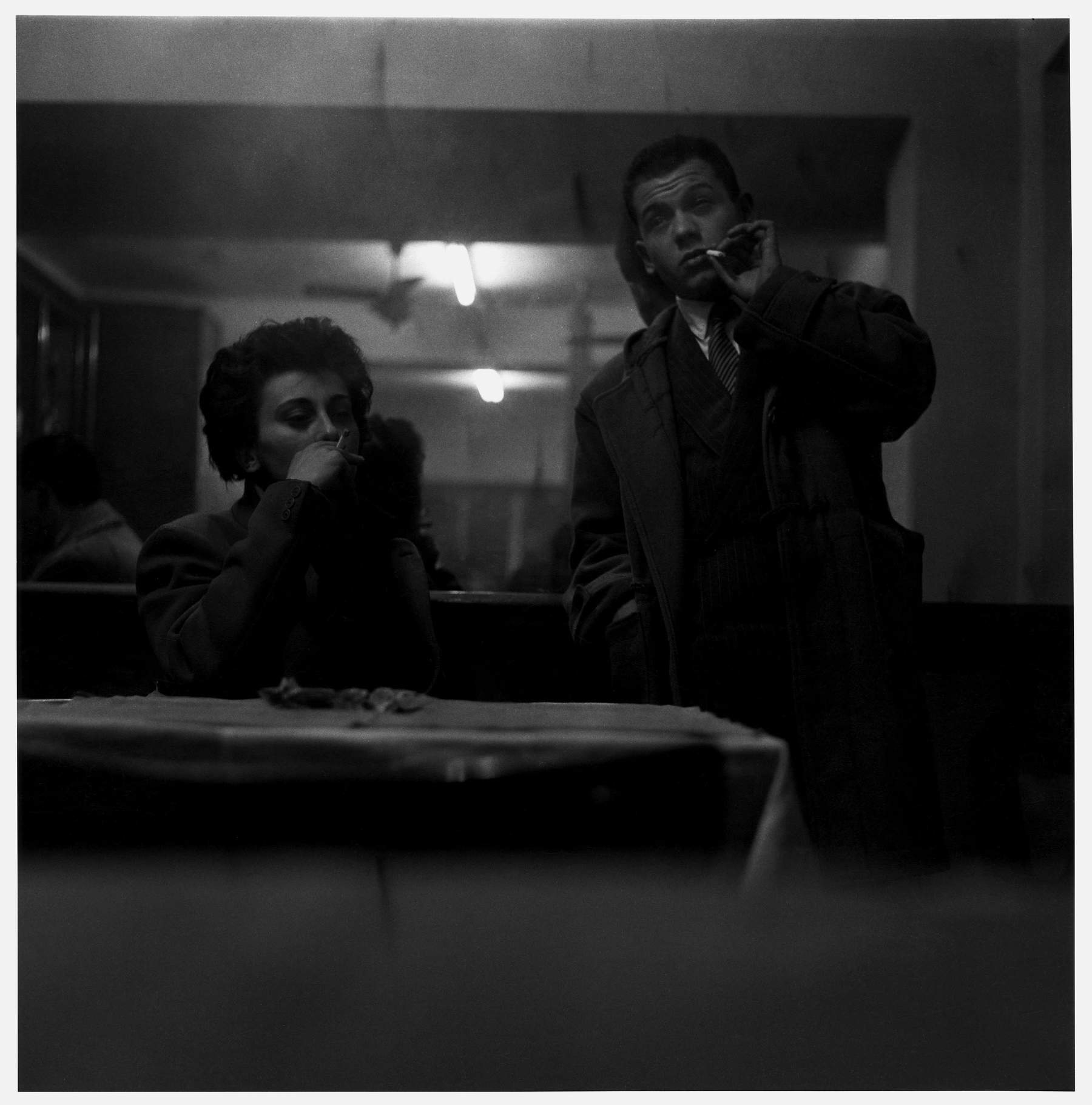
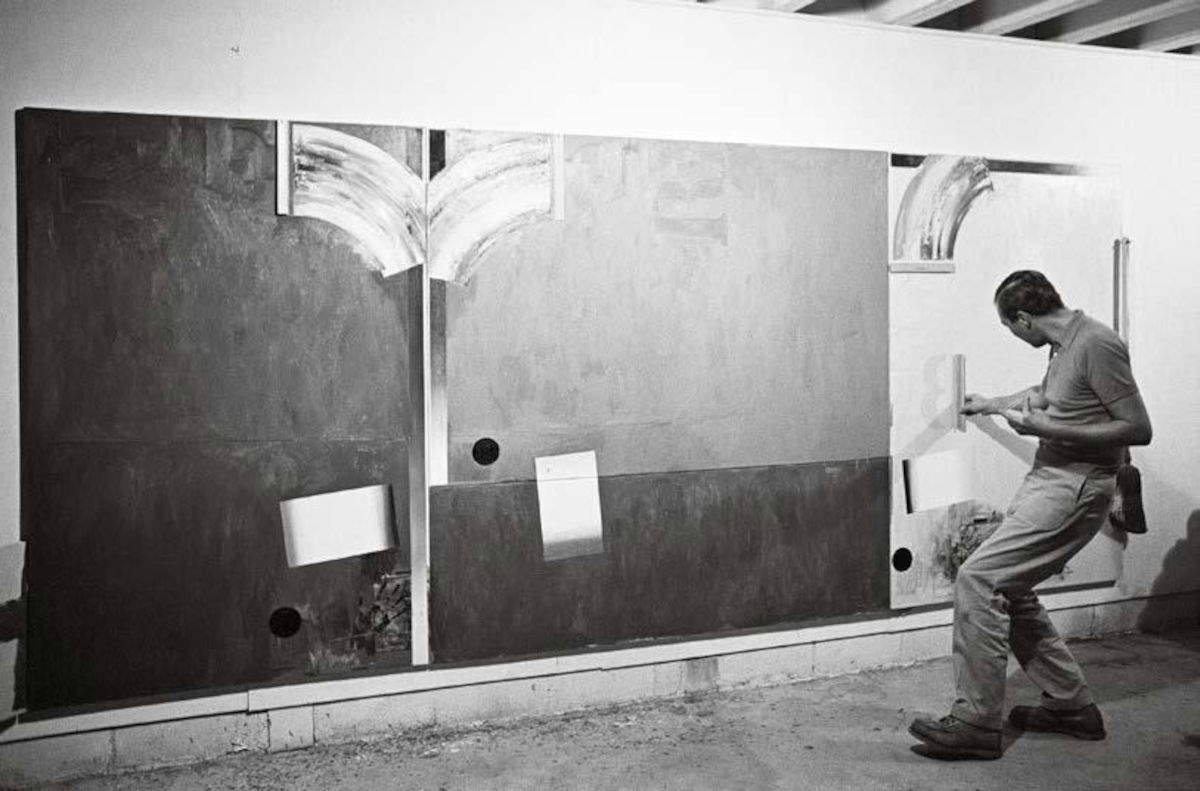
The first stay in 1964, culminating in the shooting in the Riverside Drive studio in New York, marks the beginning of this methodical exploration. Mulas arrived in the United States with an urgency to understand the deeper reasons for the New Art Scene that had triumphed at the Venice Biennale that same year. In these early sessions, Mulas’ focus is on the spatiality of the work. He begins to break down Johns’ working environment. Here emerges the first fundamental insight: photographing an artist means investigating the system of relationships between the artist’s body, his tools and the surrounding space. Johns began to reveal to Mulas his gestures as segments of a strict executive protocol. In 1965, the relationship deepened during his second American sojourn, which took Mulas outside the metropolitan confines of New York City. The shootings in Edisto Beach, South Carolina, and at the Universal Limited Art Editions print shop in West Islip, Long Island, represent a moment of exceptional documentary and theoretical value. In South Carolina, Mulas immersed himself in Johns’ daily rhythm. The artist’s routine, driving the car, walking along the coast, preparing meals, was captured with a naturalness that resets all celebratory detachment. It is an aseptic narrative that aims to bring the figure of the artist back into a human and phenomenological dimension, necessary to strip the work of art of mystical superstructures.
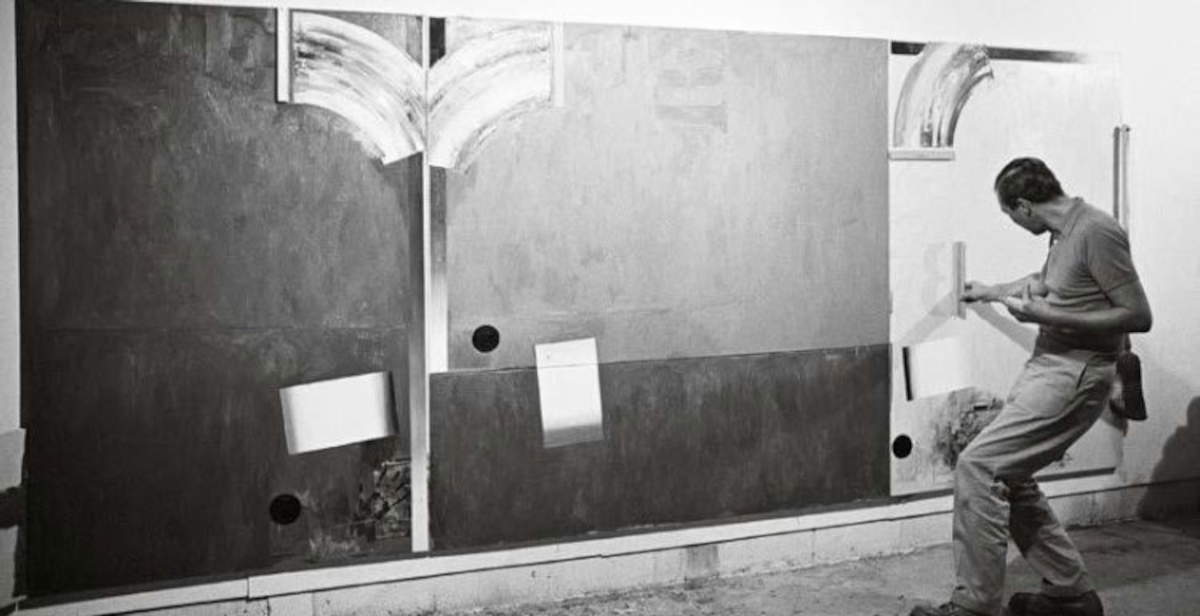
The technical focus of 1965 was particularly on the execution of a replica of the work 0 through 9. Through the negatives of this period, one observes Johns engaged in a constant verification of the visual datum. Mulas highlights the artist’s almost scientific rigor: Johns paints through a calculation of overlays and erasures and not by sudden inspiration. The photographer records the contrast between the exactness of reference models, such as street maps or graphic matrices, and the controlled indeterminacy of painting. In these images, what Fergonzi calls an act of “photography as a critical act” takes place: Mulas is not just looking at Johns, he is verifying, through the lens, the validity of his own theories about vision. There is an emblematic shot in which Mulas himself appears in the field of vision (probably taken by Solomon), filmed while photographing Johns, creating a play of mirrors that underscores the awareness of his own presence and the inherent artificiality of the photographic medium.
The third and final round of shots, dated 1967 and taking place in the Canal Street studio, shows a further evolution toward abstraction and synthesis. If in the first reportages the environment played a central role in contextualizing the work, in 1967 Mulas tightened the framing on the minute details of the painterly making. The atelier disappeared in the background to leave room for the hand, the brush, and, above all, the shadow of the artist projected onto the canvas. This interest in the shadow, visible in the sessions devoted to the work Harlem Light, is not accidental. The shadow represents the physical but intangible trace of the author’s presence, a theme that Johns was exploring and that Mulas recognized as fundamental. At this stage, Mulas’s photography became less narrative and more meditative; the silence of the studio, broken only by the artist’s reiterated gestures, resulted in a sequence of images where time seems to dilate.
The analysis of the contact specimens conducted in Fergonzi’s studio reveals the intellectual ferocity with which Mulas operated his choices. Of the hundreds of shots produced in each session, only very few were selected for publication. This process of exclusion is integral to the value of Mulas’ work. When the volume New York: Art and People, graphically edited by Michele Provinciali, was published in 1967, the sequence of Johns’ images was designed to guide the reader on a path to understanding art that was, first and foremost, a mental experience. Many of the 1967 materials, however, remained in the drawer, excluded from a narrative that at that time favored the documentary impact of the avant-garde scene, only to reemerge years later as study materials.
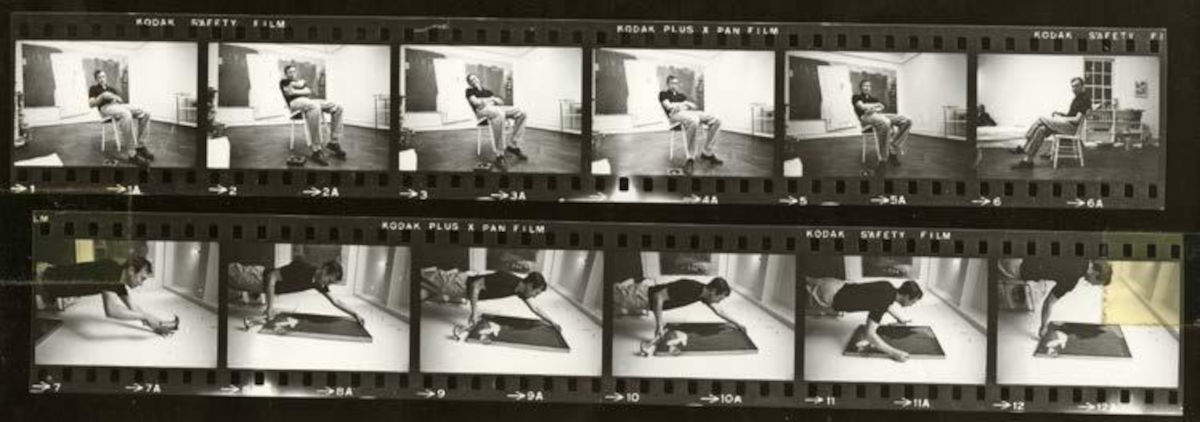
Jasper Johns’ impact on Mulas’ late production was revolutionary. The photographer found in the American artist an intellectual alter ego. Johns was undermining painting through painting; Mulas, observing him, began to undermine photography through photography. This awareness led to the birth of Verifications, Mulas’ testamentary work. In the latter research, Mulas abandoned reportage to devote himself to the analysis of the constituent elements of photographic language: surface, exposure time, magnification, and the relationship between the author and the medium. Johns’ influence is clearly traceable in this need to verify language, to take nothing for granted, and to consider the image as a question.
The reception of Johns’ work in Italy was also indirectly affected by Mulas’ work. The way in which the artist had decoded the figure of Johns provided a key to interpretation based on the analysis of language and conceptual seriality. For Mulas, understanding Johns meant giving durability and critical consistency to the ephemerality of the photographic image, transforming it into an object that could withstand the rapid media consumption typical of those years.
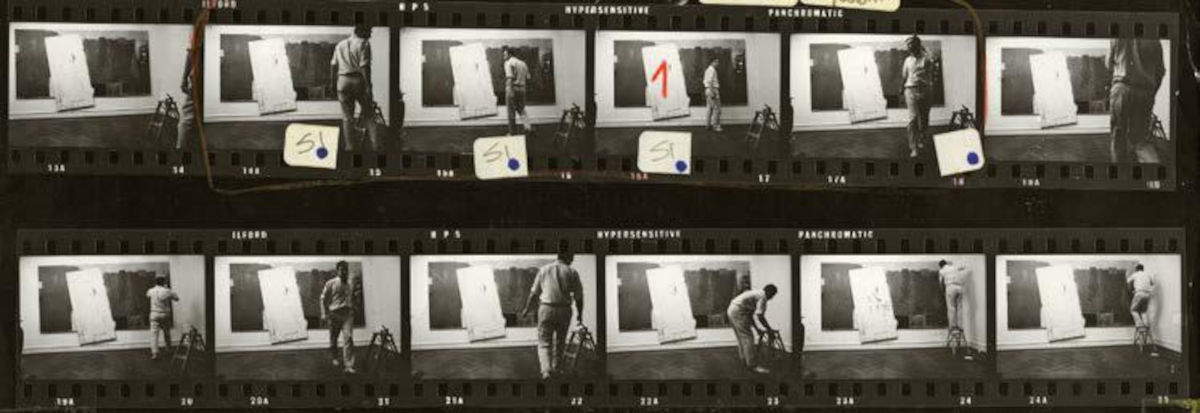
Flavio Fergonzi’s study now makes it possible to reread these reportages as a single, large-scale investigation of perception. Mulas’ photography does not celebrate Johns’ genius, instead analyzing it as a case study of the complexity of seeing. The transition between the spaces of Riverside Drive, the wilderness of South Carolina and the intellectual seclusion of Canal Street traces an evolutionary arc from the curiosity of the chronicler to the depth of the philosopher of the image. Each negative analyzed confirms that for Mulas the act of photographing Johns had become a cognitive duty. The total rejection of rhetoric, the absence of heroic poses, and the choice to show Johns in the moment of doubt or technical pause are elements that make the reportages peculiar.
Mulas understood that Johns’ strength lay in the analytical tension that led to his making. Similarly, the value of Mulas’ photography lies in the ability to make the artist’s thought visible, not in the formal beauty of the shot. The publication and analysis of these materials thus present a novel perspective on Mulas’ career, which was prematurely interrupted in 1973 with the photographer’s death, and also on the reception of American culture in Europe. Mulas’ work on Johns thus reminds us that photography can and should be a critical act, an exercise of intelligence constantly interrogating reality.
 |
| Ugo Mulas and Jasper Johns: photography and analysis as the birth of a language |


The author of this article: Noemi Capoccia
Originaria di Lecce, classe 1995, ha conseguito la laurea presso l'Accademia di Belle Arti di Carrara nel 2021. Le sue passioni sono l'arte antica e l'archeologia. Dal 2024 lavora in Finestre sull'Arte.Warning: the translation into English of the original Italian article was created using automatic tools. We undertake to review all articles, but we do not guarantee the total absence of inaccuracies in the translation due to the program. You can find the original by clicking on the ITA button. If you find any mistake,please contact us.




















 IT
IT FR
FR DE
DE ES
ES CN
CN


