





Queues of at least two hours to get in, signs warning that the work might offend public sensibilities, endless chatter, invitations not to take photos systematically disregarded by the public, and even a few tense moments caused by those who failed to get in after hours in line. This is the outline of the most talked about pavilion of the Venice Biennale 2026, namely the Pavilion of Austria. Representing the Alpine country is Florentina Holzinger (Vienna, 1986), who brings SEAWORLD VENICE to the 61st International Art Exhibition, an interdisciplinary project that transforms the Austria Pavilion into a perturbing space where water, bodies, technology and rituals coexist in an ever-changing ecosystem. The work, curated by Nora-Swantje Almes of Gropius Bau Berlin, will be open to the public from May 9 to Nov. 22, 2026, as will the entire Biennale. Here are some images, then in the coming days we will publish the review.
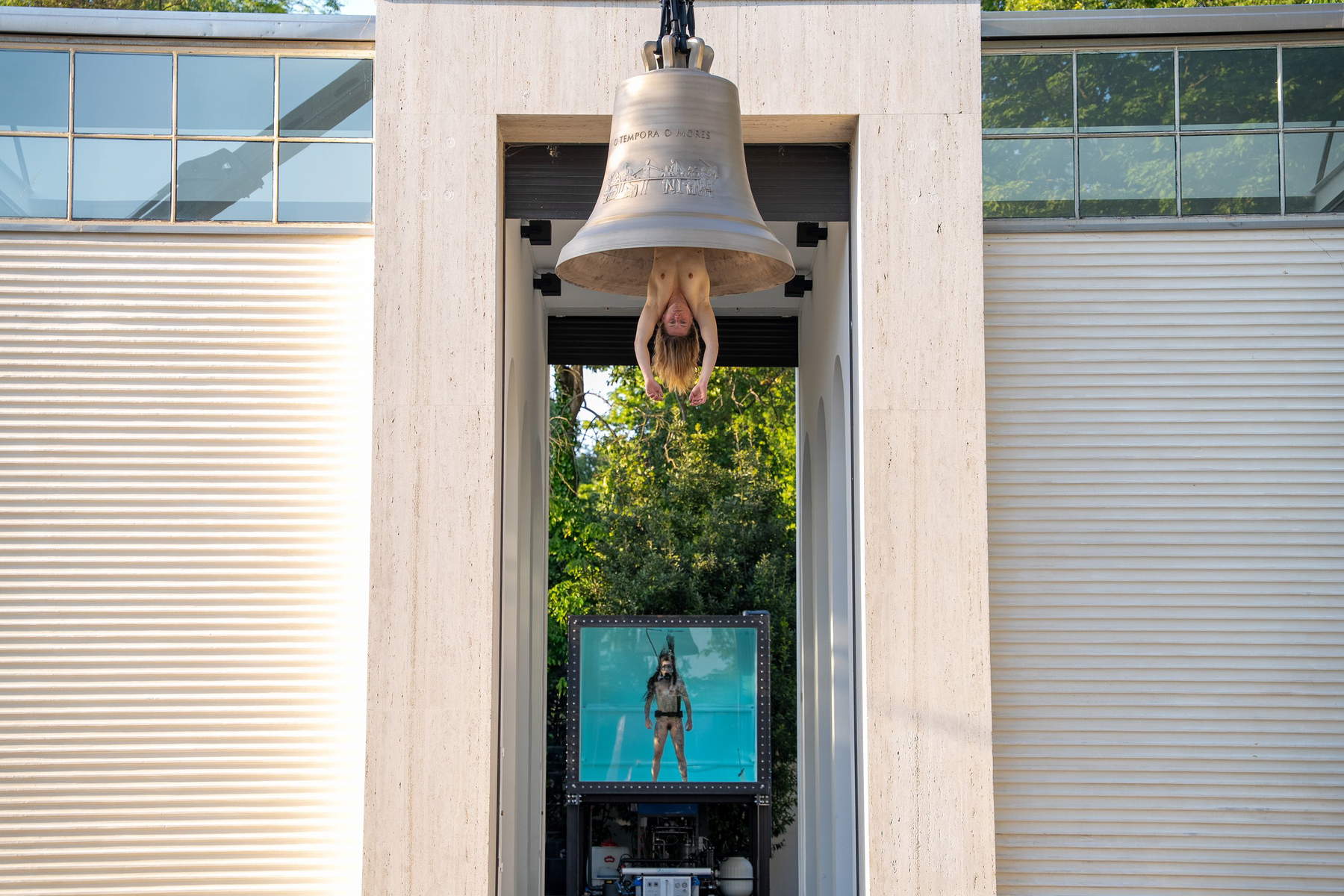
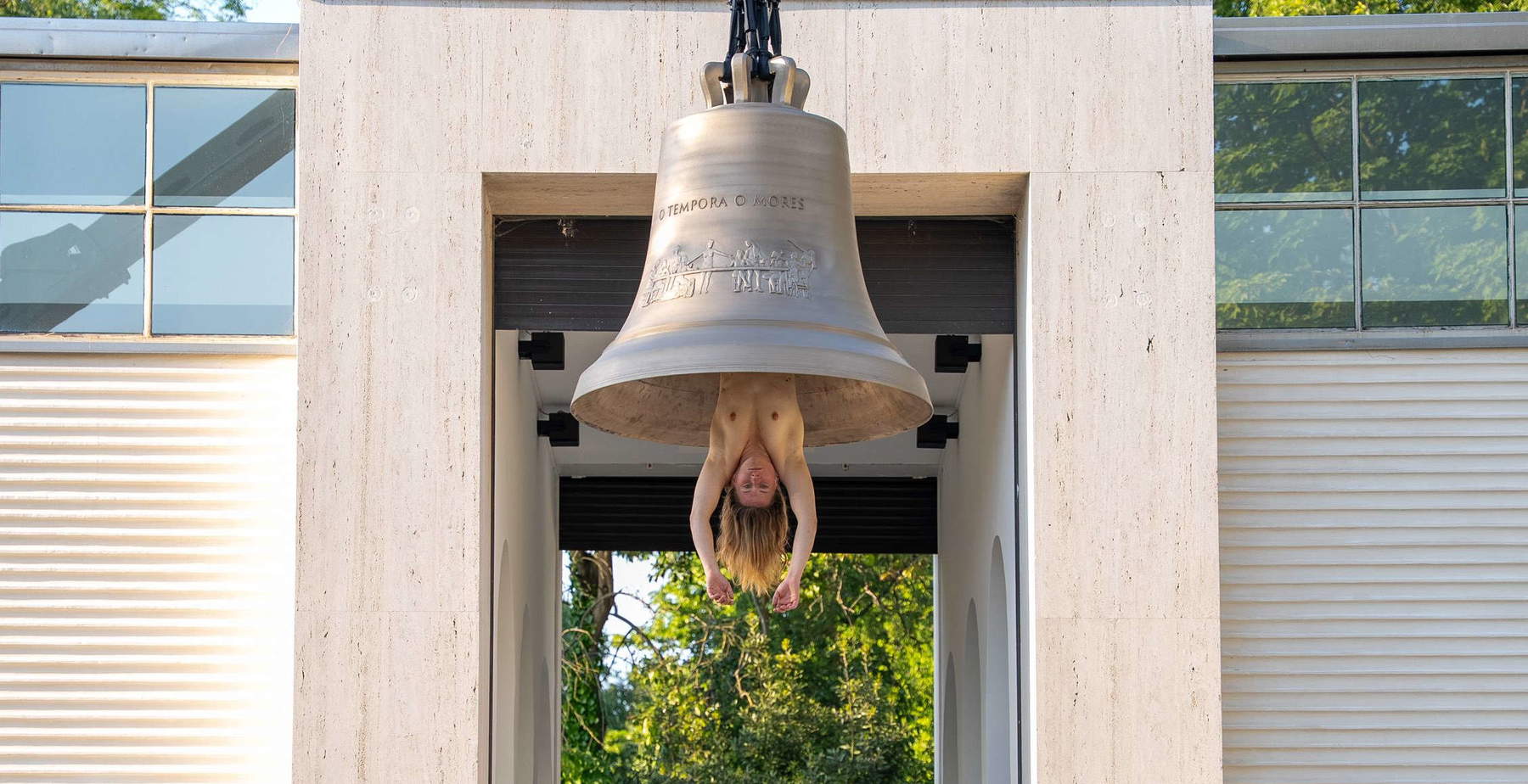
The project kicks off with Opening Étude: a church bell retrieved from the Venetian lagoon was in recent days carried in procession to the Austria Pavilion, where it dominates the entrance to the structure, hoisted on a crane. The bell takes on multiple meanings: a symbol of the sacred, a measure of time, a collective call and a warning signal. Instead of the traditional clapper, however, it is a performer, completely naked as is often the case in Holzinger’s performances, who rhythmically produces the tolling: the performance is meant to be a symbol of the worn-out structures of patriarchal history and religious authority. The ritual occurs every time the hour strikes and lasts about four minutes.
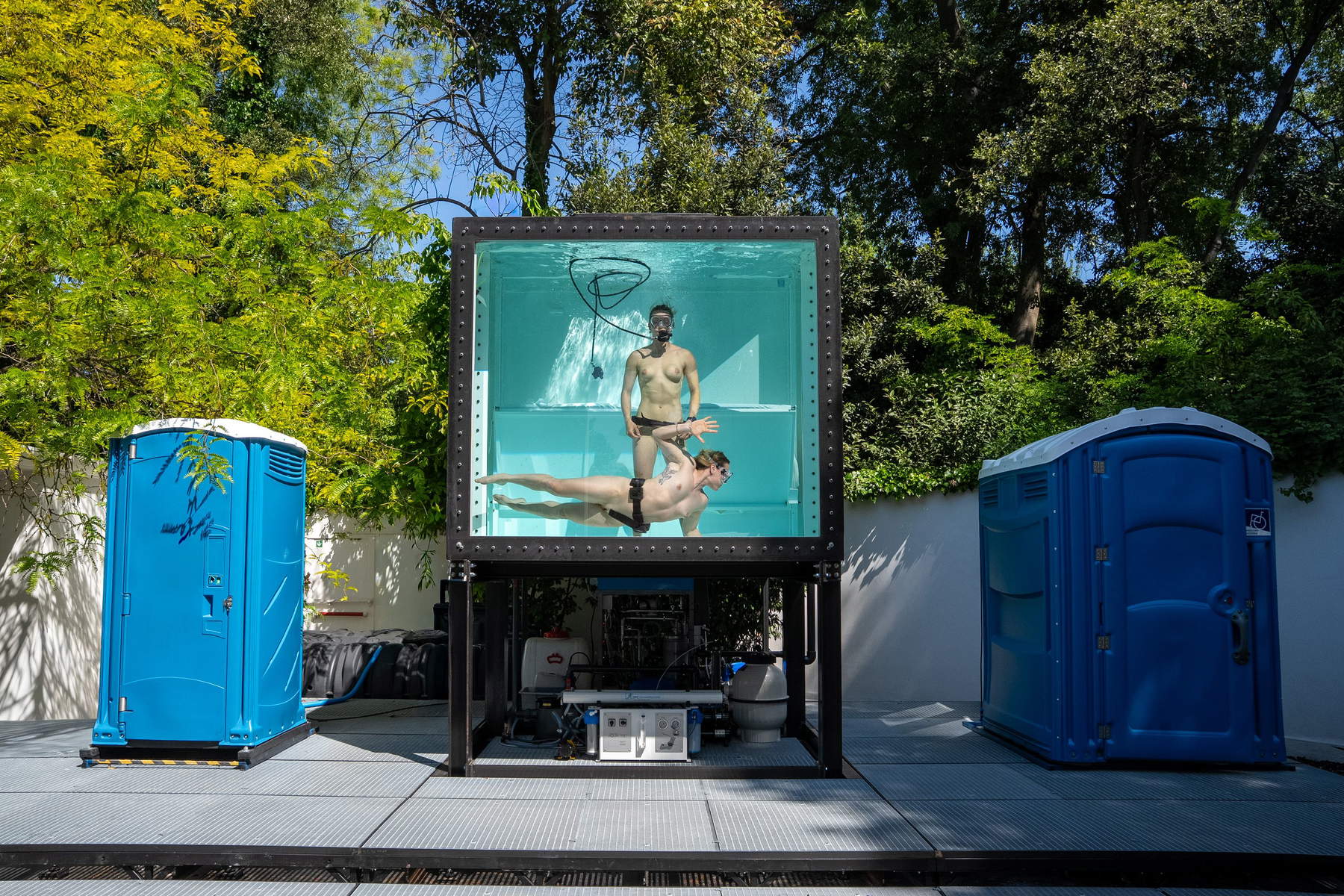
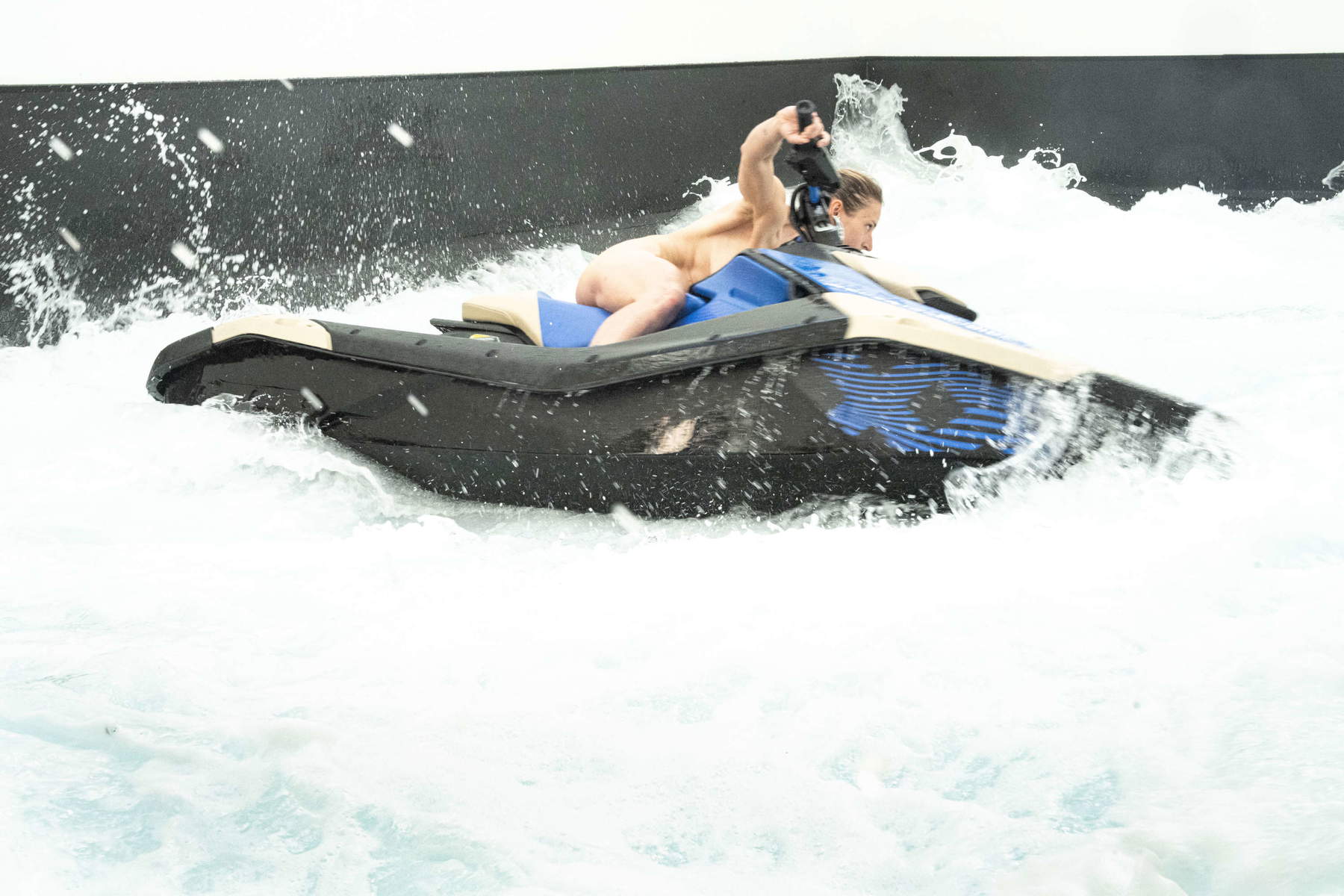
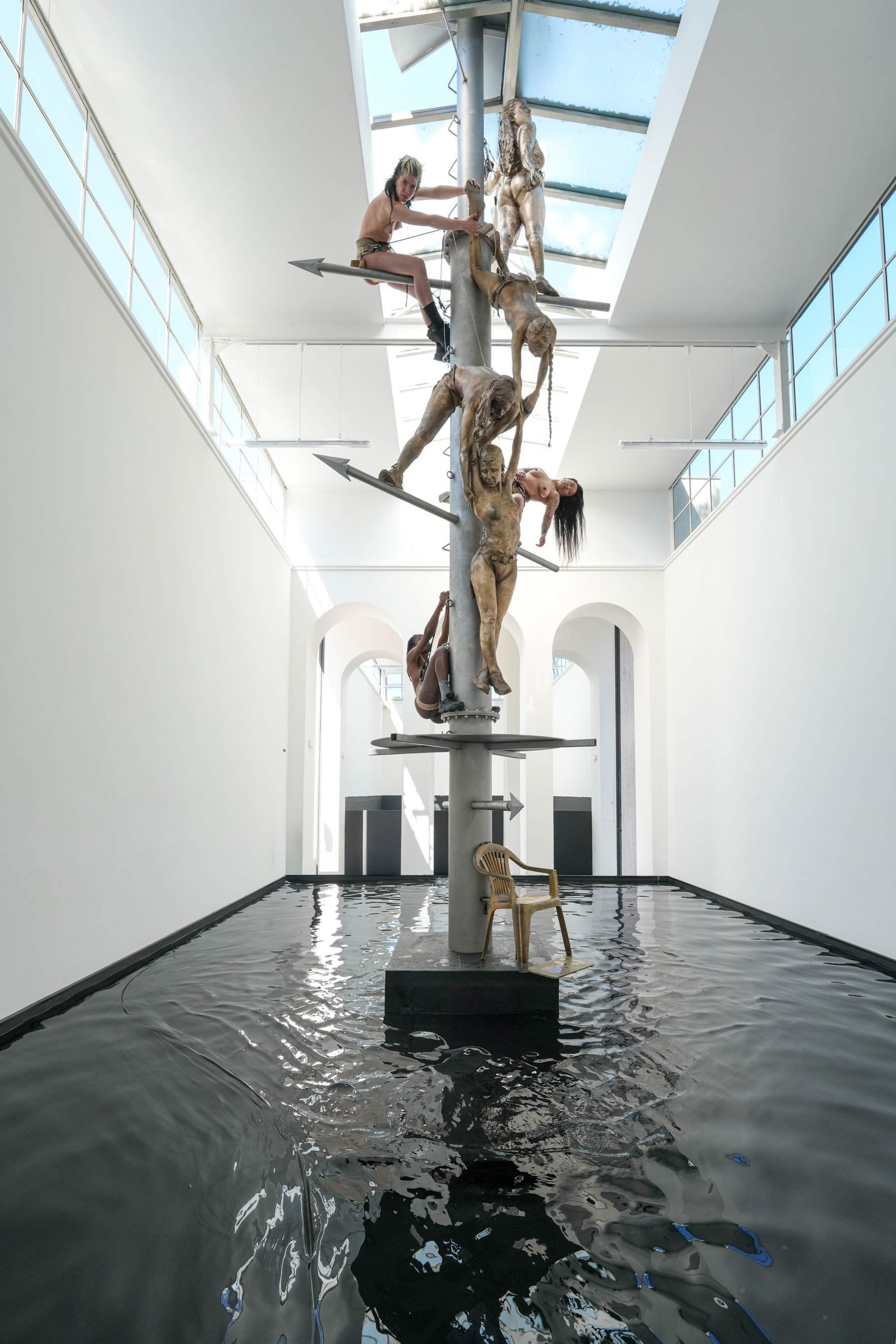
Inside the pavilion, which is all flooded for the occasion (which is why it can only accommodate a few people at a time, hence the queues), one of the central elements of the installation appears: a jet ski, driven by a naked performer, traversing concentric trajectories in the exhibition space. The performance is meant to be a critique of the ecological catastrophe generated by overtourism, in constant collision with a city, Venice, that is progressively sinking. For Holzinger, the watercraft is symbolic of the human attempt to dominate nature. In the second room, on the right, we see the underside of a giant weathervane piercing the pavilion’s architecture through it completely. In place of the traditional static monument, however, appears a mobile and feminine Deposition of Christ, with naked performers attached to the pole, which rotates with the changing wind, transforming itself into a symbol of a collective force in motion. Finally, last moment, in the courtyard of the pavilion, a performer lives permanently inside a tank fed by the bodily fluids provided by the public, through the bathrooms of the Biennale: their droppings are purified and converted into the water into which the performer descends. The performer will inhabit this environment for the duration of the Biennale, within a closed recycling system that transforms the human body into an integral part of the exhibition mechanism. According to Holzinger, this system symbolically reflects a global order in which the most vulnerable populations are forced to live among the waste produced by the most powerful. The figure of the performer is also meant to draw on the iconographic tradition of Giorgione’s Sleeping Venus: according to the artist, the beauty of Venice in her view can no longer be separated from the material consequences of mass tourism and the environmental impact the city produces and suffers.
Florentina Holzinger’s artistic research, extremely indebted to theViennese Actionism of Hermann Nitsch and associates, has always focused on the limits of bodily action through extreme physicality and strict stage control. Her performances, like those of the pioneers of the 1960s-1970s, test the physical and psychological endurance of bodies to make visible power dynamics and mechanisms of control.
SEAWORLD VENICE will continue its evolution through adapted versions to be presented at Gropius Bau in March 2027, at Kunsthalle Wien in June of the same year, and at AMANT in the spring of 2028.
 |
| Images of the Austria Pavilion, the most talked about Pavilion at the 2026 Biennale |

Warning: the translation into English of the original Italian article was created using automatic tools. We undertake to review all articles, but we do not guarantee the total absence of inaccuracies in the translation due to the program. You can find the original by clicking on the ITA button. If you find any mistake,please contact us.

























 IT
IT FR
FR DE
DE ES
ES CN
CN


