





From April 29 to September 20, 2026, the Manica Lunga of the Castello di Rivoli Museo d’Arte Contemporanea will host Cecilia Vicuña - El glaciar ido (The vanished glacier / The vanished glacier), the artist’s first solo exhibition in an Italian museum. The exhibition, curated by Marcella Beccaria, will be presented to the press on Tuesday, April 28, 2026, and is developed as a new commission conceived specifically for the longitudinal spaces of the third floor.
Born in Santiago, Chile in 1948 and living in New York City, Cecilia Vicuña is an artist, poet and activist. Her work intertwines feminist and ecological instances and focuses on the defense of democracy, freedom of expression and decolonial practices oriented toward the protection of the cultural heritage of indigenous peoples. Performance, poetry, drawing, painting, video and installations, both minimal and monumental, compose a research that began in the 1960s, when the artist coined the term “Precarious Art.” The concept of precarity becomes the backbone of a practice that privileges ephemeral and participatory works, often made with debris and found materials, in dialogue with the places and communities involved.
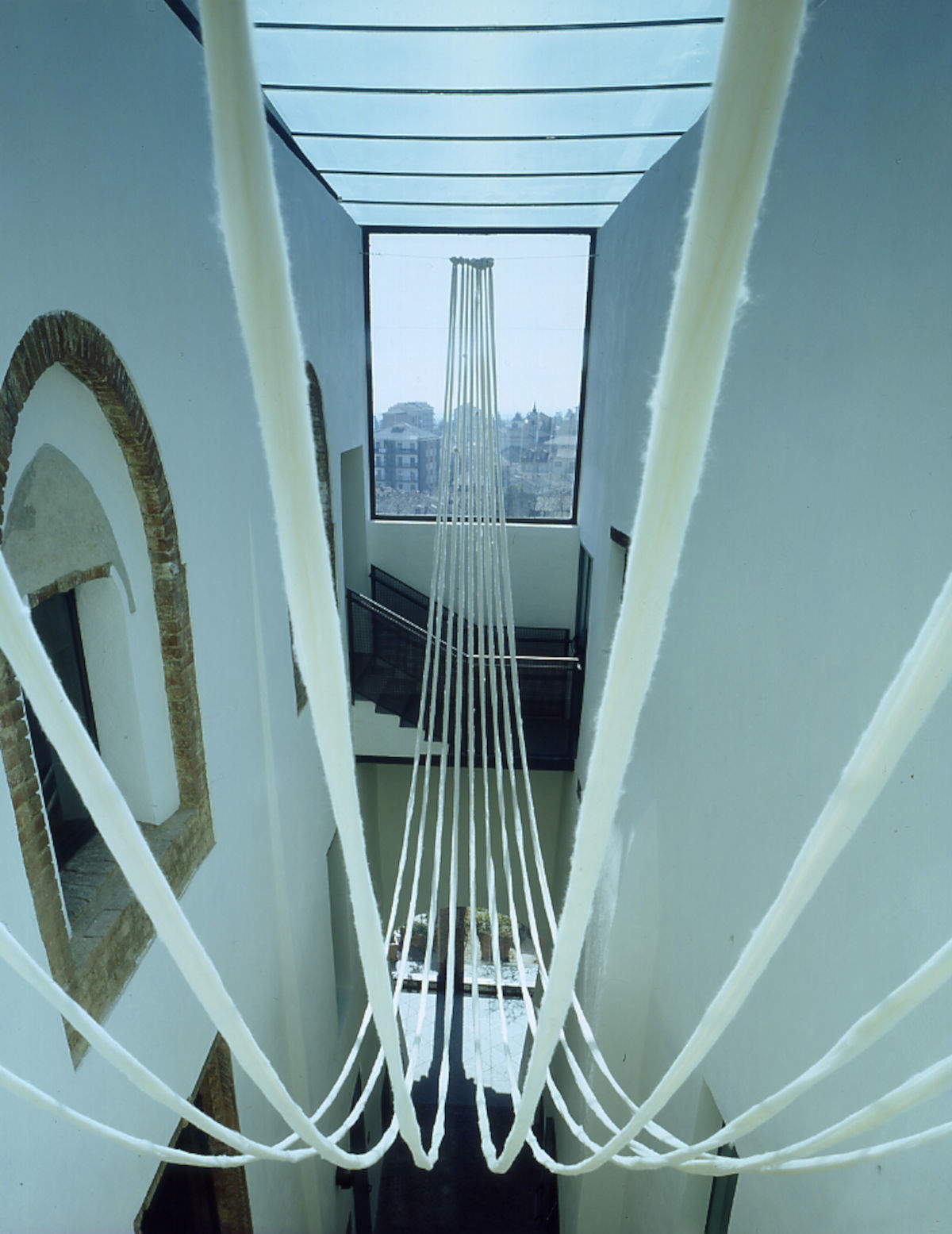
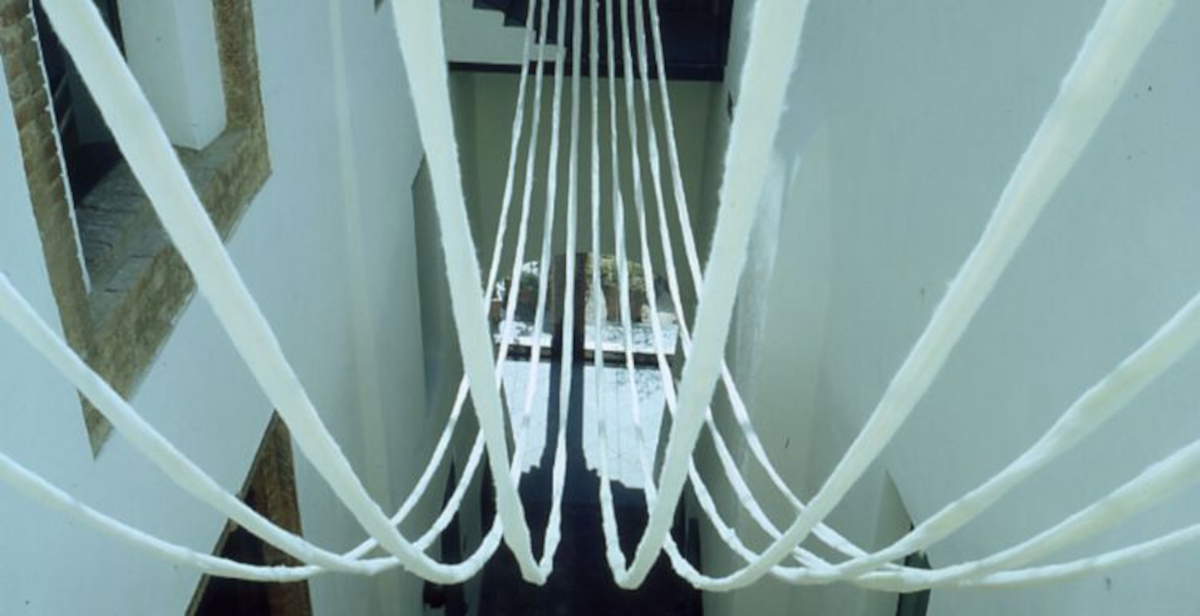
The project for Rivoli takes the form of a quipu acostado, a horizontal installation suspended at different heights. Quipu (knots in the Quechua language), knotted string systems belonging to ancient Andean civilizations, constituted a form of writing and recording used in mathematical, administrative, and astronomical fields. From that model, Vicuña develops contemporary quipu that translate into traversable environments capable of articulating relationships between space and time. In making them, the artist employs raw, unbleached wools, which are unwound, assembled and knotted until they generate aerial architectures of strong visual impact.
In the Long Channel, the new quipu takes on the value of a presence evocative of the passage of time, human and geological, and the movement of natural elements, such as wind and water. The work recalls the transience of human presence with respect to the environment and connects to the memory of the ancient glaciers that once dominated the landscape of the Susa Valley, where the museum is located. The territorial reference extends to nearby streams and water basins, including the Dora Riparia and the Avigliana Lakes, from which the artist hopes small residual natural materials, fragments of wood, stones, shells, feathers, collected by local communities, may come. The participatory dimension is an integral part of the work and helps to define the quipu as a device for relationships between people and places. The exhibition also includes video works that introduce images, sounds and songs, elements present from the beginning in the artist’s practice. In consideration of Vicuña’s role in the field of poetry, the exhibition itinerary presents new compositions written for the occasion. The project will be accompanied by a new publication.
The initiative marks a return of the artist to Castello di Rivoli, an institution that first presented his work in Italy in 2000 as part of the group exhibition Quotidiana. The realization of the exhibition is supported by Andrea Zegna.
 |
| Cecilia Vicuña at Rivoli Castle: a hanging quipu for the missing glacier |

Warning: the translation into English of the original Italian article was created using automatic tools. We undertake to review all articles, but we do not guarantee the total absence of inaccuracies in the translation due to the program. You can find the original by clicking on the ITA button. If you find any mistake,please contact us.





















 IT
IT FR
FR DE
DE ES
ES CN
CN


