





At the Gemäldegalerie Alte Meister (Old Masters Gallery) in Dresden, within the Zwinger complex, the first-ever retrospective exhibition outside Italy dedicated to Antonio Allegri known as il Correggio (Correggio, c. 1489 - 1534), titled Correggio , is scheduled to run from September 19, 2026 to January 10, 2027. Berührend menschlich - Correggio. Profoundly human. The exhibition takes the form of a project of critical reconstruction of the Emilian artist’s career, through a set of international loans normally distributed in different museum contexts.
The initiative is part of the work of the Gemäldegalerie Alte Meister, which already holds one of the most relevant nuclei of the artist’s paintings, and also arises in relation to the exhibition entitled The Rebirth of Correggio, hosted at the Zwinger between Jan. 7, 2022 and Dec. 31, 2025, focusing on the conservation and restoration of the work Madonna di San Sebastiano. The painting, created by Correggio around 1524 for the confraternity of San Sebastiano in Modena, was already damaged in ancient times and suffered progressive deterioration over the following centuries. The conservation intervention had to deal with a severely compromised pictorial surface, marked by a convex deformation of the wooden support, which caused the lifting of the layers of varnish and widespread losses of pictorial matter, particularly along the joints of the panels.
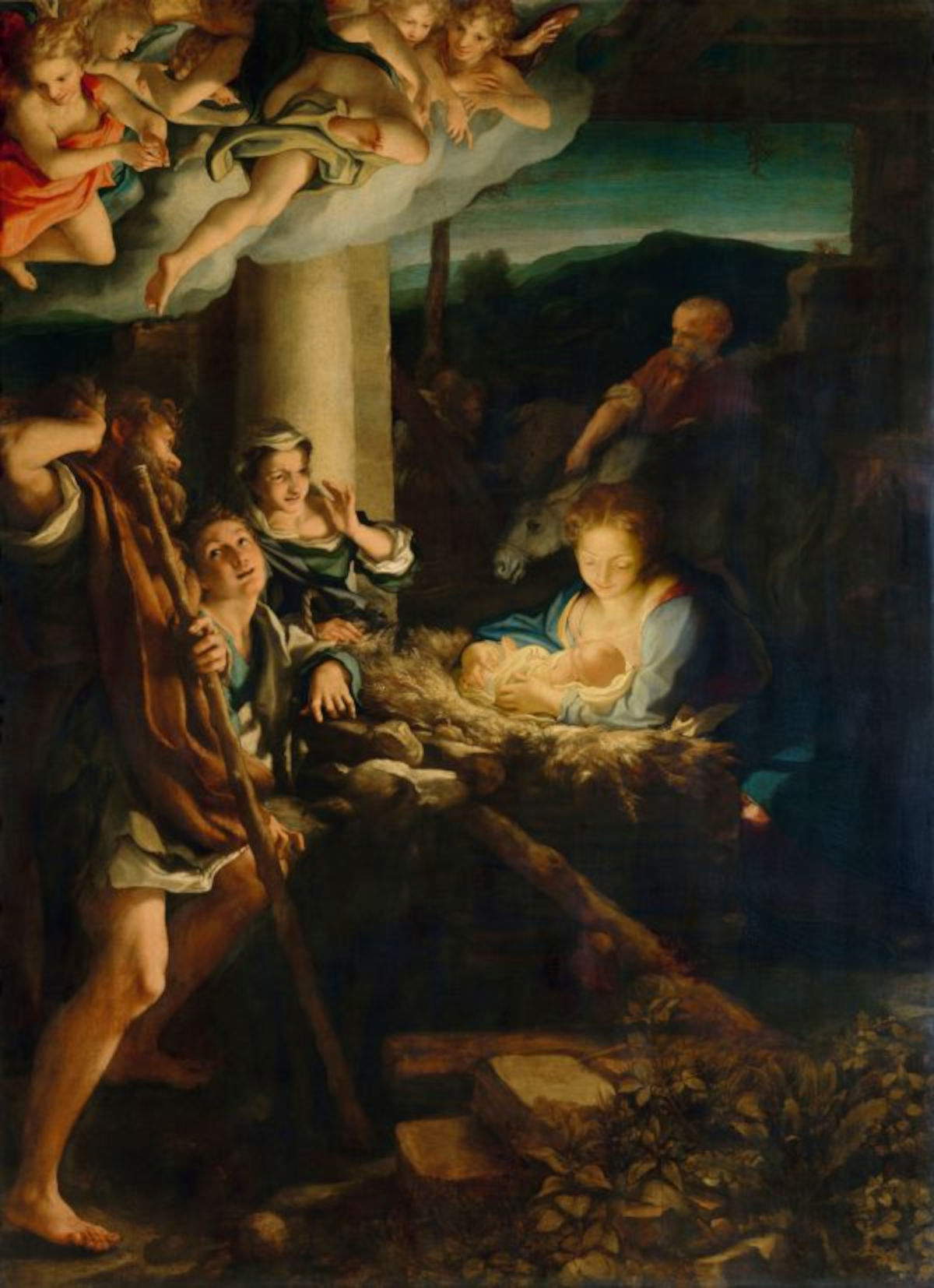
At the center of the 2026 itinerary is thus the Madonna of Saint Sebastian, a work that is presented as a pivotal element in understanding the evolution of his style. The focus is primarily on the use of chiaroscuro, the construction of light as a narrative device, and the rendering of the emotions of the subjects depicted. These aspects are read in relation to the subsequent evolution of European painting, with references to Baroque experiences and developments found in the work of artists such as Annibale Carracci and Pieter Paul Rubens. The exhibition takes on additional value because of the presence, in the same museum, of Raphael’s Sistine Madonna. The proximity between the two works allows a direct comparison between two different models of representation of the sacred in the Italian Renaissance, highlighting different approaches to the construction of the image and the relationship between figure, space and light.
A further important element concerns the historical position of the artist. Correggio, who was active between Parma and the Emilian area, is considered by art historiography as a central figure of the Italian Renaissance, although his notoriety is less immediate today than that of other coeval masters such as Leonardo, Michelangelo, Raphael and Titian. The Dresden exhibition intervenes precisely on this aspect, proposing a reinterpretation of his role within European art history. The artist is shown as capable of giving sacred images a profoundly human dimension, through a narrative construction that emphasizes the expressiveness of the subjects. The aim of the exhibition is to provide a documented reading of Correggio’s artistic corpus, integrating historical-critical analysis and material data related to the works.
 |
| Correggio in Dresden: the first retrospective outside Italy at the Gemäldegalerie |

Warning: the translation into English of the original Italian article was created using automatic tools. We undertake to review all articles, but we do not guarantee the total absence of inaccuracies in the translation due to the program. You can find the original by clicking on the ITA button. If you find any mistake,please contact us.


























 IT
IT FR
FR DE
DE ES
ES CN
CN


