



by Redazione 15/03/2026



Categories: Exhibitions / Disclaimer
From March 28 to July 5, 2026, the San Domenico Museum in Imola hosts "Vera da pozzo," a monographic exhibition dedicated to Milanese artist Giovanni Frangi. More than forty works including paintings, sculptures and drawings articulate a path through the most recent cycles of his research.

From March 28 to July 5, 2026, Museo San Domenico in Imola will host Vera da pozzo, a monographic exhibition dedicated to the Milanese artist Giovanni Frangi, curated by Diego Galizzi, director of Imola Musei, and Marta Cereda, independent curator. The exhibition takes place in the interior spaces of the museum, in the quadriporticus and cloister of the former Dominican convent, in an exhibition project designed in direct relation to the historical architecture of the complex.
The exhibition brings together more than forty works including large paintings, sculptures and drawings, organized in four autonomous but interconnected cycles. The itinerary offers a reconnaissance of the artist’s most recent experiences and is presented as a broad verification of his research. The works are arranged to create visual continuity between the different sections, in an itinerary that relates recurring elements of Frangi’s work, including nature, sky, movement and memory. The title of the exhibition finds a concrete translation in the unpublished intervention made by the artist for the well placed in the center of the cloister. The term “well vera” means the protective balustrade surrounding the hole of a well and, in the context of the exhibition, takes on a symbolic function. The well becomes an evocative image associated with depth and reflection, but also a point of contact between architectural space and pictorial research.


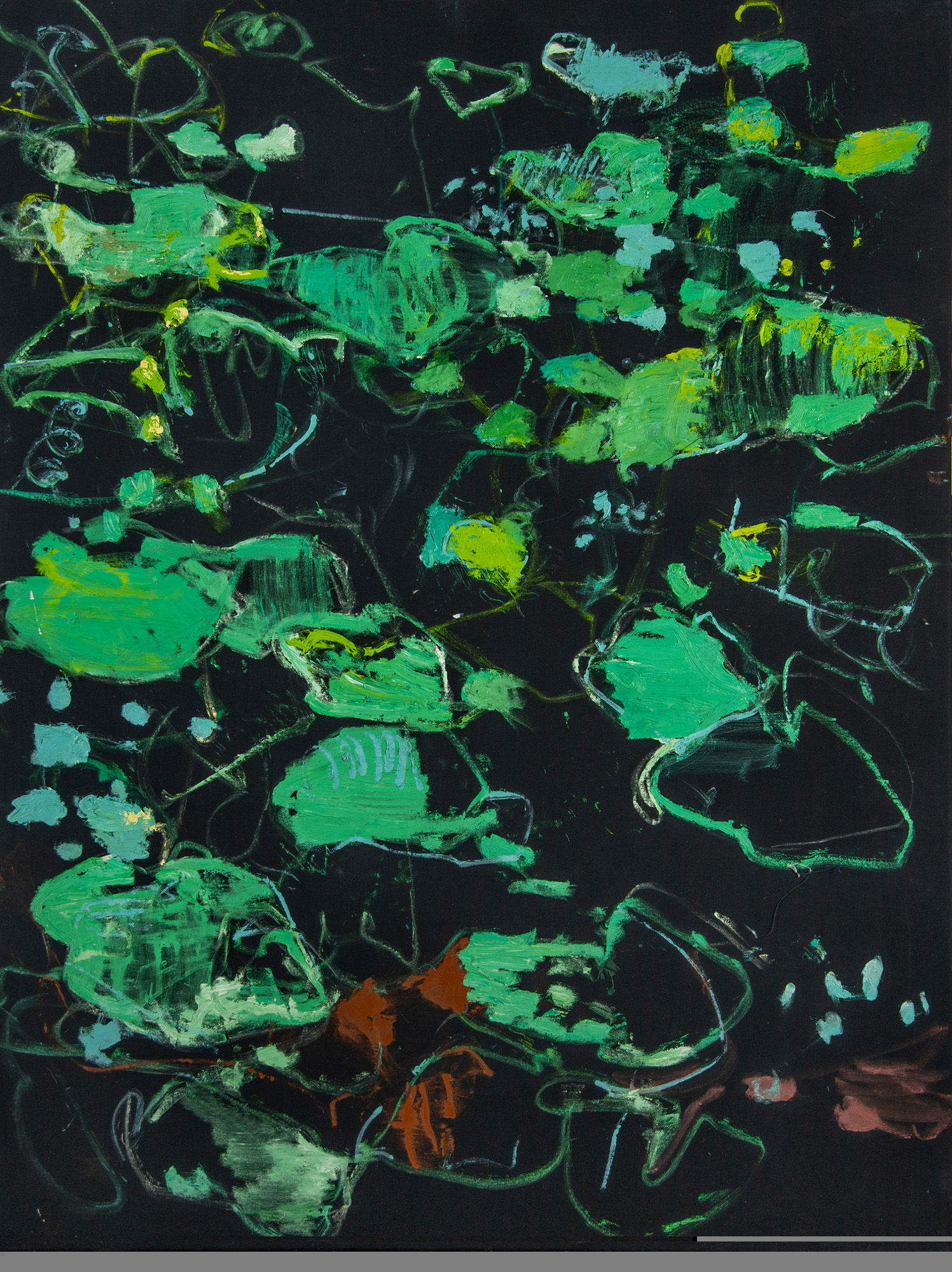
The theme of nature, central to Frangi’s production for several years, emerges prominently in the first section of the exhibition, entitled Urpflanze. Here are presented works dedicated to Water Lilies andHeliconia paradise made between 2015 and 2025. The paintings, executed on media as diverse as cotton, linen and velvet, feature black backgrounds that function as generative spaces. Vegetation emerges from this chromatic depth through gestural marks that define ever-changing plant forms.
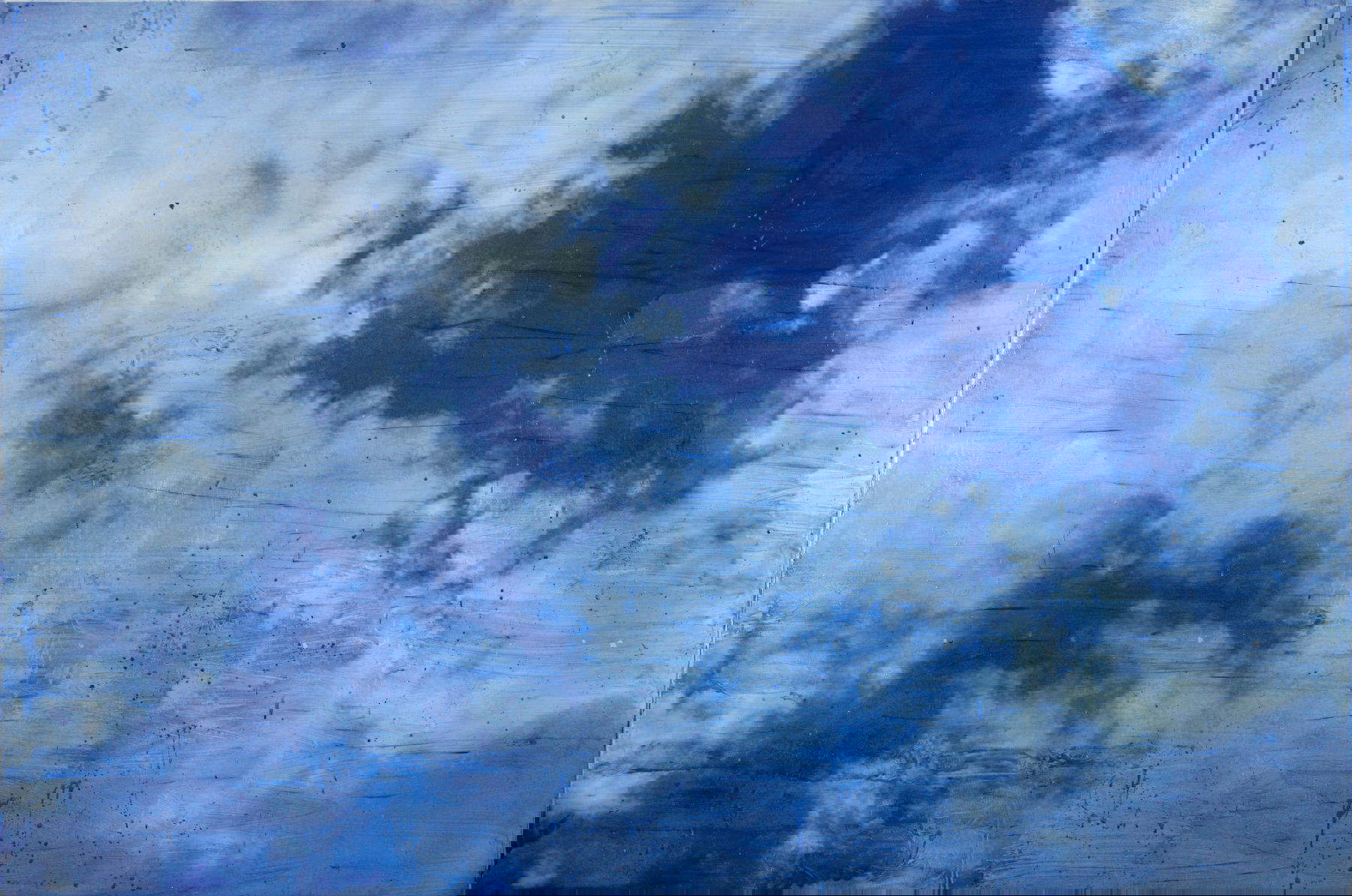
Alongside the terrestrial and vegetal dimensions there is a parallel reflection on the sky. In the emulsified canvases belonging to the series The Sky is a Great Space - Panorama, the artist intervenes on photographic images made by himself, using pigments and Primal, an acrylic resin in aqueous dispersion. The process modifies the source image and redefines its visual structure. The sky thus takes on a dimension that goes beyond the atmospheric datum to become a mental space, associated with a condition of suspension and slowness. The relationship with photography also constitutes an important element in the most recent cycle, Singing in the Rain, made in 2025. In these works Frangi recovers the monotype technique, learned during a long stay in San Francisco. The large canvases present white surfaces traversed by essential signs that refer to a nature observed years earlier in Fuerteventura. The image is constructed through a process of subtraction: the sign reduced to the essential is configured as an imprint and primary trace, capable of organizing space and defining the rhythm of the composition.
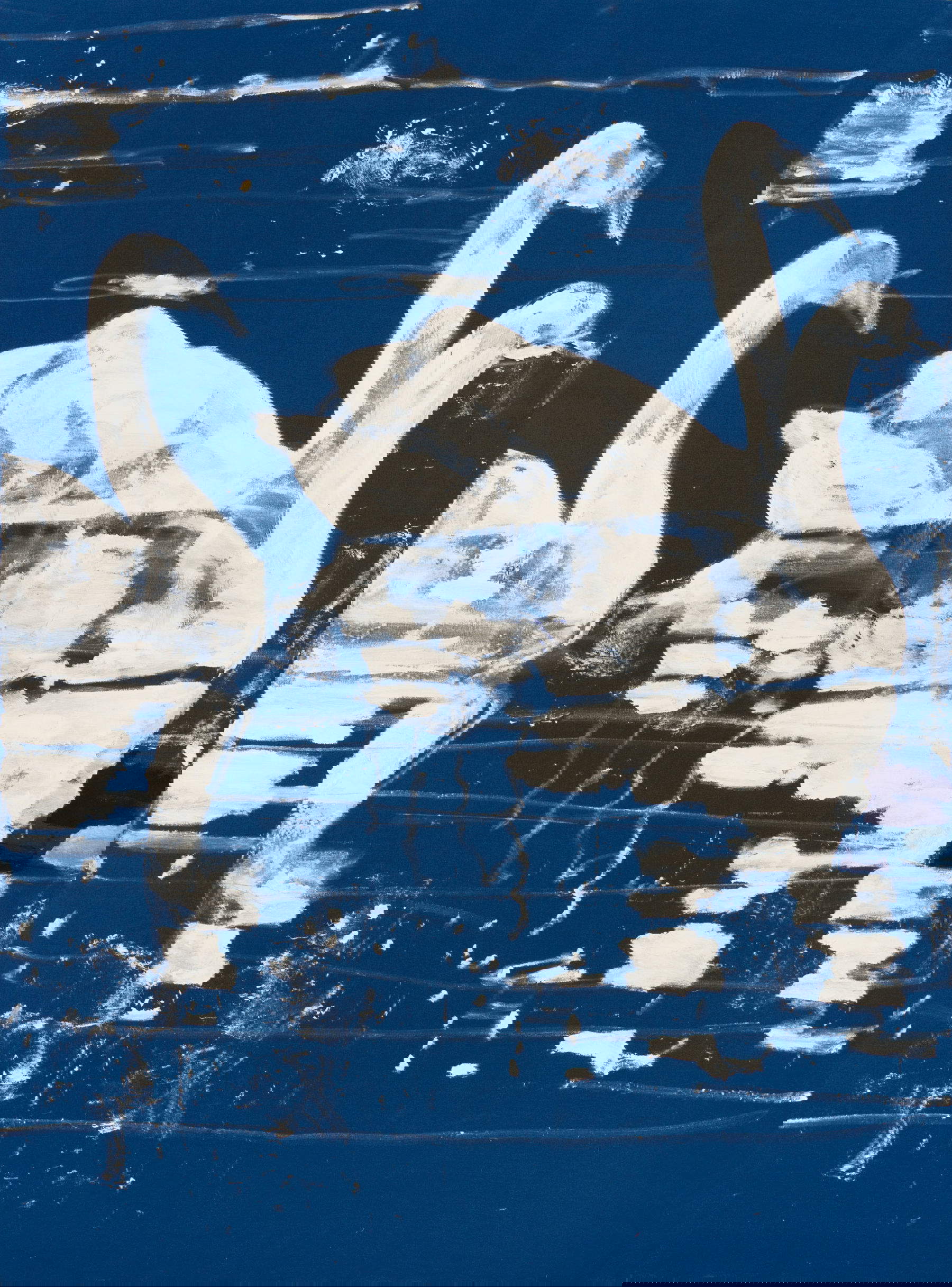
A further chapter of the exhibition is represented by the cycle Du côté de chez swan, initiated in 2024 and subsequently developed into a series of coherent works. The canvases, all of the same format and characterized by blue or light blue backgrounds, feature the white figure of the swan repeated in horizontal sequences. The arrangement is reminiscent of the succession of film stills and implicitly refers to the studies on movement conducted in the late 19th century by photographer Eadweard Muybridge, known for his research on the decomposition of human and animal gesture that had a major impact on the visual arts of the 20th century. In Frangi’s work, reference does not take on an analytical or scientific dimension. Rather, the focus is on perception and the relationship with time. The repetition of the swan figure suggests a reflection on the difficulty of grasping reality in its entirety at the very moment it is observed, introducing an element of distance between visual experience and representation. The exhibition concludes with the intervention dedicated to the cloister well, which takes up and synthesizes the themes present in the previous sections.
“With his artistic research,” comments Diego Galizzi, curator and director of Imola Musei, “Giovanni Frangi offers us the chance to enter a seductive and somewhat elusive pictorial dimension, where the place of art blurs with reality and the sphere of memory, breaking down any pre-established boundary between abstraction and figuration. Proceeding by means of a fresh and fast execution, but at the same time strongly conscious, Frangi gives shape to a ’naturalism’ all his own, essentially subjective, participatory, founded on the one hand on the emotional value of the instant, on the other on the evocative power of the pictorial matter.”
"With Vera da pozzo," comments the Councillor for Culture of the Municipality of Imola, Giacomo Gambi, “the San Domenico Museum returns to broaden its gaze on contemporary art, this time through the work of an artist with great sensitivity who has been able to capture, and then return to the public with great elegance and essentiality, the poetry that is hidden behind the simplest manifestations of nature: a sheet of water rippled as swans pass by, a sky jagged with clouds, the irregular outline of an expanse of water lilies. Visitors will be able to appreciate, once again, the uniqueness of the cultural offerings of our civic museums and in particular the originality of a project that will accompany us through the summer, with side events and guided tours.”
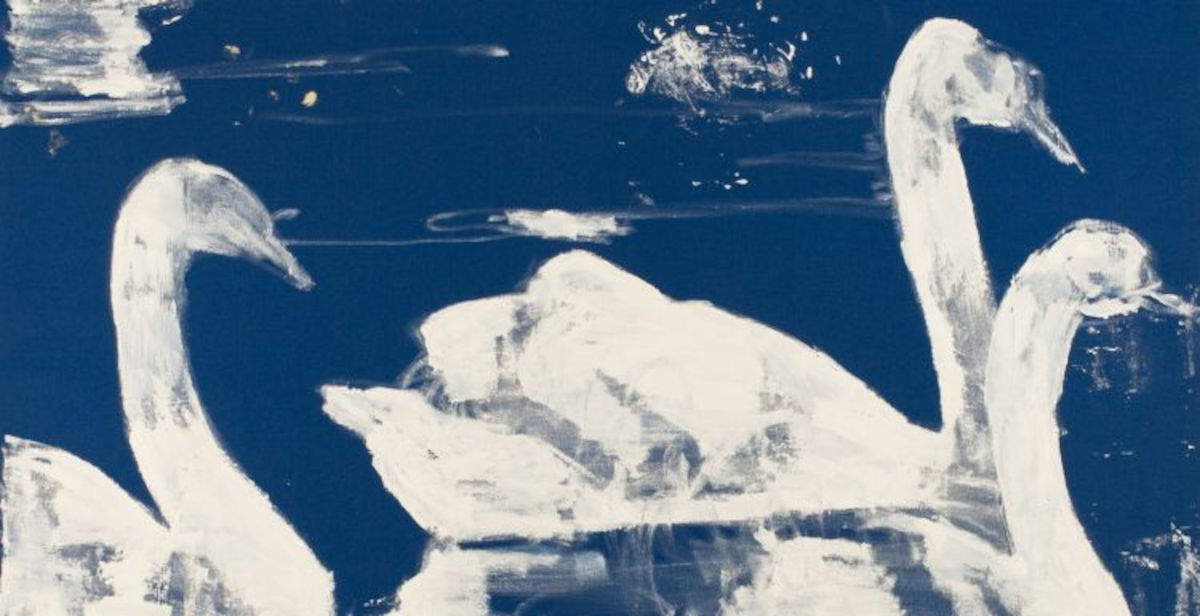 |
| Giovanni Frangi in Imola: at the San Domenico Museum, the monographic exhibition Vera da pozzo |
Warning: the translation into English of the original Italian article was created using automatic tools. We undertake to review all articles, but we do not guarantee the total absence of inaccuracies in the translation due to the program. You can find the original by clicking on the ITA button. If you find any mistake,please contact us.