




by Redazione 23/04/2026



Categories: Exhibitions / Disclaimer
At the Munchmuseet in Oslo for the first time up close the decorative cycle created by Edvard Munch for the Freia chocolate factory. An exhibition that interweaves public art, workers' rights and women's emancipation
An art project created for a factory now becomes the focus of an exhibition that interweaves art, social history and rights. In fact, the Munchmuseet in Oslo is hosting from May 21 to October 11, 2026 the exhibition Edvard Munch and the chocolate factory dedicated to the decorations created by Edvard Munch (Løten, 1863 - Oslo, 1944) for the Freia chocolate factory, offering for the first time to the public the opportunity to look closely at these monumental works along with preparatory sketches and archival materials. The large canvases were commissioned in 1923 and represent a pioneering case in art history: in fact, they are the first decorative works ever created specifically for a factory and, in particular, for a women’s company cafeteria. Today, thanks to the temporary relocation from Freia’s historical headquarters to the Munchmuseet, the painting cycle is accessible in an exhibition context that enhances its details and deepens its meaning.
The exhibition builds on the frieze created by Munch for the factory and develops as an investigation of his interest in art in public spaces. In parallel, it reconstructs the social context in which the project was born. In the early 1920s, Freia was considered one of the most modern and progressive companies in Norway, concerned with the welfare of its employees. Two-thirds of the workforce were women, and it was for them that the canteen decorated by the artist was intended. The exhibition highlights the role of women workers and their path to emancipation, emphasizing the link between industrial production and social rights.


The decorative project was born on the initiative of Johan Throne Holst, a central figure in the company’s development, who wanted to introduce art into the factory to improve the quality of life for employees. It was Georg Dedichen, head of the Freia workshop and Munch’s childhood friend, who initiated negotiations with the artist in 1921. That same year Munch submitted a proposal that included twelve paintings for the women’s canteen and six for the men’s. Only the first series was chosen, completed in time for the company’s 25th anniversary in 1923.
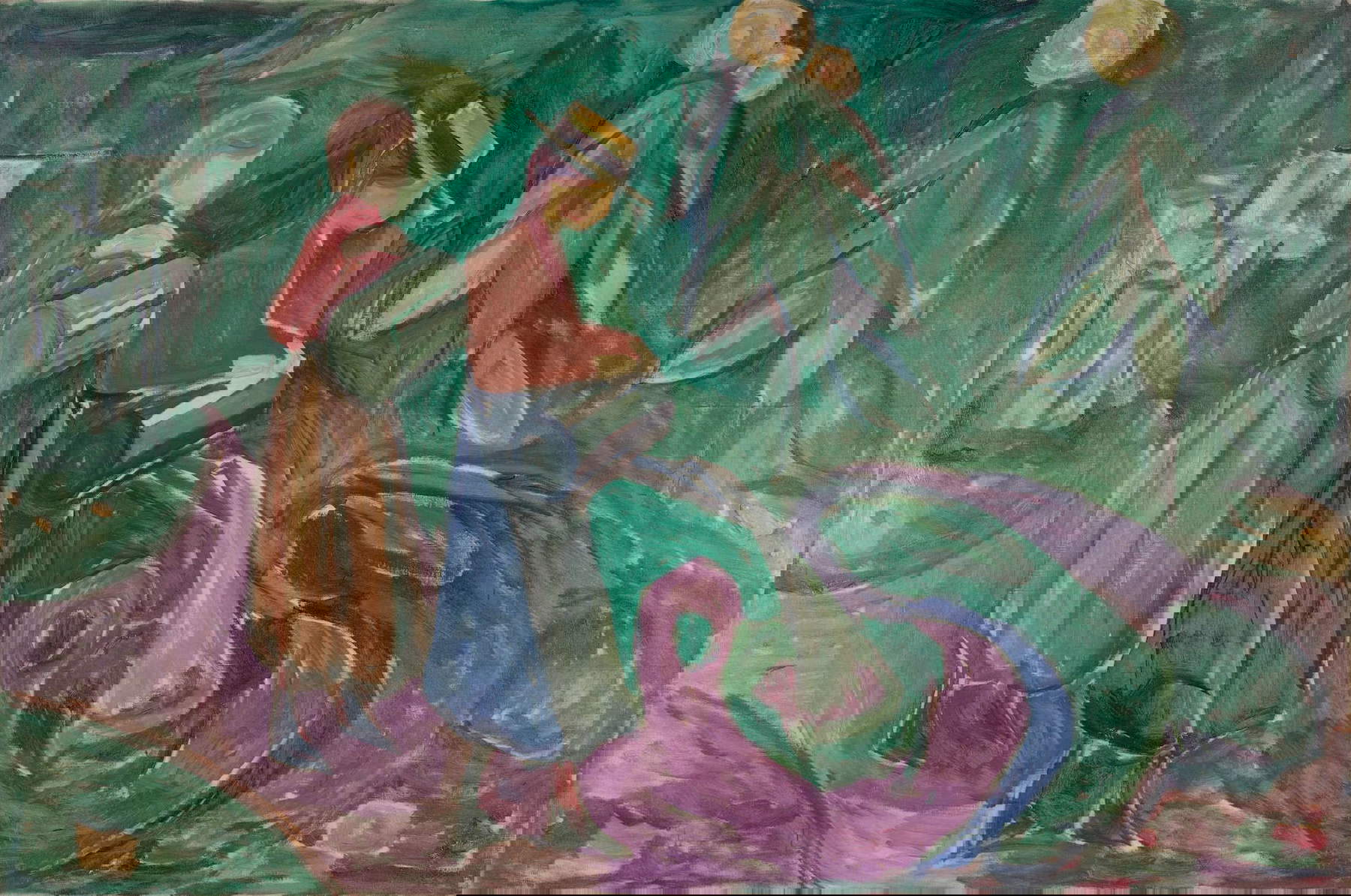
Despite the management’s enthusiasm, the reception by the workers was initially mixed. Some of the stylistic elements typical of Munch’s expressionism, such as figures without defined features or stylized architecture, caused perplexity among the workers, who went so far as to demand changes to the images. To maintain a serene atmosphere inside the factory, Munch agreed to intervene again on the works, adding details such as doors and chimneys. However, one episode that has remained in memory tells of his sudden reaction: annoyed by an organizational mishap, the artist abandoned the work before completing all the changes, leaving some parts deliberately unfinished.
While the judgment of the workers was initially uncertain, critics of the time enthusiastically welcomed the decorations. Newspapers emphasized the exceptional nature of the intervention, calling the factory canteen a unique space in the world’s industrial landscape. Over time, the historical and artistic value of the cycle was further recognized: in 2015 the Freia room was declared a protected property by the Norwegian authorities, with an explicit reference to the importance of Munch’s works.
The exhibition at the Munchmuseet also delves into the artist’s creative process through the display of preparatory sketches and related works from the museum’s collection. These materials highlight his interest in recurring themes such as work, childhood and the female figure. A wide selection of documents and archival materials also enables the reconstruction of living and working conditions in the factory, offering a glimpse of Norwegian society at a time of transformation.
The frieze created for the Freia is part of Munch’s broader research on pictorial series. The artist was particularly fascinated by the possibility of creating cycles of interconnected images, in which the dialogue between individual works generated overall meaning. In Norway, apart from the Freia cycle, only the decorations of the University Hall represent an example of this kind of intervention.
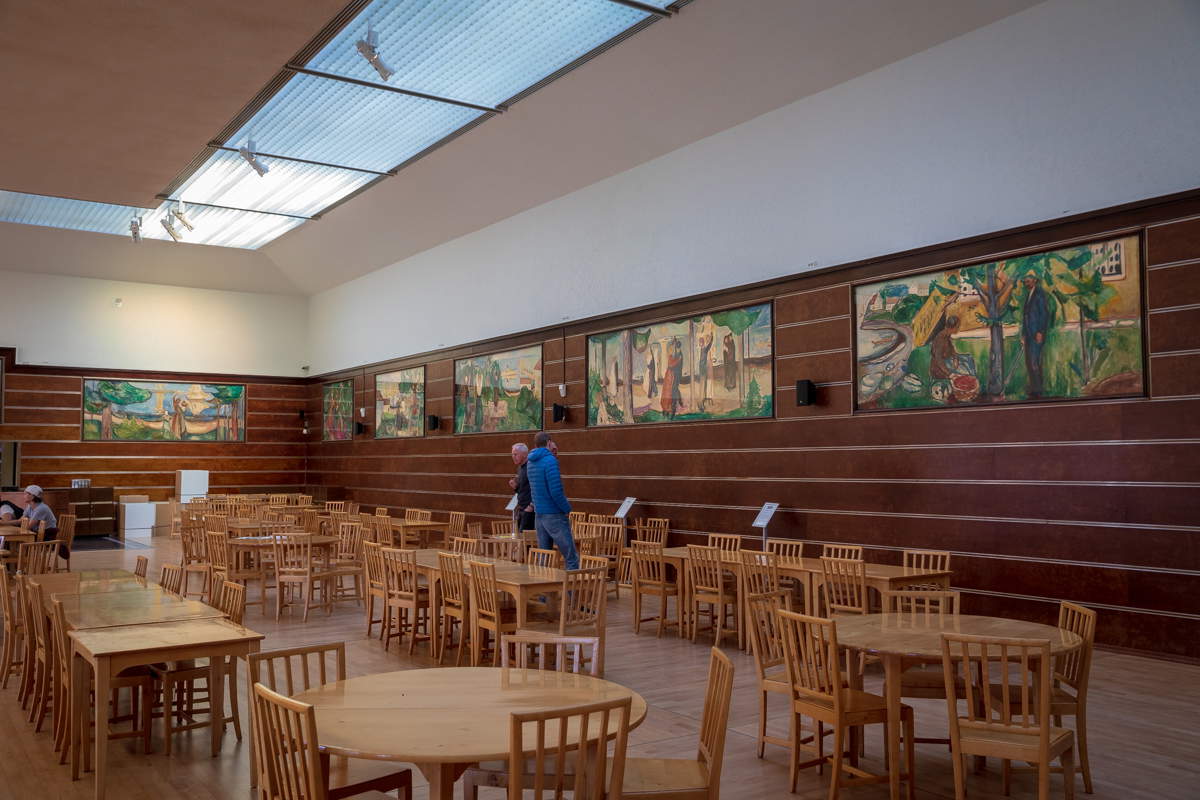
Iconographically, the works take up motifs already found in other cycles created in Germany, such as the Linde-frieze and the Max Reinhardt-frieze, as well as elements of the famous Frieze of Life. The paintings convey a sense of harmony, tranquility and vitality, with scenes set in a summer landscape reminiscent of Åsgårdsstrand, where Munch owned a house. The subjects depict moments of work and leisure, with figures of different ages immersed in a natural setting.
In 1934, with the construction of the Freiasalen, a large dining hall capable of seating up to 700 people, the works found a new location that fully enhanced their monumental dimension. Designed by architect Ole Sverre, the hall quickly became a cultural landmark. The environment, characterized by modern architectural solutions and careful integration with Munch’s works, hosted events, lectures and concerts, attracting thousands of visitors even in the first weeks after its opening.
Munch himself expressed satisfaction with the new arrangement of his works, recognizing how the space helped enhance their visual and symbolic impact. In some of his reflections, he defined the Freia cycle as a transposition of the Frieze of Life into a different context, related to the world of work and the daily life of a community.
The current exhibition is thus an opportunity to reread this project in light of the social and cultural transformations of the 20th century. Through the dialogue between art and the industrial context, the exhibition highlights how Munch’s work can be interpreted not only as an individual expression, but also as a tool for collective reflection on issues of labor, identity and rights.
|
| Norway, works Munch painted for chocolate factory on display in Oslo |
Warning: the translation into English of the original Italian article was created using automatic tools. We undertake to review all articles, but we do not guarantee the total absence of inaccuracies in the translation due to the program. You can find the original by clicking on the ITA button. If you find any mistake,please contact us.