



by Redazione 19/03/2026



Categories: Exhibitions / Disclaimer
From March 26 to September 20, 2026, the Museo Civico d'Arte Industriale and Galleria Davia Bargellini will host a unique work by Marcantonio Franceschini, made as a confidential model for his son Giacomo Maria, never before exhibited to the public.

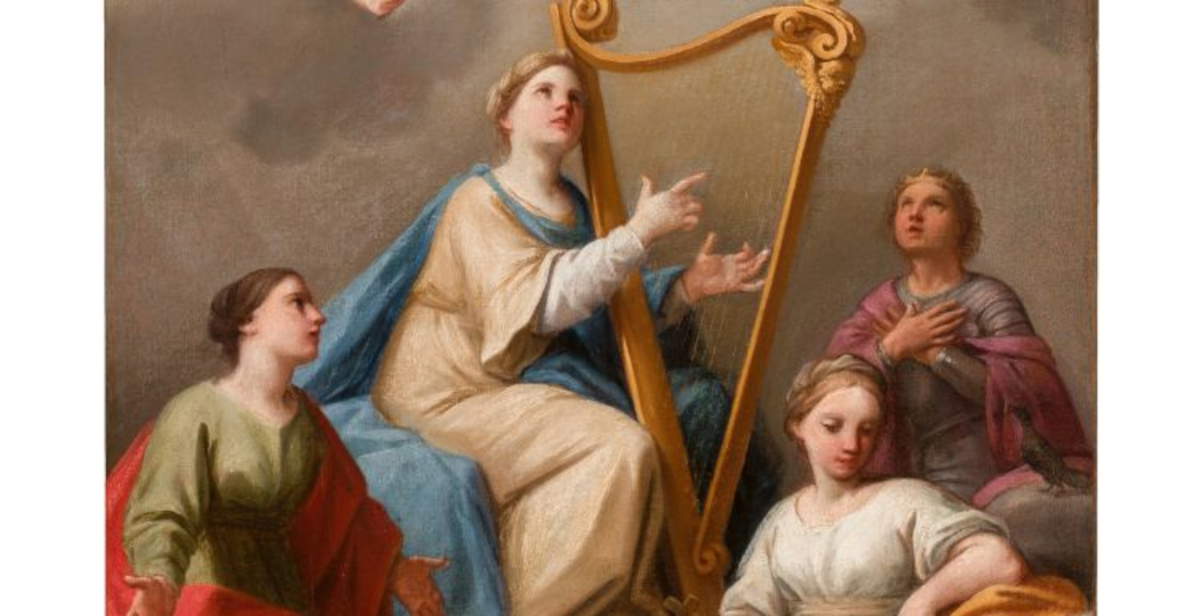
From March 26 to Sept. 20, 2026, the Municipal Museums of Ancient Art of the City of Bologna will host a painting by Marcantonio Franceschini (Bologna, 1648 - 1729) from a private collection at the Museo Civico d’Arte Industriale and Galleria Davia Bargellini. The work, titled Saint Cecilia in Glory with Saints Lucy, Margaret of Antioch, and Oswald of Northumbria, represents an unpublished model of the Bolognese artist’s production and provides an opportunity for study and comparison with the paintings of his school in the museum. The public presentation will take place on Wednesday, March 25, 2026 at 5:30 p.m. The exhibition Secret Franceschini. A Model Revealed, curated by Antonella Mampieri, offers the opportunity to reread with greater attention, through a direct comparison, the numerous paintings by the master and his school preserved in the museum’s rooms and made for the Bargellini family.
Franceschini is placed within the great Bolognese painting tradition ranging from the Carracci to Donato Creti. A pupil of Giovanni Maria Galli, known as Bibiena, and later of Carlo Cignani, he worked closely with Luigi Quaini, with whom he executed frescoes in important city buildings, including the porticoes of San Bartolomeo, Santa Maria dei Servi and the apse of the basilica of San Petronio. Starting in 1680, Franceschini developed an independent career, decorating palaces such as Ranuzzi, Monti, and Marescotti and producing numerous altarpieces for churches in Bologna and Italy. Despite requests from abroad, he preferred to keep production at home, sending works to Madrid, Vienna and Germany and moving only for important assignments to Genoa and Rome. His efficient and well-organized workshop included his son Giacomo and brother-in-law Luigi Quaini, as well as numerous collaborators, and enabled him to manage production on a large scale. Franceschini was among the founders of the Accademia Clementina, helping to consolidate the classicist Bolognese model based on Carracci, Guido Reni, and Domenichino.


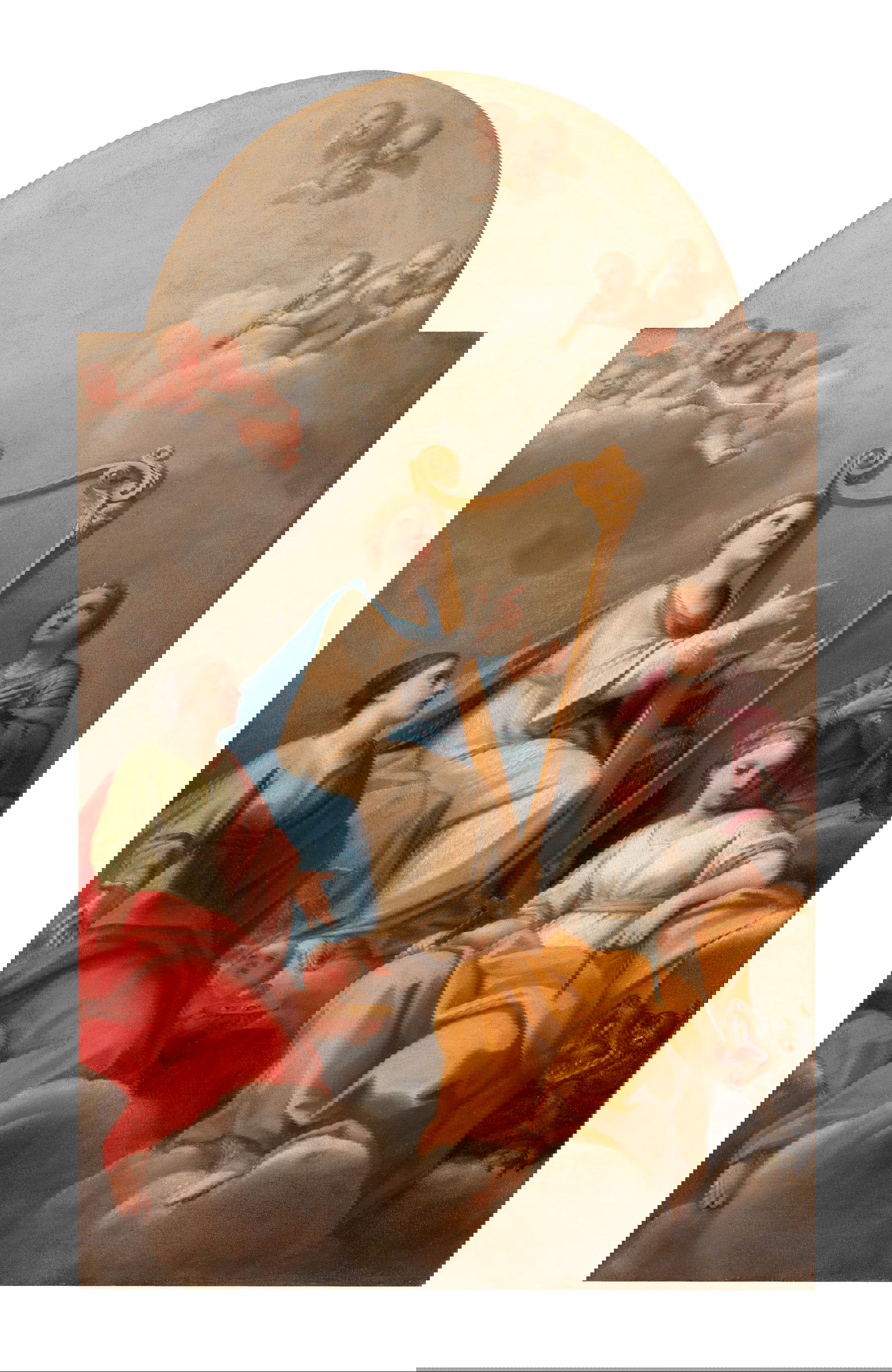
The work on display, a small canvas from 1711 (64 x 38 cm), represents the only known surviving model among the preparatory ones made by Franceschini. Its existence was unknown until recent archival research, and it reveals the confidential work intended for his son Giacomo Maria, who was in turn engaged in making an altarpiece for the church of Santa Maria Incoronata. The small canvas, although conceived as a preparatory model, shows a level of finish and compositional care unusual for works of this type, giving the painting significant artistic value. The subject includes the saints Cecilia, Margaret of Antioch and Lucy, historically venerated in the chapel of the Bentivogli Paleotti Coltelli family, and later the figure of St. Oswald of Northumbria, linked to the Anglo-Saxon connections of a branch of the Paleotti family.
The church of Santa Maria Incoronata, at 13 Via San Giacomo in Bologna, provides an important, if little-known, historical context. Built in 1465 by the Confraternity of Santa Maria Incoronata del Suffragio to house a 14th-century panel painting attributed to Simone de’ Crocifissi, the church has undergone closures and reconversions, including conversion to a women’s boarding school in the 19th century. Restructuring in the 18th century standardized the interior style in a “Baroque” key, with pictorial and sculptural decorations still preserved today. Currently, a restoration promoted by the Committee for Historic and ArtisticBologna and carried out by theAcademy of Fine Arts of Bologna aims to restore the church to its original appearance.
To learn more about the painting and its artistic context, the museum is organizing free guided tours and lectures, with reservations required subject to availability. Scheduled guided tours, curated by Antonella Mampieri and Mirko Bonora, include appointments on April 12, May 9 and 6 and June, Aug. 30 and Sept. 12. The lectures will take place at Palazzo Segni Masetti and will address topics such as the continuity between the paintings of Carlo Cignani and Franceschini, the organization of the master’s workshop and the social and architectural history of the church of Santa Maria Incoronata, with talks by Angelo Mazza, Mirko Bonora and Antonio Buitoni.
The exhibition is part of a program to rediscover the church, enhanced through the workshop-school of the Academy of Fine Arts of Bologna and the special openings organized during the FAI Spring Days, March 21 and 22, 2026. Students, together with teachers, guide visitors to discover the history of the church, from the original construction to the ongoing restoration, with special attention to architectural and artistic elements, including works by Bigari, Bertuzzi, Sandoni and the contribution of Giacomo Maria Franceschini. In this context, the building once again becomes a place of historical and artistic interest, offering a more complete reading of 18th-century Bologna and its religious communities.
In parallel, the volume La Chiesa e il Santuario di Santa Maria Incoronata in Bologna, edited by Daniele Benati, Mirko Bonora, Antonio Buitoni, Irene Graziani and Angelo Mazza, presented on March 19, 2026 at the Archiginnasio Library, traces the history of the church through archival documentation and field research. The text offers a detailed picture of the restorations, decorations and works present, accompanied by an extensive iconographic set of unpublished images of often neglected corners and works, restoring an in-depth reading of a monument that has long remained inaccessible.
Tours of the church of Santa Maria Incoronata will be conducted on April 14 and May 19, 2026, at 3:30 p.m., by the Academy of Fine Arts of Bologna and the Committee for Historic and Artistic Bologna. Participation is free with reservations required, while during FAI Spring Days admission will be free, even without reservations, with guided tours by Apprentice Tour Guides from city high schools. Access is limited for safety reasons and is not usable by people with disabilities due to architectural barriers.
 |
| Secret Franceschini: in Bologna, the unreleased model of Santa Cecilia in glory |
Warning: the translation into English of the original Italian article was created using automatic tools. We undertake to review all articles, but we do not guarantee the total absence of inaccuracies in the translation due to the program. You can find the original by clicking on the ITA button. If you find any mistake,please contact us.