




A medal from the first Modern Olympic Games in Athens in 1896 sold for 900,000 Danish kroner, or 120,422 euros, excluding auction fees, during an online auction organized by the Danish house Bruun Rasmussen Arts Auctioneers. Including buyer’s fees, the total reached 1,152,000 Danish kroner, equivalent to 154,140 euros. The result marks one of the most significant sales in numismatics in the history of the house.
The medal, initially estimated at between 200,000 and 300,000 Danish kroner, tripled expectations, attracting the interest of collectors from around the world. The object represents a legendary specimen related to the birth of the modern Olympics and stands as a piece of sporting and cultural history of absolute rarity. According to Christian Grundtvig, head of the auction house’s Coins and Stamps department, the result achieved testifies to the exceptional nature of the lot. “We are absolutely thrilled with today’s result,” he said. “The Olympic medal represents a ’unicorn’ among international collectors, a rare fusion of Olympic history and cultural history. It is an heirloom of such extraordinary caliber that news of the sale has reached audiences around the world. It is, without a doubt, one of the most extraordinary sales in the field of numismatics in the history of our auction house.”
The first Olympic Games of the modern era were held in Athens in April 1896 and involved 241 athletes from 14 nations. The participating countries included Denmark, which won its first Olympic title in that edition with Viggo Jensen, winner in weightlifting. However, the auction house specifies that it cannot confirm whether the medal awarded is actually the one awarded at its victory.
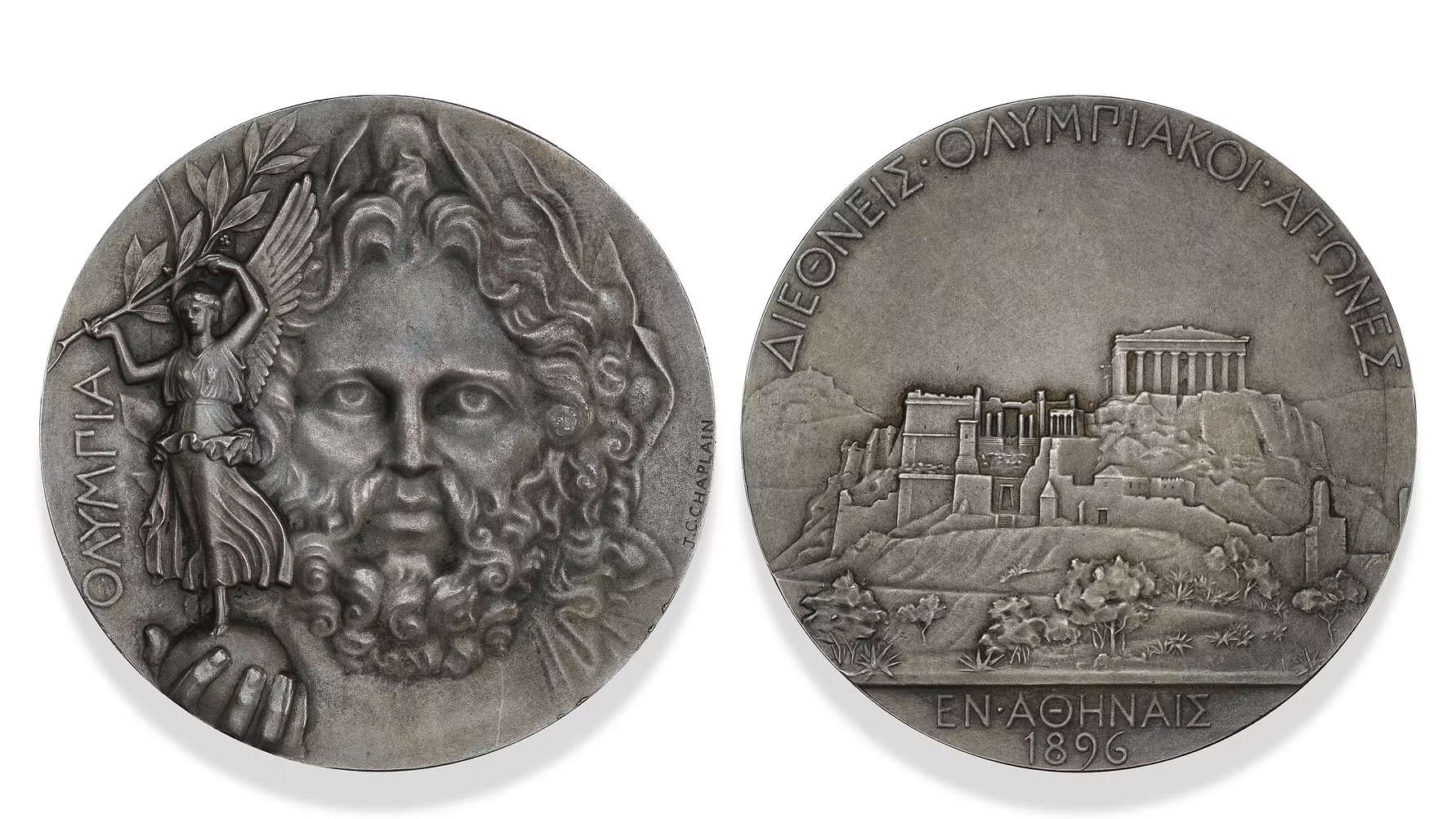
From an iconographic point of view, the medal is a work by French artist Jules-Clément Chaplain (Montagne-au-Perche, 1839 - Paris, 1909). On the obverse appears the laureate head of the Greek god Zeus, depicted holding an orb on which stands the goddess of Victory, Nike, with an olive branch. The reverse, on the other hand, features the Acropolis rock with the Parthenon and bears the Greek inscription “Διεθνείς Ολυμπιακοί Αγώνες - Αθήναι 1896,” referring to the International Olympic Games in Athens. The set of symbols recalls the classical legacy and the desire, specific to the 1896 edition, to ideally reconnect the present with the tradition of ancient Greece. The adjudication confirms the growing interest in memorabilia related to Olympic history and, more generally, in objects that mark founding moments in contemporary sport. The fact that the medal comes from the first edition of the modern Games further enhances its symbolic and collectible value, placing it among the most coveted pieces in the field.
Bruun Rasmussen has been selling art, design, jewelry, wristwatches, antiques and collectibles such as wine, books, coins and stamps since 1948. Considered the leading auction house in Denmark, it conducts more than 75,000 sales annually through online auctions at bruun-rasmussen.dk and live auctions at its Lyngby location. The facility employs specialists with long experience who are called upon to operate in an environment that requires in-depth expertise both in art history and in reading market trends.
Bruun Rasmussen also describes itself as one of the most modern and digital auction houses in Europe, emphasizing that innovation is part of its DNA while maintaining strong roots in the company’s history. In 2022, after three generations of family management, the company joined the international Bonhams Network, expanding its global presence and access to specialists worldwide. This integration makes it possible to present and sell works in the contexts deemed most appropriate with respect to potential buyers, strengthening the group’s international strategy. The sale of the 1896 Olympic medal fits into this framework of openness and global positioning.
|
| First Olympic medal from 1896 sold for 120 thousand euros |

Warning: the translation into English of the original Italian article was created using automatic tools. We undertake to review all articles, but we do not guarantee the total absence of inaccuracies in the translation due to the program. You can find the original by clicking on the ITA button. If you find any mistake,please contact us.





















 IT
IT FR
FR DE
DE ES
ES CN
CN