




by Redazione 18/03/2026



Categories: News / Disclaimer
The Ministry of Culture awards Ancona the title of Italian Capital of Culture 2028. The dossier interweaves sea, memory and innovation with more than 80 projects across museums, arts and urban regeneration, involving Italian and international artists and institutions.
Ancona has been proclaimed Italian Capital of Culture 2028. The announcement was made on Wednesday, March 18, 2026 by Minister Alessandro Giuli during the official ceremony held in the Spadolini Hall of the Ministry of Culture, in the presence of the selection jury and delegations from the finalist cities.
The winning project bears the title “Ancona. This Now,” an expression inspired by the words of poet Francesco Scarabicchi. The dossier builds a dialogue between historical memory and contemporaneity, identifying culture as the engine of a process of urban and social transformation. In this framework, the sea is indicated as a structural element and common matrix of initiatives, capable of connecting identity, landscape and planning.
The proposal is divided into four design macro-areas, conceived in relation to the geographical and historical configuration of the city: This Sea, Via Maestra, Now Park and Cultural Sea. The overall plan includes over eighty original and site-specific projects, entrusted to figures from the Italian and international cultural scene. They include Oscar-winning set designer Dante Ferretti, director Abel Ferrara, and scholars and curators such as Francesco De Melis, Enrico Maria Dal Pozzolo, Marco Ansaldo, Gabriele Simongini, Rachele Dubbini, Giuliana Giusti, and Gabriele Tinti. The program also involves artists and musicians such as Dardust and the Quiet Ensemble collective.


The macro-area “This Sea” focuses on the cultural reactivation of the port area and the historical relationship between the city and the sea, interpreted as a scenic and productive space. The main projects include a cinematic narrative of the Arch of Trajan entrusted to Abel Ferrara, along with the creation of a Visual and Sound Archive of the Sea curated by Francesco De Melis. The program also includes a network of relations with cities on the Adriatic shore such as Dubrovnik, Split, Zadar and Venice, which have joined the dossier. The relaunch of the Adrjo digital platform, promoted by the Port Authority of the Adriatic Sea System, is also part of this context.
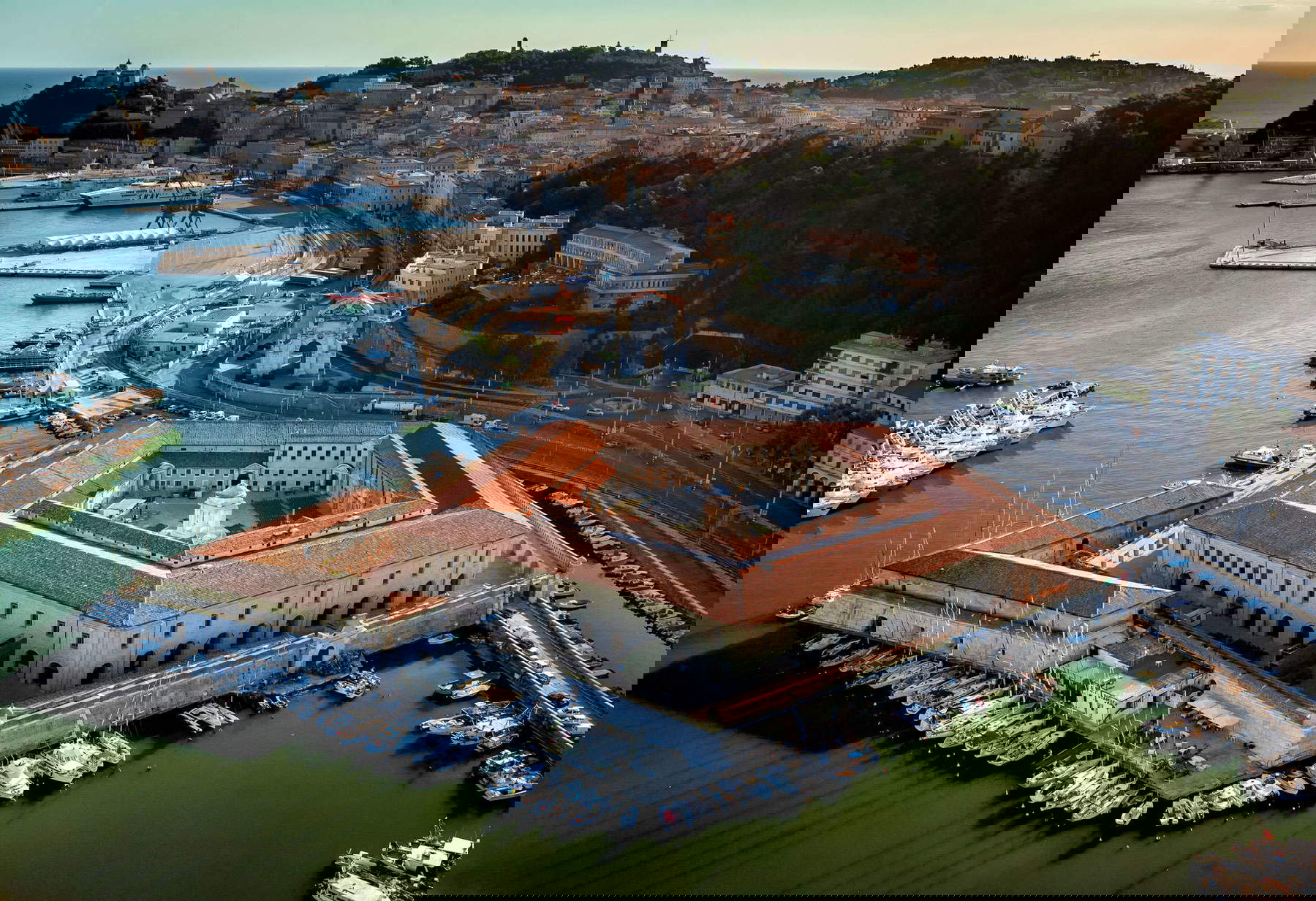
A central role in the project is assigned to the Mole Vanvitelliana, identified as one of the city’s main cultural hubs. The Museum of the Civilization of the Adriatic Sea, directed by Dante Ferretti, should be built here, flanked by a program of research and exhibitions including the “Trilogy of the 1900s” curated by Gabriele Simongini. Planned initiatives also include the Center for Contemporary Talent, in line with regional regulations on cultural and creative industries, and Design Sea Week, developed with the involvement of Confindustria.
The second route, “Via Maestra,” follows the axis of the historic center to the acropolis and is connected to the figure of humanist Ciriaco d’Ancona. An Intercultural Dialogue Award developed in cooperation with the Permanent Secretariat of the Adriatic Ionian Initiative is dedicated to him. This axis coincides with the urban museum network, which includes the National Archaeological Museum of the Marche and the Francesco Podesti Civic Art Gallery, institutions that from 2026 will test the Ministry’s guidelines for city museum networks.
This will include research and in-depth exhibitions promoted by institutions such as the Archaeological Museum, the Soprintendenza and the University of Ferrara. The Pinacoteca Civica will host a multi-themed exhibition cycle: the Adriatic Renaissance and the figure of Lorenzo Lotto, curated by Enrico Maria Dal Pozzolo; a reconstruction of the representation of Ancona between Grand Tour and the work of William Turner, curated by Giovanna Capitelli, with digital contribution from the Università Politecnica delle Marche; and an itinerary dedicated to female art and culture, linked to the symbolic figure of Venus.
Within the same director are projects that delve into the international dimension of the city. At the headquarters of the Marche Chamber of Commerce, along the Loggia dei Mercanti, the figure of Cinzio Benincasa, ambassador to the court of Matthias Corvinus in the 15th century, will be reconstructed. The relationship with Budapest will be further developed through an exhibition project on Lorenzo Lotto planned for 2027 at the Hungarian capital’s National Museum. The dossier also enhances Ancona’s historical role as a gateway to the East and a hub of trade with the Mediterranean and the Balkans, in connection with the Marche hinterland and with productions such as Fabriano paper.
The Museo di Ateneo of the Università Politecnica delle Marche is participating with a project dedicated to the history of scientific research, proposing a museum model oriented toward popularization. At the same time, Ca’ Foscari University Venice is developing a study program on the Ancona dialect under the guidance of Giuliana Giusti, with activities also aimed at the scholastic world.
The third macro-area, “Adesso Parco,” relates natural heritage and cultural production, with Cardeto Park at the center, overlooking the sea and ideally connected to Conero Park. The latter is currently a candidate for Geopark status under the auspices of UNESCO. Within Cardeto, where the Jewish cemetery founded in the 15th century is also located, 2028 will coincide with the 600th anniversary of the site’s founding. Immersive poetry gardens dedicated to Francesco Scarabicchi and Franco Scataglini are planned in this context.
Cultural itineraries are a central element of the project. Ancona intends to fit into the system of Council of Europe-certified itineraries, including Destination Napoleon and Atrium, integrating them with thematic routes related to Greco-Roman, Byzantine, Renaissance and Vanvitellian history.
The fourth directorate, “Cultural Sea,” proposes the sea as a platform for contemporary artistic production. The program includes digital and performing arts coordinated by entities recognized by the Ministry through the National Live Performing Arts Fund. The main implementers include Marche Teatro and the Fondazione Teatro delle Muse, which is responsible for the city’s opera season.
The project also involves festivals already active in the area, such as Adriatico Mediterraneo, Popsophia and Pensiero Plurale. Adriatico Mediterraneo will host a new program dedicated to geopolitics directed by Marco Ansaldo. The artistic calendar includes site-specific interventions and the participation of artists such as Dardust, Subsonica and Quiet Ensemble.
A relevant part of the project concerns the use of digital technologies, with videomapping interventions and audiovisual installations on symbolic places such as Trajan’s Arch and Passetto. The goal is the creation of a hub dedicated to audiovisual production, gaming and digital creativity, with the support of Rainbow, the Marche Polytechnic University and the Fondazione Marche Cultura - Marche Film Commission.
The dossier devotes ample space to issues of accessibility and cultural welfare. One point of reference is the Omero State Tactile Museum, considered an international model for museum accessibility. Digital technologies have been developed in collaboration with the Marche Polytechnic University, while cultural welfare policies align with recent ministerial measures.
Economically, the project includes investments of more than 50 million euros for urban regeneration interventions, plus 70 million allocated by the Office of the Extraordinary Commissioner for the 2016 earthquake reconstruction. The cultural program, should it be awarded the title, will have a budget of about 7 million euros, managed by a steering committee led by the City and implemented by Marche Teatro, chaired by Valerio Vico and directed by Giuseppe Dipasquale.
The bid was promoted by the City of Ancona together with the Marche Polytechnic University, the Marche Region and ANCI Marche. Numerous institutional stakeholders joined the dossier, including the Archdiocese of Ancona-Osimo, the Port Authority, the Chamber of Commerce, Confindustria and the Federation of Adriatic Ionian Cities, as well as the Conero Regional Park and the Conero Riviera.
State institutions involved include the Soprintendenza Archeologia Belle Arti e Paesaggio for the provinces of Ancona and Pesaro Urbino, the Marche Regional Museums Directorate, the Marche National Archaeological Museum, the Museo Tattile Omero, the Ancona State Archives, the Marche Archival and Bibliographic Superintendence and the Central Institute for Intangible Heritage.
In recent months, the network of partners has expanded further with the membership of the Federico Zeri Foundation of the University of Bologna, the Accademia Nazionale di San Luca, the Circuit of Young Italian Artists and the Cassa di Risparmio di Fabriano, Cupramontana and Marche Foundations. Economic support also involves investee companies of the municipality and the Chamber of Commerce.
The dossier was developed by a multidisciplinary directorate. Cultural direction and institutional governance are entrusted to Marta Paraventi, administrative and project management to Viviana Caravaggi, creative direction and design to Anghela Alò, digital innovation and university coordination to Paolo Clini, and European strategy and relations with the European Union to Barbara Toce.
 |
| Ancona is the Italian Capital of Culture 2028, "This Now" project wins |
Warning: the translation into English of the original Italian article was created using automatic tools. We undertake to review all articles, but we do not guarantee the total absence of inaccuracies in the translation due to the program. You can find the original by clicking on the ITA button. If you find any mistake,please contact us.