





Important archaeological discovery in the heart of Ancona’s historic center: a few steps away from the Church of San Gregorio Illuminatore and the so-called House of the Florentines, excavations started on March 30, 2026 have brought to light a monumental wall structure, most likely dating back to Roman times, which, in terms of size and construction quality, has no direct comparison in the city’s urban archaeological landscape.
The discovery occurred as part of excavation essay C4, included in the safety works and archaeological investigations financed through funds provided by Article 1, paragraph 140, of Law 232/2016. The identified structure is developed with a northwest/south-east orientation and is made of large squared blocks of local stone with a chalky component. The construction technique employs alternating orthostats and regularly staggered rows, supplemented by fills in opus caementicium and brecciated material according to the system of “sack” masonry, typical of large Roman public works. The dimensions that emerged are particularly significant: the wall is preserved for about 4.5 meters in height, has an estimated thickness of more than 4 meters and an already investigated length of about 10 meters, continuing beyond the currently explored limits. Three projecting pillars, arranged at regular intervals and made of calcarenite and sandstone with great executive precision, were also identified on the southeastern side. According to archaeologists, the structures surpass in impressiveness even the most important Roman remains known so far in Ancona, including those attributed to the so-called Temple of Venus in the area of the Cathedral of San Ciriaco.
The discovery also seems to find confirmation in historical sources. As early as 1811, Abbot Leoni described in the same area a building he called the “Imperial Palace,” characterized by large masonry in squared blocks, pillars leaning against the facade and sloping floors equipped with systems for water runoff. The evidence unearthed may correspond precisely to those structures identified more than two centuries ago, offering today the possibility of studying them through modern stratigraphic and technical analysis.
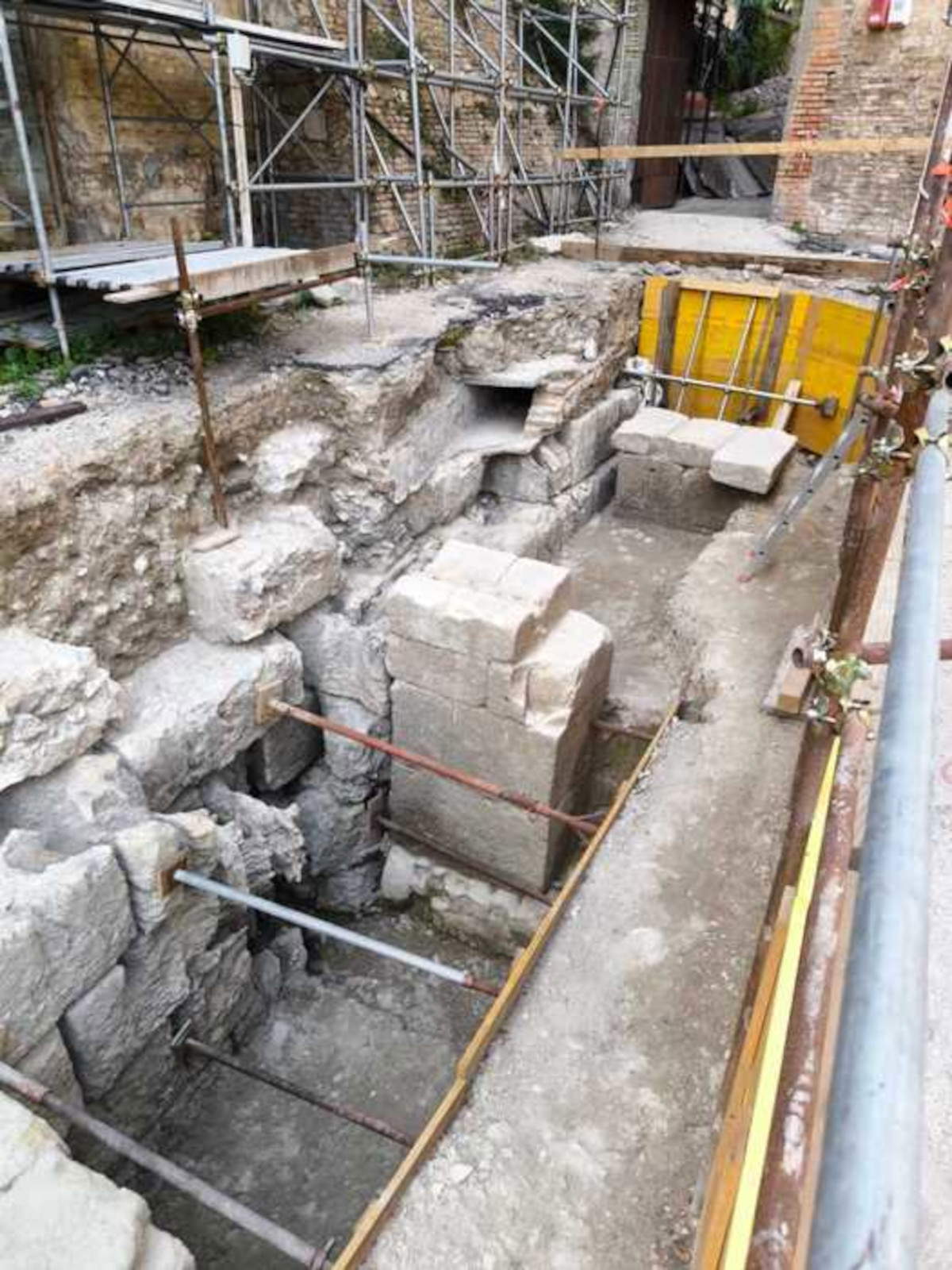
The location of the complex also helps underscore its importance. Indeed, the area is located in a strategic sector of the Roman city, near the amphitheater and in direct connection with the coastal front and the cliff system. Additional Roman wall remains are still visible along the slope, some of which have surfaced as a result of erosion and slope retreat. Scholars speculate that the structure was part of an articulated monumental urban system developed on several levels, designed to scenically enhance the relationship between the ancient city and the sea.
The finding takes on even greater significance in light of Ancona’s recent nomination as Italian Capital of Culture 2028, which was unanimously awarded by the jury and accompanied by a state grant of 1 million euros. The winning dossier, Ancona. This Now, identifies culture as a central tool for the urban, social and economic regeneration of the city. In this context, the emergence of a monumental structure of this magnitude represents a new and extraordinary testimony to the millennial history of Ancona, a city founded by the Greeks, a bridge between East and West and always deeply linked to the sea.
The Soprintendenza Archeologia, Belle Arti e Paesaggio for the Provinces of Ancona and Pesaro-Urbino chose to make the discovery known only after the completion of the first phase of investigations, which also involved the Casa dei Fiorentini. Here an orthogonal wall was identified, later reused as the wall of three rooms, which seems to belong to the same building complex. Excavation activities are still ongoing, and further results will be announced in the coming months through institutional channels.
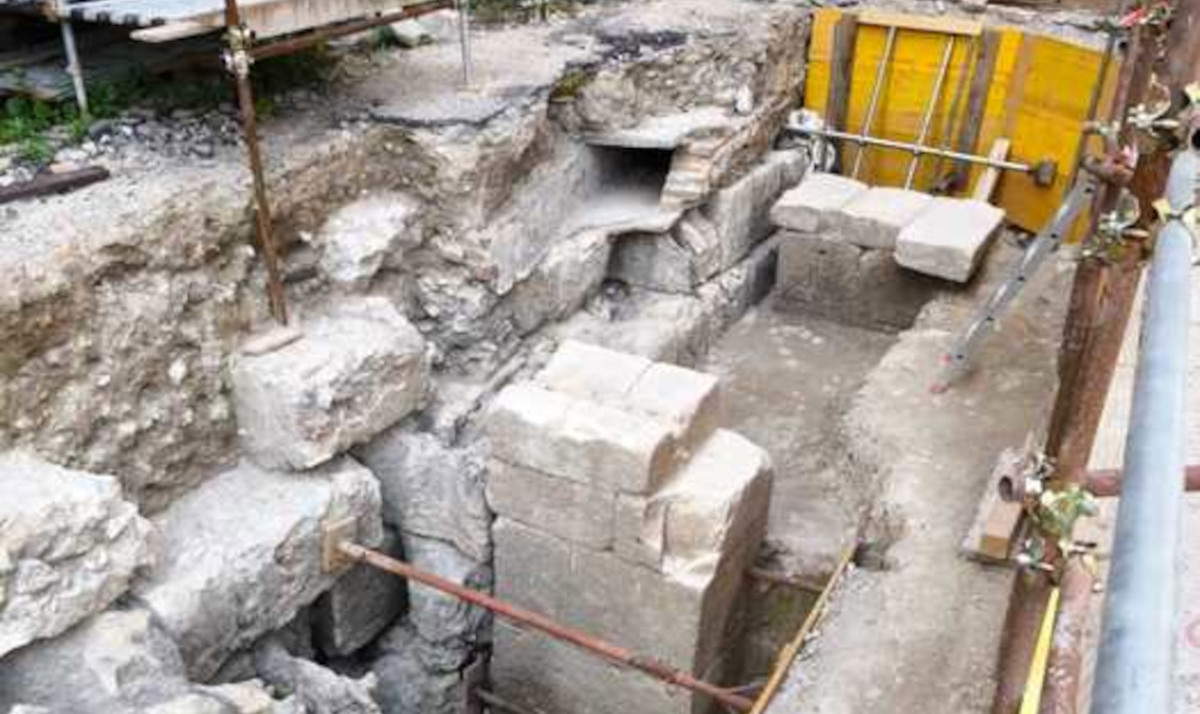 |
| Ancona, monumental Roman wall structure discovered in the heart of the city |

Warning: the translation into English of the original Italian article was created using automatic tools. We undertake to review all articles, but we do not guarantee the total absence of inaccuracies in the translation due to the program. You can find the original by clicking on the ITA button. If you find any mistake,please contact us.
















 IT
IT FR
FR DE
DE ES
ES CN
CN


