





Historic Poggioreale (Trapani) returned to visitors as a cultural asset, fifty-eight years after the Belìce earthquake. Mayor Carmelo Palermo called the event “an extraordinary achievement, because we transform the memory of these places into an urban regeneration project that will revive them with people and activities.”
Among the towns affected by the 1968 earthquake, Poggioreale has preserved part of its original architectural fabric: houses, buildings, churches and squares still tell the identity of the village before the tragedy. For this reason it has often been called the “ghost town,” a place suspended in time that restores the measure of the drama experienced by the population forced to abandon the village on the night of January 15, 1968.
Today, thanks to an urban regeneration intervention funded through the PNRR and the Ministry of Culture’s call dedicated to historic villages, historic Poggioreale is being returned as a cultural asset open to the community. Its architectural heritage represents a rare testimony of what a Belìce town looked like in the 1950s: a lively agricultural center made up of stores, churches, aristocratic palaces, a theater and the large Elimo square dominated by the bell tower of the mother church.
The inaugural ceremony, which took place on June 10, was attended by some seven hundred citizens along with numerous civil, religious and institutional authorities. Among those present were the Prefect of Trapani Daniela Lupo, Land and Environment Councillor Giusi Savarino representing the regional government, parliamentarians Giuseppe Bica, Cristina Ciminnisi, Margherita Rocca Ruvolo, Senator Maria Pia Castiglione, Segesta Archaeological Park Director Luigi Biondo, Trapani Regional Province President Salvatore Quinci, the provincial commander of theCarabinieri and delegates of the Police and Guardia di Finanza, the bishop of the Mazara diocese Angelo Giurdanella, who celebrated a religious service in honor of the patron saint, and numerous mayors from the provinces of Trapani and Agrigento.Also particularly significant was the presence of a delegation from Australia, where a large community of Poggiorealese origin lives today, led by Peter Maniscalco.
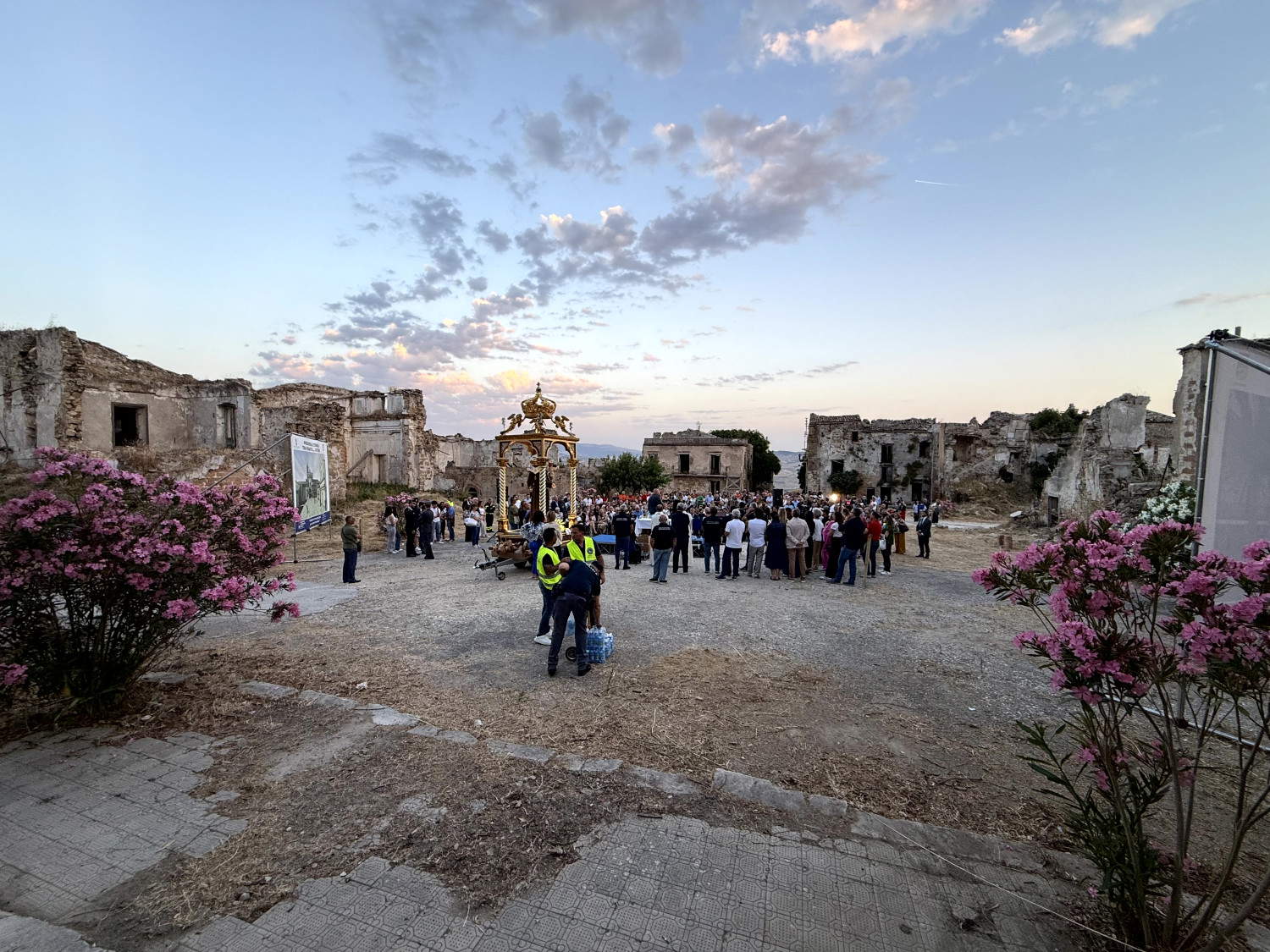
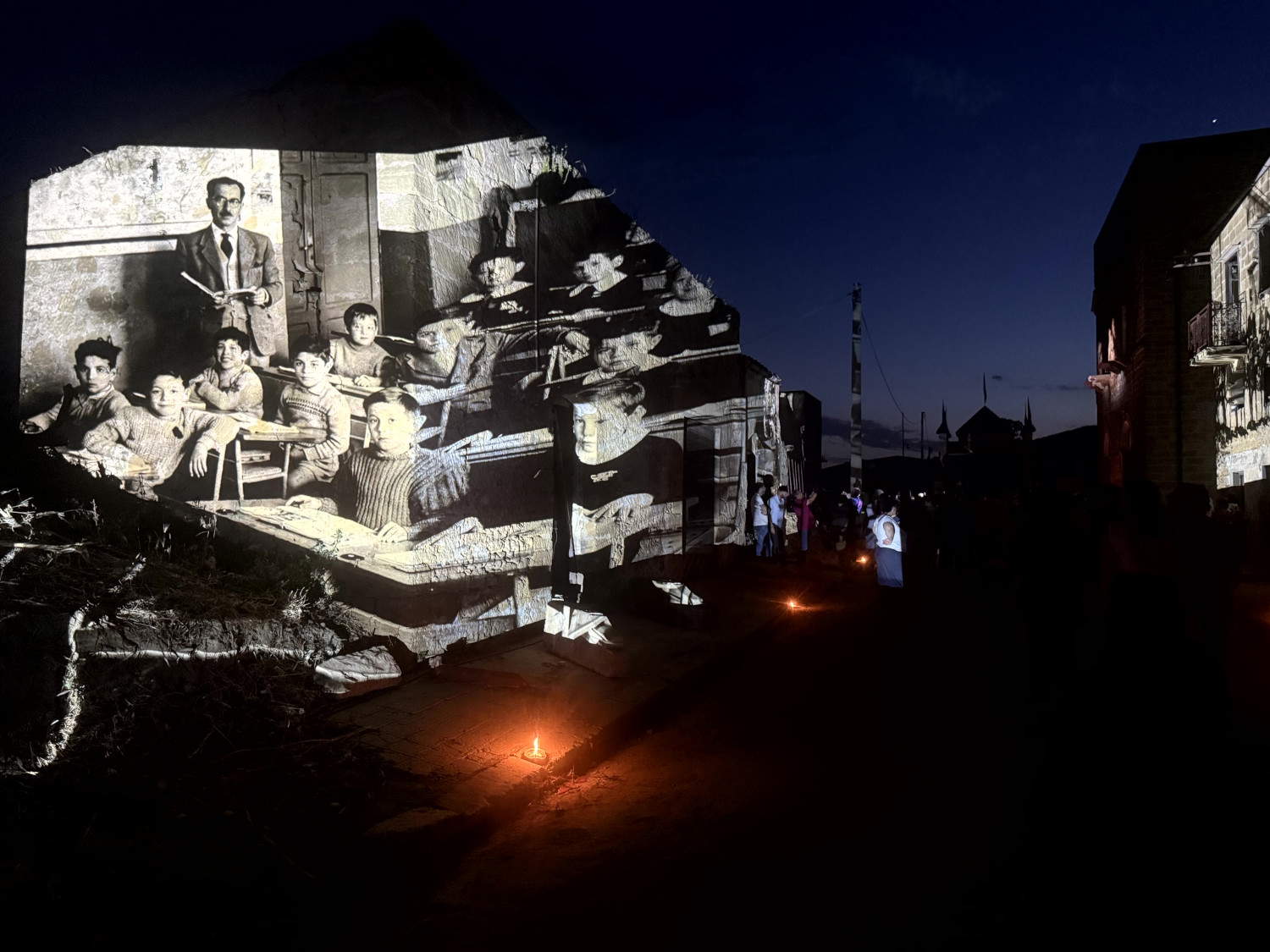
During the course of the day, the Multimedia Museum of Casa Agosta, conceived by Pino Di Buduo, Stefano Di Buduo and Lucenzo Tambuzzo, was inaugurated, offering an immersive journey into the memory of old Poggioreale through historical images and period projections. The most striking moment took place at sunset, when the procession of citizens accompanied the ferculum of St. Anthony in procession along Elimo Square. At that instant the torches and lights of Corso Umberto lit up, while on the facades of the abandoned houses, multimedia installations curated by the Potlach Theater and organized by the social cooperative “Creative Interlocks” came to life. Images and faces from the past appeared on the walls and crumbling buildings: weddings, folk festivals, Sunday lunches and scenes of daily life fifty-eight years ago. The historic photographs, retrieved through extensive research and cataloging, were animated through artificial intelligence, arousing great emotion especially among the older residents, who recognized relatives, friends and familiar faces now belonging to the collective memory.
The celebrations will continue through Sunday with the iART festival, which will animate both historic Poggioreale and the new town through concerts, literary meetings and performances. Among the most anticipated events is the concert by Roy Paci and the Aretuska, scheduled for June 12 in the new Poggioreale.
|
| Historic Poggioreale is reborn: the ghost town of Belìce reopens to visitors 58 years after the earthquake |

Warning: the translation into English of the original Italian article was created using automatic tools. We undertake to review all articles, but we do not guarantee the total absence of inaccuracies in the translation due to the program. You can find the original by clicking on the ITA button. If you find any mistake,please contact us.





















 IT
IT FR
FR DE
DE ES
ES CN
CN


