





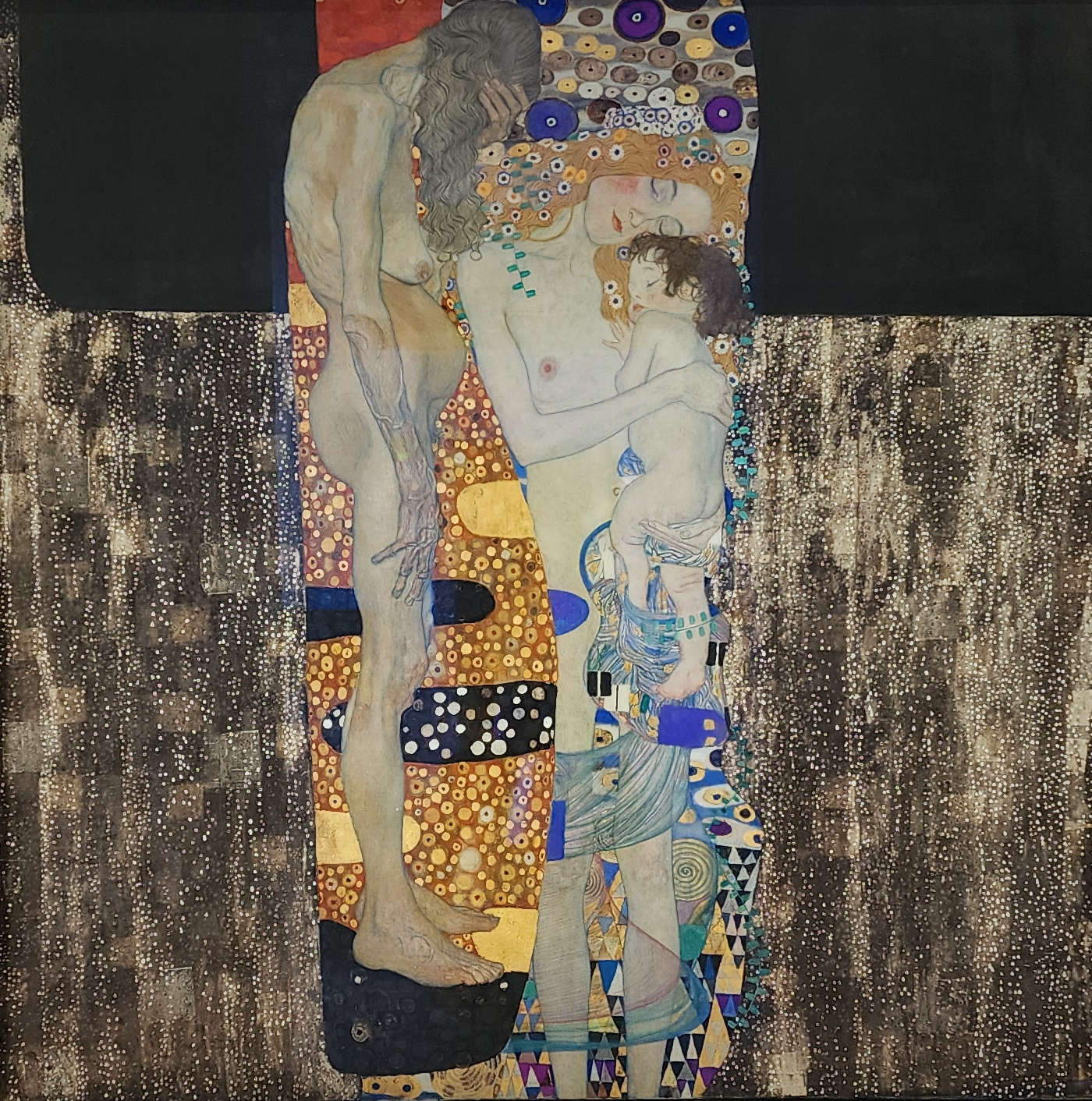
For what reasons, in May 2024, did the National Gallery of Umbria pay a sum of 100 thousand euros to the National Gallery of Modern and Contemporary Art for the loan of Gustav Klimt’s The Three Ages ? Was an exception made to the guidelines governing loans between state museums? Or are we facing a new and worrying practice that threatens to undermine the principle of cooperation between public institutions? We ask these questions in the wake of the operation involving the Perugia and Rome museums: the news was not leaked at the time, but a year and a half later, and published by the respective museums, for reasons of transparent administration, the data that allow us to derive this information, it seems entirely legitimate to reason about what happened. In the 2024 payments of the Perugia museum is in fact recorded, dated May 22, a transfer addressed to Gnam with the reason for payment “Loan work Gustav Klimt The Three Ages 1905 oil on canvas cm 171x171-inv.951”: it would thus seem to be a loan fee, i.e. a rental fee, paid a month before the opening of the exhibition A Masterpiece in Perugia. Klimt, The Three Ages, which ran until Sept. 15, 2024, and would have offered the Umbrian public the work of Klimt, with an outline of some drawings, paintings and ceramics by Galileo Chini. An exhibition, in short, exclusively centered on the masterpiece.
On the surface, it might not sound strange that a museum pays another museum a loan fee: we are talking, after all, about an increasingly common practice. The problem, however, is that the charging of a loan fee is a practice strongly discouraged by ICOM (International Council of Museums, the highest representative body of museums in the world), and that the Ministry of Culture asks its museums, state museums, not to charge any loan fee if the borrower is another state museum. Specifically, ICOM, in its 2019 Recommendation on Exhibition Loans , suggests that the Ministry of Culture "not make the granting of a loan conditional on the payment of a fee (loanfee) and not agree to pay a fee(loan fee) for requested loans, without prejudice to the possibility of of considering compensation for related expenses (costs related to administrative procedures, maintenance, preventive conservation and restoration work, preparation for handling the loaned work, for study and enhancement activities, etc.)". As for the Ministry, Circular 5 of June 3, 2025 (thus issued a year after the Klimt exhibition, but it should be specified that even before 2025 the MiC’s guidelines, at least as far as this writer is aware, were against loan fees among its institutions) invites state museums, while respecting their autonomy, “not to apply loan fees (loan fees)” when “the organizing party is another institution pertaining to the Ministry of Culture.” These principles should therefore prevail, at least in theory, over any contingent considerations. For example, the fact that Klimt’s The Three Ages is a much sought-after work (GNAM has lent it several times in recent years and, moreover, the masterpiece is also stopping in Perugia in the fall of 2024 for another exhibition dedicated to gold), or even forms of reciprocity (future exchanges of works, long and expensive scientific collaborations), or the’possible lack of enthusiasm on the part of the Roman museum in depriving itself (especially after a long tour abroad) of what is, to all intents and purposes, one of its most important assets (forgive the use of a term borrowed from business jargon), one of the reasons that drive the public to visit the institution.
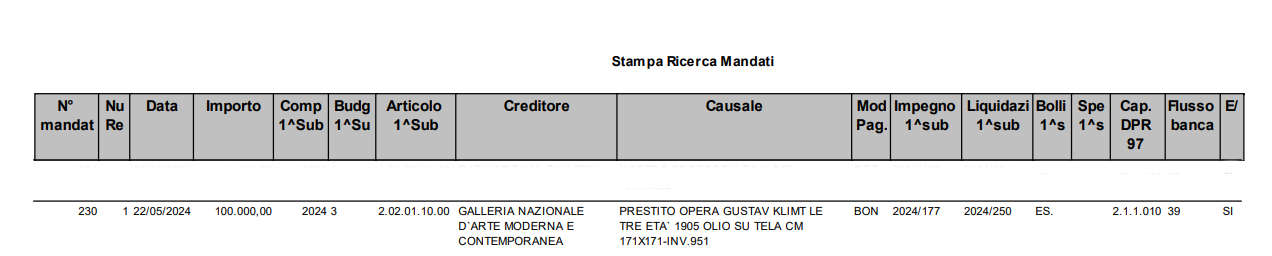
It is, moreover, a disproportionate fee. Scanning GNAM’s financial statements, one can easily see how in 2024 there is only one 100-thousand euro loan contract (it is not specified for which work, as is usual in the museum’s financial statements), followed by a 75-thousand contract and a 50-thousand contract. Often, however, the contracts include multiple works. In 2023, for example, GNAM entered into a 90-thousand contract with Civitas srl, an instrumental company of the Fondazione Cassa di Risparmio di Forlì that was organizing the exhibition L’arte della moda, but for the loan of six works (including the Gallery’s only Mondrian, Large Composition A). The year before, a Spatial Concept by Lucio Fontana was loaned to Hauser&Wirth for 10 thousand euros. This is, broadly speaking, the order of magnitude, and we can also add that GNAM, under the direction of Renata Cristina Mazzantini, has become particularly exorbitant (at least comparing the budgets with those of the previous management), since already a loan fee of 10 thousand euros is considered particularly high, especially if we then consider that usually the costs of transportation, insurance and set-up are borne by the applicant: the Perugia exhibition is no exception, with the National Gallery of Umbria having paid for the services, as is readily apparent from the payment data that can be found on the Ministry of Culture website.
Why, then, such an irritating transfer of money between two state museums, both belonging to the Ministry of Culture? The reason for the transfer does not leave much room for interpretation, after all: why then would the National Gallery of Umbria pay 100,000 euros to obtain the loan of the Klimt work? A masterpiece in Perugia. Klimt, The Three Ages was an exhibition devoid of scientific novelty, which could be justified solely on the basis of popularizing reasons (assuming, of course, that anyone finds acceptable the idea of moving from its location one of the only three works of Klimt ch’exist in Italy, a work that moreover at the time was coming from a lasting period of absence from Gnam due to a long tour in China, only to make it known to a different public) and the idea of attracting a new audience. The figure thus seems disproportionate, although the director of the National Gallery of Umbria, Costantino D’Orazio, has certainly achieved his goal of increasing the museum’s audience: D’Orazio, at the end of the summer of 2024, did not fail to gin up visitor numbers, pointing out how Klimt’s presence had been able to attract “the interest of younger people” (needless to say, however, to acknowledge that this is an entirely empirical observation and therefore to be taken with due benefit of inventory, since no statistics on the composition of the public have ever been released). Looking at the bare data of the number of visitors, one might think that the exhibition had the effect of drawing more crowds than usual, though without going so far as to undermine the record of 2023, when the National Gallery of Umbria welcomed the Perugino exhibition. However, it should also be remembered that it is impossible to isolate the “Klimt effect,” let’s call it that, from the usual flow of the National Gallery of Umbria. In other words, it is not possible to know the exact number of visitors who entered Palazzo dei Priori just for Klimt, because there was no separate ticketing: therefore, it cannot be said that it was the exhibition that scored over 62,000 visitors in three months, as the press releases of the time recited, for the simple fact that it was not possible to measure them, so the 62,000 are nothing more than the people who entered the museum during the period of the exhibition. But that is not the point, not least because the 2025 numbers were entirely comparable to those of the previous year, with Modigliani arriving in Perugia to enliven the Umbrian summer in place of Klimt. If anything, the observation can be drawn from this that D’Orazio has found an evidently winning formula: summon any work to Perugia, as long as it is by an artist whose name is known to everyone, and bet on its inevitable appeal.
At this point, the only possible justification for such an outlay would have been a massive research or restoration campaign. It should be added that, when the exhibition was over, the painting was subjected to some analysis, coordinated by the Diagnostic and Restoration Office of the National Gallery of Umbria and carried out in collaboration with a team of researchers from the “G.Natta” (CNR-SCITEC) and “CNR-ISPC” Institutes of Chemical Sciences and Technologies and Cultural Heritage Sciences (CNR-ISPC) of the CNR and the SMAArt center of the University of Perugia. The objective was to investigate certain aspects of Klimt’s materials and technique: the analyses( hyperspectralimaging in the visible and near-infrared, scanning X-ray fluorescence) were used to probe the pigments and metals in Klimt’s canvas, and led to a discovery that was by no means revolutionary and yet confirmed what we already knew about the artist, namely that he used precious materials such as gold, silver and platinum in his paintings. The loan fee , however, would not seem to be justified even by this brief survey campaign since, in addition to having been conducted “in house,” one might say, it was carried out, as the PNRR press office confirmed to us, “as part of a research project between the institutions involved, CNR, GNAM in Rome and GNU in Perugia, and not as a paid commission.” The activities, it was explained to us, “were carried out under the agreement for the conduct of research activities that exists between CNR-SCITEC, CNR-ISPC and the Regional Directorate National Museums of Umbria.” Therefore, at least on the surface, nothing extraordinary: the only extraordinary element in the affair is the payment of an exaggeratedly high loan fee by a state museum to another state museum. Therefore, it would be appropriate for the institutions involved to clarify the contours of the case: why did two state museums, which should operate in a regime of scientific cooperation and mutual assistance and enhancement of national heritage, choose to pass on a masterpiece to each other by marking such a high cost item in the budget?

The author of this article: Federico Giannini
Nato a Massa nel 1986, si è laureato nel 2010 in Informatica Umanistica all’Università di Pisa. Nel 2009 ha iniziato a lavorare nel settore della comunicazione su web, con particolare riferimento alla comunicazione per i beni culturali. Nel 2017 ha fondato con Ilaria Baratta la rivista Finestre sull’Arte. Dalla fondazione è direttore responsabile della rivista. Nel 2025 ha scritto il libro Vero, Falso, Fake. Credenze, errori e falsità nel mondo dell'arte (Giunti editore). Collabora e ha collaborato con diverse riviste, tra cui Art e Dossier e Left, e per la televisione è stato autore del documentario Le mani dell’arte (Rai 5) ed è stato tra i presentatori del programma Dorian – L’arte non invecchia (Rai 5). Al suo attivo anche docenze in materia di giornalismo culturale all'Università di Genova e all'Ordine dei Giornalisti, inoltre partecipa regolarmente come relatore e moderatore su temi di arte e cultura a numerosi convegni (tra gli altri: Lu.Bec. Lucca Beni Culturali, Ro.Me Exhibition, Con-Vivere Festival, TTG Travel Experience).
Warning: the translation into English of the original Italian article was created using automatic tools. We undertake to review all articles, but we do not guarantee the total absence of inaccuracies in the translation due to the program. You can find the original by clicking on the ITA button. If you find any mistake,please contact us.























 IT
IT FR
FR DE
DE ES
ES CN
CN


