





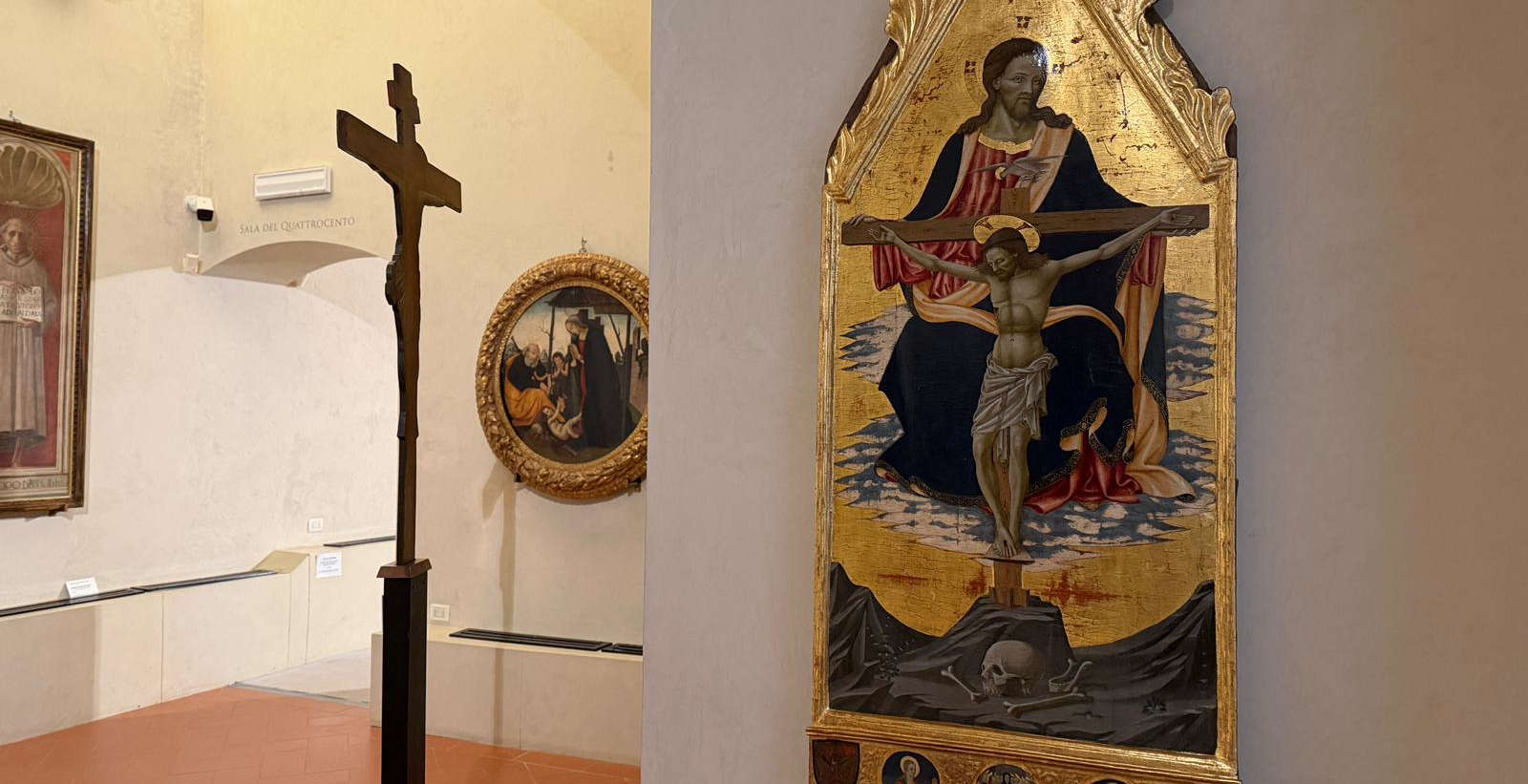
After six months of restoration , the Trinity attributed to Apollonio di Giovanni, a significant testimony to Florentine painting of the mid-15th century, has returned to the Museo dell’Opera del Duomo in Prato . The work, a cusped panel with a gold background depicting the Holy Trinity, now re-enters the museum itinerary after careful conservation work that has restored its legibility and historical-artistic value.
The official presentation of the restoration is scheduled for Saturday, Feb. 14, at 4:30 p.m. at the Museo dell’Opera del Duomo, with entrance from the bell tower. The meeting represents a public moment of restitution to the city of a work that, due to its size and quality, holds a significant place in the museum’s collection and in the artistic history of the area.
The presentation will be attended by Silvia Benassai, art historian official of the Soprintendenza Archeologia, Belle Arti e Paesaggio for the metropolitan city of Florence and the province of Prato, restorers Serena Cappelli and Paola Mariotti, who supervised the intervention, and the director of the Museo dell’Opera del Duomo, Veronica Bartoletti. The appointment will be an opportunity to illustrate in detail the critical and methodological choices that guided the restoration, delving not only into the technical aspects of the operation but also into the historical and figurative context in which the work is set.
Apollonio di Giovanni’s Trinity is a cusped panel just over two meters high and 88 centimeters wide, characterized by a gold background and a composition that reflects the devotional models of 15th-century Florentine culture. Apollonio di Giovanni, who was active in Medici Florence, is best known for his works related to the production of wedding chests and paintings with historical and religious subjects, but the Prato panel fits fully into the tradition of sacred images intended for devotion.
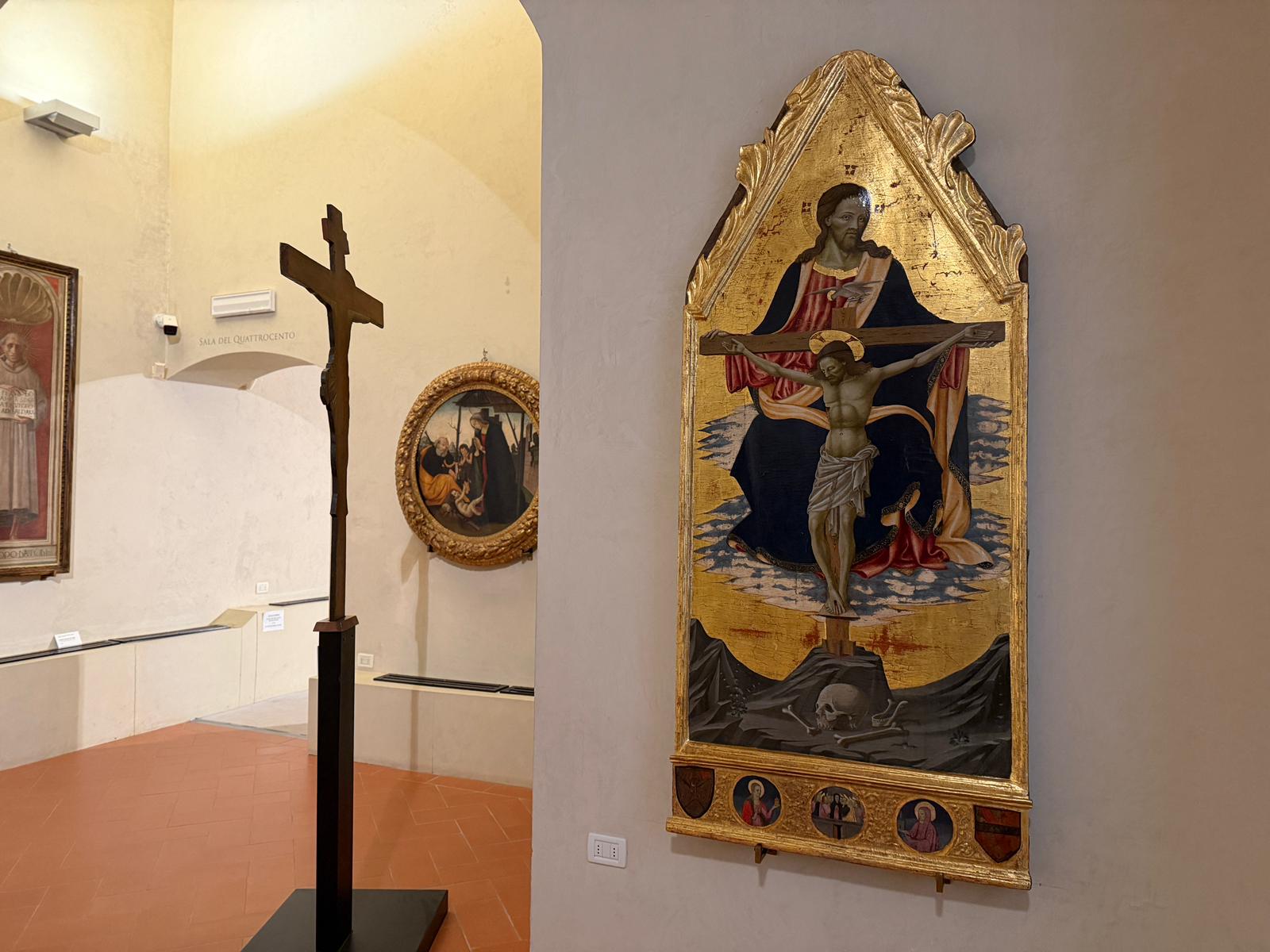
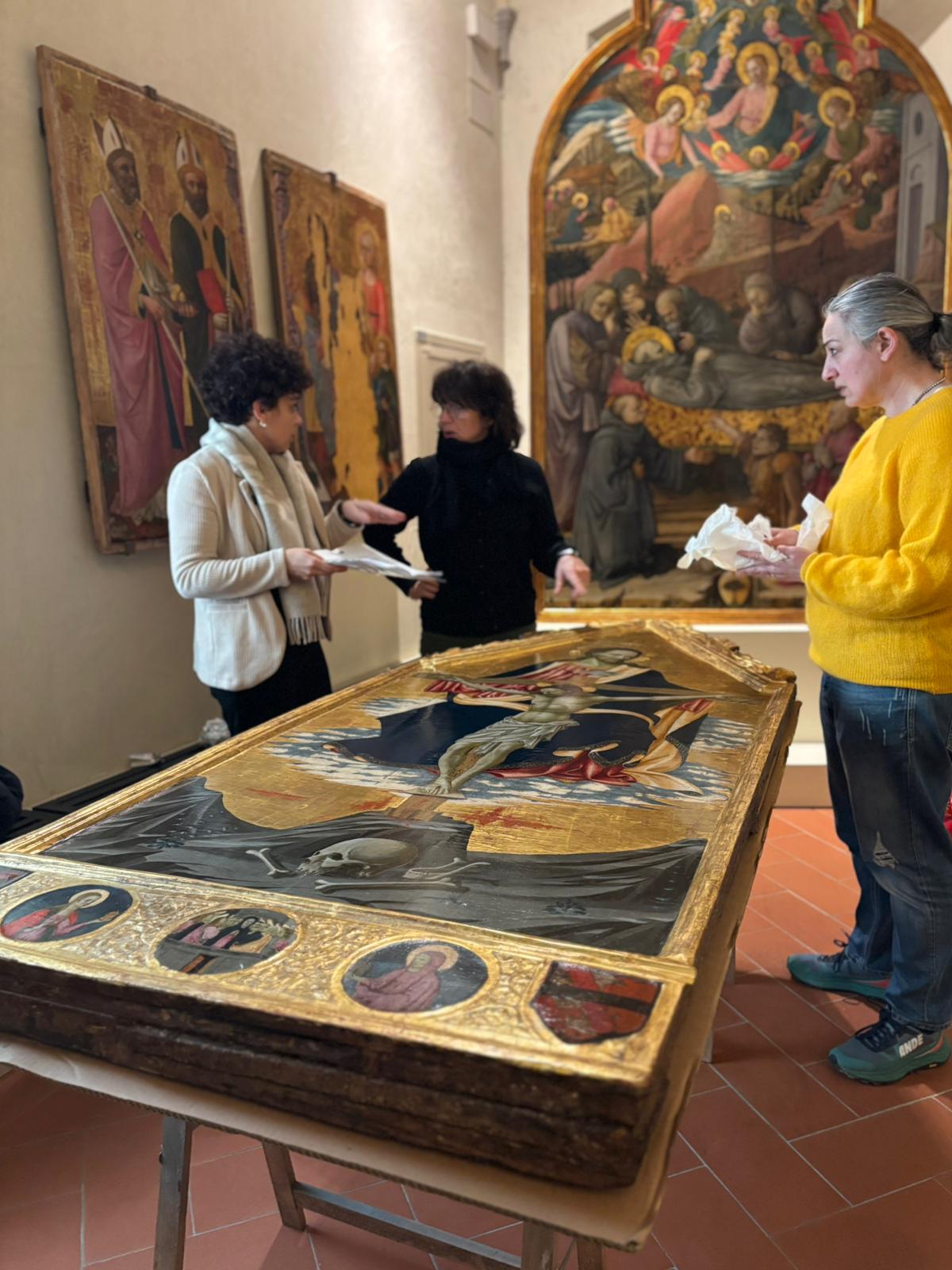
Little is known about theorigin of the work. There are no documents attesting with certainty to its original commission or location. It is likely that it was made for the altar of a church as part of a private patronal devotion, a hypothesis suggested by both the type and size of the panel, but no archival sources have emerged at present to confirm this reconstruction.
The presence of the Trinity in Prato is documented in the twentieth century, at the turn of the two world wars. In 1932 the painting was exhibited on the occasion of the first exhibition of sacred art organized in the bishop’s palace, an event that marked an important moment in the enhancement of the diocesan artistic heritage. On that occasion the work was among the works presented to the public, helping to delineate the panorama of Renaissance testimonies preserved in the city.
Later, with the purchase of Villa del Palco as a diocesan asset, the panel was placed there. It was not until about 30 years ago that it became a permanent part of the collection of the Museo dell’Opera del Duomo, where it was included in the room dedicated to the Renaissance, finding a location consistent with its historical and artistic context.
In 2015, on the occasion of the Jubilee of Mercy, the Trinity was chosen as the sign work of the holy year. For that event it was moved to the chancel of the cathedral, assuming a central role in the spiritual and liturgical path proposed to the community. A further recognition of the symbolic and religious value of the work, which is still capable of dialoguing with contemporary sensibilities. With the return of Apollonio di Giovanni’s Trinity to the halls of the museum, Prato fully recovers a work of great value, a witness to the Renaissance season and the long history of devotion and protection that has accompanied its path to the present day.
 |
| Prato, Apollonio di Giovanni's Trinity restored. Back to the Museo dell'Opera del Duomo |

Warning: the translation into English of the original Italian article was created using automatic tools. We undertake to review all articles, but we do not guarantee the total absence of inaccuracies in the translation due to the program. You can find the original by clicking on the ITA button. If you find any mistake,please contact us.















 IT
IT FR
FR DE
DE ES
ES CN
CN


