





Starting May 1, the public will once again be able to admire in the Throne Room of the Royal Palace in Genoa two large canvases by Luca Giordano, one of the main protagonists of seventeenth-century Italian Baroque painting. They are The Struggle between Perseus and Phineas and Clorinda Saves Olindo and Sofronia from the stake, monumental works created around 1680 and undergoing a lengthy restoration that has restored their legibility, luminosity and chromatic quality.
The two paintings, which measure about four meters by three and a half meters, are part of the palace’s historical picture gallery and have long been one of the most important nuclei of the collection. Their presence in Genoa has been documented since at least 1739, although they are believed to have come to the city as early as the early 18th century. The room that now houses them was originally known as the Sala del Giordano, precisely because it housed three large canvases by the Neapolitan painter: in addition to the two that are preserved today, there is also the Death of Seneca, which left the collections after 1836 and is currently missing.
The works have undergone several adaptations over the course of time already in ancient times, probably to standardize their size and adapt them to the architectural spaces of the palace. Despite these modifications, the paintings retain intact the narrative force and compositional complexity that characterize the production of Giordano, an artist capable of transforming literary and mythological episodes into grand scenographic constructions.
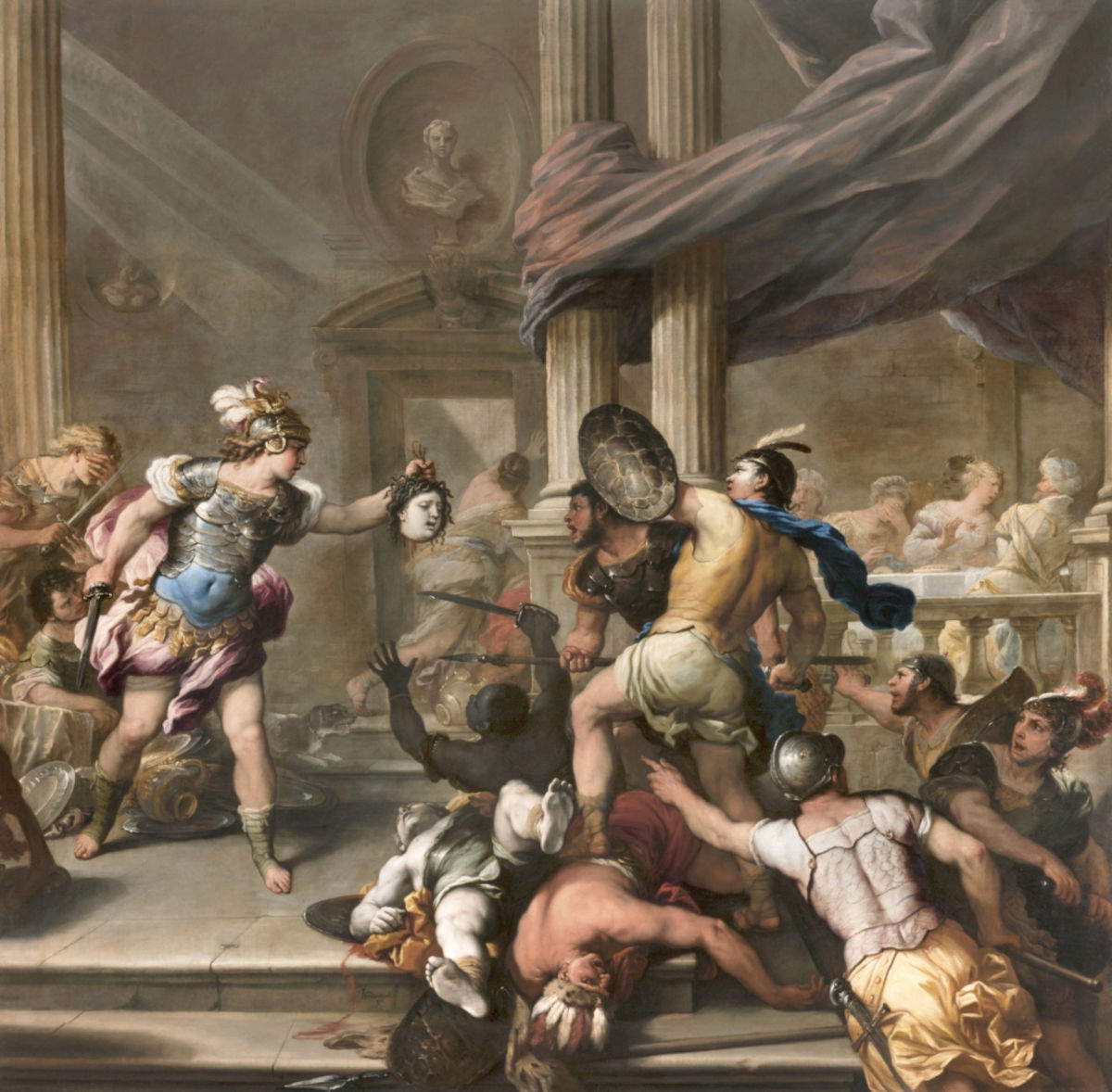
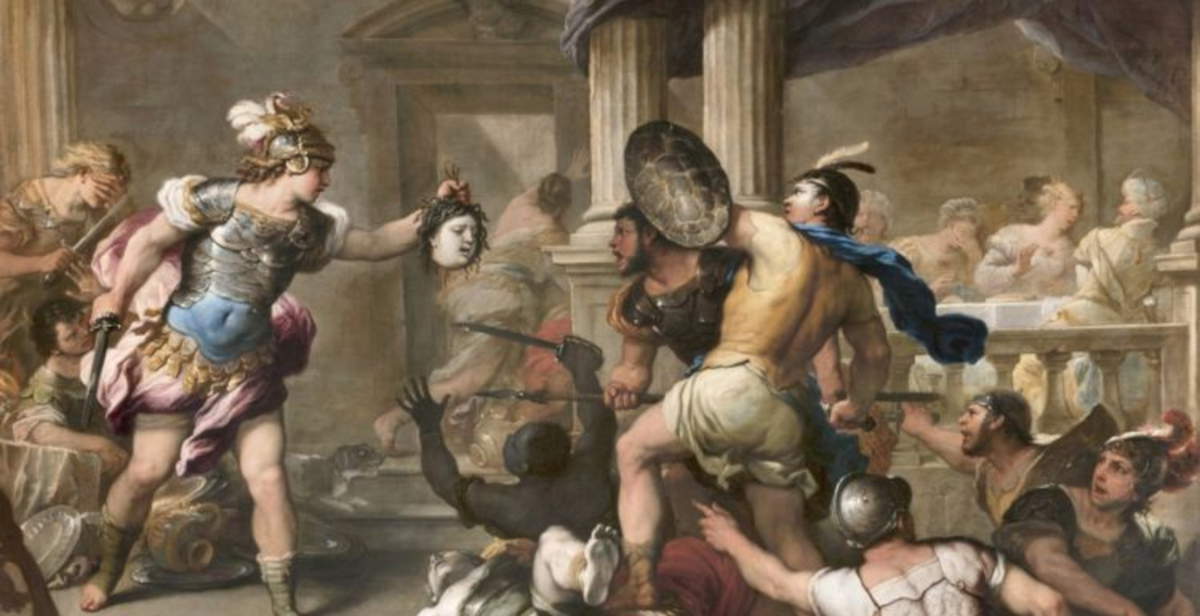
Both canvases are in fact derived from famous texts in literature. The Struggle between Perseus and Phineas takes its cue from Ovid ’s Metamorphoses and represents one of the best-known episodes in the Perseus myth. Phineas, to whom Andromeda had been betrothed, interrupts the wedding banquet to avenge the rejection of the young woman, now destined for the Greek hero who had saved her from the sea monster Ceto. In the scene painted by Giordano, Perseus defends himself by displaying the head of the Gorgon Medusa, whose gaze petrifies Phineas. In the background, terrified guests try to cover their eyes to escape the spell.
The work has always been considered one of the masterpieces of the Royal Palace’s picture gallery and was already one of the main attractions for travelers visiting the palace in the 18th century. The painting also bears the artist’s signature, visible on the foreground step with the inscription “Jordanus fecit,” an element that further reinforces its historical and attributive value.
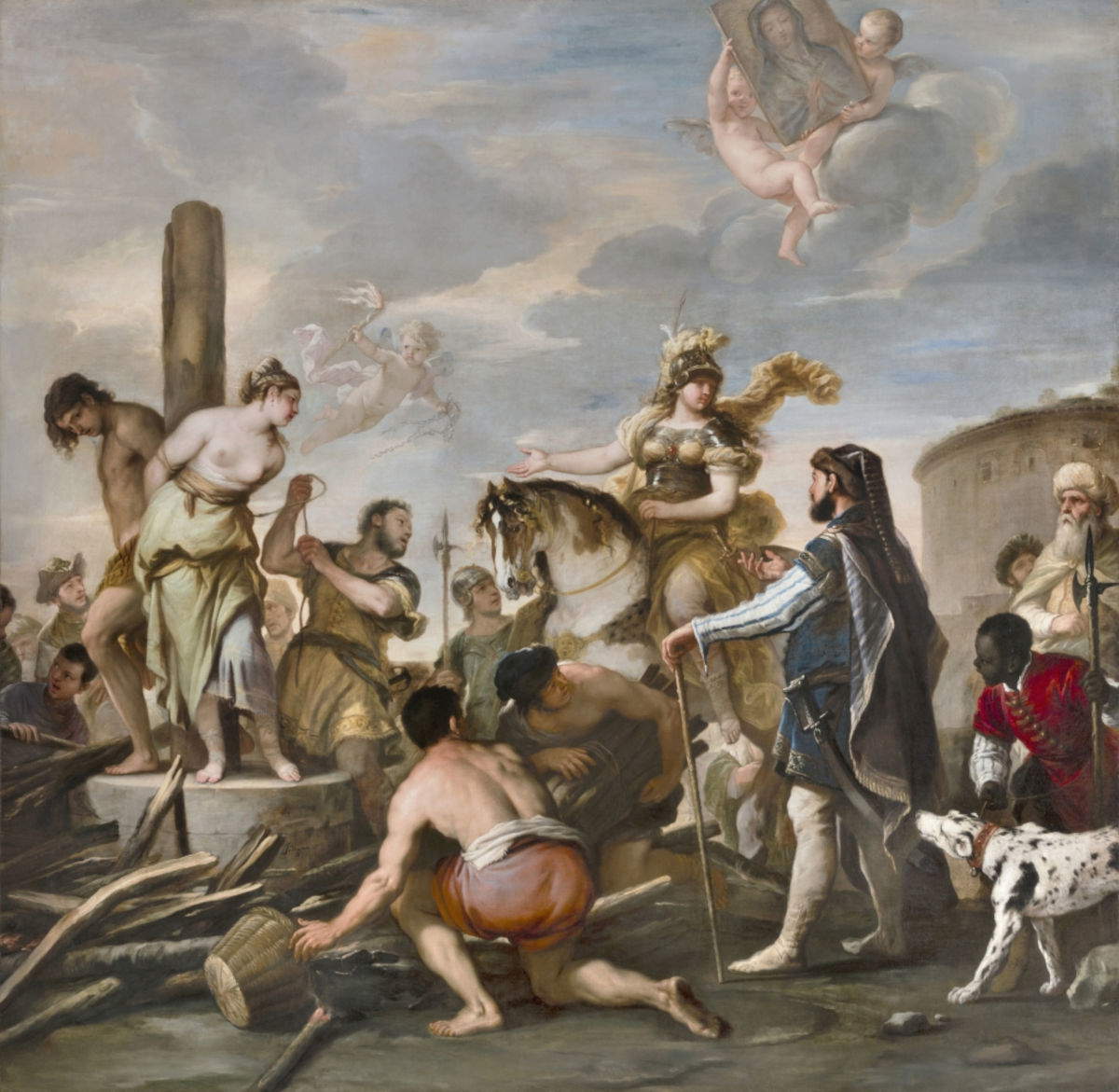
The second canvas, Clorinda saves Olindo and Sofronia from the stake, is instead taken from the second canto of Torquato Tasso’s Gerusalemme Liberata . The scene depicts the arrival on horseback of the Saracen warrior Clorinda, ready to intervene to save the two young Christians Olindo and Sofronia, accused of stealing a sacred image. Again Giordano constructs the episode as a theatrical scene, arranging the characters on a kind of ideal stage and entrusting gestures, postures and expressions with the task of directly engaging the viewer.
Placed on the east wall of the Throne Room, this canvas is also signed “Jordanus F” and returned to the exhibition venue in April 2026, upon completion of the restoration. The intervention made it possible to recover the work’s original stylistic values, restoring the richness of colors, diffuse luminosity and refined tonal balances that characterize the Neapolitan master’s painting.
The restoration of both canvases was entrusted to Luigi Parma ’s Milan workshop and took place between 2024 and 2026 through complex work on the pictorial surfaces. The operations made it possible to work on the conservative condition of the paintings, recovering colors altered by time and restoring the luminous depth and theatrical effects that constitute one of the most recognizable aspects of Giordano’s painting.
For the Struggle between Perseus and Phineas, the restoration was carried out between 2024 and 2025 thanks to the call for proposals for the 20th edition of Intesa Sanpaolo’s Restituzioni program, an initiative dedicated to the recovery and enhancement of Italy’s artistic heritage. The work is now in optimal conservation condition, allowing for a more precise reading of the pictorial quality and scenic construction. On the other hand, the recovery of Clorinda saves Olindo and Sofronia from the stake was made possible thanks to public-private collaboration, with the support of the Passadore Foundation 1888 E.F., in synergy with the Ministry of Culture. The foundation’s contribution made it possible to complete the intervention and bring the great painting back to full public enjoyment.
To accompany the reopening of the two canvases to the public, the Royal Palace will organize a series of meetings in the coming months dedicated to learning more about and recounting the restoration. The first appointment is scheduled for May 14 at 5 p.m. with Anna and Luigi Parma, restorers responsible for the intervention. Anna Manzitti and Luca Leoncini will introduce.
 |
| Royal Palace of Genoa, Luca Giordano's large canvases in the Throne Room restored |

Warning: the translation into English of the original Italian article was created using automatic tools. We undertake to review all articles, but we do not guarantee the total absence of inaccuracies in the translation due to the program. You can find the original by clicking on the ITA button. If you find any mistake,please contact us.






















 IT
IT FR
FR DE
DE ES
ES CN
CN


