





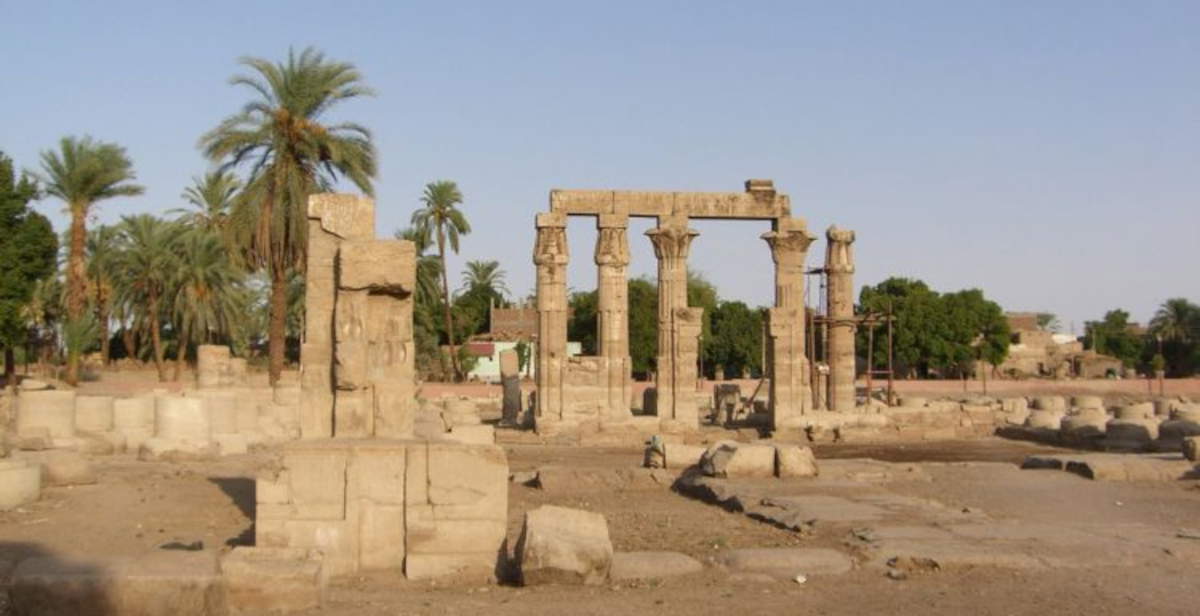
At the Karnak temple complex in Luxor, Egypt, a joint Chinese-Egyptian archaeological mission has unearthed a number of new findings that help redefine knowledge of the Montu temple area. Among the most notable findings, as reported in the Chinese newspaper Global Times article, is the discovery of a hitherto unknown sacred lake identified within the temple enclosure, west of the Temple of Maat. The structure, covering more than fifty square meters, looks like a well-preserved ancient reservoir with an articulated construction.
The sacred lake has been interpreted as a ritual space dedicated to the goddess Maat, a deity associated with the principles of truth, justice and cosmic balance. Its location within the enclosure of the temple of Montu and its proximity to the temple of Maat suggest a functional and symbolic relationship between the structures, embedded in a vast ceremonial system. Architecturally, the basin features an entrance made of mud brick, reused sandstone blocks and a sandstone staircase along the eastern side.
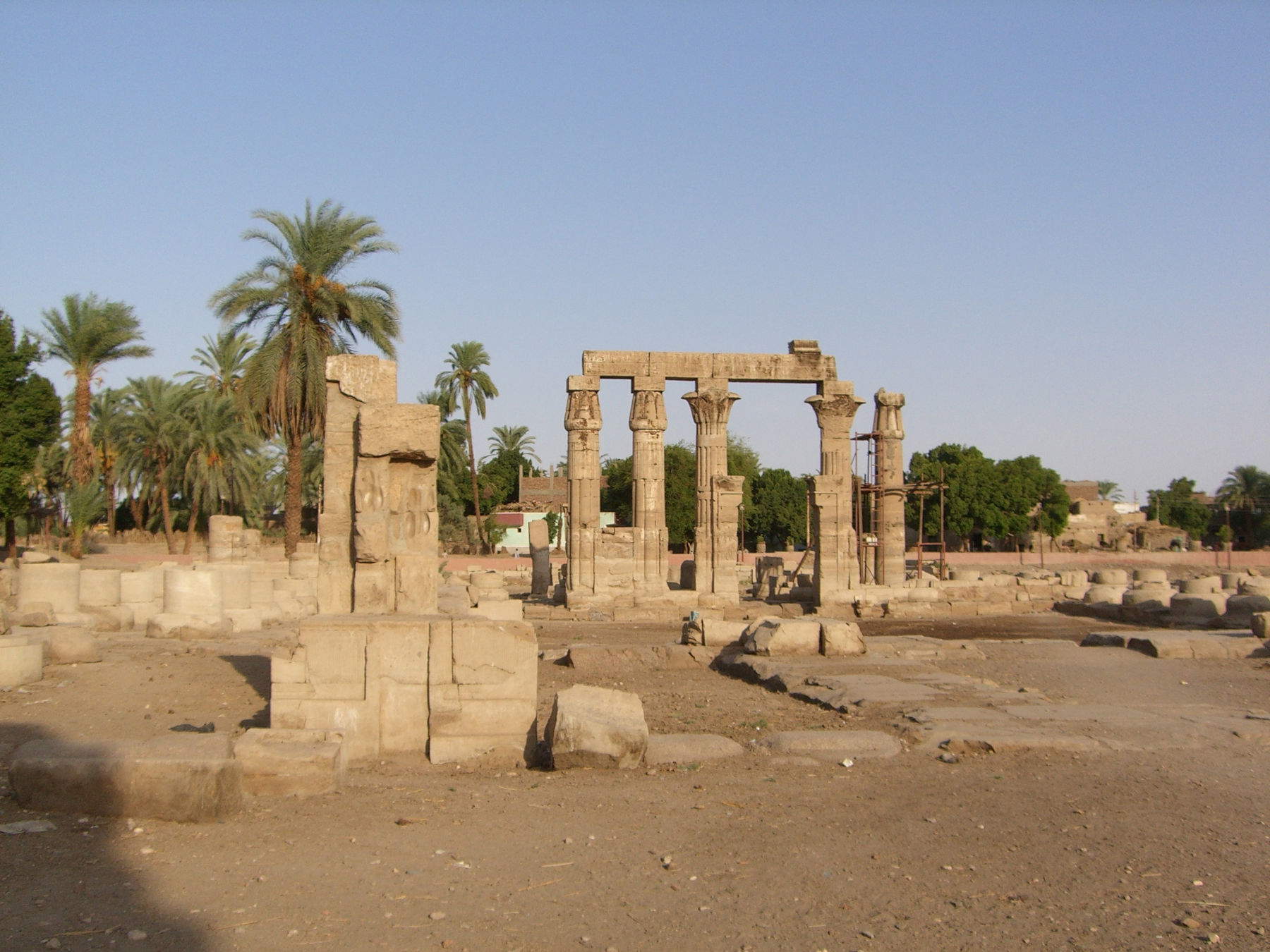
The upper parts of the walls, particularly the southern one, appear to be reinforced with a combination of red brick, mud brick and sandstone blocks, indicative of consolidation work or later construction phases. Of particular interest is the presence, integrated into the staircase, of a sandstone block that appears to have come from the ancient portal of the temple of Maat, datable to the 25th dynasty. This portal would later be replaced by a new sandstone structure during the XXX dynasty, indicating a systematic reuse of materials within the complex. The discovery takes on added significance considering the overall layout of the area: the new basin was identified as thesouthern sacred lake, as it was flanked by a second sacred lake located further north, both located within the walls of the Karnak enclosure. The presence of two sacred lakes arranged next to each other represents an unusual configuration, which opens new interpretive perspectives on the ritual practices and spatial organization of the complex.
During the excavations, the team also found dozens of bovine mandibles, as well as reused architectural blocks bearing references to rulers and the Divine Worshipper of Amun, a prominent priestly figure in the late period between 747 and 332 BCE. The materials provide useful elements for reconstructing the cultic context and will be crucial in establishing more precisely the early phase of construction of the sacred lake.
The investigations were not limited to the lake area. As the article reports, in another sector of the site, known as the Osiriac chapel area, archaeologists have identified three chapels dedicated to Osiris, one of the main deities of the Egyptian pantheon, linked to agricultural cycles, fertility and the afterlife. The chapels, intended for ritual functions, were accompanied by numerous statuettes depicting the god, of different sizes and materials, as well as fragments again associated with the Divine Worshipper of Amun.
 |
| Egypt, a lake sacred to Maat and three chapels dedicated to Osiris emerge at Karnak |

Warning: the translation into English of the original Italian article was created using automatic tools. We undertake to review all articles, but we do not guarantee the total absence of inaccuracies in the translation due to the program. You can find the original by clicking on the ITA button. If you find any mistake,please contact us.




























 IT
IT FR
FR DE
DE ES
ES CN
CN


