



by Carlo Alberto Bucci 26/02/2026



Categories: Exhibition reviews / Disclaimer
The major anthological exhibition in two stages, now in Rome at the Accademia Nazionale di San Luca, and then in Agrigento, recounts the journey of Fausto Pirandello, "painter of dramas": from the nudes of the 1920s to Bathers, to the post-World War II period, between Rome, Paris and Agrigento. What the exhibition is like: a review by Carlo Alberto Bucci.

Sicily, distant motherland but indelible matrix of many paintings. And Rome, city of birth and election, vital meeting point for art and family existence. But also launching pad to the international horizon, Parisian and American, before and after World War II. Fausto Pirandello between two worlds, one of origins and the other of adulthood sheltered from the looming figure of his father Luigi, the great playwright. The exhibition that of Pirandello’s son’s existence investigates the twisted roots, entwined with those of an art that the painter himself, however, insisted on defining as autonomous and free from the literary sphere, is about to leave Rome: it opened in December at the Accademia di San Luca where it will remain open until Saturday, Feb. 28. And from March 20, until June 2, it will be hosted by Villa Aurea, the collected exhibition space of the great Archaeological Park of Agrigento, the city of her father and mother.
Fabio Benzi and Flavia Matitti, among the leading experts on this protagonist of the Roman School of the 1930s and 1940s, were called in to curate the essential two-stage anthological exhibition - capable of bringing together the foundation and association named after Fausto Pirandello, plus the Institute of Pirandellian Studies dedicated to his father. But also an active, yet often lonely and forgotten actor on the postwar Italian scene, squeezed between the opposing factions of figuration and abstraction that Pirandello, a “painter of dramas,” according to Corrado Alvaro’s felicitous 1938 definition, tended to ignore. Keeping away from them and seeking, rather, a laborious but successful synthesis between the two then-dominant languages.


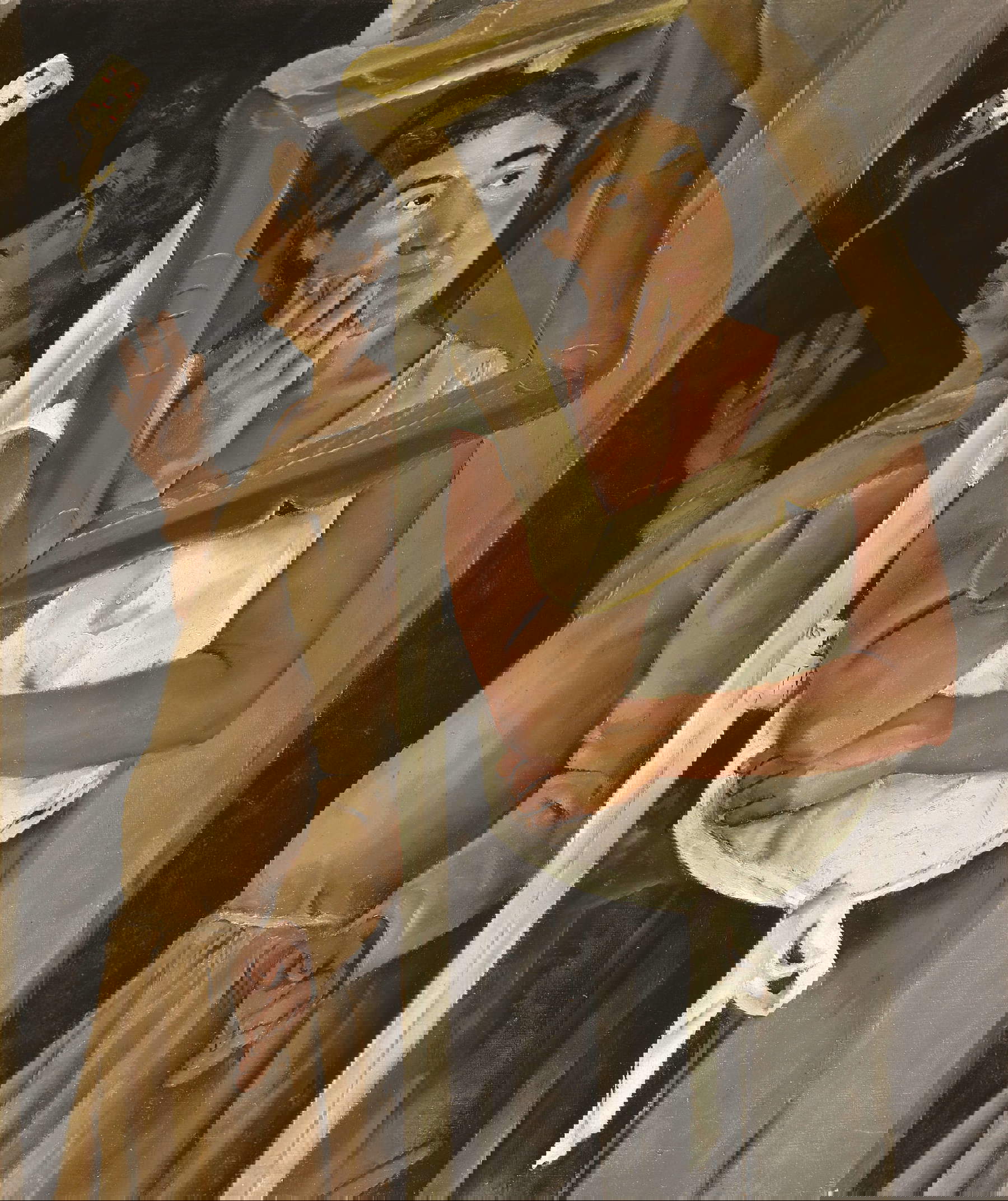
It is precisely the production of the last thirty years of the painter’s activity, born in 1899 in Rome where he died in 1975 at the age of 76, that is the qualifying and new datum of the exhibition Fausto Pirandello, the magic of the everyday. That of the post-Liberation production, in fact, is the Pirandellian phase too often undeservedly “looked at coldly” by critics, “if not actually with hostility, as if it were a nonessential appendix,” Matitti notes well in his text in the catalog (Accademia nazionale di San Luca editions, 191 pages). And a central work in this sense turns out to be the 1965-1966 Nude of a Woman, which the artist donated to the guild of painters of San Luca in which he had been accepted in 1947 and which now houses him to remember him half a century after his death.
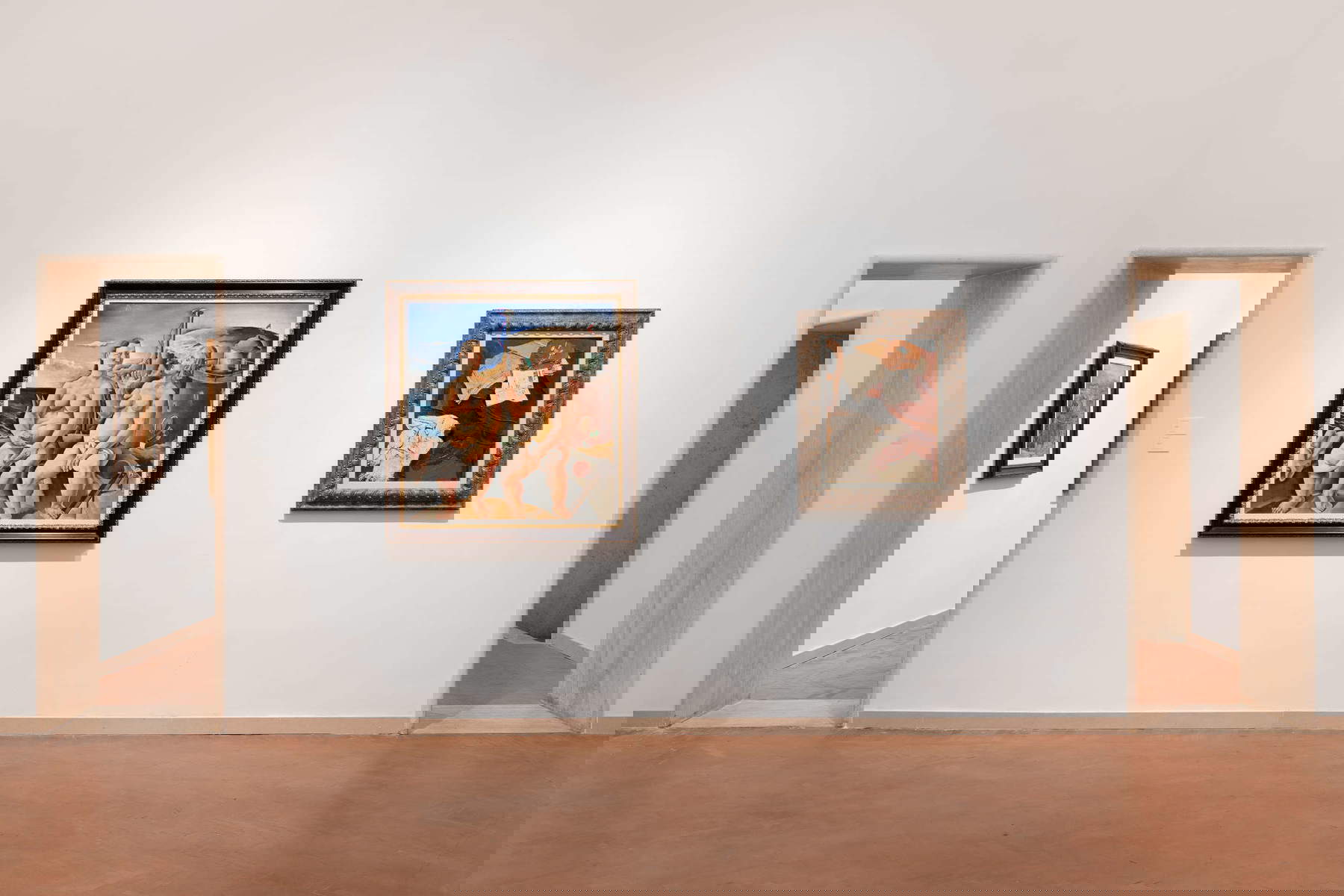
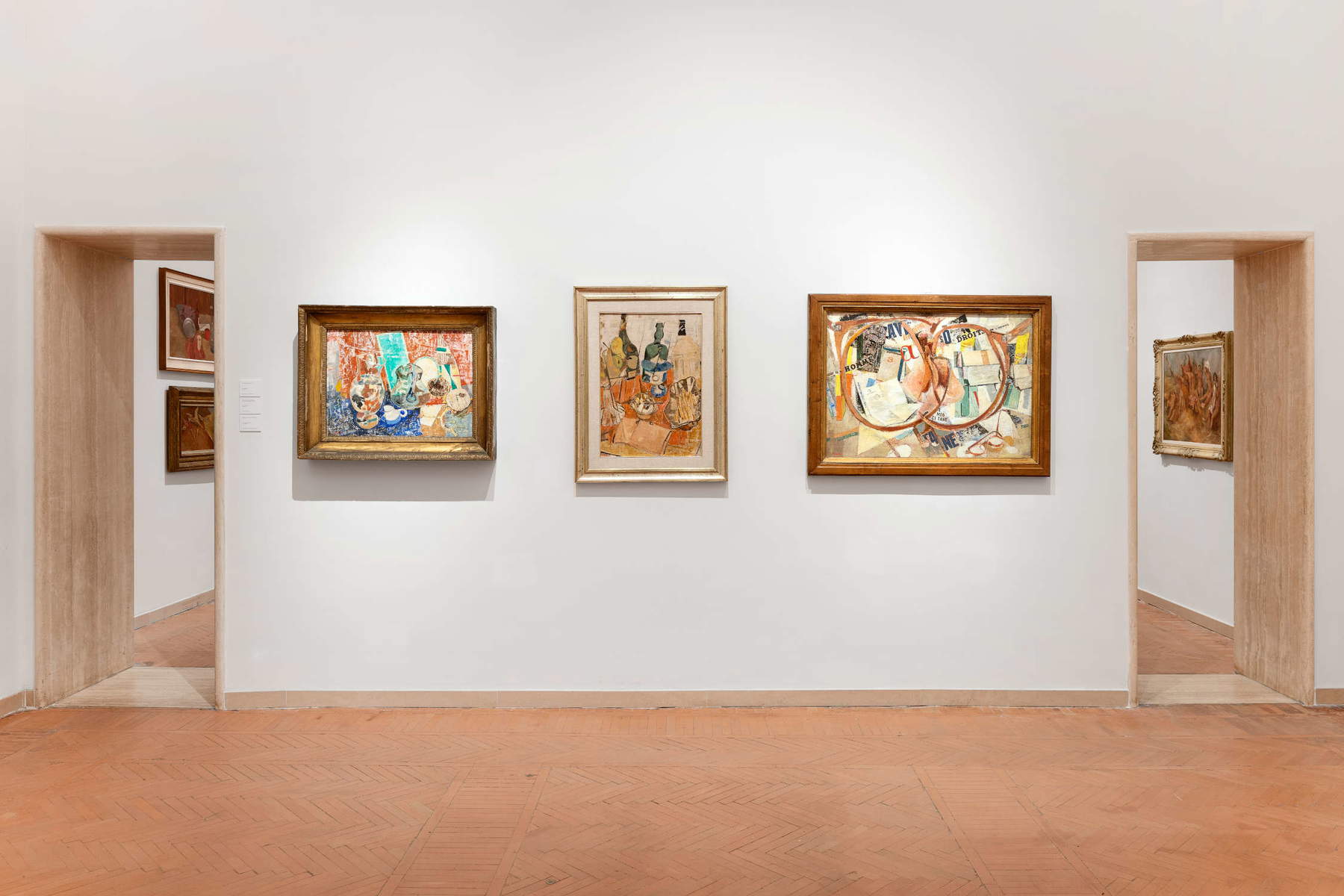
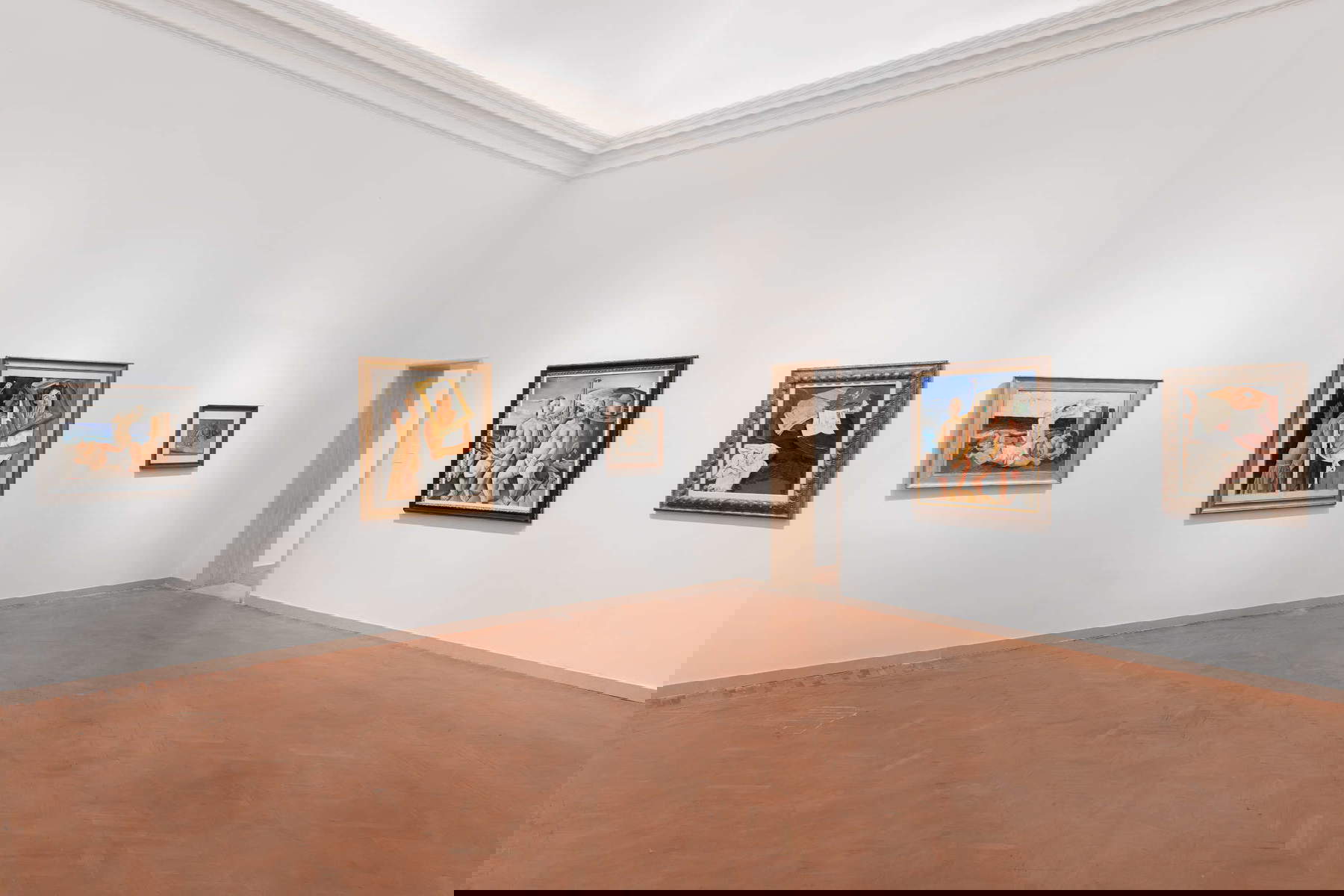
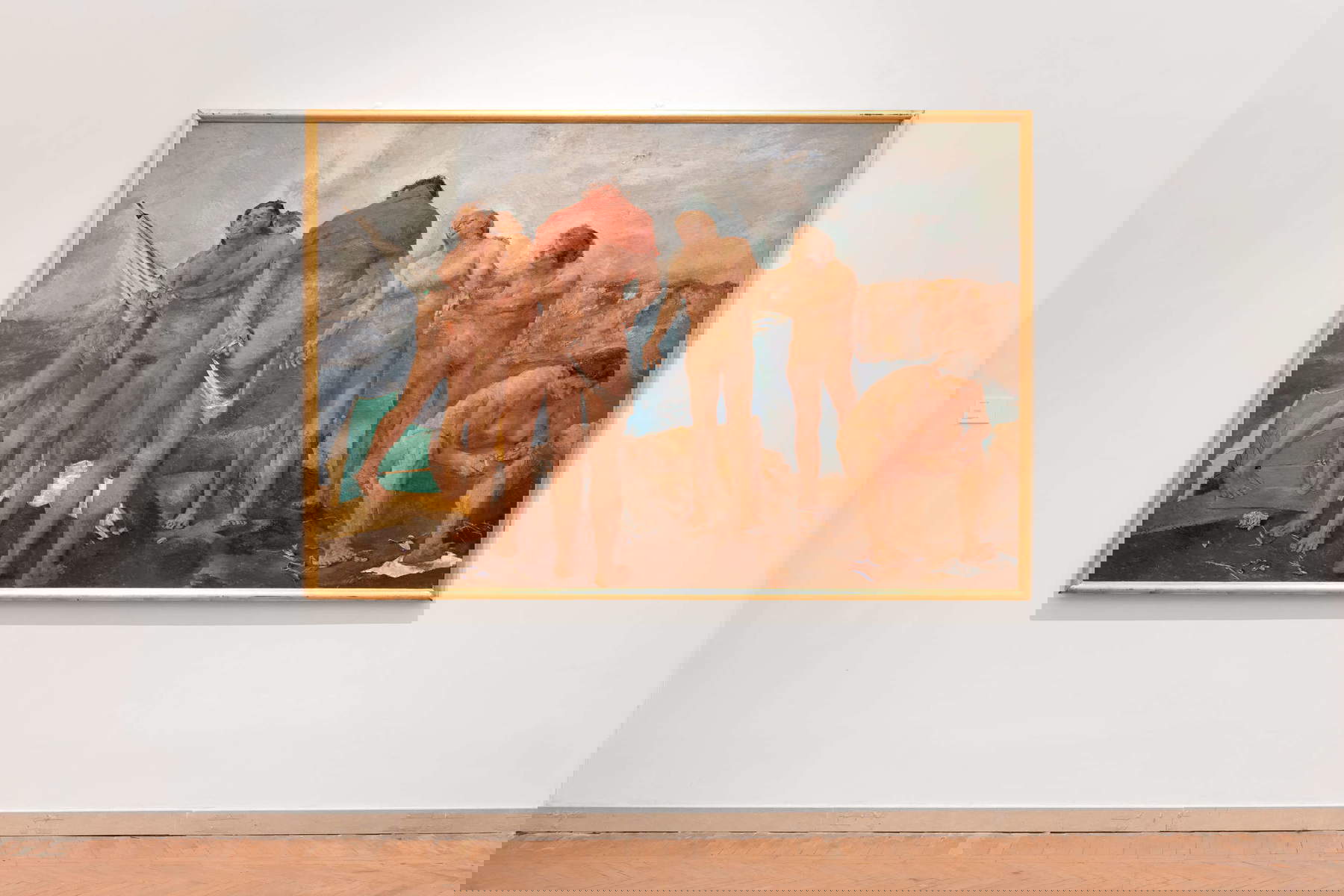
The archaic, acerbic beauty of this painted female figure is the replica with minimal variations, in the midst of the 1960s triumph of Pop art, of a 1953 painting with which Pirandello had won the Marzotto prize, two years after having, moreover, reached the highest podium at the Quadriennale nazionale in Rome (testifying to a success then, ignored by the more recent historiography all focused on the painting of the Ventennio rediscovered since the 1980s). This Nudo muliebre, which the painter calls at times “of a little girl” while at others “of a little girl,” offers the sculptural body and childlike sex to the viewer’s gaze. And in the arms raised, almost as a sign of surrender, as in the hands resting on top of the brim, one senses the “ancestral memory of the Atlantes,” Matitti again points out, “who on their shoulders supported the weight of the lintel of the temple dedicated to Zeus Olympius in Agrigento.” The primal myth of mother Sicily, then, which nevertheless passes through the filter of a modern, material painting, made of a full-bodied and dense paste, colors that are nevertheless transparent and sharp contrasts: “The blacks and reds are violent, and plasticity arises spontaneously from expressive accents rather than from conventional chiaroscuro,” Lionello Venturi, Pirandello’s mentor of the first hour, noted after all, writing about the 1953 Nudo in Commentari, and noting that that work had “begun a new cycle of figures.”
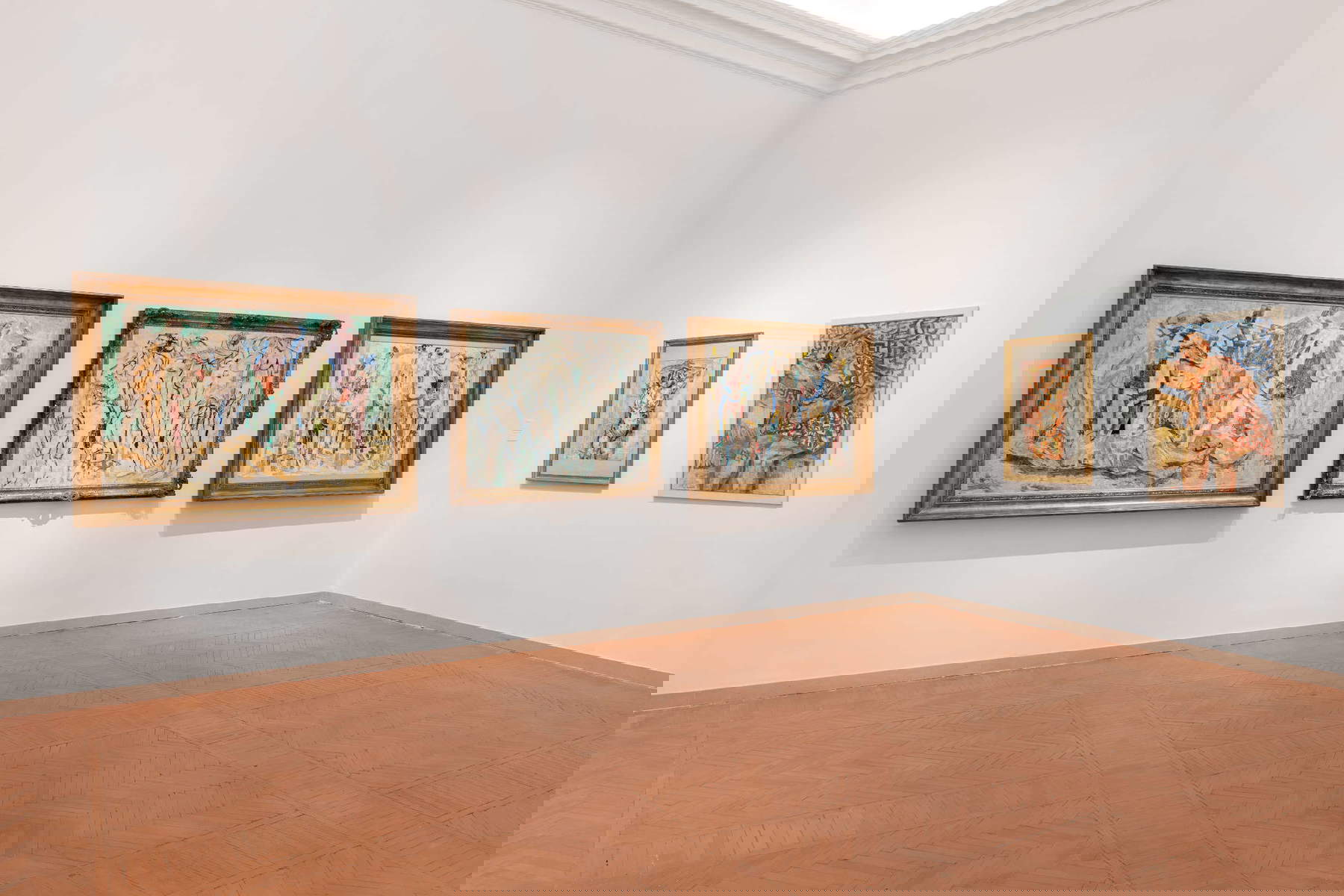
Such is Pirandello’s postwar palette, made up of spatula-like mosaic tesserae in glass paste but on the post-Cubist layout and according to the logic of the reversed plane of Cézannean memory. As early as the 1940s, the artist had noted on a cigarette packet that he always held between his fingers in photos in his studio, "The first character of my painting is clarity, the second the synthesis of forms, the third the strength of color." These are the ingredients we find in theSelf-portrait of 1948-where yellow, orange and electric blue ring around the congealed face in an expression of pained, twisted concentration-but above all in the three paintings of identical subject, Bathers, which close at Palazzo Carpegna the sequence of rooms of the exhibition on the ground floor, before climbing the grand staircase to reach the small room with the drawings of his early years and the pastels of his maturity (the graphic section is absent, however, in Agrigento).
Fabio Benzi, in his text in the catalog, explains in depth the reasons and the sense of the artist’s choice to focus on the figures of nudes on the beach, so much so as to make them almost the recurring theme of his repertoire of images. As if Pirandello had elected a personal experience at the seaside, perhaps during frequent summer returns to Sicily, as an emblem and mirror of a suffered, universal, existential condition. To the scorching sun and stifling heat that inflamed the earthy colors of the Cubist matrix of the 1920s, Pirandello repeatedly exposed his bathers, beginning in 1937. "At the time of his father’s death in December 1936 (and coinciding with the Bathers series),“ writes Benzi, ”he increasingly radicalizes the sense of a rough and naked reality, simultaneously reducing to the point of nullifying those more explicitly magical and surreal characters that had hitherto fascinated him."
Here, then, is the monumental (150 by 225 centimeters) and theatrical Tempest of 1938, exhibited at the Quadriennale the following year and now in a private collection in Rome, with the figures disrupted by the rushing wind, stripped of their clothes and huddled in the stampede before the stepmotherly nature. All under a figure of marked realism that is nevertheless more tonalist, intimate and tragic than that of Renato Guttuso’s popular 1939 Fuga dall’Etna. And which marks, for Pirandello, a departure from the surreal climate of his own Composition of 1928 (Milan, private collection)-with the two Junoesque and grotesque bathers denuded before a marina dominated by the lighthouse and dechirican-print toys (the pictor optimus will remain however, an important point of reference, by Pirandello’s own admission) - or from the symbolic and esoteric fabric of the famous painting Women with Salamander, which, remaining in the endowment of the artist’s heirs, was executed between 1928 and 1930, that is, the years of his stay in Paris.


An unenthusiastic pupil at a young age of the Sicilian sculptor Ettore Ximenes to whom his father had directed him in Rome after finishing his classical studies at the Tasso high school, then from 1919 a follower of the German painter and engraver transplanted to the banks of the Tiber Sigmund Lipinsky, who would initiate him to the nitty-gritty of the Central European secessionist sign, Fausto Pirandello had landed in the French capital to conceal from his parent his union with model Pompilia D’Aprile and the birth of their firstborn son, Pierluigi. The lie was functional to conceal a love that his father would not have accepted given the humble origins of the girl destined (on March 8, 1930) to become Mrs. Pirandello, but also to allow an allowance to keep coming from the family to finance Fausto’s transalpine studies, which meant the fruitful acquaintance and immediate reworking of Cubism, Surrealism and the art of the École de Paris.
Fausto had met Pompilia in Anticoli Corrado, a village in the province of Rome known for its good climate and girls willing to pose for painters who had come from Rome. Pirandello had arrived there by taking summer courses alongside other protagonists of the future Roman School such as friends Emanuele Cavalli and Giuseppe Capograssi, taught by the other important master, Piedmontese painter Felice Carena. Belonging precisely to the phase of the beginnings - albeit prior to 1925 of the first exhibition of the artist who participated in the third Roman Biennale with the painting of unknown location but significantly entitled Bathers - are the paintings in Rome that now make up the first, powerful room of the exhibition at Palazzo Carpegna. These include the large Nudes of 1923 in the two paintings lent by the Mart in Rovereto (but absent in Agrigento), the discreet bodies in the Siesta rustica of 1924 (Milan, Giuseppe Iannaccone collection, lender also of the beautiful still life La lettera of 1929), or the other nudes in the composite Scena campestre of 1926 lent by a Roman collector: through these paintings the young and prepared city artist depicts rural, bucolic and pastoral reality without idyllic and academic complacency, infusing it with “a realistic and ’unpleasant’ carnality, intellectually and expressively twisted and suffered,” as Fabio Benzi writes, who points out the contact between these paintings and the future ones of Lucien Freud, the grandson of the father of psychoanalysis.
Of his father Luigi, in 1936 Fausto made the striking Portrait now at the National Gallery of Modern Art in Rome, which granted the oil on panel for loan to the Archaeological Park of Agrigento. By then the bond between the author of Fu Mattia Pascal and his third-born son had strengthened so much that that summer the Nobel laureate in literature stayed with his son and daughter-in-law in Anticoli Corrado. On December 10 of that same 1936, however, Pirandello passed away in Rome, breaking the chain that united the great writer, but an artist for pleasure and of attardati tastes, to his brilliant, independent painter son. And to their difficult relationship is dedicated in the catalog Claudio Strinati’s writing, entitled Luigi e Fausto.
Warning: the translation into English of the original Italian article was created using automatic tools. We undertake to review all articles, but we do not guarantee the total absence of inaccuracies in the translation due to the program. You can find the original by clicking on the ITA button. If you find any mistake,please contact us.