




by Redazione 25/12/2025



Categories: Archaeology / Disclaimer
In San Casciano dei Bagni (Siena), the results of the 2025 excavations of the Sanctuary of Bagno Grande were presented. The discoveries of the latest season open unprecedented perspectives, backdating its origins by at least two centuries and strengthening the hypothesis of the existence of a true Etruscan-era medical school.

On Sunday, December 21, the results of the 2025 excavation campaign of the Sanctuary of Bagno Grande were presented in San Casciano dei Bagni (Siena). The site is once again confirmed as one of the most significant archaeological complexes in the entire ancient Mediterranean. The discoveries of the latest season of research open new perspectives on the history of the sanctuary, backdating its origins by at least two centuries and offering data of extraordinary importance for the study of religion and ancient medicine.

The most relevant discovery concerns the chronology of the sanctuary’s earliest phases. Finds unearthed during the 2025 excavation date to the late fifth century B.C. and no longer to the third century B.C. as previously assumed. This element suggests the presence of a large sanctuary of High Archaic age near the spring, or in its immediate vicinity. Also confirming this is the finding of a bronze candelabrum fragment, a material that emerges as central to the sanctuary’s sacred practices in all its phases of use.
To the final phase of the site belong new finds, including a thunderbolt and a bronze branch, referable to the time of the sanctuary’s closure in the fifth century CE, following the edicts of Theodosius. During this phase of profound transformation, several altars were broken and reused to create a platform located in front of the temple entrance, in an intermediate position between the main spring, which has been the subject of investigation in recent years, and a second spring located further south, probably the fulcrum of an additional sacred space.


Architecturally, the 2025 excavation campaign confirmed the existence of a large Etruscan-era enclosure, active at least from the 3rd century B.C. onward but in all likelihood of older origin, characterized by dimensions comparable to those of the Roman-Imperial temple. Traces of abandonment rituals, recognizable in the deliberate scattering of architectural terracotta elements, were found at various points of the enclosure.
If in previous campaigns it was mainly bronze artifacts that provided the most spectacular discoveries, this year it is the terracottas that play a central role. Outside the oldest enclosure, in the southwestern area, excavation has begun of what appears to be a favissa, or sacred votive deposit. The materials that have emerged include terracotta anatomical parts, such as feet, legs, hands, heads, and depictions of infants in swaddling clothes, as well as fragments of statues and architectural decorative elements, including antefixes.
Of particular interest is the late antique phase of the sanctuary. In the fourth century AD, following a series of collapses of the imperial-age temple, a massive retaining wall was built, which involved deep excavation of the oldest stratifications. On that occasion, some of the Etruscan deposits were intercepted and spilled outside the temple according to a ritual involving the lighting of hearths, the sprinkling of organic materials such as pine nuts and talus, and the use of painted objects with magical significance. Votive objects of exceptional quality were found within these levels, including heads, intact child figures, and, most importantly, a terracotta polyvesical model that represents, at the current state of knowledge, the most detailed depiction of human viscera ever found.
This discovery reinforces the hypothesis of the existence, at Bagno Grande, of a real medical school of Etruscan age, active since at least the 3rd century BCE. The sanctuary thus appears not only as a place of healing related to thermal waters, but as a complex treatment center, comparable to an ancient hospital, in which knowledge of the human body is translated into anatomical representations of the highest precision. Such knowledge also seems to be shared by artisans, capable of transforming it into sacred objects in bronze and terracotta. A particularly noteworthy feature is the gradual decline in anatomical accuracy as one moves away from San Casciano dei Bagni, an indication of the presence here of a center for the elaboration and dissemination of medical knowledge.
The excavation of the favissa is still in the early stages and promises, as early as the next campaign, to be an extraordinarily important source of information not only for knowledge of Etruscan and Roman artistic craftsmanship, but also for the study of religious and medical practices in antiquity.
Finally, the presentation of the 2025 results was an opportunity to take stock of the overall development of the project. TheUniversity for Foreigners of Siena, through the CADMO Center, has recently acquired a building in the historic center of San Casciano dei Bagni, in the Porticciola locality, destined to become an international research hub dedicated to the study, enhancement and sharing of the area’s cultural heritage. On Dec. 5, the tender process for the renovation and fit-out works was published, the awarding of which is expected in the coming days, allowing the operational start of the new research and dissemination hub closely connected to the Bagno Grande project.
During the presentation, Superintendent Gabriele Nannetti outlined the technical surveys, which by mid-January will make it possible to have the executive structural design of the museum, so as to start a first phase of work by spring 2026. Archaeological official Ada Salvi, on the other hand, presented the preliminary investigations for the definition of the master plan, which will guide the future realization of the archaeological park.
“The presentation of the results of the 2025 excavation campaign represents a milestone in our project, which is also made of sharing,” commented Agnese Carletti, Mayor of the Municipality of San Casciano dei Bagni. “I thank all the subjects who came to tell the citizens about the progress, illustrating the complexity of such a large and ambitious project. We have a firm date for the start of work on the Hub, and we also look forward to the start of the museum’s construction, because we want the bronzes to come home soon.”
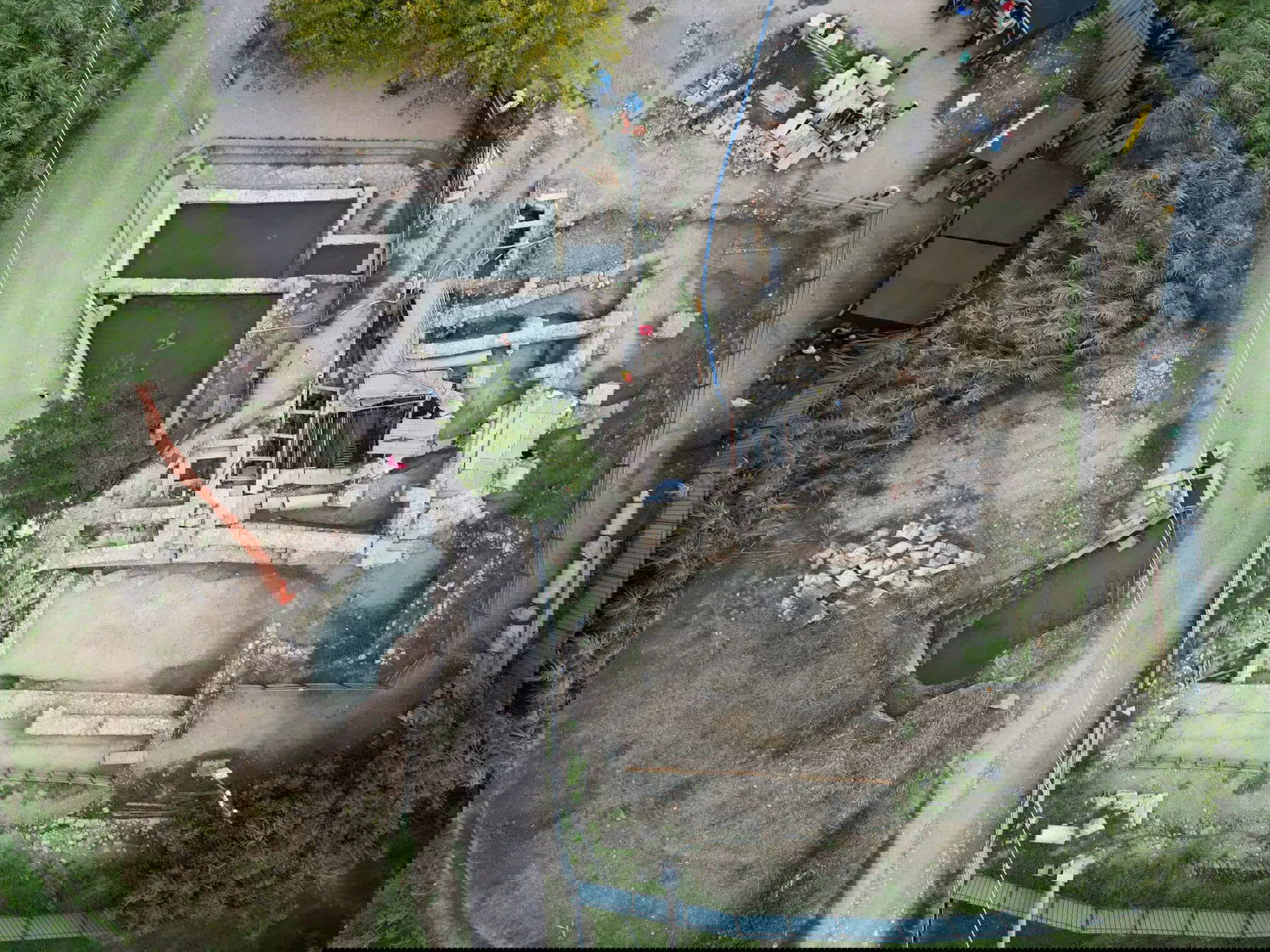
Pictured, Overview of the excavation. Photo: Municipality of San Casciano dei Bagni
 |
| There was probably a large Etruscan medical school in San Casciano dei Bagni: research findings 2025 |
Warning: the translation into English of the original Italian article was created using automatic tools. We undertake to review all articles, but we do not guarantee the total absence of inaccuracies in the translation due to the program. You can find the original by clicking on the ITA button. If you find any mistake,please contact us.