





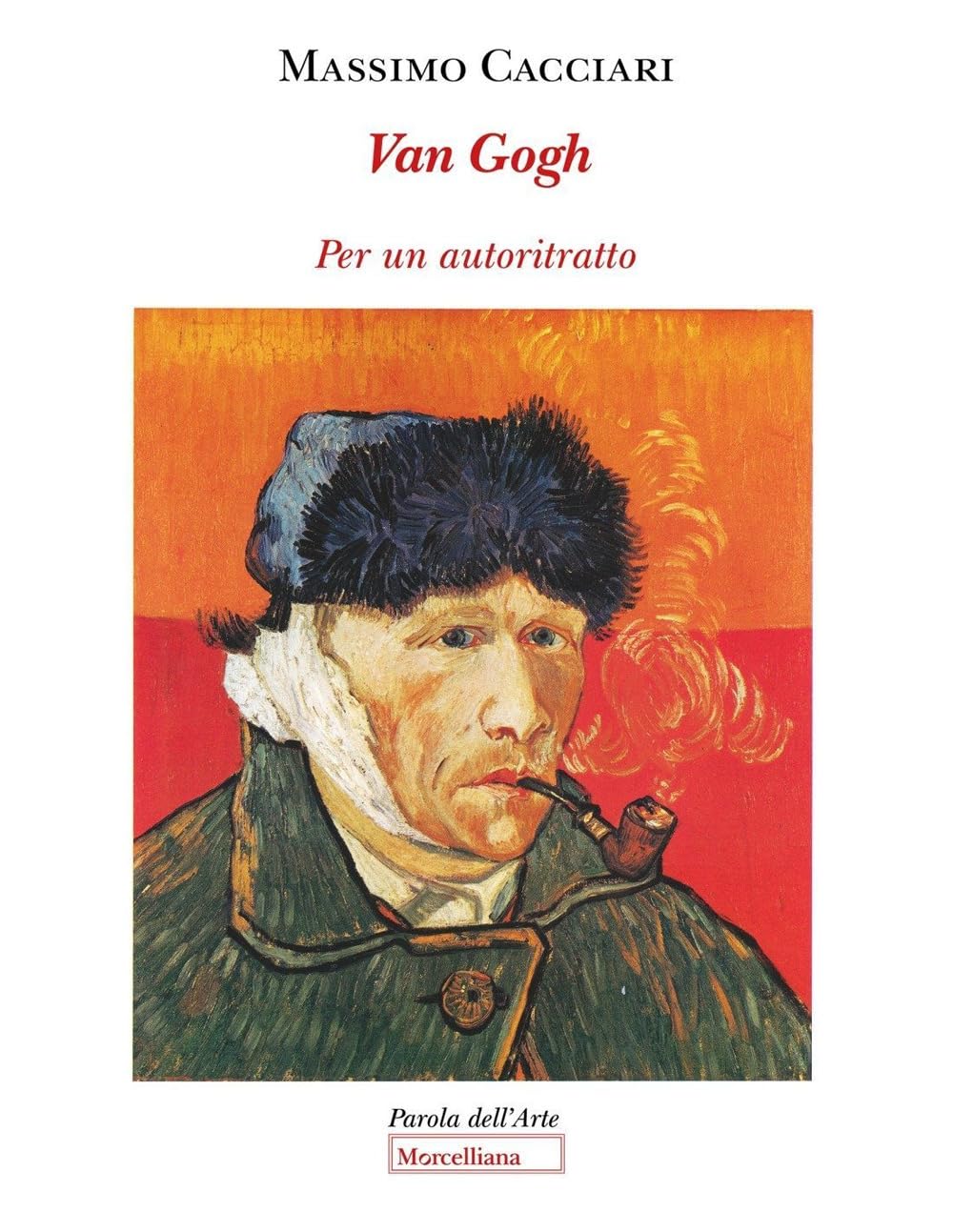
Massimo Cacciari’s Van Gogh cannot indulge in despair, and it is in this profound longing for salvation, it is in this certainty continually tormented by restlessness, peace, pain, joy, and fragility that all the reasons for his art are nested. Cacciari has reworked one of his writings from his youth, a paper on Van Gogh dating back to 1983, in order to make some slight updates, to provide it with a substantial iconographic apparatus and to republish it (Editrice Morcelliana has taken on the burden), but the substance remains unchanged: Cacciari, in essence, seems almost to tell us that Vincent van Gogh is a completely invented artist. And to realize this, perhaps it would also suffice to stop at the reading of a short story jotted down in 1875 and sent to some writers (and, invariably, to his brother Theo), many years before Van Gogh became a painter: it was the tale of a man forced to leave his country, to drag his existence away from home, and finally return before his sea when he was dying, because he could not conceive of the idea of dying without having seen his country again. The man in the story was, for Van Gogh, a “stranger on earth,” but he was also “one of the true citizens.” The stranger on earth, an image from Psalm 119 (but Cacciari also finds consonances in Georg Trakl’s poem), is destined to a feverish, inflamed search, to follow a voice not because there is an inhuman, a brutal instinct that compels him, but because, on the contrary, he feels like a call to precision, to the truth of feeling. “Everything, in Vincent,” Cacciari tells us, “is a wayfarer headed somewhere, destined he does not know where.”
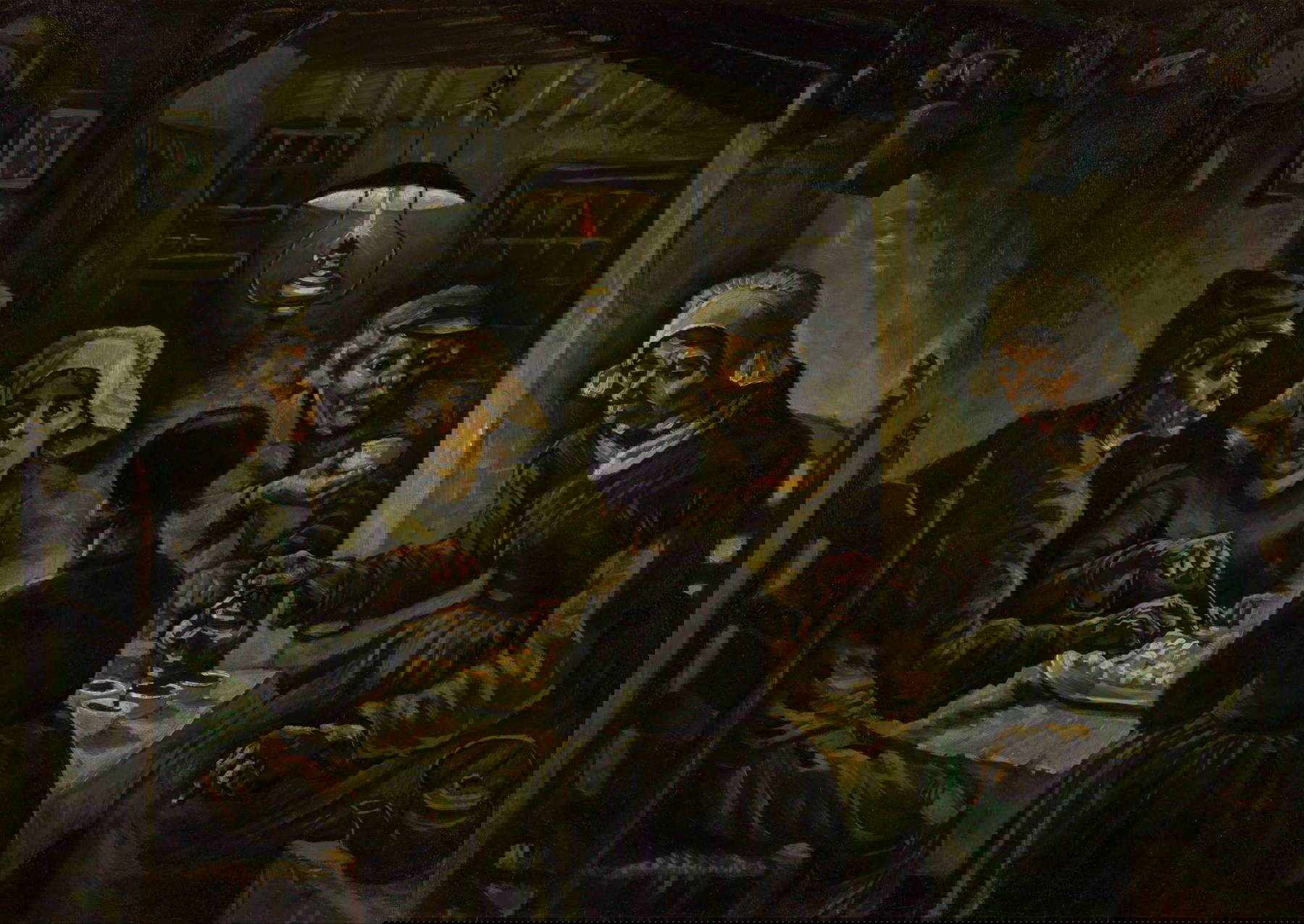
Vincent van Gogh is calculating. Or rather: he could be someone who resembles a calculator. In his colors circulate numbers, in his shapes appear mathematical signs. Of course, we do not discover this today: Van Gogh is a wild and impulsive artist only in the dank fantasies of those who have always wanted to peddle us a painter built under the plasterboard ceilings of some sales office given the task of rummaging through mid-nineteenth-century registry offices. No, Van Gogh is a calculator caught up in a tenebrous arithmetic, a calculator who is driven by an unconditional desire for knowledge from the very beginning, even before what Cacciari identifies as the moment of the first cognition of pain, and which coincides with the lamplight of the Potato Eaters (“I really wanted,” Vincent writes to Theo on April 30, 1885, “for people to understand that these people, who eat their potatoes by the light of their little lamp, have cultivated the land with the hands they put in their plates, and so we talk about manual labor and how they have honestly earned their food. I wanted it to convey the idea of a completely different lifestyle than ours, that of civilized people. So I certainly don’t want everyone to admire it or approve of it without understanding why.”) The Potato Eaters is also a political manifesto, a manifesto elaborated, compiled and signed after four or five years of frantic drafting, which began even before Van Gogh moved to the Borinage to preach to the peasants and then to draw and paint them, because Van Gogh had come to Millet through Jules Michelet, reading the History of the French Revolution. Van Gogh, however, was not content to paint the peasant with the same land he sowed (this was what was said about Millet, and Van Gogh knew it). Had that been the only problem, Millet would have been sufficient. It is Van Gogh himself who abdicates himself because he wants to be the farmer, the soil, the seed, the room lit by that dim light, even those miserable, black roots on the farmer’s plate. Even the Potato Eaters are kneaded with earth and night, there is no face that does not carry with it the grain of wood or the frost of metal, they are made of the same hard, hollowed-out material that the peasant turned over in the Borinage. The difference is that the painter, more than portraying, more than representing, is searching for a fragment of eternity, and in this search he wants to make himself a lump, a stubborn clot of earthy colors that smell of plowed sod.
From the first moment his pencil touched a sheet of paper, Van Gogh felt a deep need for truth. A need driven partly by faith, partly by reason. He is, Van Gogh, an artist who seems to approach painting as a form of asceticism that exposes itself to the fire of things in expectation of salvation, and at the same time a mathematician perfectly aware that that of color is a discipline admittedly unstable but necessary, because there is no exact perception of reality, because a photograph cannot be taken of the truth, because perhaps there is not even an essence that can be distilled from the visible, and therefore it is necessary to try to obtain a reproduction that, however felt and faithful, will always, inevitably be constructed.
Calculation, rather than giving a form, seems almost to serve to hold back that which tends to unravel, to fix for a moment that misery which without an indestructible form would be only dust and fog, to that pain which without an illusion of eternity would end up buried under meters of crushed stone, to that pain (look at the miserable, sad peasants of the early 1980s) that Van Gogh feels not out of pity, but because it is the same that he experiences on himself (Julius Meier-Graefe had gone so far as to say that Van Gogh was “a peasant among peasants”). Calculus could be a necessary form of resistance, though obviously more like a tremor than an engineering project, to convey to the relative that profoundly human essence to which the peasants of the Borinage are martyrs, witnesses: a reflection, in Van Gogh’s mystical vision, of Christ’s own sufferings, and therefore an unbreakable essence, impossible to destroy. Calculus, then, could also be the ultimate tool of this geometer of the unspeakable convinced that works of art are not pieces of wood, but animate objects. When, on April 9, 1885, he sent Theo the sketch with the first composition of The Potato Eaters, Vincent was dead serious as he told his brother that the composition, transferred to canvas, had come to life. He had already guessed that a scrap of cloth can be a dynamic field, a system of forces, a source of energy. Energy that translates into color, but into a disharmonious color, a screaming color, a tremendously noisy color, because color, in Van Gogh, is not a sign: it is already a symbol. It does not mean, it happens: it imposes itself as the visible substance of a dissonant research that knows no theory of color, but never ceases to demand an intransigent discipline of color. Cacciari juxtaposes Van Gogh with Spinoza, rejects the idea that Van Gogh is sick or possessed, and sees him more as a wayfarer, as that stranger on earth whose conatus, whose incessant vital effort is not aimed so much at the preservation of his own being, wanting to be adherent to Spinoza, as, if anything, at a search for eternity in the everyday.
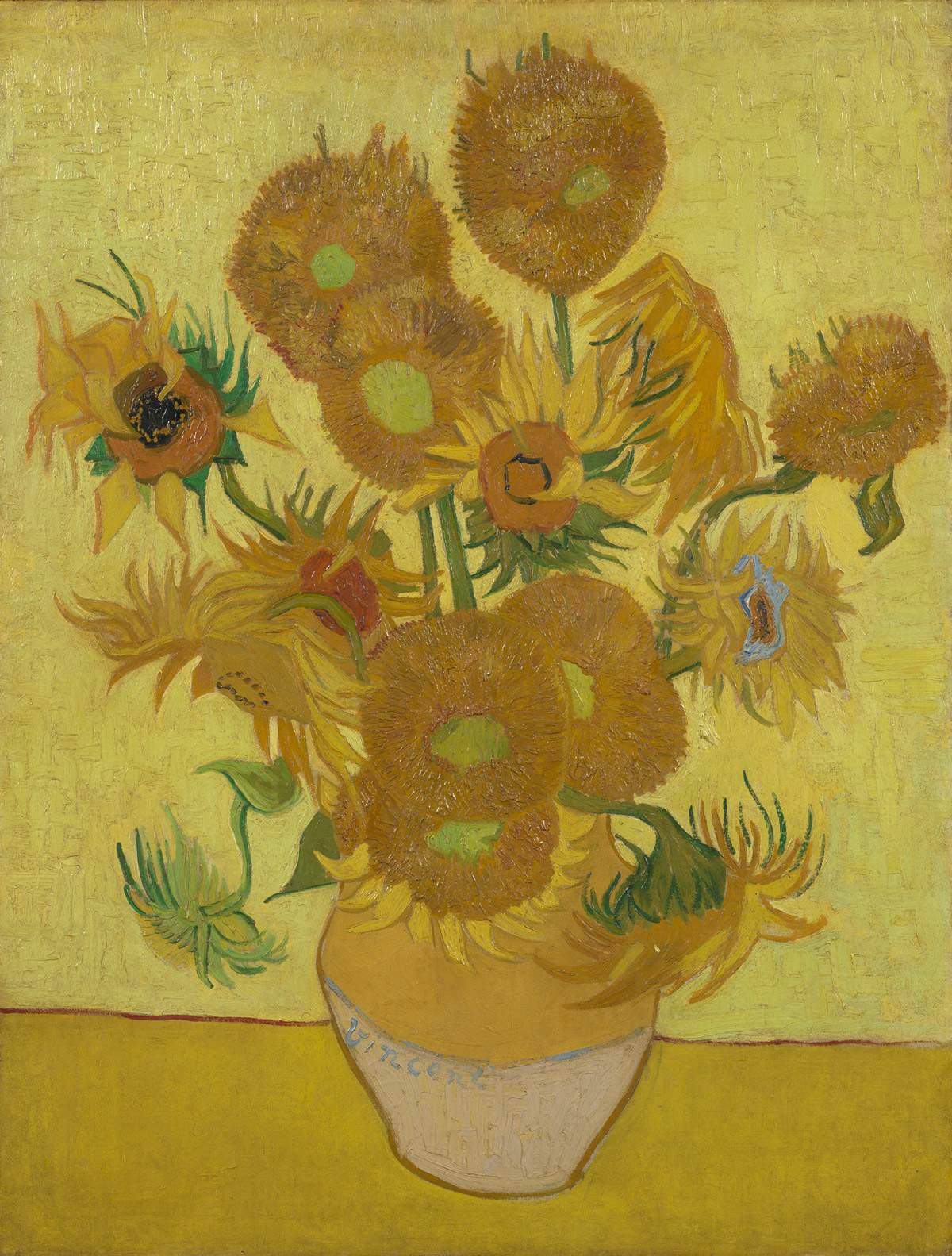
An eternity that appears to us dark, black, lumpy, horrifying even when it bursts with color, even under the sun of Provence, under its clear skies, in the midst of olive groves at sunset. If there is a form of madness in Van Gogh (or an excess of lucidity, if you prefer), it is to be found, rather, in his incessant desire to find the eternal in the finite. In his passion for the thing, Cacciari would say, in his continuous attempt to effuse himself toward the other. A sunflower is not a flower inside a vase, and Van Gogh himself had an understanding that his sunflowers were “a cry of anguish,” he would tell his sister Willemien, in a letter sent from Saint-Rémy-de-Provence on February 19, 1890. A sunflower is seed, sap, water, photosynthesis, life seeking its light, life trying to preserve itself with the utmost intensity, roots splitting the earth, insects, rotting, withering, death, tension, explosion. All of Van Gogh’s painting is a quest for direct contact with the violence of the real, it is the calculated attempt to avoid the lashings of the wind that freeze the bare skin, to escape the flame that burns the hands. No human being can withstand this force, the same force that consumed Van Gogh. The difference is that most do not think about it. Others seek a form of consolation. Van Gogh sought to express the unbearable truth of objects by enthusing about their colors, with the eye of the artist who, knowing that truth cannot be grasped, and that there is probably not even an essence of reality that is possible to capture, ends up indulging in his intellectual torment, in the scientific computation that allows him to make sense of what he sees: “Instead of trying to reproduce exactly what is in front of my eyes, I use color more arbitrarily to express myself powerfully. [...] I would like to make a portrait of an artist friend who has big dreams, who works as the nightingale sings, because that is his nature. This man will be blond. I would like to express in the painting my esteem, my love for him. I will paint him, therefore, as he is, as faithfully as I can, to begin with. But the painting is not finished like that. To complete it, I will now use arbitrary coloring. I will exaggerate the blondness of the hair, arrive at orange, chrome, pale lemon yellow shades. Behind the head, instead of painting the anonymous wall of an insignificant room, I paint infinity.”
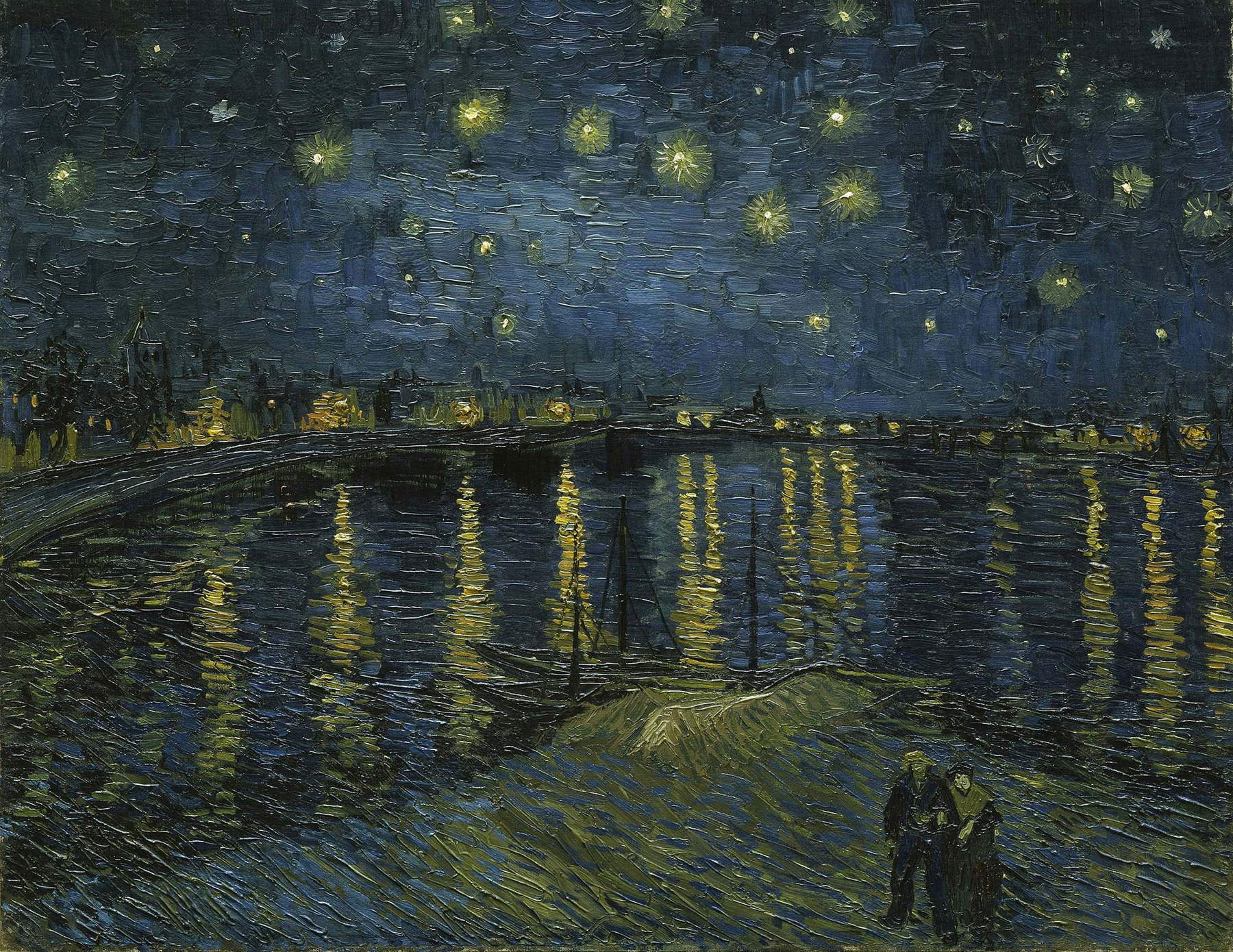
Vincent van Gogh’s painting is a search for the signs of a suffering eternity even when he himself seems to wear the vestments of a priest of torment, even in the midst of the ghostly peasants of the fields of the Borinage, even in the midst of the transfigured furrows of the fields of Provence, because Van Gogh feels that he is part of the same flux, because he knows that he is an artist sensitive to the scream of the world, to the violence of existence, because he knows that there is no other way to feel the weight of an object, to taste its hardness, to burn with its heat. And because he probably feels the discomfort of seeing himself being overwhelmed, annihilated, incinerated: and it is for this precise reason that it is difficult, not to say impossible, to speak of a Van Gogh who abandons himself. There is always, in Van Gogh, a solemn discipline, a heated rigor, an ascetic severity. The hand is calm even when he may find that he is unable to bear the mystical burden of a starry vault, for one must be impassive when holding a shield, when trying to dampen a fire.
There is obviously pain in Van Gogh’s experience, but perhaps it is more of an ontological pain than a physical, psychiatric pain, a pain shared with every being on earth who suffers in his effort to exist. Van Gogh tried to fix it on canvas, perhaps with the hope of seeing it shine in the light of day. Painting horror knowing, however, that the stranger on earth owns nothing. With an unseemly lucidity, an unpopular lucidity because it is irreconcilable with any consolatory reading. Painting the horror and continuing to experiment until the last of days, with lena, with science, with calculation. Already having the knowledge that one can never fully understand the leaf of a sunflower, the trunk of a tree, a light in the starry night. A pursuit that will never end. Or which, at best, may stop at times in an ever unresolved painting.

The author of this article: Federico Giannini
Nato a Massa nel 1986, si è laureato nel 2010 in Informatica Umanistica all’Università di Pisa. Nel 2009 ha iniziato a lavorare nel settore della comunicazione su web, con particolare riferimento alla comunicazione per i beni culturali. Nel 2017 ha fondato con Ilaria Baratta la rivista Finestre sull’Arte. Dalla fondazione è direttore responsabile della rivista. Nel 2025 ha scritto il libro Vero, Falso, Fake. Credenze, errori e falsità nel mondo dell'arte (Giunti editore). Collabora e ha collaborato con diverse riviste, tra cui Art e Dossier e Left, e per la televisione è stato autore del documentario Le mani dell’arte (Rai 5) ed è stato tra i presentatori del programma Dorian – L’arte non invecchia (Rai 5). Al suo attivo anche docenze in materia di giornalismo culturale all'Università di Genova e all'Ordine dei Giornalisti, inoltre partecipa regolarmente come relatore e moderatore su temi di arte e cultura a numerosi convegni (tra gli altri: Lu.Bec. Lucca Beni Culturali, Ro.Me Exhibition, Con-Vivere Festival, TTG Travel Experience).
Warning: the translation into English of the original Italian article was created using automatic tools. We undertake to review all articles, but we do not guarantee the total absence of inaccuracies in the translation due to the program. You can find the original by clicking on the ITA button. If you find any mistake,please contact us.














 IT
IT FR
FR DE
DE ES
ES CN
CN


