




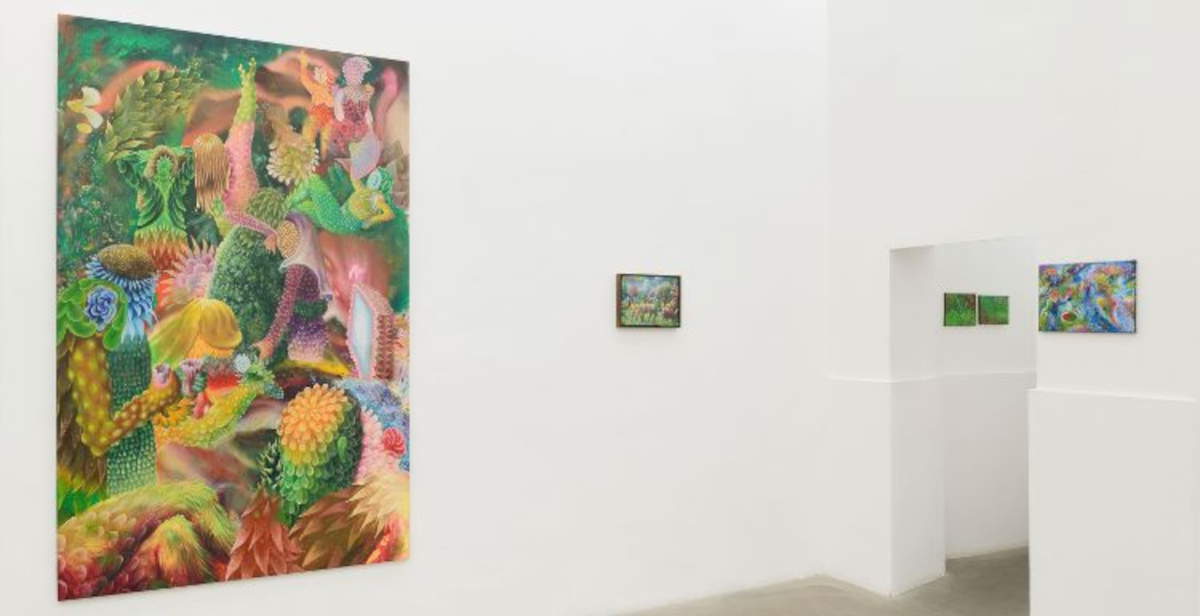
At the Ada Gallery in Rome, from April 10 to May 24, 2026, is presented the exhibition by Diego Gualandris (Bergamo, 1993) entitled Floralia, a project that develops as a fragmented narrative in the form of stream of consciousness, built around a plurality of voices and perceptual states that overlap without a linear structure. The work is articulated as an investigation into the transformation of living matter, particularly plant matter, through images of growth, deterioration and dispersal. For the solo show at ADA, Diego Gualandris presents a new cycle of oil paintings.
The central text of the exhibition takes the form of afirst-person riddle, in which the narrative voice identifies with a plant form torn from its original environment by a giant hand. The transition from the natural cycle to the condition of a severed object introduces a reflection on the fragility of organic matter, subjected to the action of the sun that gradually dries and breaks it down. Dissolution is presented as a continuous process that leads to fragmentation and multiplication into dispersed parts. Embedded within this narrative are references to an altered perceptual dimension, in which the plant body registers the movement of insects on the surface, perceived as a road traversed by incessant activity. Temporality expands to include the succession of seasons and moons, which contribute to a form of cosmic observation of transformation.
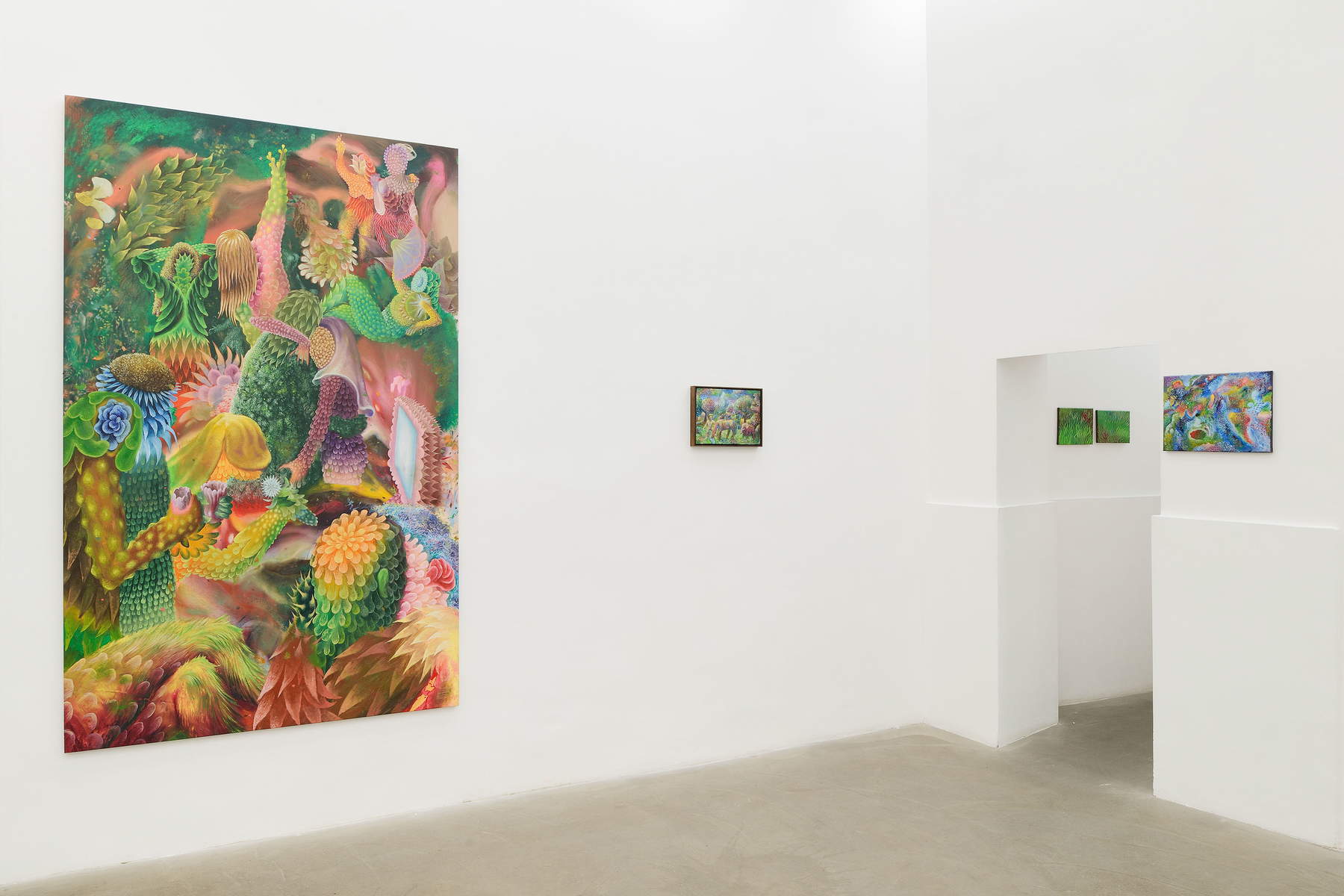
The text also introduces a reflection on thought and perception, interrupted by an episode related to the figure of Ernesto, who in his sleep asks a question about the nature of light, questioning the relationship between external origin and visual perception. This element opens up a philosophical dimension that runs through the entire narrative structure, without resolving itself into an unambiguous answer. The narrative then shifts to a plane of movement and travel, with a nighttime relocation faced in sensory isolation, marked by a strong sensitivity to smells and the presence of others. The desire for sleep and suspension is accompanied by the idea of an uncertain destination, in which the body seeks a form of relocation.
Subsequently, the narrative takes on a marine dimension: the subject crosses the water until he loses contact with his place of origin, carrying with him a house that grows larger and progressively heavier. The breaking of this form leads to dispersal on the seabed and a slow return to the shore, where the subject is collected and relocated in a new, unfamiliar context. From this new position a detached perspective develops, in which reality appears as a sequence of scenes that are composed through thought. Observation is transformed into sudden action, described as a rapid and impactful descent to earth, devoid of sound and external reaction. Subsequent time is represented as a cyclical condition, likened to a music box, in which the form changes further, assuming different proportions and a condition of isolation.
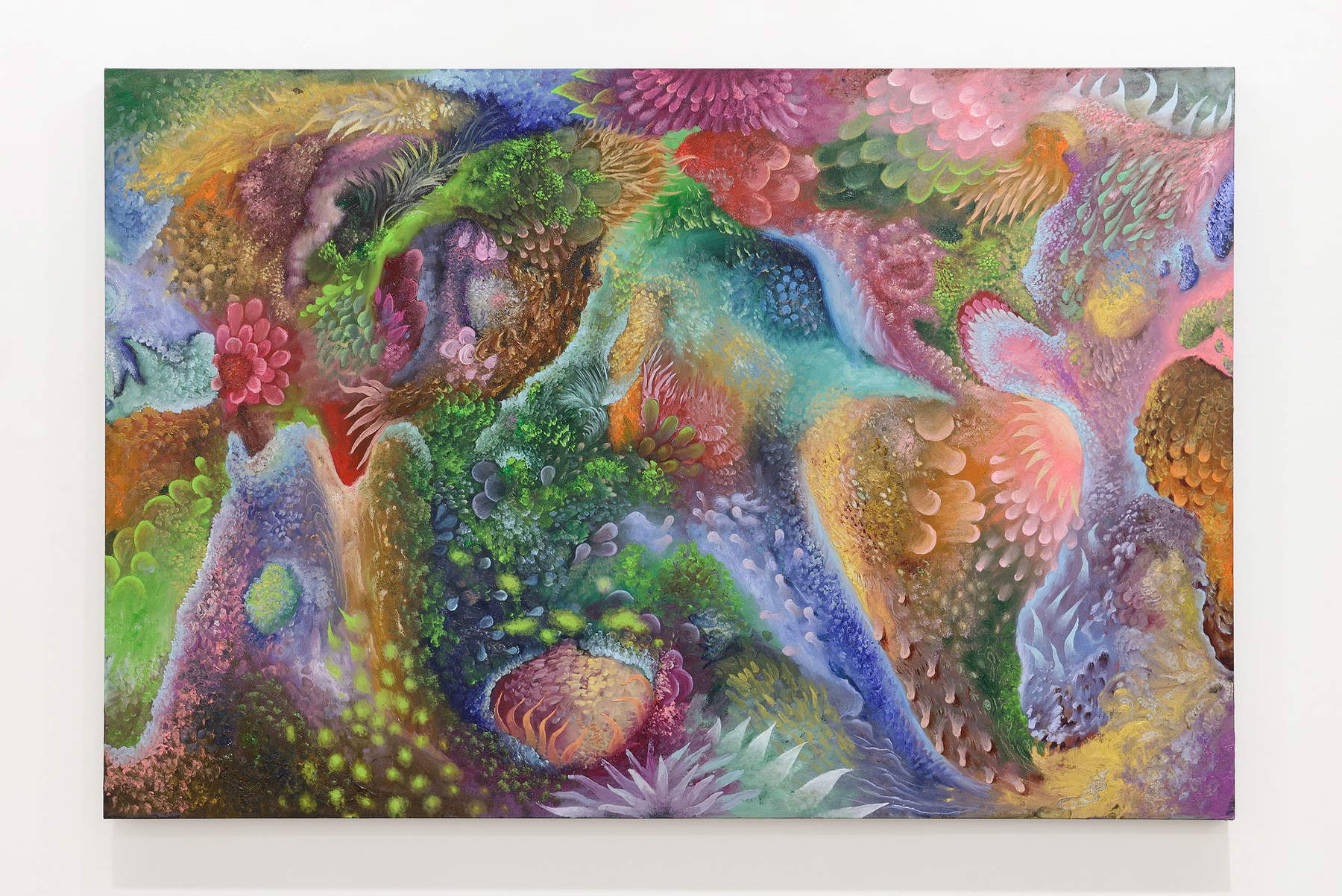
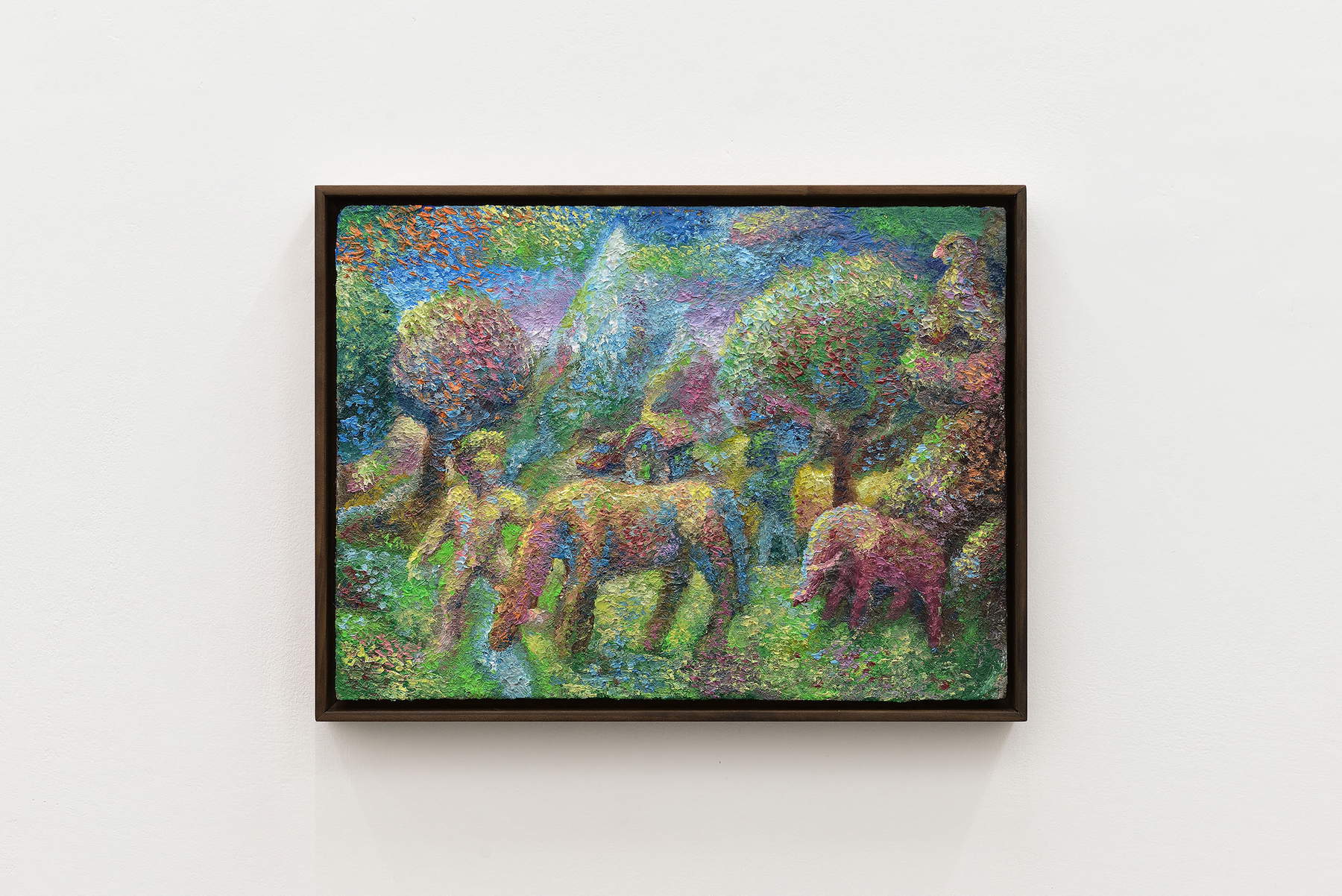
A further collective image introduces a row of elements that, crushed and raised by the wind, temporarily take on the appearance of a marching army, with visual references to spears and coordinated movement. The everyday dimension alternates with moments of perceptual instability, in which the subject declares that he is singing while being aware of his own out-of-tune, driven by an internal necessity rather than an aesthetic purpose. The conclusion of the text focuses on a sensation of intense physical crossing over, described as an electrical discharge that runs through the nervous system and produces an internal tension that can be likened to a returning force toward an undefined origin. The experience culminates in a condition of repeated suspension and falling, until the final transformation into an insect trap perceived as food and as a passive device of attraction.
The narrative closes with a direct, unanswerable question “What am I?” that summarizes the entire course of the exhibition as a process of continuous redefinition of the identity of living matter and its perception. The Floralia exhibition is accompanied by a limited edition vinyl and a text written by the artist.
Diego Gualandris lives and works in Rome. He graduated in painting in 2018 from the Academy of Fine Arts in Bergamo. Recent solo exhibitions include those in 2026 at ADA, Rome, and 2025 at Studio Pesca in Milan, curated by Arianna Pavoncello and Carolina Latour. In 2022 he exhibited again at ADA in Rome and at the Instituto Italiano de Cultura in Mexico City, curated by Matteo Binci. In 2019 he presented a project also at ADA, Rome, while in 2018 he participated in an exhibition at Tile Project Space in Milan together with Riccardo Sala.
More recent group exhibitions include participation in 2026 at the National Gallery of Modern and Contemporary Art in Rome. In 2025 he took part in an exhibition at Museo MACRO, curated by Luca Lo Pinto and Cristiana Perrella, and in Proyecto Nasal in Mexico City. In 2024 he exhibited at the Studiolo in Milan, curated by Maria Chiara Valacchi and Antonio Di Mino. In 2023 he participated in several exhibition projects including Triennale Milano, curated by Damiano Gullì, Panorama L’Aquila as part of ITALICS curated by Cristiana Perrella, CURA. Basement in Rome, Galerie Kandlhofer in Vienna, the MACRO Museum in Rome and Mai 36 Galerie in Zurich, curated by Antonio Grulli. In 2022 he again took part in Proyecto Nasal in Mexico City, curated by Matteo Binci, while in 2020 he participated in the Quadriennale d’arte at the Palazzo delle Esposizioni in Rome, curated by Sarah Cosulich and Stefano Collicelli Cagol. In 2026 he received the Urban Connections competition prize, sponsored by the National Gallery of Modern and Contemporary Art in collaboration with Techbau S.p.A., while in 2020 he was the recipient of the Pollock-Krasner Foundation Grant in New York.
 |
| Diego Gualandris in Rome: the metamorphosis of dissolving plant matter |

Warning: the translation into English of the original Italian article was created using automatic tools. We undertake to review all articles, but we do not guarantee the total absence of inaccuracies in the translation due to the program. You can find the original by clicking on the ITA button. If you find any mistake,please contact us.















 IT
IT FR
FR DE
DE ES
ES CN
CN


