




by Redazione 23/03/2026



Categories: Exhibitions / Disclaimer
From April 11 to October 25, 2026, Tenuta Dello Scompiglio in Vorno (Capannori, Lucca) will host Danse Macabre, a solo exhibition by Belgian artist Hans Op de Beeck curated by Angel Moya Garcia. The project brings together a site-specific installation and the animated film Vanishing Point.


At the Dello Scompiglio Estate in Vorno, in the municipality of Capannori (Lucca), theDello Scompiglio Cultural Association presents Hans Op de Beeck ’s solo exhibition entitled Danse Macabre, curated by Angel Moya Garcia. The exhibition opens to the public on April 11, 2026, with opening scheduled between 11 a.m. and 7:30 p.m., and remains open until October 25, 2026.

A Belgian artist active on the international scene, Hans Op de Beeck develops his research through a wide range of media and languages. Over the course of his career he has built a body of work that includes installations, sculptures, videos, texts, drawings, photography and watercolor paintings. Over the past decade, he has also extended his activities to theater, opera, and contemporary dance, working as a playwright, director, set and costume designer.
His work is best known for installations of large scale and immersive character, sensory environments organized as enigmatic scenes suspended in time, capable of suggesting moments of silent contemplation or wonder. Op de Beeck’s research addresses the complex relationship between human beings and the world around them, interweaving reflections on universal questions related to the invisible structure of existence.




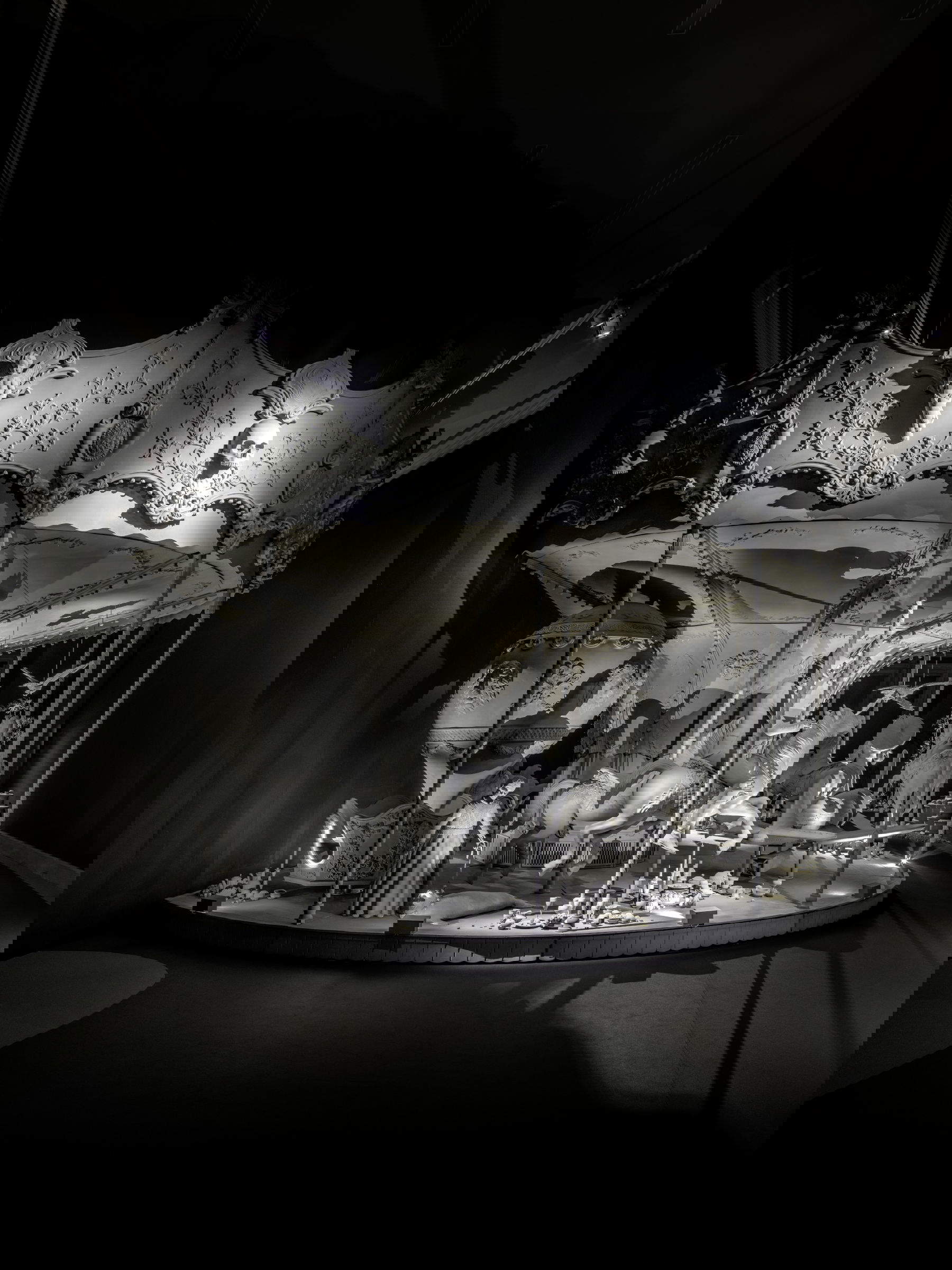
The project presented at Tenuta Dello Scompiglio consists of two main elements: a site-specific installation and an animated film. The installation, which gives the entire exhibition its title, takes the form of a monochrome black-and-white landscape that evokes a nocturnal park. The space consists of bare trees, water surfaces, and a winding path leading toward a life-size gray merry-go-round. The environment appears as a suspended scene, almost a cinematic “opening shot.” The visitor traverses a fictitious landscape devoid of color, where oil barrels turn into hearths and vegetation takes on a bare look. The path leads toward an abandoned attraction immersed in a completely black night.
The merry-go-round represents a recurring element in the artist’s production. In its traditional form, which is still present in many contemporary variations, it is a decorative and flashy object, often characterized by bright colors and ornaments of baroque taste, recalling a nostalgic imagery related to past forms of entertainment. As early as 1999, Op de Beeck made the video Blender, in which a colorful and pompous merry-go-round slowly began to rotate and then dissolved into an indecipherable swirling motion, resembling a mass of cotton candy, until it stopped again.
Since then, the artist has used the merry-go-round as a metaphor for the human condition. According to Op de Beeck, the merry-go-round represents a deeply human form of entertainment, endowed with a tragicomic dimension. At the same time, it appears as a paradoxical object: adults place children on wooden horses and watch them as they go around in circles with no real destination. When such leisure facilities are no longer in operation, or appear abandoned, they take on a melancholy tone. The original merriment seems to fade or disappear, giving way to a sense of emptiness similar to that which remains after a party has ended.
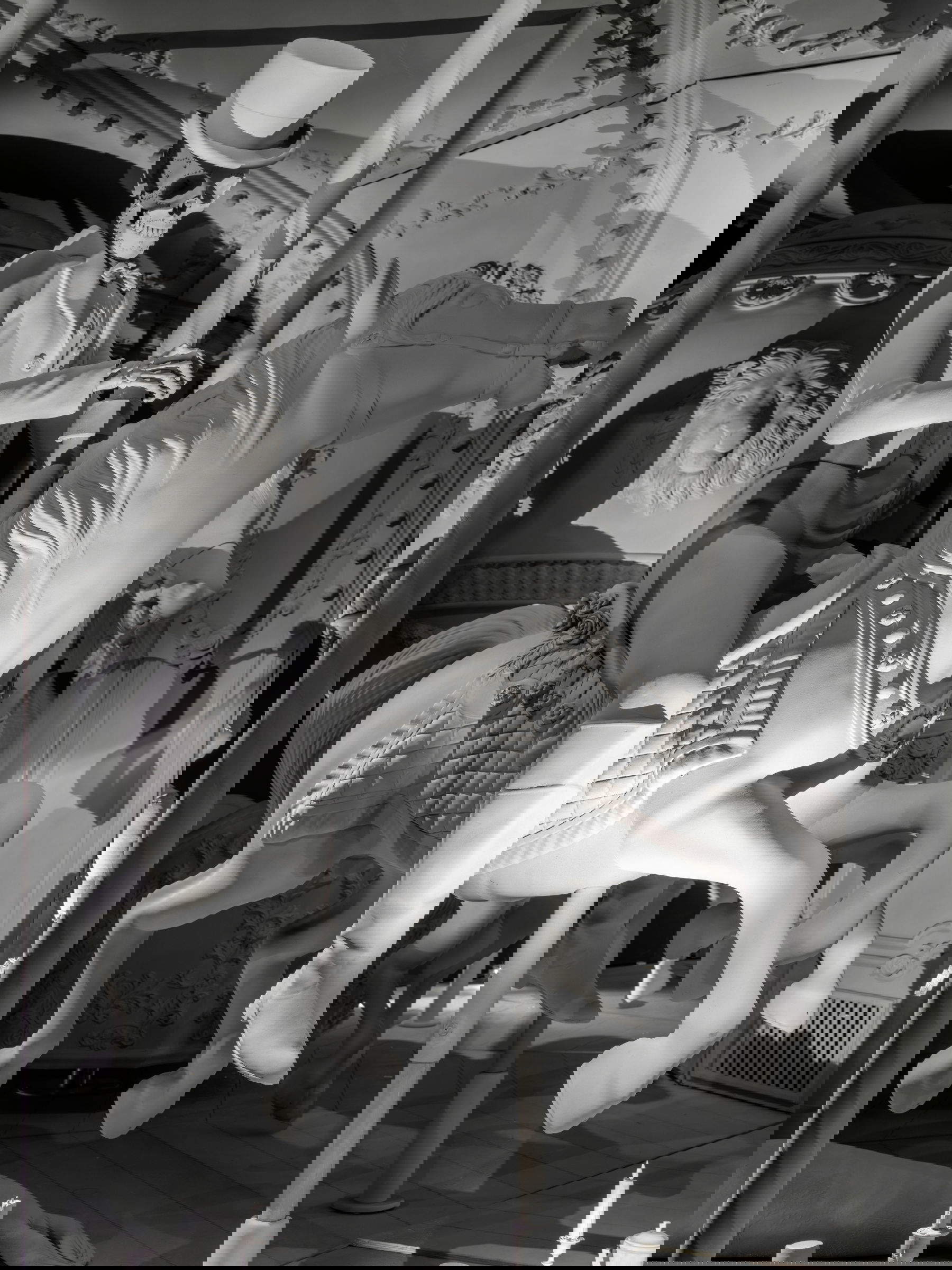
In the installation presented in Vorno, the merry-go-round appears completely monochrome. The dull gray blocks all its dynamics and returns the impression of a crystallized object, almost a fossil immobilized in time. The elimination of color deprives the structure of any residual vitality, further distancing it from the real object. The work takes the form of a sculptural reinterpretation. The uniform, dull tone transforms the carousel into something else, likened to an ash-covered remnant after a fire or an object abandoned in the aftermath of a war or nuclear catastrophe.
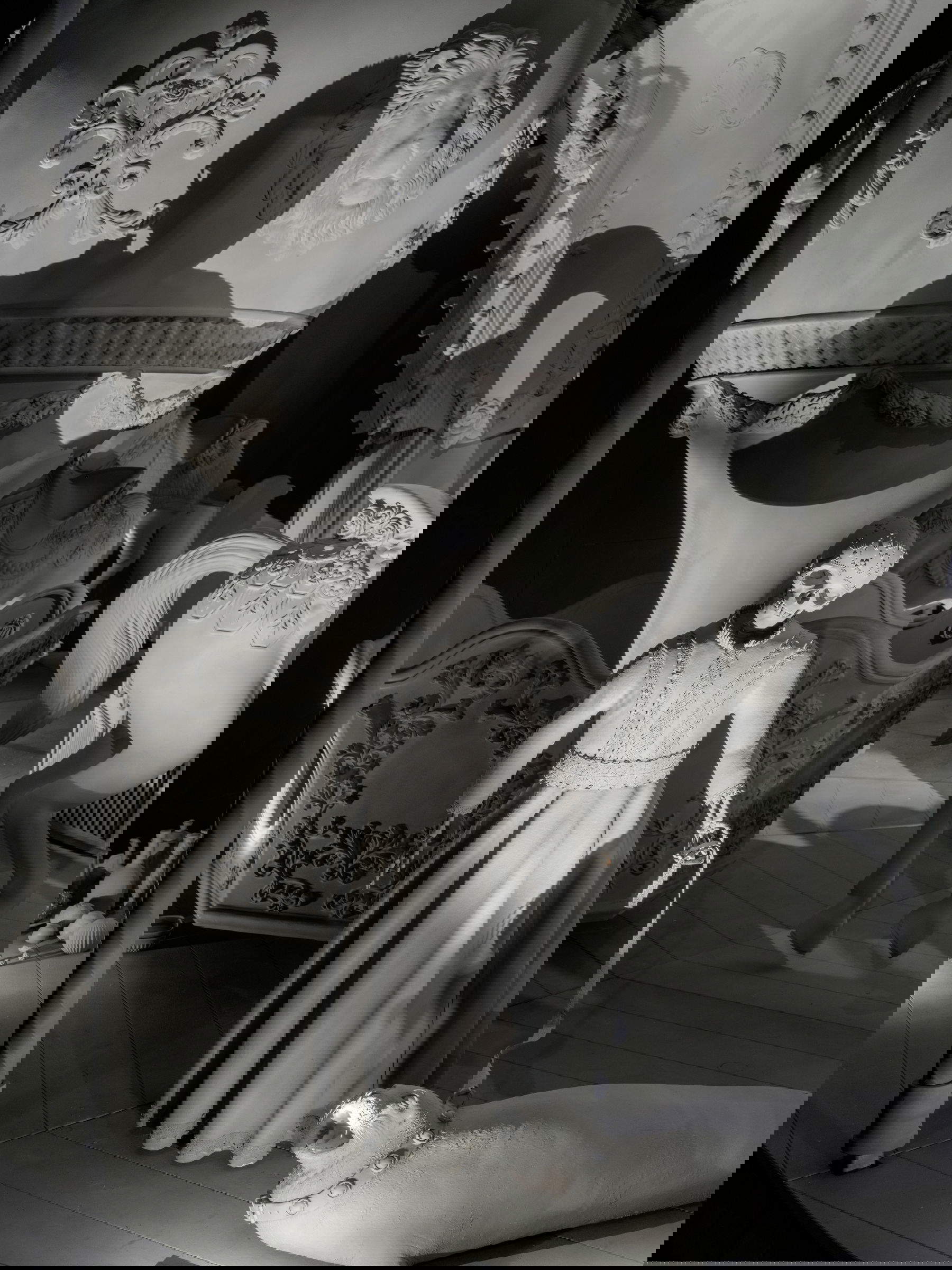
The title Danse Macabre recalls the iconographic tradition of the dance of death. In Op de Beeck’s work, the reference takes shape through a motionless procession of carriages, horses and other elements that allude to death. The whole is conceived as a still life of monumental dimensions. In art history, the still life genre has often taken on the meaning of memento mori, a reminder of the transience of existence and the relativity of human life. Numerous details appear on the carousel that amplify this reference. A family of skeletons seems to revel in the attractions.
Piles of used dishes, remnants of cakes, empty bottles and glasses, ashtrays, and fruit accumulate around them. The whole evokes a landscape reminiscent of a now-abandoned battlefield. Unexpected situations emerge within the scene: the skeleton of a little girl leads a roaring seal on a leash; the skeleton of an elegant man quietly smokes a cigarette while sitting in a carriage; a small airplane recalls the shape of a World War I bomber.
The installation is accompanied by a soundscape composed by Sam Vloemans and performed by theHermes Ensemble (B). The music resonates in the distance in the exhibition space and introduces the second part of the exhibition, where the animated film Vanishing Point is presented. The work completes the exhibition path, expanding the reflections developed in the installation. The title of the film refers to the vanishing point in pictorial perspective, the point in the picture plane where parallel lines seem to converge. At that distance the perception of three-dimensional depth dissolves. Op de Beeck uses the term in a metaphorical sense, as a threshold that leads from the measurable and legible dimension into territories that are more uncertain and difficult to interpret: from the concrete to the abstract, from the intellectual to the spiritual.
The film opens with the image of a child lying supine, asleep with his eyes closed. From that initial scene, the visual narrative unfolds through a sequence of imaginary landscapes, still lifes, and figures. The artist’s watercolors come to life along with the music, generating a suspended and contemplative atmosphere. The visual narrative invites the viewer to a moment of abandonment, in which the perception of time seems to fade away.
The term “vanishing” means the sudden and complete disappearance of something. In mathematics it can also mean “becoming zero.” Op de Beeck is interested in moments when human beings experience a temporary dissolution of their identity. These are situations in which the linguistic, logical and rational understanding of the world loosens and gives way to a condition of loss of self and temporal suspension.
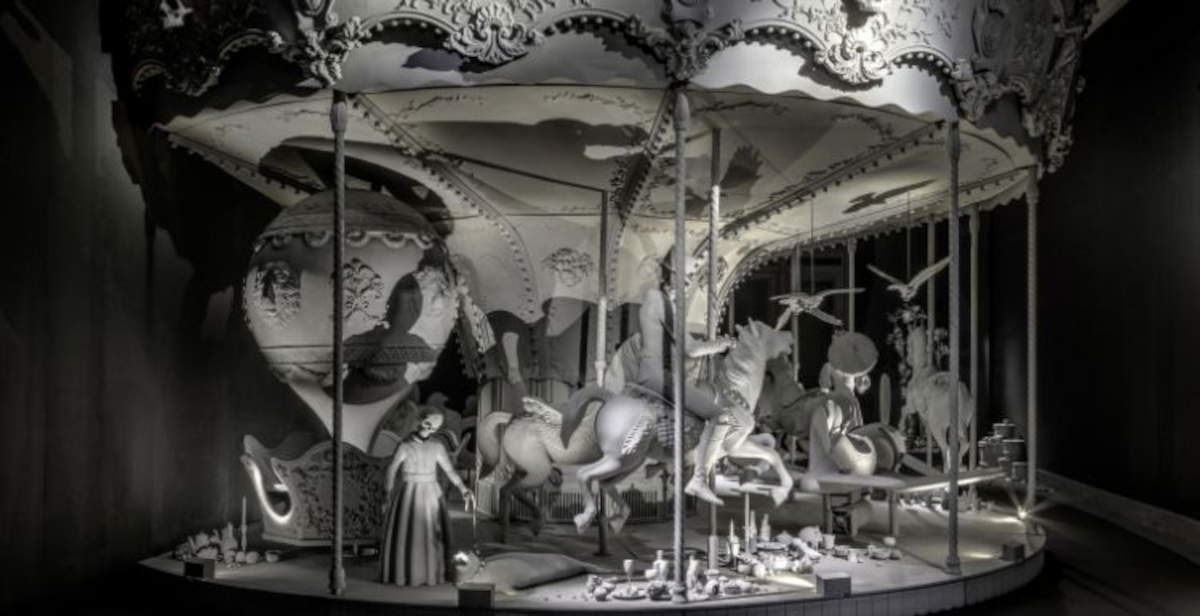 |
| Hans Op de Beeck at Tenuta Dello Scompiglio in Lucca with Danse Macabre |
Warning: the translation into English of the original Italian article was created using automatic tools. We undertake to review all articles, but we do not guarantee the total absence of inaccuracies in the translation due to the program. You can find the original by clicking on the ITA button. If you find any mistake,please contact us.