





The Luigi Pecci Center for Contemporary Art in Prato has scheduled a double exhibition for 2026 that is divided between the enhancement of an important donation and a critical reinterpretation of the work of a central figure in Italian photography of the second half of the 20th century. From May 31 to November 1, 2026, ROTTE. ARTE DI ROTTURA DALLA DONAZIONE CARLO PALLI, while from May 31 to August 30, 2026 there will be CARNALE, the first exhibition in an Italian contemporary art center dedicated to Verita Monselles (1929-2004). The two exhibitions share the same start, opening on May 30, 2026 from 6 to 9 p.m., and are located within the spaces of the Pecci Center designed by architect Italo Gamberini.
The exhibition ROTTE. ARTE DI ROTTURA DALLA DONAZIONE CARLO PALLI, curated by Stefano Pezzato, head of the Pecci Center’s collection and archives, stems from the large nucleus of works and archival materials donated by Prato-based collector Carlo Palli. The exhibition design is entrusted to Ibrahim Kombarji. The donation was formalized on May 29, 2025, and is presented as a bequest designed to further strengthen and define the city’s museum heritage.
The exhibition itinerary begins with an articulated selection of materials from three main nuclei: about 180 works from the private collection, 380 works and documents belonging to the donor’s Fluxus collection, and 230 works related to Visual Poetry and its Environs, a set that represents the complex of donations made by Palli to the Pecci Center over the course of about two decades. The final selection offered in the exhibition includes about 150 works created by some 80 artists, outlining a critical map of the transformations of art in the second half of the 20th century.
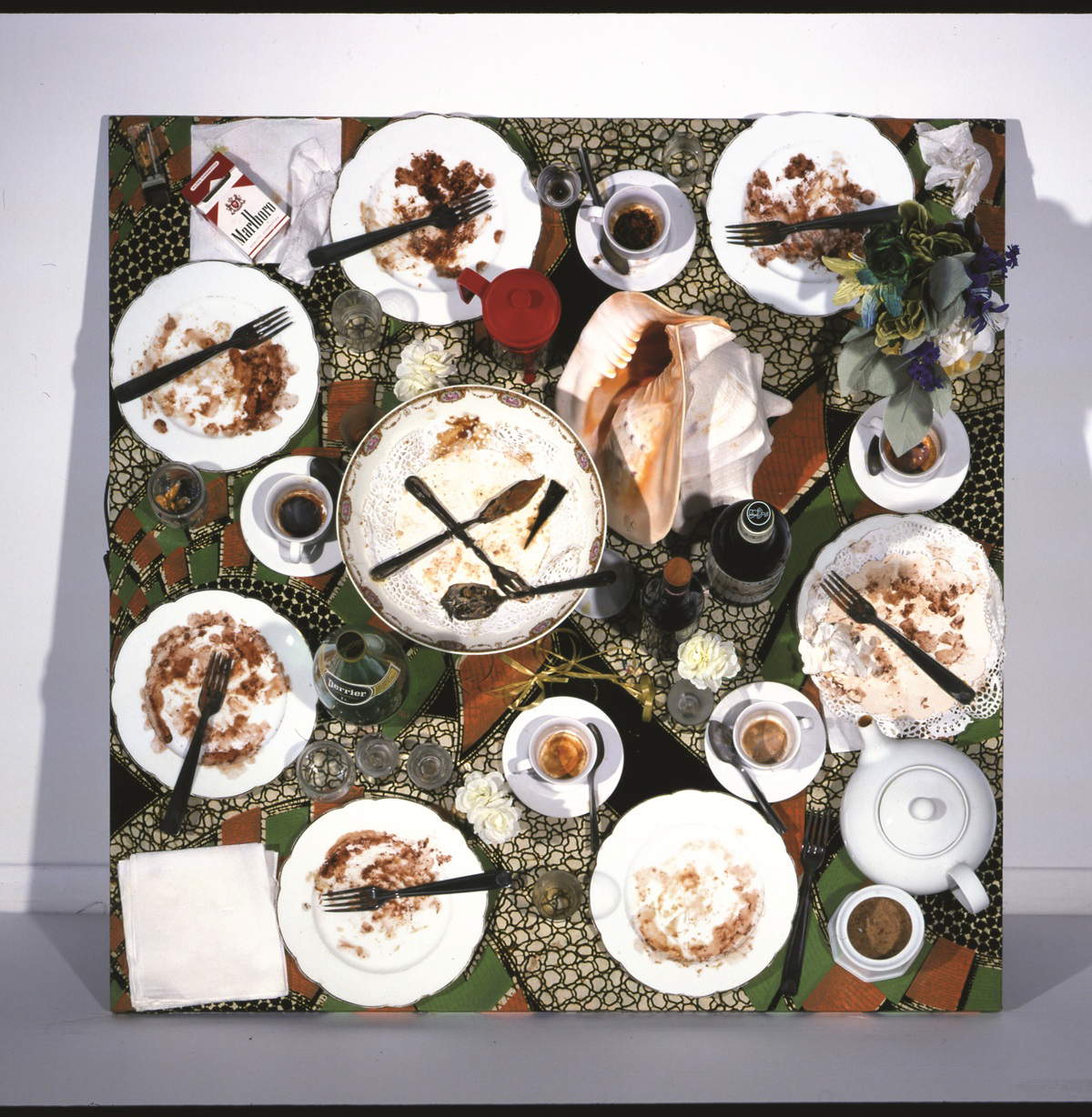
The curatorial framework identifies a series of trajectories that traverse different movements and languages, with particular attention to the practices of rupture that have redefined the boundaries between visual arts, performance, music, poetry and action. Key references include Group 70 and Visual Poetry, Nouveau Réalisme, Fluxus,Viennese Actionism, conceptual and processual research, practices related to writing and expanded painting, as well as object art experiences.
The selection includes artists who contributed to these developments, including Vincenzo Agnetti, Franco Angeli, Arman, Bernard Aubertin, Ay-O, Gianfranco Baruchello, Massimo Barzagli, Joseph Beuys, Lapo Binazzi (UFO), Alighiero Boetti, George Brecht, Antonio Bueno, Sylvano Bussotti, John Cage, César, Sandro Chia, Giuseppe Chiari, Joseph Cornell, Claudio Costa, Roberto Crippa, Enzo Cucchi, Alan Davie, Daze, Fortunato Depero, Gérard Deschamps, Raymond Hains, Al Hansen, Emilio Isgrò, Ray Johnson, Joe Jones, Allan Kaprow, Wilfredo Lam, Ketty La Rocca, George Maciunas, Roberto Malquori, Lucia Marcucci, Gino Marotta, Roberto Matta, Eugenio Miccini, Larry Miller, Charlotte Moorman, Massimo Nannucci, Maurizio Nannucci, Hermann Nitsch, Yoko Ono, Luciano Ori, Nam June Paik, Mimmo Paladino, Michele Perfetti, Gianni Pettena, Lamberto Pignotti, Michelangelo Pistoletto, Rammelzee, Renato Ranaldi, Man Ray, Dieter Rot, Mimmo Rotella, Takako Saito, Mario Schifano, Carolee Schneemann, Andres Serrano, Gianni Emilio Simonetti, Daniel Spoerri, Stelarc, Antoni Tápies, Jean Tinguely, Toxic, Franco Vaccari, Ben Vautier, Emilio Villa, Jacques Villeglé, Wolf Vostell, and Andy Warhol.
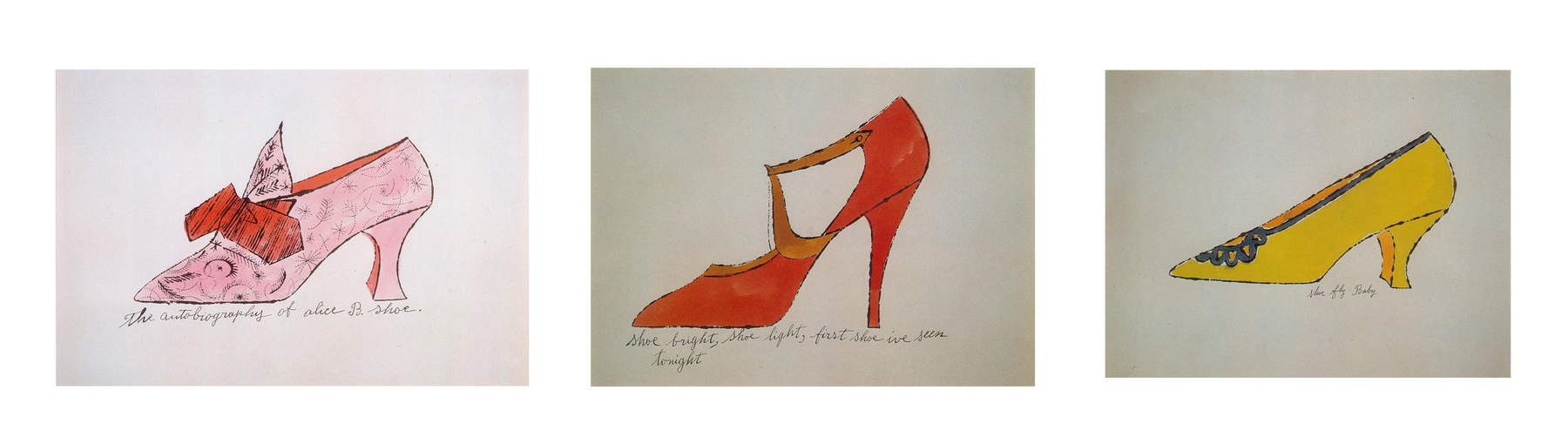
The exhibition is also shaped as the outcome of a history of relationships between the collector and the Pecci Center. Carlo Palli had already donated about 200 works of Visual Poetry and its surroundings in 2006, accompanied by an exhibition and a dedicated catalog. The new bequest is thus part of a continuing path and contributes to strengthening the museum’s role as a reference institution for the preservation and study of artistic practices of the second half of the 20th century, in parallel with other important documentary acquisitions, including the archive of the scholar Lara-Vinca Masini merged into the CID/Visual Arts.
Alongside ROTTE is CARNALE exhibition curated by Alessandra Acocella, Michele Bertolino and Monica Gallai, with installation by Giuseppe Ricupero. The exhibition is produced in collaboration with theTuscan Photographic Archive and the Verita Monselles Fund. The exhibition offers the first reconnaissance in an Italian museum institution of the work of artist and photographer Verita Monselles, whose research spans fashion, photography, performance and languages of visual culture between the 1960s and 1980s.
Born in Buenos Aires and moved to Italy during her childhood, Monselles initially developed her own path within bourgeois contexts between Florence and Naples, before approaching photography in the late 1960s. At this stage, the photographic medium becomes a tool for autobiographical and social investigation, used to reflect on the condition of women and the cultural and religious structures that define their roles. Her work develops in dialogue with some central figures of the coeval art and theoretical scene, including Ketty La Rocca, Tomaso Binga and Lara-Vinca Masini, as well as with theatrical experiences such as Magazzini Criminali and Krypton.
The works of the 1970s show a systematic use of religious and patriarchal symbols reworked through scenic and photographic devices that include mannequins, stuffed animals, devotional objects and constructed settings. The intent is to deconstruct established visual codes by relating body, identity and representation.
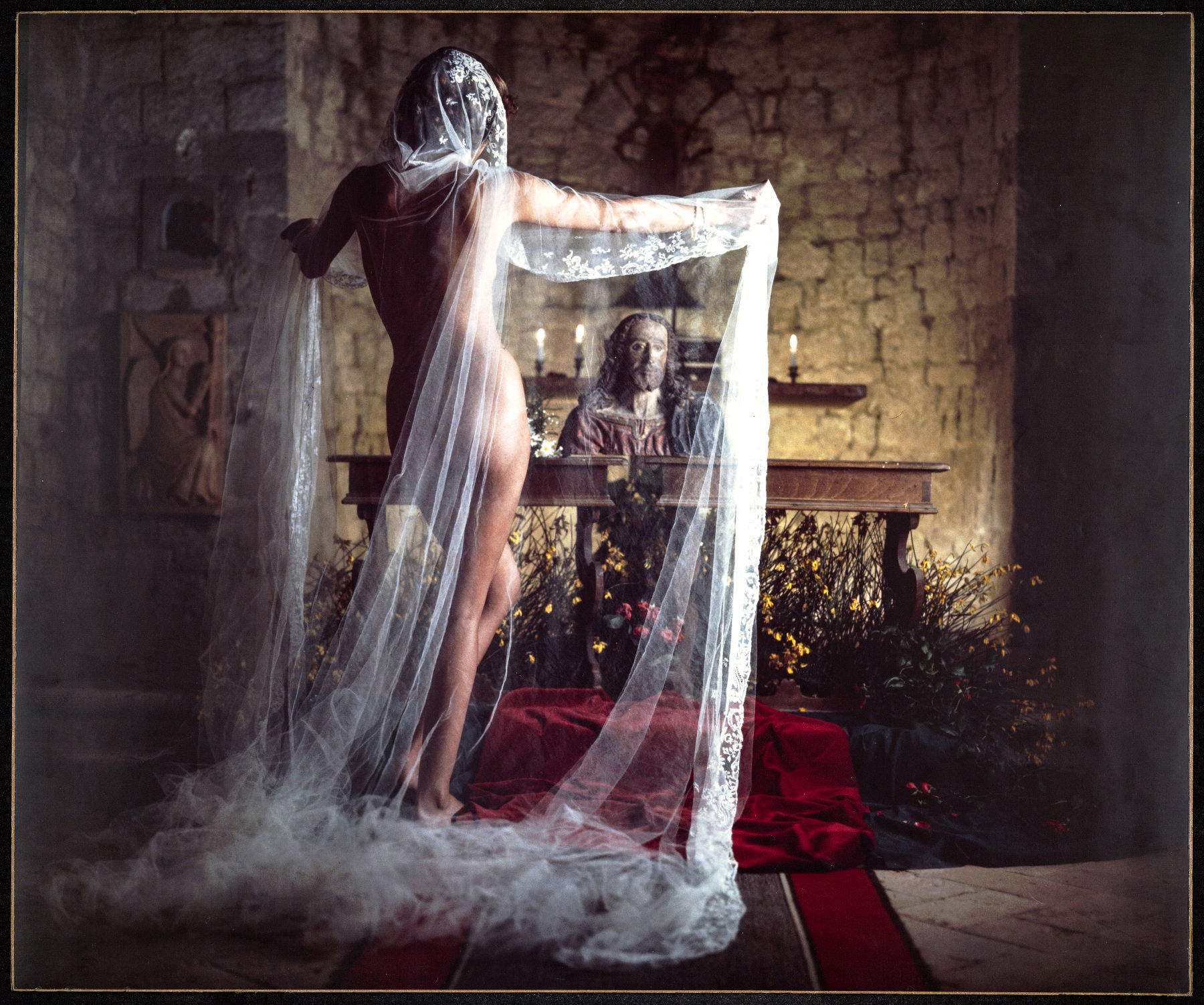
“A woman who questions her role in the face of motherhood, family, religion, and sexuality in the context of a repressive and inadequate society,” the artist emphasized.
“There is almost never, in Verita’s photographs, aggression,” writes Lara-Vinca Masini, “but a sense of painful rejection against any power expressed by the ’masculine,’ that of sex, that of ecclesiastical penitential constraint, that of convention and prejudice.”
“Verita you have been kind of seen as a feminist artist because you make this work about the condition of women, however, some people would like you to make it of the kind that is considered more political,” said Ketty La Rocca. “Instead, you do it in the condition that is, in my opinion, the only one you have experienced, of denunciation and suffering of the bourgeois woman. You make a discourse that is political in the long run.”
In later years, the production shifted toward greater formal essentiality, with an increasing centrality of the female body, represented as an autonomous subject of desire.
“Today I can express more confidence, and that comes from observing these women fortified by previous struggles. The solution to the conflict is in their hands, their determination, the new strength they have acquired,” the artist wrote in 1981.
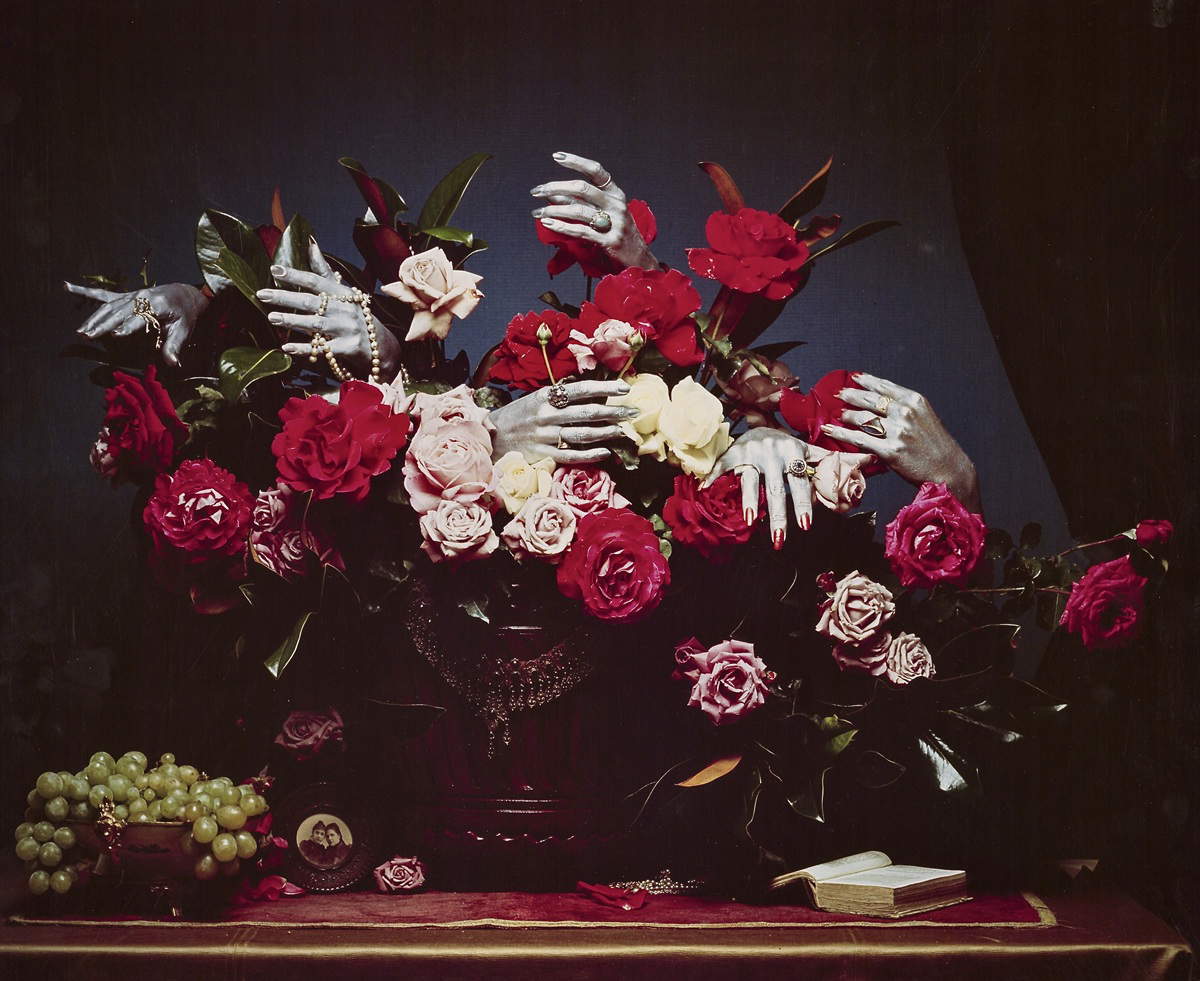
The images produced during this phase often take on a pop and kitsch dimension, reworking traditional genres of photographic representation. The exhibition path does not follow a chronological order, but builds relationships between the different phases of production, including lesser-known works such as Rosematic from 1984, in which photography and video are combined in sequences of transformation and hybridization between body, nature, and animal and plant imagery. Twenty years after the last solo exhibition dedicated to the artist, CARNALE offers a comprehensive rereading that restores the complexity of his language, between social criticism and use of the visual codes of fashion and advertising. The exhibition highlights a production that lies at the intersection of artistic practices and mass culture, directly interrogating representations of the body and gender in the second half of the 20th century.
The exhibition project is supported by Enrico Pecci of Alberto Pecci & C. Verita Monselles and is part of the Pecci Center’s program dedicated to the reinterpretation of collections and archives as instruments of historical and critical research.
 |
| Prato, on display at Pecci the "Routes" of breaking art and the shots of Verita Monselles |

Warning: the translation into English of the original Italian article was created using automatic tools. We undertake to review all articles, but we do not guarantee the total absence of inaccuracies in the translation due to the program. You can find the original by clicking on the ITA button. If you find any mistake,please contact us.





















 IT
IT FR
FR DE
DE ES
ES CN
CN


