





In the shortlist of ten Arab artists competing in the 61st Venice Art Biennale, including such well-known ones as Kader Attia and Walid Raad, only three artists are from an earlier generation, born between the 1940s and 1950s: Palestinian Vera Tamari, Lebanese Hala Schoukair and Moroccan Amina Saoudi. The story of Amina Saoudi, who has been married to a well-known Tunisian professor and art critic, Naceur Ben Cheikh, since 1983, is the most fictional and singular: an exceptional art couple who in the 1980s established their studio away from the spotlights in a small village near Sousse, Akouda, which had so enchanted Paul Klee and his artist friends on their Mediterranean Grand Tour in 1914 and marked a turning point for Western abstractionism.
Amina defines herself as an artisan artist, elevating humility and authenticity to valid artistic pursuit, and her works, exquisite tapestries and painted silks all executed in person, testify that the less obvious and predictable the recognition, the quicker and more guaranteed indeed the historicization. A small virtuous circle between the tireless cultural activism of Amina and Naceur and that, since 2021, of Tunisian foundations and galleries has facilitated the identification of an artist like Amina (to put it in the art market lexicon: “underestimated”) by the curator of the 61st Venice Art Biennale, Koyo Kouoh, and her team, an otherwise almost impossible identification. The story of Amina Saoudi’s recognition certifies that Koyo’s method makes law in the art sector and should be applied and refined as a curatorial procedure in all international competitions. Otherwise Amina’s case is miraculous, her recognition a mere canonization, and the current art system of religious scope.
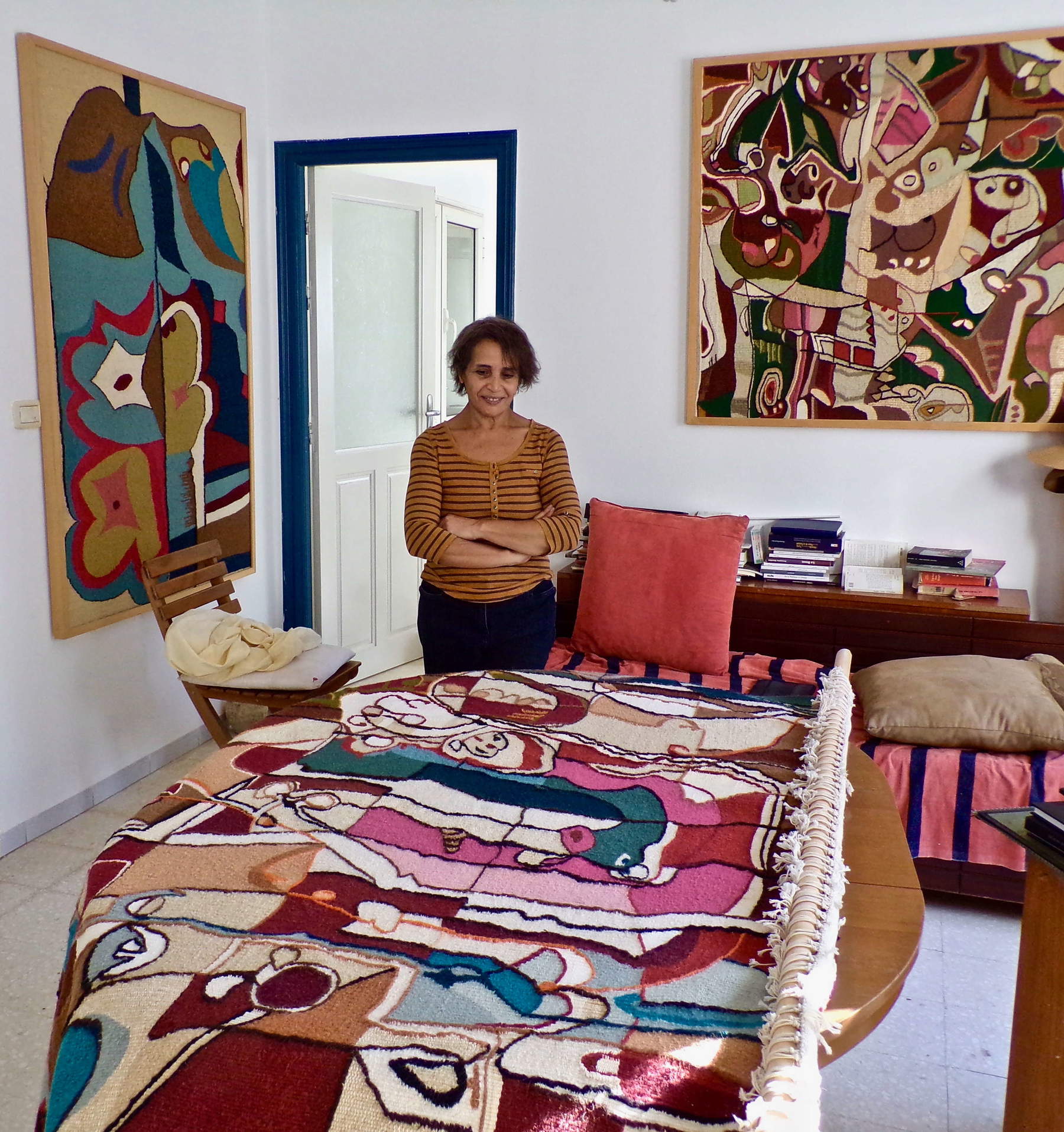
REF. Like many women artists of your generation, you were discovered late and, in a very short time, your career has taken a surprising leap forward. This year you are exhibiting for the first time at the Venice Biennale. How did you learn that you were selected for the 61st Venice Biennale?
AS. I have always wanted to see Venice and it is a joy to know that, thanks to my work, I will finally be able to experience this city. The gallerist Selma Feriani contacted me a year ago to tell me. It was the curator herself, Koyo Kouoh, who chose me. She was looking for emerging artists, and her assistant, Rasha Salti, contacted me to see if I had any other tapestries besides the ones Selma had shown her.
How many works are you exhibiting at the Biennial and which ones were selected?
Three tapestries and six silk paintings. My silk paintings cannot be dated because they were not all done in one year-I revisited the work several times. I see them as a palimpsest.
When did you start painting on silk?
I started in 1994. I had already been living in Tunisia for ten years, after my marriage to Naceur, a period during which I mainly took care of my two young children. Yet, when I met my husband in Morocco, I was teaching physics and chemistry in a middle school in Casablanca. 1994 was also the year my father died, which deeply affected me. I needed to break free from my role as a housewife, so I enrolled in a silk painting course in Tunis. But I was only able to attend one class.
What kept you from continuing?
As a first exercise, the teacher asked me to copy and color a drawing of a bird’s plumage, starting by outlining the shapes with gutta-percha. Gutta-percha is a kind of viscous ink (originally a natural milky substance obtained from tropical trees in Southeast Asia, now produced from petroleum) that prevents the color from smudging. Because I could not trace the outlines of a drawing that I had not created, my hand trembled. Noticing my discomfort, the lab manager reprimanded me, advising me to go back to taking care of my children, my husband and my kitchen! I never went back. Back home, Naceur encouraged me and I began to learn silk painting on my own. I fell in love with gutta-percha. Above all, I decided to follow my intuition and let my emotions flow. To this day, I still let emotions flow in my work. Without any reference to a pre-programmed representation, I would trace my lines by listening to Iranian, Indian or Chinese music that Naceur had introduced me to. Not understanding the languages of these songs sent me into a kind of trance.
Are these the works you returned to years later, some of which will be exhibited at the Venice Biennale?
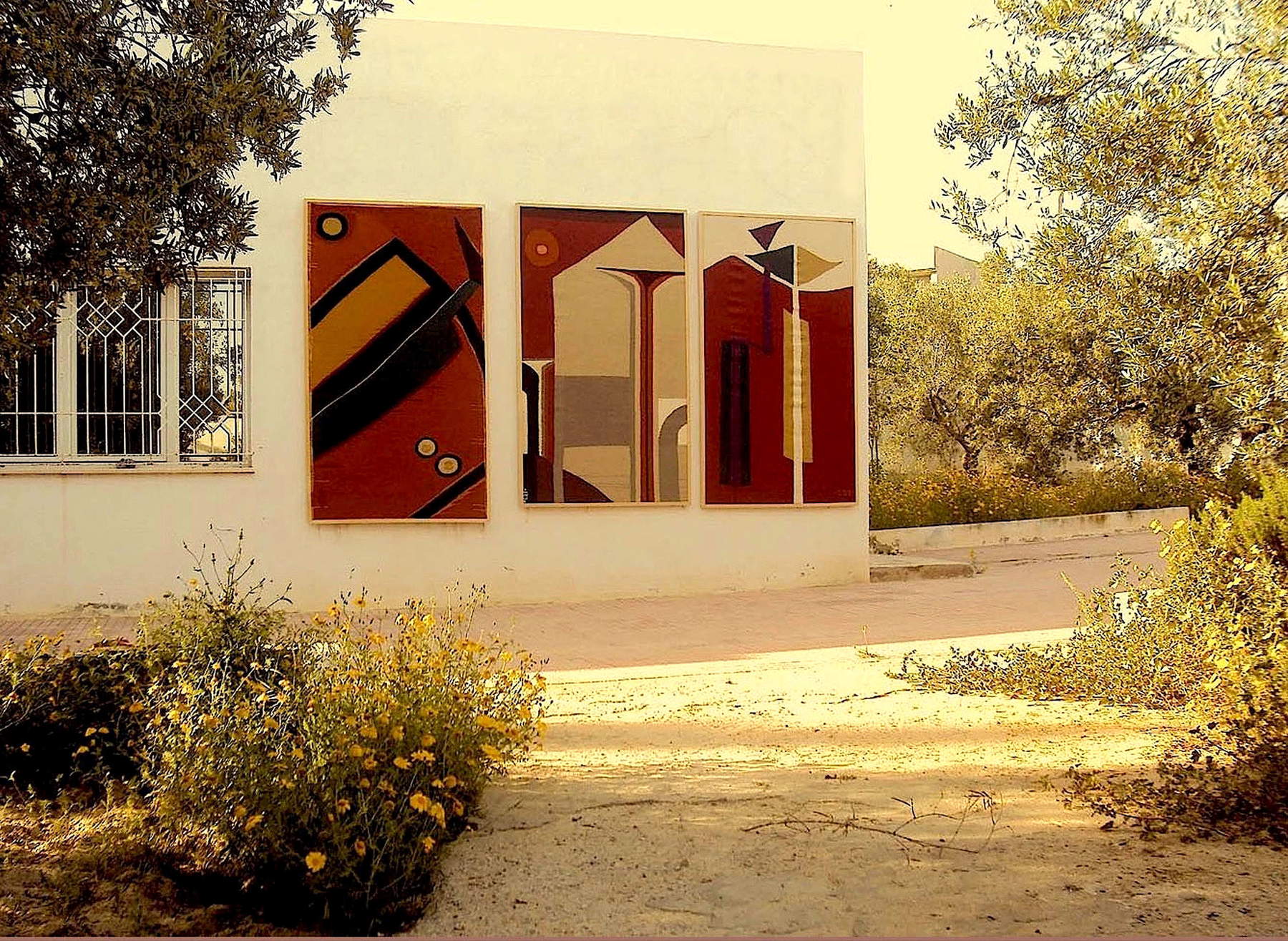
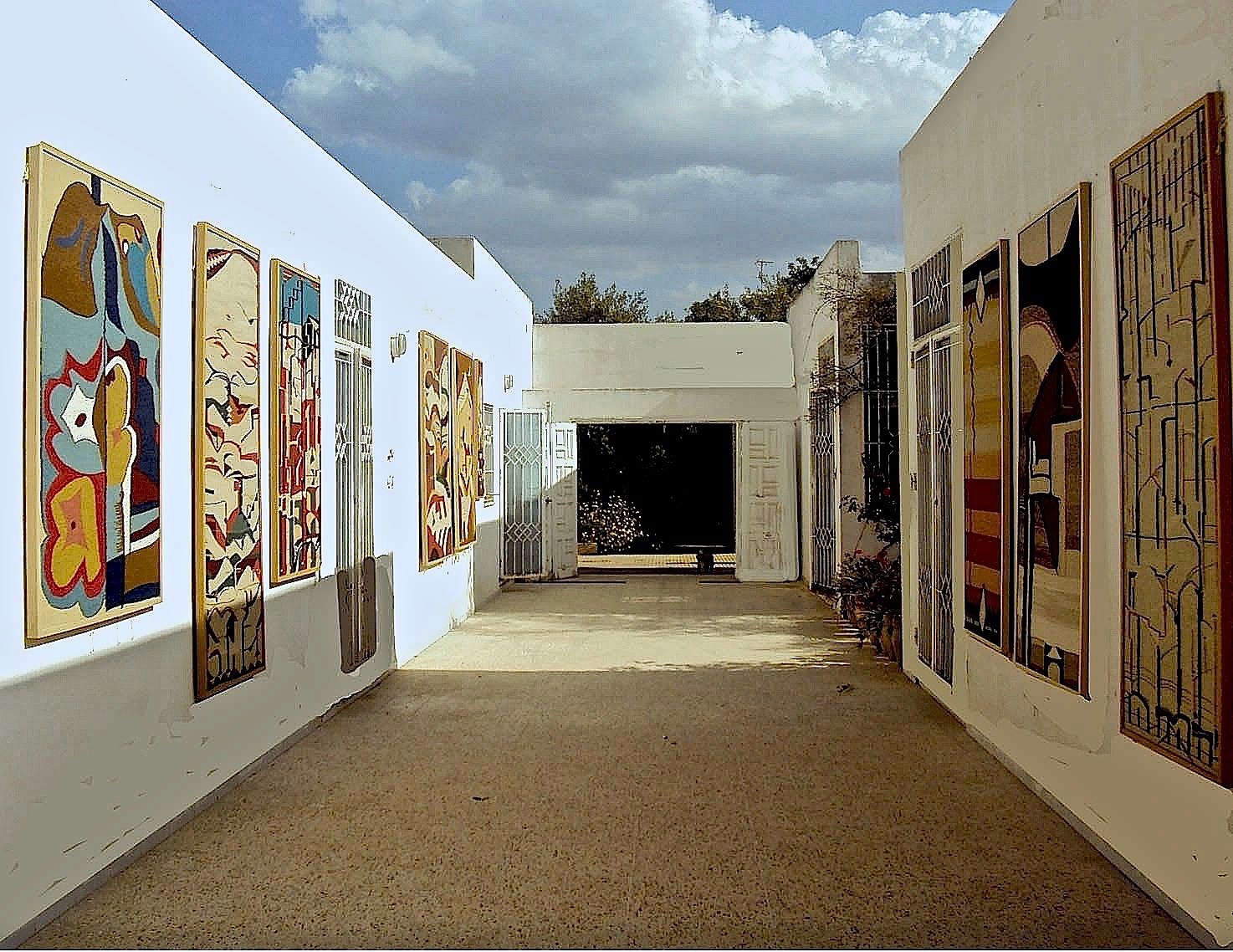
I returned to my silk paintings when we moved in 2004 to Akouda, a picturesque village near Sousse, where my husband was born. On a 2000-square-meter plot in the family olive grove, we built our house, designing the plans ourselves. It is a large house, with 300 square meters of covered space, a large outdoor patio, two conservatories and a shared studio of 50 square meters. The whole is surrounded by 16 magnificent ancient olive trees with gnarled trunks. Later, the patio was transformed into a gallery covered by barrel and cross vaults. I was thus able to rework my silk paintings more easily, reinforcing my practice of improvised, almost dancing graphic art.
Your silk paintings are incredibly rich in pattern, like a patchwork, and forms emerge from this graphic profusion.
I paint memories of Morocco, of Moroccan heritage, drawing inspiration, for example, from my memories of antique caftans and Berber jewelry collected by my older sister Naima, who was a costume designer for the cinema. Her house in Rabat was a veritable museum-she was married to the great Moroccan director Ahmed Bounani. As a child, I was immersed in their world. Their house was filled with trunks, hats, film reels, posters of Omar Sharif, satirical magazines like Charlie Hebdo, and comic books like Tintin.
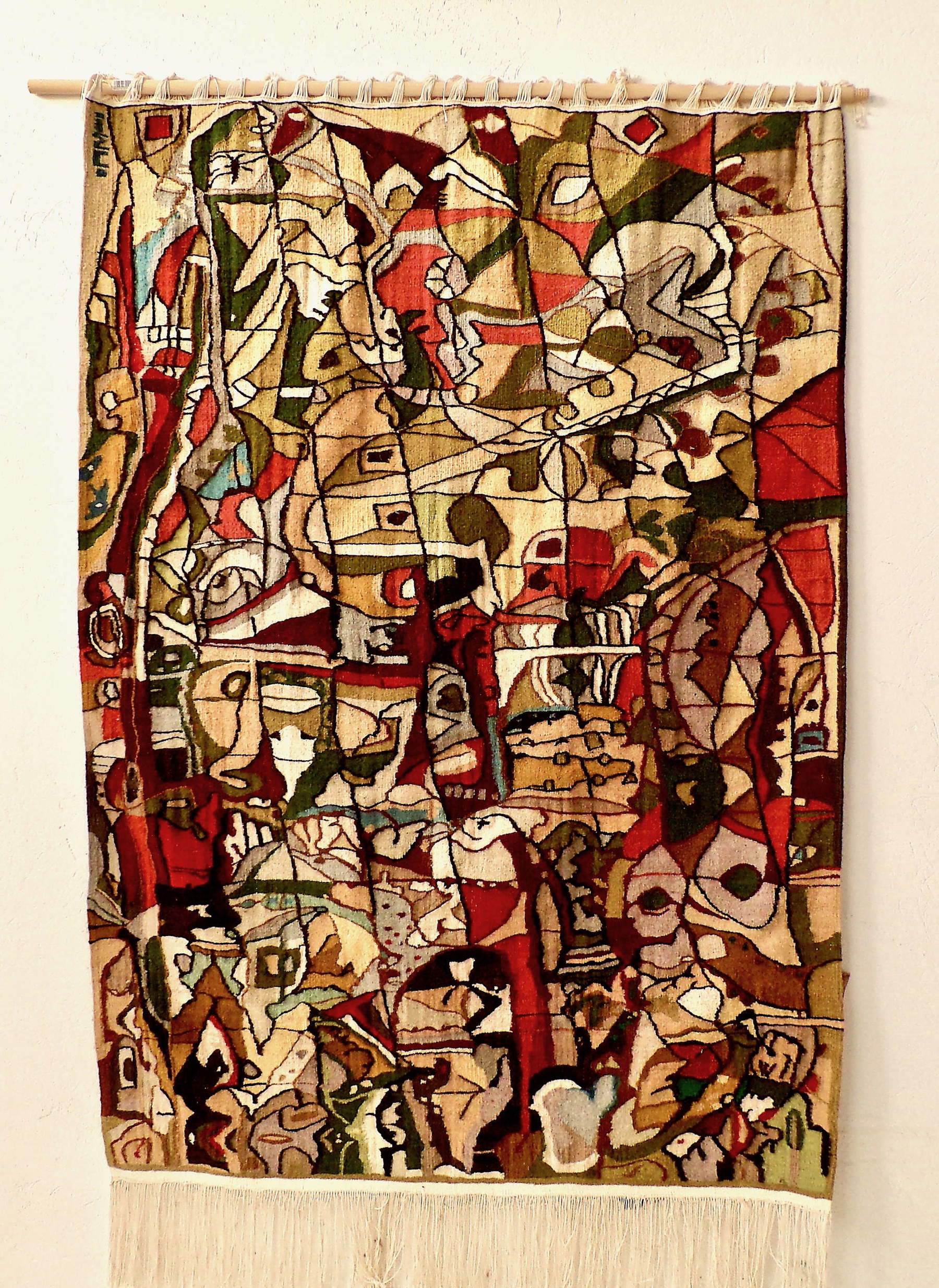
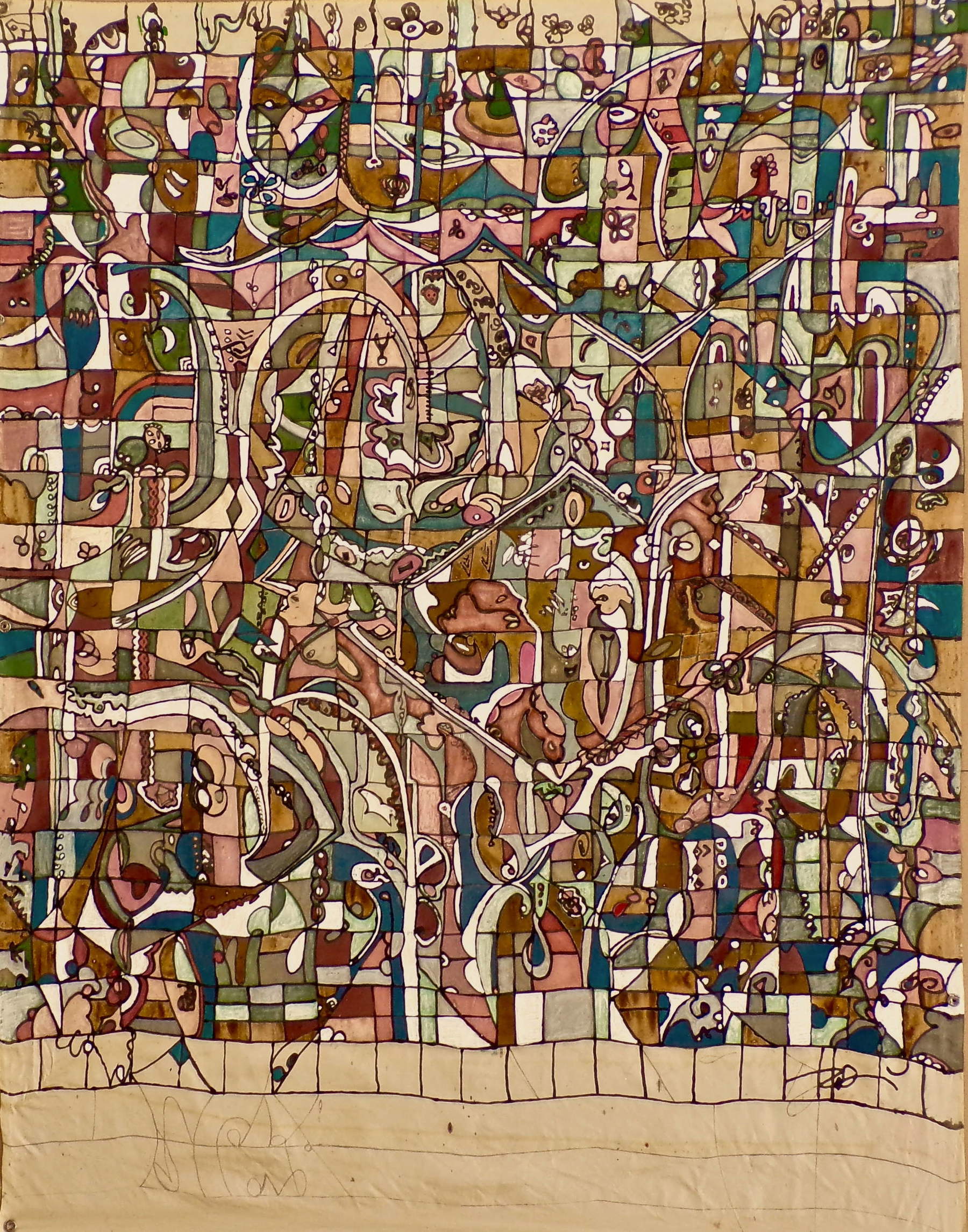
Weaving also ties you to your childhood in Morocco. You started weaving as a child with your mother at home.
We were ten children. To keep us quiet while she worked, my mother would tell us stories from the Arabic oral tradition, like The Arabian Nights. She would often lose the thread of the stories and, being clever, she would make up another one or transform the original. She never finished her stories. She wove bedside rugs, small carpets and wedding trousseaus, which she sold to friends and acquaintances. At home she had a wooden loom; neighbors would come to help her prepare the warp. Everyone helped out, and each of us had a specific domestic task. I didn’t like going out much, and my brother Nourredine and I competed to finish the weaving, some at night, some at dawn--this rivalry suited my mother just fine!
Your brother Nourredine later became an activist in the Ilal Aman movement and was arrested under the reign of Hassan II during the Lead Years.
It was 1974. Plainclothes police officers came to get Nourredine in the middle of the night and we lost sight of him until 1976. It was a tragedy and a terrible shock for the whole family. My mother stopped weaving, my brother was pardoned ten years later, following a hunger strike, and published two books. I went to study Biology and Geology in Besançon, then returned to Morocco and taught Physics and Chemistry in a secondary school.
It was during this period that I met your future husband, Naceur Ben Cheikh, in Casablanca. At that time, he was already a journalist and columnist for the newspaper of Tunisia’s first president, Habib Bourguiba, L’Action.
In the 1970s, Naceur traveled throughout the Maghreb. He was a professor at the Academy of Fine Arts in Tunis, an adviser in Chedli Klibi’s office and a journalist. Naceur knew the Maghreb inside out. He had deep ties with Moroccan and Algerian intellectuals and artists of the 1970s. He wrote for Moroccan newspapers and magazines. My brother-in-law, Ahmed Bouanani, was one of his friends, and it was at his house that we met.
Your husband, Naceur Ben Cheikh, is also a painter and art critic. There is a thirteen-year difference between you, and he belongs to the group of Tunisian artists like Sehili, Lotfi Larnaout, Nejib Belkhouja, and Lamine Sassi. Did he not know at the time that you were an artist? Did he influence you?
Naceur has always defended authentic and genuine creation and is very critical of commercial art. When he held his first solo exhibition at the Galerie de l’Information, next to the Cathedral of St. Vincent de Paul in Tunis, he refused to sell his work, even to the state commission for the purchase of art. Many artists hated him for his beliefs, and I, too, when I started painting and weaving, feared his ideas. I worked in silence and hung my pieces on the wall only when I finished them. He pretended not to and respected my time. But even when I rejected his advice, he recognized my boldness.
In a way, you were his most rebellious student, and now he has become, as you say, your manager. He has been writing his catalogs since your exhibition at Selma Feriani’s gallery, and his latest book, which traces your entire artistic journey, is currently in print.
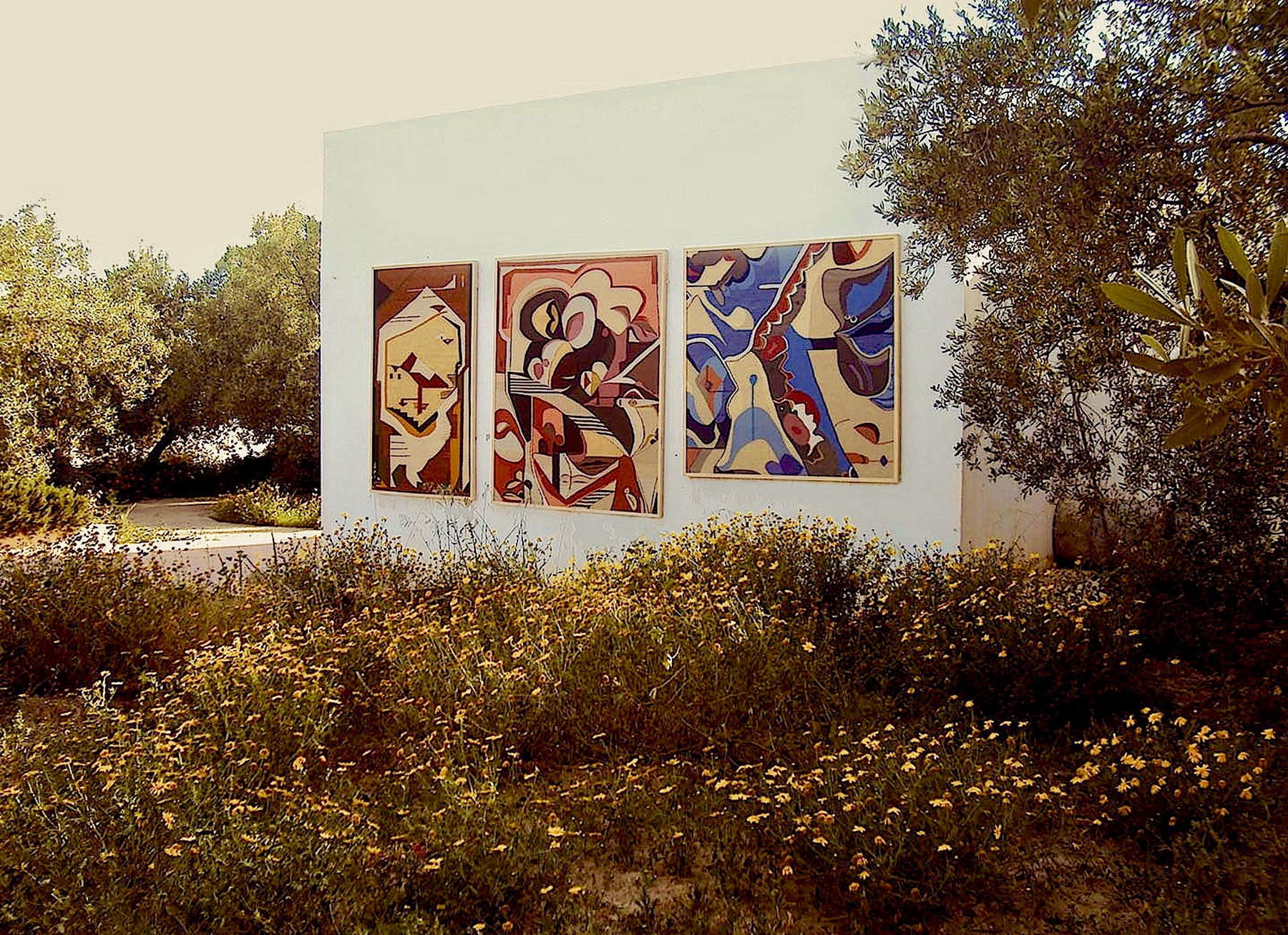
The book, which is being printed, is partly written and typeset by him, but he has given it a collective dimension by including testimonies from university professors in his circle, all family friends. The book will thus contain several analytical texts, critical essays and even poems. In 2014, he conceived the idea of a private exhibition in tribute to Paul Klee, in conjunction with an artistic and cultural program organized by the Goethe-Institut in Tunis for the centenary of Paul Klee, Macke and Moillet’s trip to Tunisia. For the occasion, their works were reproduced in tapestries and commissioned from weavers. It was at the Kalaa-Akouda train station, the last stop before his arrival in Kairouan, that Paul Klee was struck by the view of the western quarter of Akouda, which he described in his diary, writing, “Akouda, fabulous city, we meet at the end of time.” During this private exhibition, all my tapestries were hung in the garden and patio, and beautiful photos were posted on social media, showing my tapestries among the poppies and wildflowers in our garden. It was a provocation, and it created quite a stir.
What prompted you to exhibit your work publicly for the first time?
I was never particularly enthusiastic about exhibiting my work: my tapestries stayed at home. But some artist friends (professors, art students) would come to see me and often appreciated my work. One of them suggested that I exhibit at the Kram Craft Fair. In 2008, I exhibited with other craftswomen at Kram and won the second prize for craft innovation. For me, however, there is no difference between craftswoman and artist; craftswomen should also sign their tapestries with their names. I needed recognition, but for years I was not accepted either as an artist or as a craftswoman.
The recognition came by chance, thanks to Lina Lazaar, who runs the foundation of her father, entrepreneur Kamel Lazaar, and who came to interview your husband about Nejib Belkhouja.
Before I met Lina Lazaar, I had participated in group exhibitions at the Aïn Gallery in Kram, then at the Maison des Arts du Belvédère and the Kheireddine Palace in the Medina of Tunis, the Abdellya Palace in La Marsa, and the Bardo Museum. Two of my tapestries were purchased by a major Maghreb bank and another by the Ministry of Culture’s purchasing committee. My meeting with Lina took place between 2022 and 2023. After my interview with Naceur, Lina asked to see the tapestries I had hung in the back of our studio to air them out. Later, she sent someone to photograph them and displayed twelve of my tapestries in her space in Bhar Lazreg. Lina bought four, while Emirati collector and professor Sultan Saud Al-Qassemi bought five. He visited our workshop in Akouda in 2023 and greatly appreciated my work.
What was the starting price of your works and what is their current value?
Between 2014 and 2016, I sold my first tapestries for 7,000 dinars each [about 2,000 euros, ed.] to Attijari Bank and then to the Tunisian state. Today, my works are listed on the international market. They are exhibited at the Metropolitan Museum of Art in New York and the Guggenheim Museum, as well as in several private collections in the Gulf countries.
It is important to emphasize that your tapestries are your own work, as you refuse to collaborate with other artisans and have so far produced only one or two a year.
Each of my tapestries is unique and irreplaceable. My work must remain human, with its imperfections and contingencies. It vibrates, it is visceral.
In hand weaving you don’t have the same margin for error as in painting; in the end, the result is a surprise even to yourself.
Yes, in weaving there is a lot of tension until the end, I accept that, I work with doubt. Doubt is what makes one humble. And I remain humble.

Warning: the translation into English of the original Italian article was created using automatic tools. We undertake to review all articles, but we do not guarantee the total absence of inaccuracies in the translation due to the program. You can find the original by clicking on the ITA button. If you find any mistake,please contact us.


















 IT
IT FR
FR DE
DE ES
ES CN
CN


