




by Redazione 10/01/2026



Categories: Museums / Disclaimer
Unraveled the enigma that has shrouded Father Jean Baptiste Fourcault's taxidermy collection, preserved at the Museum of Naturalistic Historiography of the University of Parma - MUST, since the 18th century.

The enigma shrouding the mysterious taxidermy collection of Father Jean Baptiste Fourcault, preserved at the Museum of Naturalistic Historiography of theUniversity of Parma - MUST, has been cleared up. An article just published in the journal Museologia scientifica has in fact resolved a question that has remained open since the 18th century. The paper is authored by Davide Persico, scientific director of MUST and lecturer in the Department of Chemical, Life and Environmental Sustainability Sciences at the University of Parma, Maria Amarante of the U.O. Sistema Museale di Ateneo and Archivio Storico, Antonella Volta lecturer in the Department of Medico-Veterinary Sciences, and graduate student Alice Giovagnoni.
The collection, consisting of a small series of taxidermic specimens preserved in glass ampoules, is in an extraordinary state of preservation despite the almost three centuries that have passed. It represents what remains of the 18th-century ornithological cabinet of Father Fourcault, a friar of the Order of Minims and a key figure in the founding of the Parma Museum. The specially made and uniquely shaped ampoules have only one opening: a small mouthpiece that Fourcault sealed after inserting the animals, larger than the visible hole, along with the elements necessary for their contextualization.


For a long time, a crucial question remained unanswered: how were animals and scenic elements introduced inside the ampoules if the only apparent hole was too narrow to allow them to pass through? The technique used by Fourcault and never revealed by the friar himself has fueled the curiosity of generations of scholars and scholars since the second half of the eighteenth century, remaining shrouded in mystery.
Today, thanks to the use of modern methods of investigation, including X-rays and axial tomography, and the study of some specimens preserved in non-original cases, this secret has finally been revealed.
Analyses have made it possible to reconstruct materials and procedures adopted by Fourcault, revealing that what appeared to be the entrance hole was actually a reduced apparent opening. The visible opening was obtained by superimposing on the real opening a glass collar attached by means of the wooden elements of the stopper. The real opening was generally three times wider and allowed the passage of rigid, non-compressible parts, such as the skulls of animals, as well as wooden objects, which, as it turned out, were introduced in separate elements and later assembled inside. Animal bodies, on the other hand, were specially prepared to be compressed and inserted into the ampullae. The seam lines of the glass collar and the edge of the ampulla opening were cleverly disguised by Fourcault through the use of elegant cords wrapped around the glass, while the seam lines of the wooden objects were concealed by glued sanding. An ingenious system that made the illusion perfect in the eyes of the observer.
“The Fourcault bells,” reads the study’s conclusion, “have a peculiar taxidermic significance. They represent not only a laborious method of preserving stuffed animals over time, but there is also, on the author’s part, a clear desire to create unique artistic museum objects with the undeniable wit to mislead the observer.”
Pictured is Fourcault’s taxidermy collection at MUST in Parma.
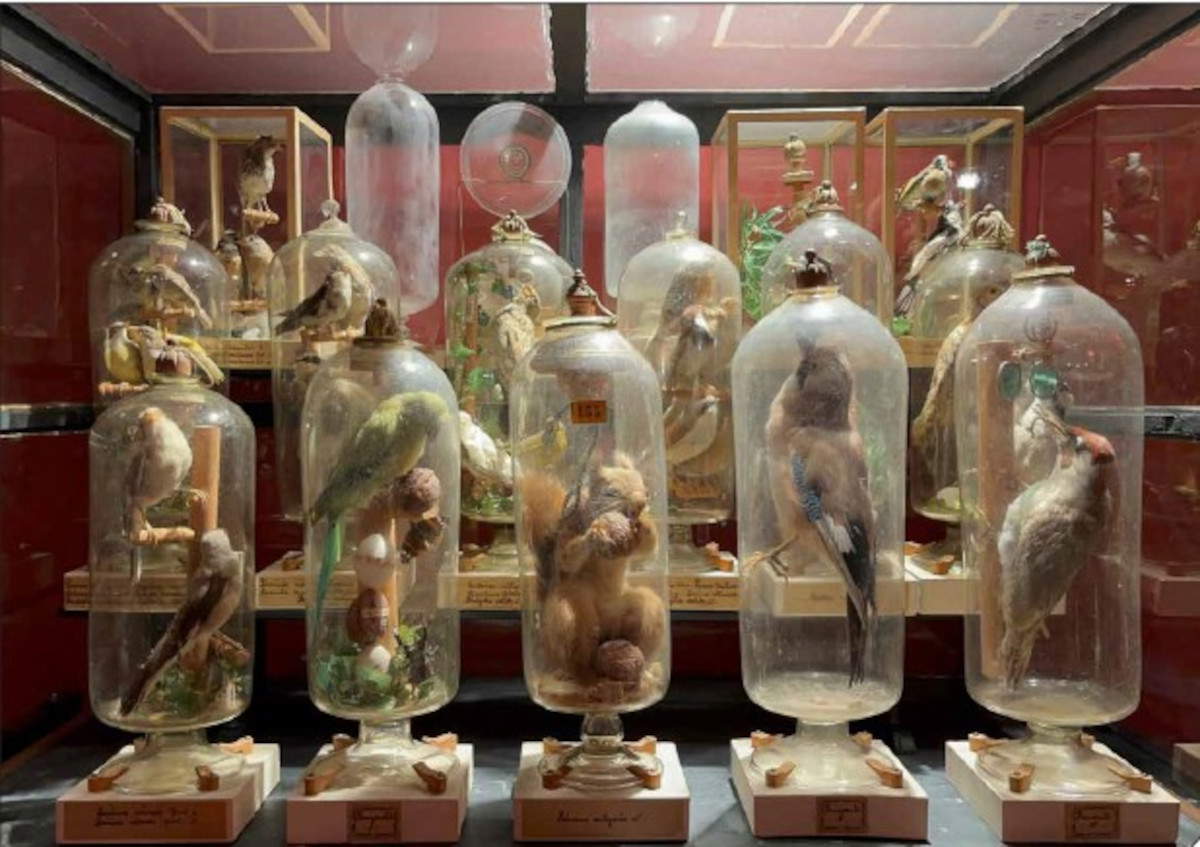 |
| Study unravels mystery unsolved since 18th century Fourcault taxidermy collection in Parma |
Warning: the translation into English of the original Italian article was created using automatic tools. We undertake to review all articles, but we do not guarantee the total absence of inaccuracies in the translation due to the program. You can find the original by clicking on the ITA button. If you find any mistake,please contact us.