





We implore readers to do an exercise this weekend: take your favorite mode of transportation, take a trip to the countryside, look for a chicken coop, and look at it. For those who don’t know where to find a chicken coop, there is the alternative: go to Leroy Merlin, or any DIY store you like, and go to the department where they sell wire mesh. The ones that are used to enclose chicken coops. After that, complete the exercise with a mental projection: imagine the Colosseum completed, in its missing parts, with wire mesh molded to take on the shape of the architectural elements that over the centuries are gone. That’s it: that’s roughly the idea circulating these days for the “enhancement” of the remains of the Basilica of Vitruvius that have just been discovered in downtown Fano. Not even ten days have passed since the discovery of those ruins, on which architectural theorists have been racking their brains for five hundred years, that in the city people have immediately begun to fantasize about how to complete what has just been found, and among the most creative proposals is the inevitable “integration” with metal nets: to advance it, Professor Paolo Clini, professor of design at the Department of Civil Engineering of the Marche Polytechnic University, who has already suggested entrusting the possible intervention to Renzo Piano, offering as a possible model the Basilica of Siponto, to which a reconstruction by Edoardo Tresoldi in metal mesh was recently added.
Clini, who has been studying Vitruvius and his basilica for 30 years, deserves credit for having assumed that the remains of the building described by the great Roman architect were in the spot where they were later actually found. And even on the basis of that premise, one struggles to understand the rationale for a completion, albeit light and removable, of the ancient remains, one struggles to see what benefit could be derived from a contemporary wire mesh construction insisting on top of the ruins. The professor, with the use of artificial intelligence, even came up with a model, posted on his social profiles and forwarded to the local press: looking at it this way in the sketch, the construction, rather than the majestic building of the Roman Fanum Fortunae , is reminiscent of the Mercato Centrale in Florence, but that is not the point. Or rather: it is one of the many points that make the idea of a contemporary completion questionable. And there are several reasons for this.
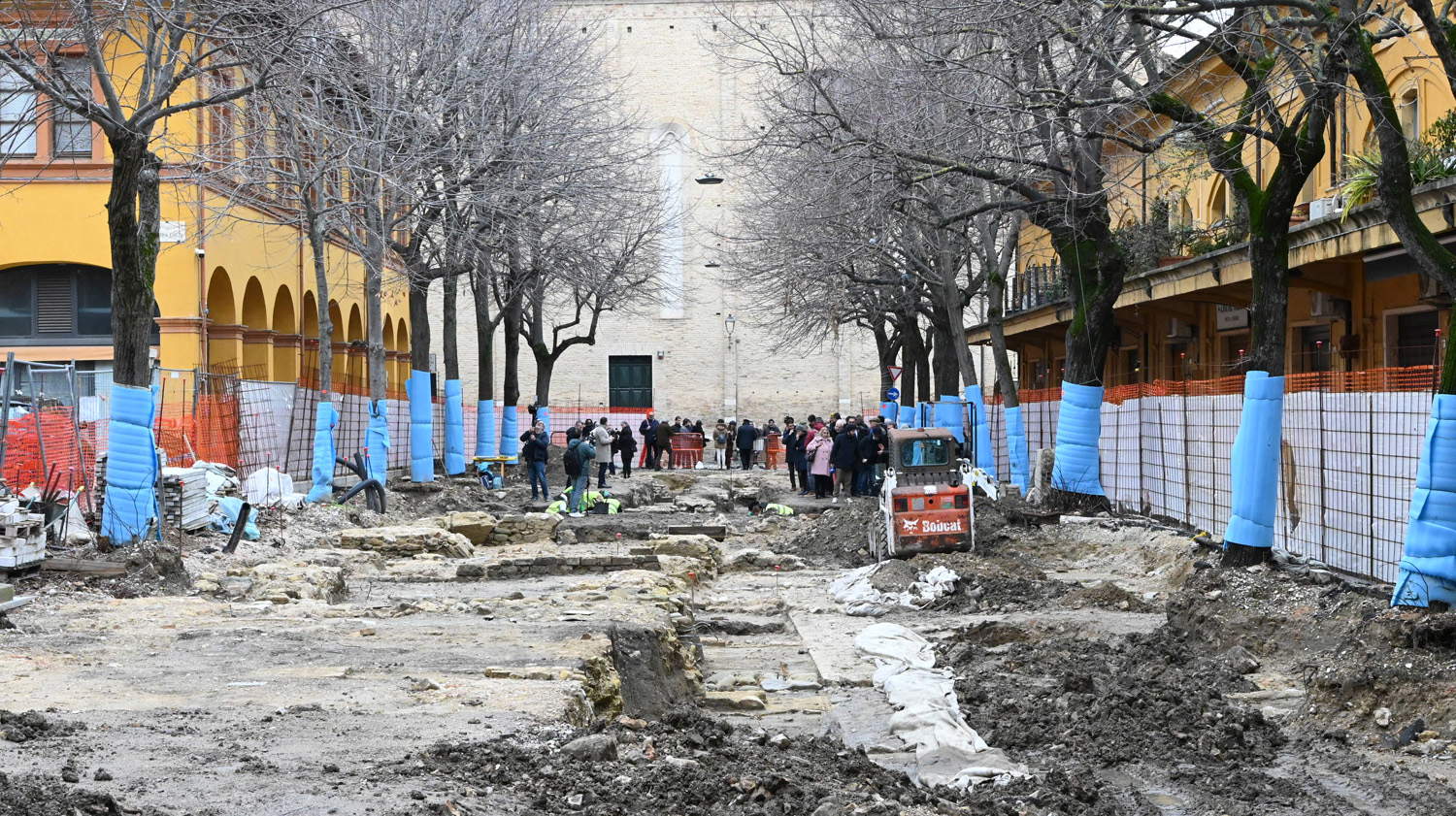
Meanwhile, such a construction, like the one in the sketch, resembles an encroachment more than a solution to “enhance” the ruins, for the simple fact that very little is left of the ancient public building (basically, what was under the road is left), and any “integration” would become a construction where the percentage of new would be very close to 100 percent, with the result that even passersby and tourists would be captured more by the metal mesh than by the ruins (as, incidentally, is the case at Siponto, where the ecstatic comments of visitors to the archaeological park are directed mostly to the integration of the early Christian basilica than to the ruins). Moreover, the legibility of the ruins would be dramatically altered, if not obliterated altogether. In six words: Tresoldi would be more visible than Vitruvius. The “dialogue,” assuming that in cases such as these there can be a truly fruitful dialogue between the remains and the new, would become almost an overpowering monologue, a soliloquy that would see the reconstruction as an almost solitary voice, and the ruins of the real basilica reduced to the role of an extra. Imagine what would happen if similar integrative proposals were made for the Colosseum, for the Arena of Verona, for a random building between the Roman Forum and the Imperial Forums: one would have to imagine popular uprisings, because the perception of the monument would be altered. But does the argument apply only if the monument is famous or has been known for centuries, whereas if the monument is little known or has been discovered recently then one can do what one wants with it? It would be a bit like if, in order to attract audiences to the Gallerie dell’Accademia in Venice, someone proposed to call Damien Hirst to repaint Giorgione’s Nuda (and to some people maybe it might even seem like an interesting idea). We are not talking, of course, about letting Vitruvius’ basilica remain invisible and letting Fano miss the opportunity to become a place capable of attracting people, but it is up to us to understand what we mean by “valorization”: do we valorize with authenticity, with respect for history, with a sense of ruin? Or do we mean by “valorization” visibility, recognizability, potential attraction for tourists (and, even if so, are we so sure that a wire mesh monument is more powerful than the naked ruin)?
There would then be reasoning about the character of integration. Any proposal for reconstruction is a guess: with the discovery of the remains it will be possible to come much closer to something like what the building must have looked like originally, but we would always be moving on very slippery ground. That is, the same ground on which, at Siponto, a wire mesh monument was built based on an interpretation that rested on an uncertain foundation, and therefore as arbitrary as any reconstruction. In practice, a monument was built in Siponto that never existed. And the same thing would happen in Fano as well. For this reason, too, it would be better if reconstruction hypotheses remained in books or information materials distributed to citizens and tourists, and did not become full-scale models installed directly on the remains. It should also be remembered that these are light sculptures only in appearance: the Tresoldi basilica at Siponto, despite being called “almost a hologram,” is a structure that weighs seven tons. A weight that would go to the ancient structures.
Then there is a conceptual problem: How should we consider the eventual contemporary monument to be built over the ancient monument? Would it be an act of restoration, or would it be an operation totally unrelated to any conservation requirements? And if the construction of the contemporary monument were to be assimilated to an act of restoration (incidentally: we do not see how it could be, but the precedent of Siponto suggests that such an operation could be read as an “artistic development of the classical conception of restoration,” as Tresoldi called it, whatever that means), how would we put it with the concept of reversibility that is one of the bases of modern restoration? At Siponto, at least from what Tresoldi stated, reconstruction was envisioned as a work intended to last until its natural demise. Are we then really thinking of a permanent work? That would perhaps be the greatest wrong that can be done to the remains of Vitruvius. Not to mention that a basilica built of metal mesh would involve actions that would directly interfere with the remains. Look at the photographs of Sipontum, with the ruins involuted by the supports that have been placed against the fragments of the ancient building to allow the elevation of the new one: beyond the aesthetic jarring (about which there is little to object anyway: aesthetic judgments are subjective, and it seems that the bulk of visitors like Tresoldi’s structure, and patience if the ruins are harassed by contemporary supports), are we really sure that the ruins do not come out irreparably and irreversibly damaged?
Again: Tresoldi’s construction in Siponto cost 900 thousand euros, and to imagine a similar operation in Fano (building to be rebuilt in its entirety, project a decade away and thus inflation) means imagining a probably larger economic burden. Beware, however: one does not want to be a no-vax of modernity. Perhaps, however, it would be more useful to avoid so much waste of public money and direct resources to more fruitful projects (be it even a serious project of augmented reality to complete the basilica without touching the stones), since such a discovery will determine the opening, in the very center of the city, of a kind of archaeological path (pardon the foul expression, but it is to make the point) that would allow anyone to observe the remains of the basilica. A path that could also be minimal: an overlook might be enough, as in Treviso in Via delle Canoniche where one can admire the early Christian mosaic, or in Grado in Piazza Marin where the remains of the Basilica della Corte are still standing (there, the two bridges with tie-rods crossing the excavation are questionable, but certainly better than a basilica made of wire mesh). But it could also be the case that for preservation reasons an enclosure is needed: already forty years ago Giovanni Urbani said that we know well “what are the dangers, the ugliness and the senselessness into which the current architectural inculture could run us into with the construction of such enclosures,” yet “one cannot believe that this would be a foregone conclusion at the outset, especially if the construction of the enclosures received its form solely from conservation needs, proven in a rigorously technical manner.” Well: it would be infinitely more profitable to avail oneself of the services of great architects and designers should one opt to protect with an enclosure what has just been discovered.
Finally, while I realize that this is the weakest motivation: a structure made of chicken wire would undermine the poetry of those remains. Grand Tour travelers came to Italy to see the ruins of the past, not arbitrary reconstructions with modern materials. Throughout the history of Western culture there has existed an attraction to ruins that has been across eras and countries. Here it is: to turn the remains of Vitruvius’ basilica into something that very dangerously resembles a pop attraction would be to wrong Goethe, Ruskin, Byres, Turner, Corot, all those great minds who were captured by the sight of Italian landscapes, by the sight of those ruins that stimulated their imaginations without offering pre-filled answers. What would they have said if they had found metal mesh constructions on top of the ruins?

The author of this article: Federico Giannini
Nato a Massa nel 1986, si è laureato nel 2010 in Informatica Umanistica all’Università di Pisa. Nel 2009 ha iniziato a lavorare nel settore della comunicazione su web, con particolare riferimento alla comunicazione per i beni culturali. Nel 2017 ha fondato con Ilaria Baratta la rivista Finestre sull’Arte. Dalla fondazione è direttore responsabile della rivista. Nel 2025 ha scritto il libro Vero, Falso, Fake. Credenze, errori e falsità nel mondo dell'arte (Giunti editore). Collabora e ha collaborato con diverse riviste, tra cui Art e Dossier e Left, e per la televisione è stato autore del documentario Le mani dell’arte (Rai 5) ed è stato tra i presentatori del programma Dorian – L’arte non invecchia (Rai 5). Al suo attivo anche docenze in materia di giornalismo culturale all'Università di Genova e all'Ordine dei Giornalisti, inoltre partecipa regolarmente come relatore e moderatore su temi di arte e cultura a numerosi convegni (tra gli altri: Lu.Bec. Lucca Beni Culturali, Ro.Me Exhibition, Con-Vivere Festival, TTG Travel Experience).
Warning: the translation into English of the original Italian article was created using automatic tools. We undertake to review all articles, but we do not guarantee the total absence of inaccuracies in the translation due to the program. You can find the original by clicking on the ITA button. If you find any mistake,please contact us.
























 IT
IT FR
FR DE
DE ES
ES CN
CN


