





In the context of the ongoing crisis in the Gaza Strip,UNESCO has already mobilized $5.7 million in emergency aid to protect cultural heritage, restore access to education, and support the media sector. This is an initial package of interventions that has enabled the rapid activation of actions on the ground, while the organization, together with international partners, now aims to raise $116.5 million to support emergency activities and recovery processes in the medium and long term. The intervention is articulated along a few key lines, considered central to rebuilding the social fabric: safeguarding cultural heritage in all its forms, restoring access to education, developing skills and human capital, and strengthening a transparent media system. These areas are, according to the organization, essential pillars for sustaining local communities and accompanying the path to recovery.
One of the most critical fronts concerns the protection of cultural heritage. As many as 164 sites are damaged in the Gaza Strip, according to UNESCO, a situation that has already compromised assets that represent an element of identity and history for the Palestinian population. In response, UNESCO, in collaboration with the Centre for Cultural Heritage Preservation, has initiated urgent interventions in Gaza’s Old City, focusing on securing structures, managing rubble and preserving architectural elements that can be salvaged in the future.
Activities include emergency stabilization operations and debris removal, with the aim of preserving what is possible for later reconstruction. In parallel, the project supports affected communities through the creation of job opportunities for local workers and heritage professionals. So far, five sites have been stabilized, generating 1,850 work days for 30 local workers, while seven other sites are currently being addressed.
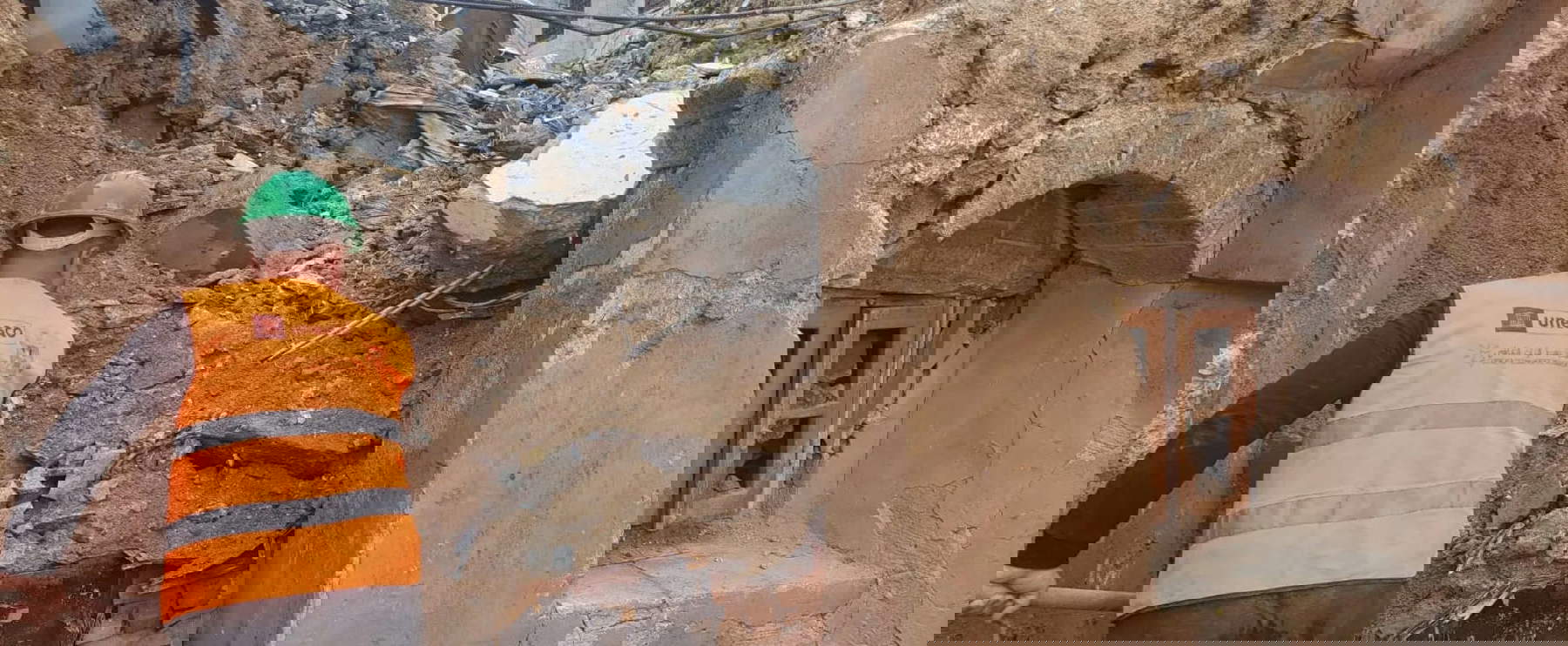
Damage monitoring is continuing through collaboration with UNITAR-UNOSAT, through satellite analysis to collect useful data to guide protection and recovery strategies. Concurrently, technical training programs have been organized for local professionals in damage assessment and emergency stabilization. Seventy-five percent of the participants in these training activities are women, confirming the focus on strengthening local expertise from an inclusive perspective.
UNESCO’s action also extends to the social impact of the crisis. Through cultural and artistic activities, more than 8,000 displaced children, youth and parents have already received support for mental health and psychosocial well-being. In the coming months, these initiatives will be expanded to reach more than 21,000 beneficiaries, including cultural workers, with the aim of accompanying communities on the path to recovery. Targeted grants to support local artists are also planned to revitalize the cultural and creative sector.
Particularly serious, however, remains the situation of the education system. Damage to tertiary education and technical and vocational training facilities is estimated at $379 million, with more than 80 percent of campuses damaged or destroyed. The human consequences are equally significant: nine out of 10 students say they need psychosocial support, while 80 percent of academic staff are living in displacement or hardship.
To address this emergency, UNESCO’s Education in Emergencies and Early Recovery program supports continuity of learning for displaced children. Through edutainment-based educational methodologies, the program engages students in early elementary school grades in math and Arabic language activities. These are complemented by a social-emotional learning initiative targeting children from kindergarten through fourth grade, which also includes training tracks for parents and teachers. For secondary school students, 1,000 tablets were distributed to enable them to participate in exams. In parallel, higher education has found new ways of delivery through the Gaza Virtual Campus, the first phase of which was launched in October 2025. The program currently reaches up to 20 percent of university students and aims to expand to 30 percent, enabling more than 30,000 students to resume their academic paths at a distance.
Temporary learning spaces equipped with psychosocial support services have also been established in cooperation with Al-Quds Open University and the Islamic University of Gaza. Two new facilities were recently activated to accommodate 2,700 students, bringing the total number of available spaces to five. These spaces currently house 13,800 university students, including 6,912 women.
The testimonies collected highlight the concrete impact of these initiatives. One 20-year-old female student told UNESCO how being able to access learning spaces was a turning point, restoring tools and hope in a context marked by a lack of electricity, internet connection and devices.
Alongside educational interventions, UNESCO conducted an in-depth assessment of the local university system, providing a baseline for reconstruction planning by authorities and international partners. Future prospects also include the expansion of vocational training programs, with the opening of three new spaces dedicated to developing skills required by the labor market and supporting the employment placement of young people.
Another area of focus concerns support for journalists. UNESCO constantly monitors the situation of media professionals in the Gaza Strip and has activated support programs that include training, psychological assistance, technical endowments and paid work schemes. So far more than 1,010 journalists, 60 percent of them women, have benefited from these initiatives.
Tools such as laptops, audio recorders, cell phones and connectivity solutions have been distributed to 200 journalists, while more than 600 professionals have participated in trainings aimed at strengthening skills and resilience. In collaboration with the Palestine Red Crescent Society, some 300 journalists received psychosocial support through individual sessions and group meetings dedicated to stress management and trauma treatment.
Training programs involved 310 journalists in areas such as ethical journalism, mobile journalism and audiovisual content production. Special attention was paid to countering misinformation, with modules on fact-checking, recognizing artificial intelligence-generated content, and using digital verification tools. Participants produced 134 pieces of verification content, helping to strengthen the reliability of the information system.
A specific focus was reserved for female journalists through the We Are Journalism program, implemented with Nisaa FM and funded by IPDC, which explored topics such as gender-sensitive media production, fact-checking in conflict contexts, and mental health. In the coming months, more than 1,000 Gaza-based journalists will receive additional support, including psychological assistance, training, professional tools and job opportunities.
UNESCO’s work is being developed in collaboration with local authorities, communities and international partners, with the aim of maximizing the impact of interventions. Looking ahead to the next steps, the organization appeals to the international community to increase financial and operational support, enabling the expansion of ongoing activities. The goal is to strengthen the protection of cultural heritage, expand access to education, protect journalists, promote women’s empowerment, and support opportunities for young people. Within this framework, UNESCO aims to contribute to the building of resilient communities capable of sustaining a lasting recovery process in a context marked by profound critical issues.
|
| Gaza, UNESCO mobilizes $5.7 million for culture, schools and information |

Warning: the translation into English of the original Italian article was created using automatic tools. We undertake to review all articles, but we do not guarantee the total absence of inaccuracies in the translation due to the program. You can find the original by clicking on the ITA button. If you find any mistake,please contact us.



























 IT
IT FR
FR DE
DE ES
ES CN
CN


