




by Redazione 02/02/2026



Categories: News / Disclaimer
A new cleaning operation on Michelangelo's Last Judgment has begun: for about three months, restorers from the Vatican Museums will work in the Sistine Chapel without interrupting access for worshippers and visitors.
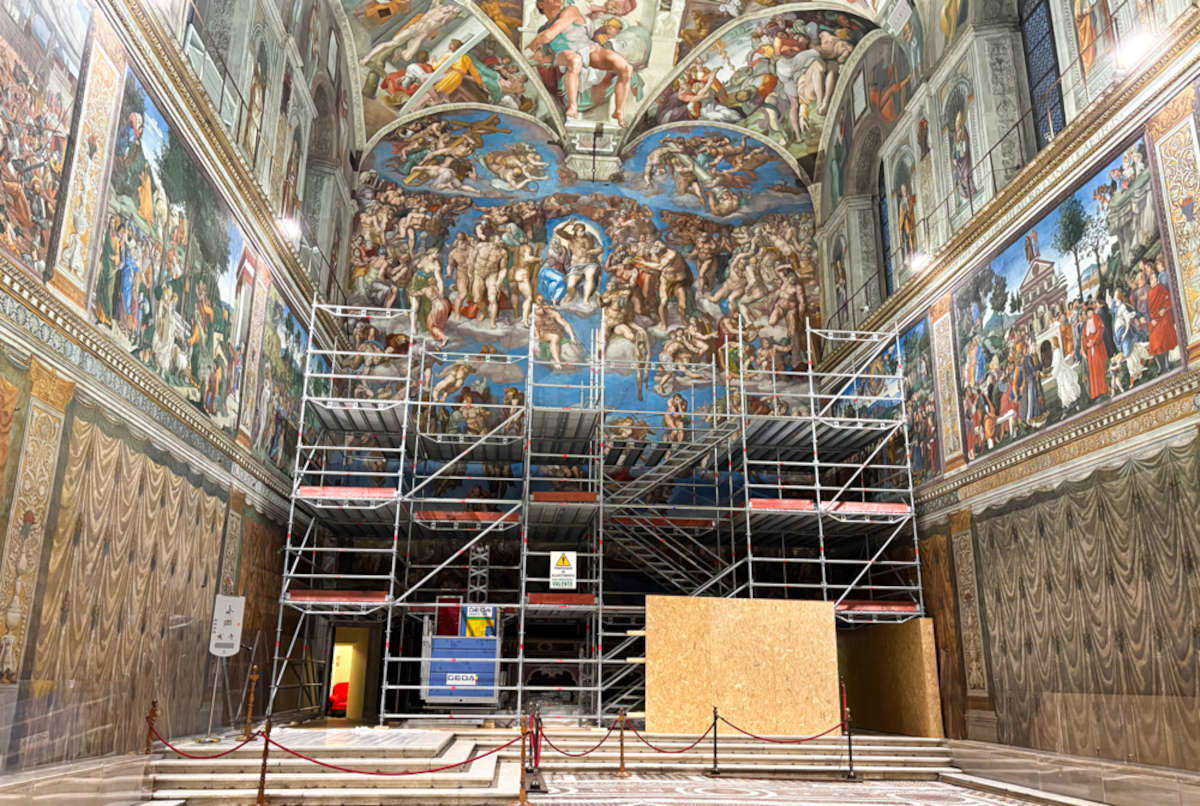
Extraordinary maintenance of Michelangelo ’s Last Judgment in the Sistine Chapel has begun, one of the most delicate and long-awaited conservation interventions in recent years on one of the absolute masterpieces of art history. The start of the work was marked by the assembly phase of the scaffolding, which will allow restorers to work safely and with maximum precision on the large frescoed wall. The intervention, lasting a total of about three months, is dedicated to a thorough cleaning operation, aimed at the protection and preservation of the work over time.
The management of the Vatican Museums has announced that the Sistine Chapel will remain open throughout the entire period of the work, continuing to welcome faithful and visitors from all over the world. In order to guarantee access to the environment and at the same time allow restoration operations to take place, the construction site will be screened by a sheet that reproduces in high definition the image of the Last Judgment. Behind this reproduction, restorers from the Vatican Museums’ Laboratory for the Restoration of Paintings and Wooden Materials will carry out the delicate cleaning operations, respecting the most advanced conservation methodologies.


The intervention comes about 30 years after the last major conservation restoration of the Last Judgment, completed in 1994. That lengthy and complex work, which marked a turning point in the history of the conservation of Michelangelo’s frescoes, was carried out under the supervision of the director general of the Vatican Museums, Carlo Pietrangeli, and executed by chief restorer Gianluigi Colalucci, who headed the Painting and Wooden Materials Restoration Laboratory. Today, three decades later, a new targeted, non-invasive intervention is needed, conceived as extraordinary and preventive maintenance, in line with the most up-to-date practices of artistic heritage protection.
Explaining the meaning and purpose of the operation is Barbara Jatta, director of the Vatican Museums, who stressed that this new phase of maintenance represents a fundamental step in ensuring the conservation of Michelangelo’s mature masterpiece. The intervention, which is expected to last about three months, is made possible thanks to the support of the Florida Chapter of the Patrons of the Arts in the Vatican Museums, who have been working alongside the Vatican Museums for years on important conservation and enhancement projects.
The Last Judgment, painted by Michelangelo between 1536 and 1541 on the altar wall of the Sistine Chapel, is a work of extraordinary technical and iconographic complexity. Exposed daily to particularly critical environmental conditions related to thehuge influx of visitors and the inevitable microclimatic variations, the fresco requires constant monitoring and periodic interventions to preserve its legibility and the stability of the materials. The extraordinary maintenance initiated in these days fits precisely into this logic of continuous care, aimed at preventing phenomena of degradation and maintaining over time the extraordinary chromatic and formal quality of the work.
The cleaning operations will be conducted by restorers from the Vatican Museums’ Painting and Wooden Materials Restoration Laboratory, one of the facilities of excellence in the international conservation scene. The work will be carried out with highly controlled methodologies, the result of a long experience gained precisely on the frescoes of the Sistine Chapel and other masterpieces of the Vatican collection. The work will not involve structural changes or invasive interventions, but will focus on removing surface deposits and optimizing the fresco’s conservation conditions.
The decision to keep the Sistine Chapel open during the work responds to the desire to ensure the continuity of the enjoyment of one of the most visited and symbolic places of the Vatican Museums. At the same time, the installation of the canvas with the high-definition reproduction of the Last Judgment allows visitors to continue to appreciate the work in its visual entirety, even while the construction work is in progress. This is a solution that has already been successfully tested in other museum contexts, combining the needs of protection, safety and accessibility.
The start of the extraordinary maintenance of the Last Judgment is also an opportunity to reaffirm the central role of the Vatican Museums in the conservation of the world’s artistic heritage. Interventions of this kind have not only a technical significance, but take on a broader cultural meaning, testifying to an ongoing commitment to the preservation of works that belong not only to the history of the Church, but to all humanity.
Thirty years after the great restoration concluded in 1994, the new intervention is therefore a natural continuation of that path of attention and responsibility towards one of the most studied, admired and reproduced masterpieces in the world. The extraordinary maintenance of the Last Judgment is part of a long-term strategy, based on prevention and scientific knowledge of the materials, which allows for timely and respectful intervention on the work.
For the next few months, while restorers work behind the scenes at the construction site, the Sistine Chapel will continue to be a living space, traversed by faithful and visitors alike, in a constant dialogue between contemplation, study and conservation. A complex but necessary balance to ensure that Michelangelo’s masterpiece can continue to speak to future generations with the same strength and intensity that have made it, for centuries, an absolute landmark in the history of art.
|
| Sistine Chapel, start of extraordinary maintenance of Michelangelo's Last Judgment |
Warning: the translation into English of the original Italian article was created using automatic tools. We undertake to review all articles, but we do not guarantee the total absence of inaccuracies in the translation due to the program. You can find the original by clicking on the ITA button. If you find any mistake,please contact us.