




The role of art historians in Italian state museums is increasingly marginal compared to the needs of protection and enhancement of the national cultural heritage. This is the complaint made by CISDA - Comitato Idonei Storici dell’Arte, which returns to intervene in the debate on the condition of the profession with a new reflection dedicated to the situation of personnel in Italian museums.
According to the committee, the recent publication of the PIAO - Integrated Plan of Activities and Organization 2026-2028 certifies a now structural shortage of staff within the Ministry of Culture. In fact, the document indicates 6,352 missing units out of a planned total staffing of 19,000. A figure that, according to CISDA, takes on even more worrisome contours if we look at the presence of a professional figure that is fundamental to the museum system: the art historian.
In the 500 or so state museum institutions that can be visited in Italy, including national museums and archaeological parks, barely 200 art historians work today. Of these, about 60 are concentrated in the 14 first-tier museums and archaeological parks, while the remainder work in the 52 second-tier institutions, which include museums, villas, archaeological parks and regional museum directorates. The spatial distribution of staff appears particularly uneven. In some regions the presence of art historians is extremely limited: Molise has only one professional for the entire regional museum system, Calabria has three and Friuli-Venezia Giulia just four. In contrast, Lazio has more than forty art historians and Tuscany more than twenty. However, the committee points out, even these figures are insufficient compared to the real need for scientific expertise in the territories.
According to CISDA, this is an imbalance that can no longer be ignored if the state really intends to promote cultural heritage as a strategic resource of the country. The issue becomes particularly relevant in light of recent initiatives launched by the Ministry of Culture, including the national program Seeds of Community - Olivetti Plan for Culture, presented in Arezzo, which aims to regenerate museums and cultural sites far from the main tourist flows. The goal of the plan is to transform these spaces into true cultural hubs, reference points for local communities and engines of economic and social development.
However, a project of this magnitude, CISDA notes, requires adequate scientific expertise. In fact, the definition of a museum adopted in 2022 by ICOM - International Council of Museums stipulates that a museum is a permanent institution that “conducts research, collects, preserves, interprets and exhibits cultural heritage” and “operates and communicates in an ethical and professional manner.” Functions that, in the daily practice of museum institutions, require the presence of highly qualified figures. Again ICOM, through its National Charter of Museum Professions, identifies the art historian as one of the most suitable professionals to carry out these functions. Indeed, this is a figure that is transversal in nature, capable of working as a conservator, curator, cataloguer, registrar or museum educator. With specialized training, the art historian can contribute to many areas of museum management, from collection care to scientific research to outreach and education.
CISDA’s analysis of six state museums representative of the Italian reality (three first-tier and three second-tier), however, highlights some significant critical issues. The institutions surveyed are the Pinacoteca di Brera, the Galleria Nazionale d’Arte Moderna e Contemporanea in Rome and the Museo e Real Bosco di Capodimonte in Naples among the first-tier museums, and the Museo Nazionale d’Abruzzo, the Castello di Miramare and the Galleria Nazionale dell’Umbria among the second-tier ones.
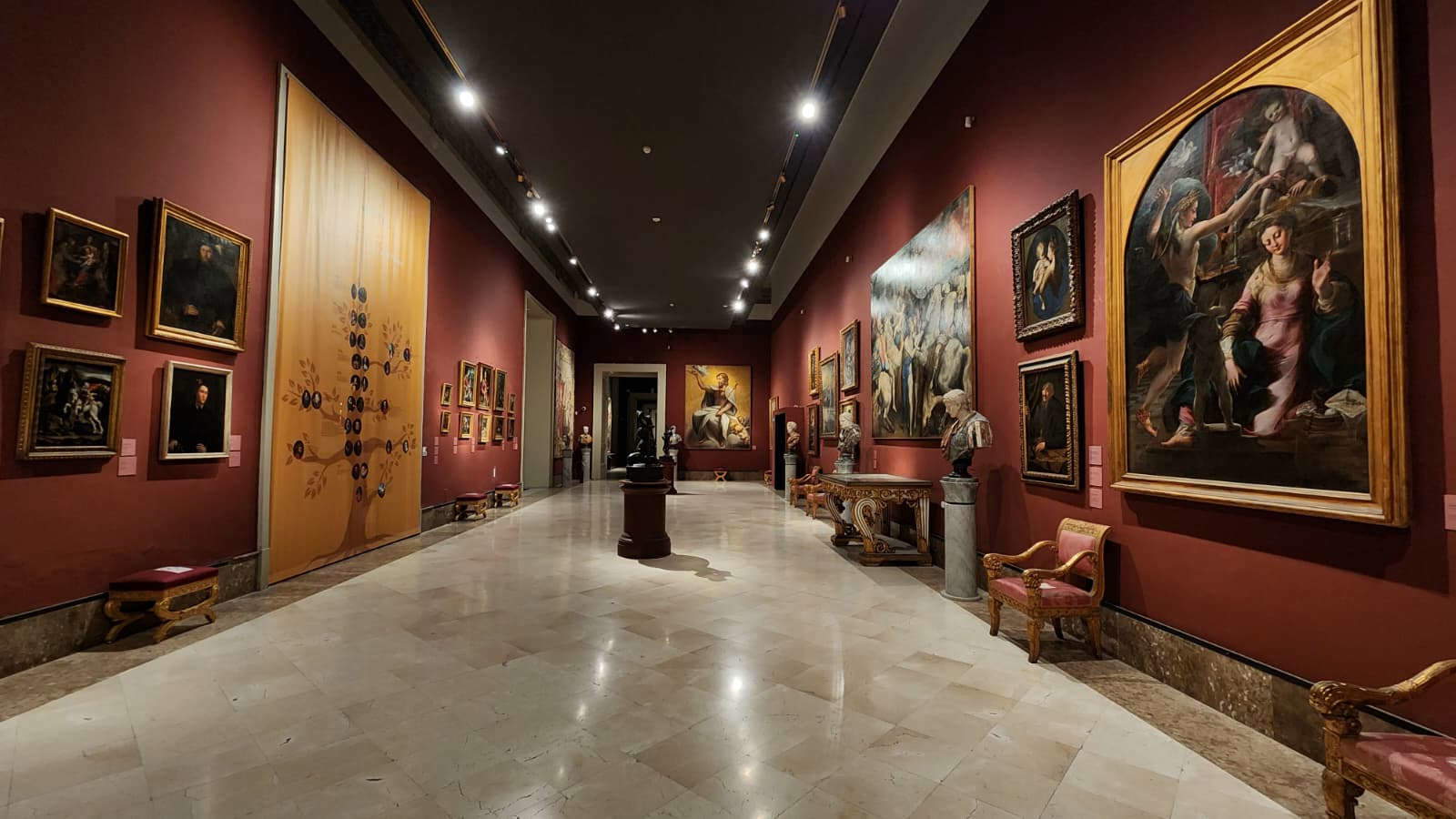
There are two critical elements that emerge from this analysis, according to CISDA: “The first concerns the lack of formal recognition of professional figures whose skills fall squarely within those of art historians. The very latter are framed almost exclusively as collection managers, with the figure of the curator being explicitly recognized only at GNAMC. Moreover, while the cataloger appears in a few institutions, the registrar is formally present only at Brera, while elsewhere those who actually perform that role generically pertain to the exhibitions office. But the most critical situation concerns a fundamental aspect that has important civic and social repercussions: education. At Capodimonte, to analyze one case among other possible ones, among 6 art historians, there is no head of educational services nor any museum educator among the ministerial staff, while at Brera the 7 art historian officials are joined by only 2 assistant museum educators. The second finding, on the other hand, concerns the distribution of staff, and in particular the fact that the already few art historians on duty cover several offices simultaneously. In the second-tier museums, the phenomenon is systematic: at MUNDA, the only official present is active in four different offices, while at Miramare and the National Gallery of Umbria, the respective 2 and 3 officials divide their time between collections, exhibitions, teaching and exhibitions. But even the top museums are not exempt from this phenomenon. Suffice it to say that at GNAMC 4 officials cover curatorship, exhibitions, catalog, archives, publications and library.”
The CISDA also points to the presence, albeit sporadic, of professional figures other than art historians employed in areas that would fall within their expertise. A situation that contributes to an even more complex picture of personnel management in state museums.
In this context, the committee draws attention to the ranking list of the competition announced by the Ministry of Culture for 518 officials, published in 2022 and related to the profile of art historian official. The ranking list, which will expire on May 30, 2026, represents, according to CISDA, a wealth of skills already selected and immediately available to the museum system.
At the same time, the Ministry’s update of the professional order has incorporated some figures envisioned by the ICOM Charter (including cataloger, registrar and museum educator) but according to the committee with questionable choices. “The inclusion of these new figures, to which is added that of the numismatist,” CISDA explains, “appears to be the result of an unfinished design: the figure of the cataloguer, although coordinated by the official, is de-qualified, moving from the third to the second rank-and therefore from official to assistant-with only a diploma as the minimum access requirement. The figures of the registrar and numismatist, on the other hand, require a master’s degree in art history or archaeology, while the figure of the heritage education officer requires a bachelor’s degree in cultural heritage. These latter figures, all in the third tier, actually share the competencies of the art historian and archaeologist officer, but have different levels of education, moreover while the former are given a technical-practical value, the latter are given more theoretical skills. This is a relevant contradiction, considering that, as the analysis conducted shows, these roles are filled - in the very rare cases in which they are formally provided for - precisely by official art historians.”
The overall analysis then leads the committee to a stark conclusion: “It is clear from this analysis that the staffing of art historians is meager and inadequate with respect to the mission that the MiC is supposed to carry out in the national interest. Italy runs nearly 5,000 museums, 500 of them state-owned, and it pains us to note that 47 of these remained closed through 2024 due to inability, restoration, or lack of staff. This picture is also incomplete if we do not consider the ecclesiastical and private heritage, which in fact constitute what is called the diffuse museum that is our country. The scope of this heritage is outlined in the General Catalog of Cultural Heritage: 2,223,359 historical and artistic assets, 414,187 archaeological assets, 227,106 photographic assets, 102,127 architectural and landscape assets have been catalogued to date.”
For CISDA, the protection and enhancement of a heritage of such magnitude cannot disregard a concrete investment in scientific expertise. Professionalism, the committee stresses, is not an accessory element but the very condition for culture to be studied, preserved and passed on to future generations.
The committee therefore makes a direct appeal to Culture Minister Alessandro Giuli and to the ministry leaders Alfonsina Russo, Massimo Osanna, Luigi Rocca and Fabrizio Magani, who head the four departments into which the MiC is divided. The cultural regeneration advocated by ministerial policies, CISDA says, cannot disregard the strengthening of the figure of the art historian in state museums. The concrete demand put forward by the committee concerns the complete scrolling of the MiC 518 competition list before it expires. Letting that list of candidates lapse without full utilization would, according to CISDA, mean giving up a pool of already-selected professionals precisely at a time when the presence of art historians in Italian museums appears more necessary than ever.
|
| State museums, CISDA denounces chronic shortage of art historians |

Warning: the translation into English of the original Italian article was created using automatic tools. We undertake to review all articles, but we do not guarantee the total absence of inaccuracies in the translation due to the program. You can find the original by clicking on the ITA button. If you find any mistake,please contact us.






















 IT
IT FR
FR DE
DE ES
ES CN
CN