





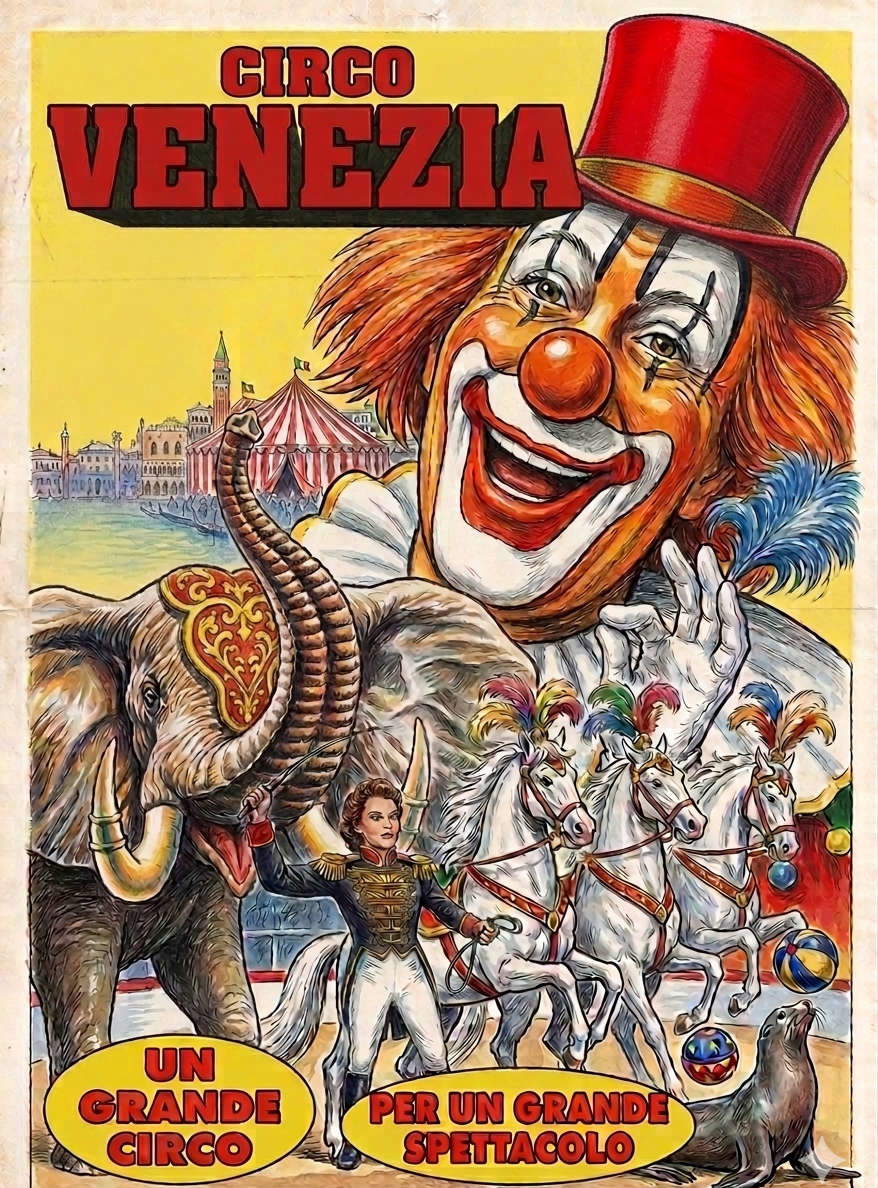
But is it the Venice Biennale or a circus? We had not yet finished reading the latest news about the arrival of the inspectors from the Ministry of Culture at Ca’ Giustinian, when today comes the communiqué announcing the en bloc resignation of the jury. Gone. Evaporated. A week before the opening. And moreover without an official reason! And yes, the jury chosen for this sixty-first edition of the Biennale, already from the day of its inauguration, had offered signs that were indeed hardly equivocal. First: it issues a declaration of intent not through institutional channels (which have been there on purpose, since 1895: evidently too nineteenth-century), but through a magazine, e-flux, certainly highly respectable in its circles but which does not appear to be the organ of any institution based in the lagoon. Second, in the declaration of intent, the jury invents its own exclusion criteria, regardless of the regulations. That is, “it will refrain from considering those countries whose leaders are currently accused of crimes against humanity by the International Criminal Court,” and this is because of an issue of “commitment to the defense of human rights.”
Now, in any institution that wants to be at least passable, any juror coup aimed at establishing a regime of ethical autarky would be rewarded with an escort to the door. Is it not okay for countries whose leaders are currently accused of crimes against humanity to participate in the Biennale? Don’t take the assignment: if politics causes embarrassment, consider the option of staying on your more comfortable couch rather than seeking a clumsy attempt at unilateral renegotiation of terms by way of declarations of intent published in the press. Where has one ever seen a dinner guest who starts throwing canapés in the host’s face because the smoked salmon is not to his liking? Sure: interesting perhaps as a performance, less so when evaluated as a sign of institutional respect. And understandable the dilemma: do we refuse the assignment, and simultaneously the opportunity to write “juror at the Venice Biennale” on the resume? Let’s try to solve it with the expedient. The problem is that the expedient goes against one of the Biennale’s cardinal principles, namely, equal treatment of all participants.
And anyway, we still don’t know what these resignations are due to. Sudden. Silent. Compact. But without a syllable of explanation, without that minimum union of accountability that in any barely decent country is considered an elementary duty of anyone in public office. We are not supposed to learn the reasons from the Adnkronos, which, “to the best of its knowledge,” says the resignation would depend on a willingness to abide by the declaration of intent. In a serious country, those who resign should explain why immediately. And do it through official channels. There is no pressure to do so. A matter of image and prestige (the Venice Biennale lives on its authority, and this jury, it can be said, has not made the Venice Biennale look good), a matter of transparency, and a matter of ethics as well: if you agree to serve on a jury of the Venice Biennale, you are taking on an important public role, after which you have the right to resign, but not giving reasons for your choice is tantamount to failing an ethical duty to the cultural community, to the public, to everyone.
In any case, while in Venice one can already hear Fučík’s March of the Gladiators resounding, the Biennale, given the obvious impossibility of forming a new jury, has invented that for this edition the Lions will be awarded by the public. For the first time in history, therefore, one of the world’s most important art prizes will be decided by televoting. As in Sanremo. So, as we wait to see whether the running institution of the demoscopic jury is a stroke of genius (the public, after all, might turn out to be a better arbiter than the professional jurors) or yet another humiliation, we will try to assess whether this institution that was that of Carlo Ripa di Meana, Paolo Portoghesi, and Paolo Baratta still has something to say or has now inexorably gone the way of the variety show.

The author of this article: Federico Giannini
Nato a Massa nel 1986, si è laureato nel 2010 in Informatica Umanistica all’Università di Pisa. Nel 2009 ha iniziato a lavorare nel settore della comunicazione su web, con particolare riferimento alla comunicazione per i beni culturali. Nel 2017 ha fondato con Ilaria Baratta la rivista Finestre sull’Arte. Dalla fondazione è direttore responsabile della rivista. Nel 2025 ha scritto il libro Vero, Falso, Fake. Credenze, errori e falsità nel mondo dell'arte (Giunti editore). Collabora e ha collaborato con diverse riviste, tra cui Art e Dossier e Left, e per la televisione è stato autore del documentario Le mani dell’arte (Rai 5) ed è stato tra i presentatori del programma Dorian – L’arte non invecchia (Rai 5). Al suo attivo anche docenze in materia di giornalismo culturale all'Università di Genova e all'Ordine dei Giornalisti, inoltre partecipa regolarmente come relatore e moderatore su temi di arte e cultura a numerosi convegni (tra gli altri: Lu.Bec. Lucca Beni Culturali, Ro.Me Exhibition, Con-Vivere Festival, TTG Travel Experience).
Warning: the translation into English of the original Italian article was created using automatic tools. We undertake to review all articles, but we do not guarantee the total absence of inaccuracies in the translation due to the program. You can find the original by clicking on the ITA button. If you find any mistake,please contact us.





















 IT
IT FR
FR DE
DE ES
ES CN
CN


