





Every two years, Venice transforms into the gravitational center ofglobal contemporary art. The Biennale, with its kaleidoscope of national pavilions, collateral events and special projects, is an expected and celebrated ritual, but also a massive, almost unstoppable machine that feeds on itself in terms of meaning, expectations and curatorial strategies. But what remains of all this outside the art circuit? Is the Biennale still a place for experimentation and confrontation, or has it turned into a perfectly oiled choreography designed to satisfy the needs of the system rather than those of art?
The numbers speak for themselves: sponsors, foundations, galleries and collectors converge on Venice with logics that, increasingly, bring theevent closer toa fair market rather than a laboratory of ideas. The curatorial role has become a cog that must hold together critical instances and financial needs, with the risk of having to favor artists and themes better suited to the dynamics of the global market. Yet, utopia endures: there are still spaces for rupture, works that challenge the system from within, languages that do not bend to the predictability of consensus.
But to what extent is thisart industry capable of generating authentic meaning? Are artists still free to express themselves, or must they play by the rules of an ecosystem that rewards recognizability, political thematization, and the aesthetics of urgency? Is the Biennale a thermometer of the contradictions of our time or a refined device that absorbs them, neutralizes them, and returns them as spectacle?
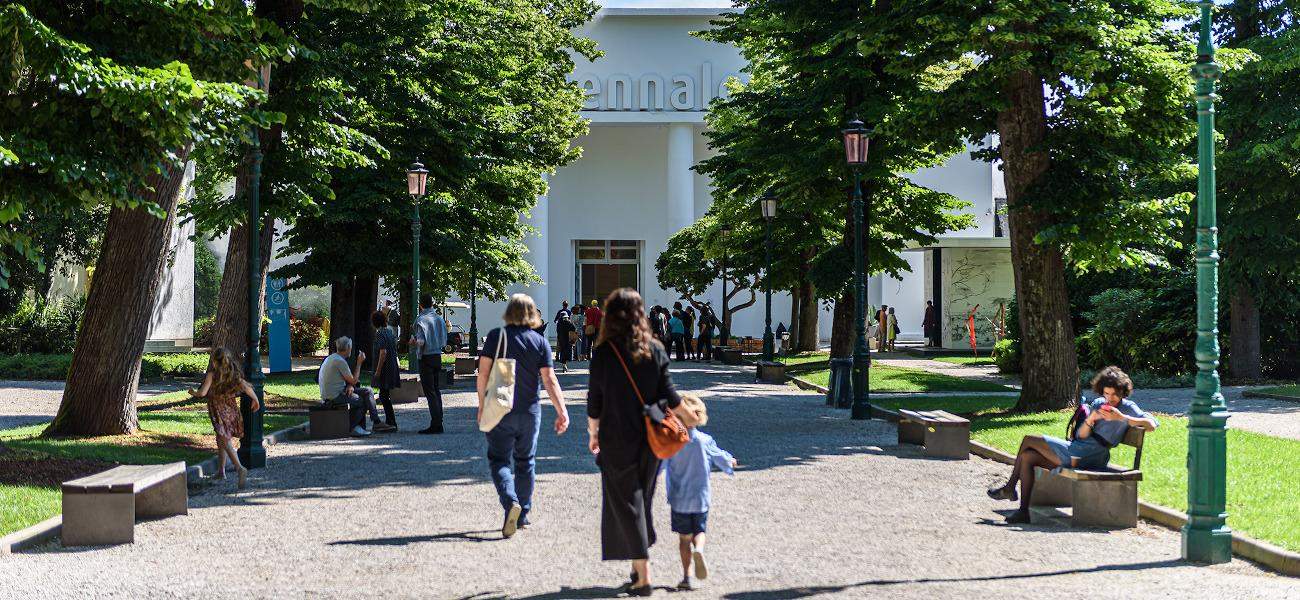
Perhaps the answer is not unambiguous. Venice, with its all-enveloping beauty, is the perfect stage for a staging that seduces and at the same time raises questions. We should, rather, ask ourselves whether the public is still able to perceive the boundary between art and the art industry, or whether, by now, we are all part of a mechanism in which dissent is, after all, just another form of consent.
It is no mystery that in recent years the Biennale has gradually taken on the role of an international showcase for artists and curators eager to consolidate their position within the system. But this comes at a price, as the art exhibited does not seem, in most cases, to be the result of free research as much as a selection influenced by power dynamics and market strategies. Increasingly, there is a sense that the Venetian exhibition is a thermometer not so much of innovation as of already established trends in the art world.
While the increasing focus on political, social and ecological issues testifies to a cultural sensibility in line with the challenges of our time, it also runs the risk of turning into a predictable formula, in which global urgencies become part of a standardized aesthetic that transforms the Biennale into anarena of narratives that meet the needs of an increasingly international and selective audience.
There is a glaring paradox: on the one hand, the Biennale presents itself as the site of experimentation and creative freedom; on the other hand, it is an event that lives thanks to an economic system that largely determines its choices. The national pavilions, for example, are often funded by public institutions and private sponsors, and the selection of artists follows logics that do not always coincide with a real desire for innovation. Similarly, commercial galleries play an increasingly central role in the promotion and visibility of the artists in the exhibition.
One could argue that all this is inevitable: art has never really been independent of economic dynamics. However, the question remains: to what extent is the Biennale still a place for experimentation? What if the real subversive act today is precisely to escape this circuit, to seek alternative spaces and exhibition models capable of escaping the dominant logics?
Despite all the contradictions, the Biennale remains a central event for contemporary art. Its ability to attract audiences, artists and intellectuals from all over the world makes it an indispensable crossroads for cultural debate. But perhaps the real question is not whether the Biennale is still needed, but how it might evolve to restore an authenticity to art that is in danger of being eroded by its own success.
Perhaps, the solution lies not in abolishing the system, but in making it more fluid, less predictable. Create spaces of real expressive freedom within the Biennale, reduce the weight of market dynamics on curatorial choices, incentivize projects that truly challenge the status quo. And, above all, question what it means to produce art today in a world where everything, even dissent, risks becoming part of a self-feeding circuit.
In the end, the Biennale is a mirror: it reflects not only trends in art, but also the contradictions of the society that produces it. And perhaps it is precisely in this ambiguity, this unresolved tension, that its deepest value lies.


The author of this article: Federica Schneck
Federica Schneck, classe 1996, è una giornalista specializzata in arte contemporanea. Laureata in Storia dell'arte contemporanea presso l'Università di Pisa, il suo lavoro nasce da una profonda fascinazione per il modo in cui le pratiche artistiche operano all’interno, e in contrapposizione, alle strutture sociali e politiche del nostro tempo. Si occupa delle trasformazioni del sistema dell'arte contemporanea, del dialogo tra ricerche emergenti e patrimonio culturale, del mercato, delle istituzioni e delle fiere internazionali. Alla scrittura giornalistica affianca quella critica, con testi per artisti, gallerie e collezioni private.Warning: the translation into English of the original Italian article was created using automatic tools. We undertake to review all articles, but we do not guarantee the total absence of inaccuracies in the translation due to the program. You can find the original by clicking on the ITA button. If you find any mistake,please contact us.

























 IT
IT FR
FR DE
DE ES
ES CN
CN