





At the Palace of Versailles , the chamber of the king’s inner apartment returns to view in its 1789 configuration, at the end of a lengthy restoration project that represents the culmination of several decades of research, historical studies and craftsmanship skills. The project restores coherence to one of the most intimate spaces of French monarchical power, an environment in which decorative refinement and extraordinary technical expertise are intertwined. Made in 1728 for Louis XV of France, the chamber marks a turning point in the way Versailles was inhabited. Unlike the parade chamber, which was intended for public representation, this room was created as a more private space while remaining embedded in the symbolic dimension of the monarchy. The design was entrusted to architects Jacques V Gabriel and Ange-Jacques Gabriel, while the rich rocaille decoration was sculpted by Jacques Verberckt. The ensemble is distinguished by the balance between ornamental richness and measure, expressing a new idea of royal intimacy.
Over the course of the 18th century, the room was enriched with furniture and objects of great value, reflecting the taste of the sovereigns. Alongside cabinetry and goldsmithing, scientific instruments find their place, testifying to Louis XV and Louis XVI of France’s interest in the sciences. The chamber thus becomes not only a place of daily life, but also a cultural and intellectual expression of power.
The central element of the composition is the decorated textile, which organizes the space around the alcove and the bed, the symbolic heart of the room. According to court custom, textiles were alternated between summer and winter versions. Lyon manufactures produced luminous brocades and precious velvets under Louis XV, while with Louis XVI a clearer, neoclassical taste took hold, without renouncing the richness of materials.
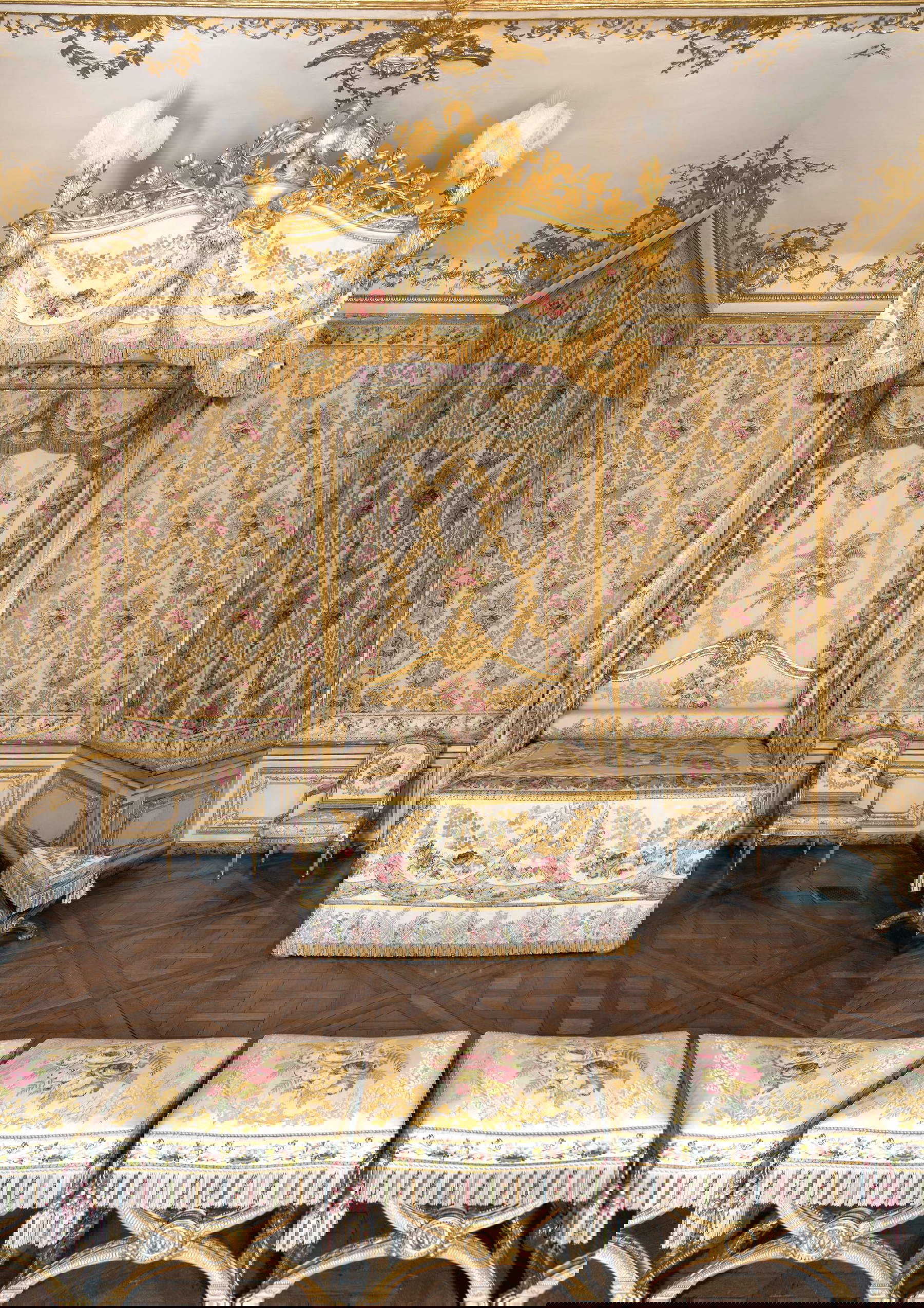
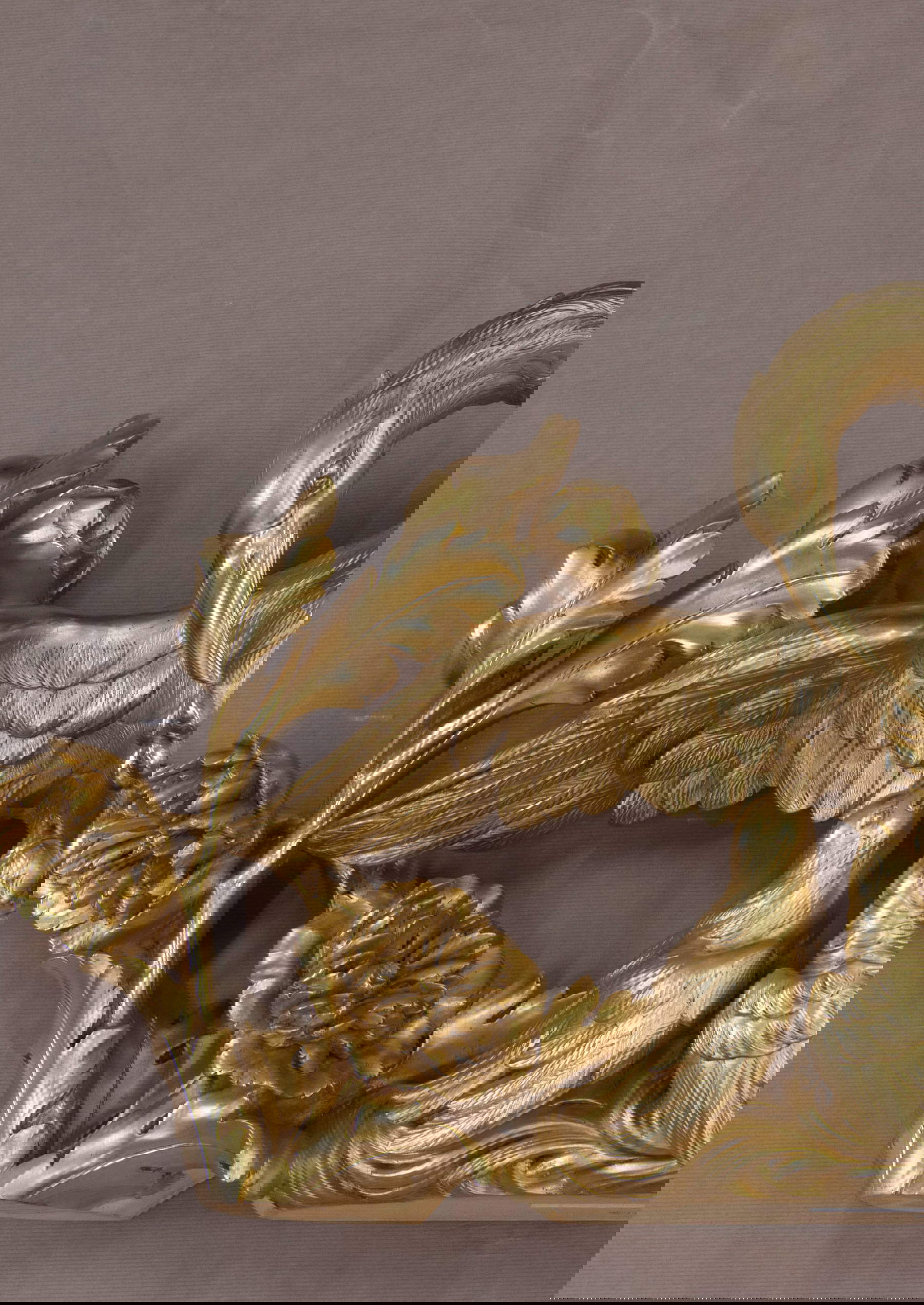
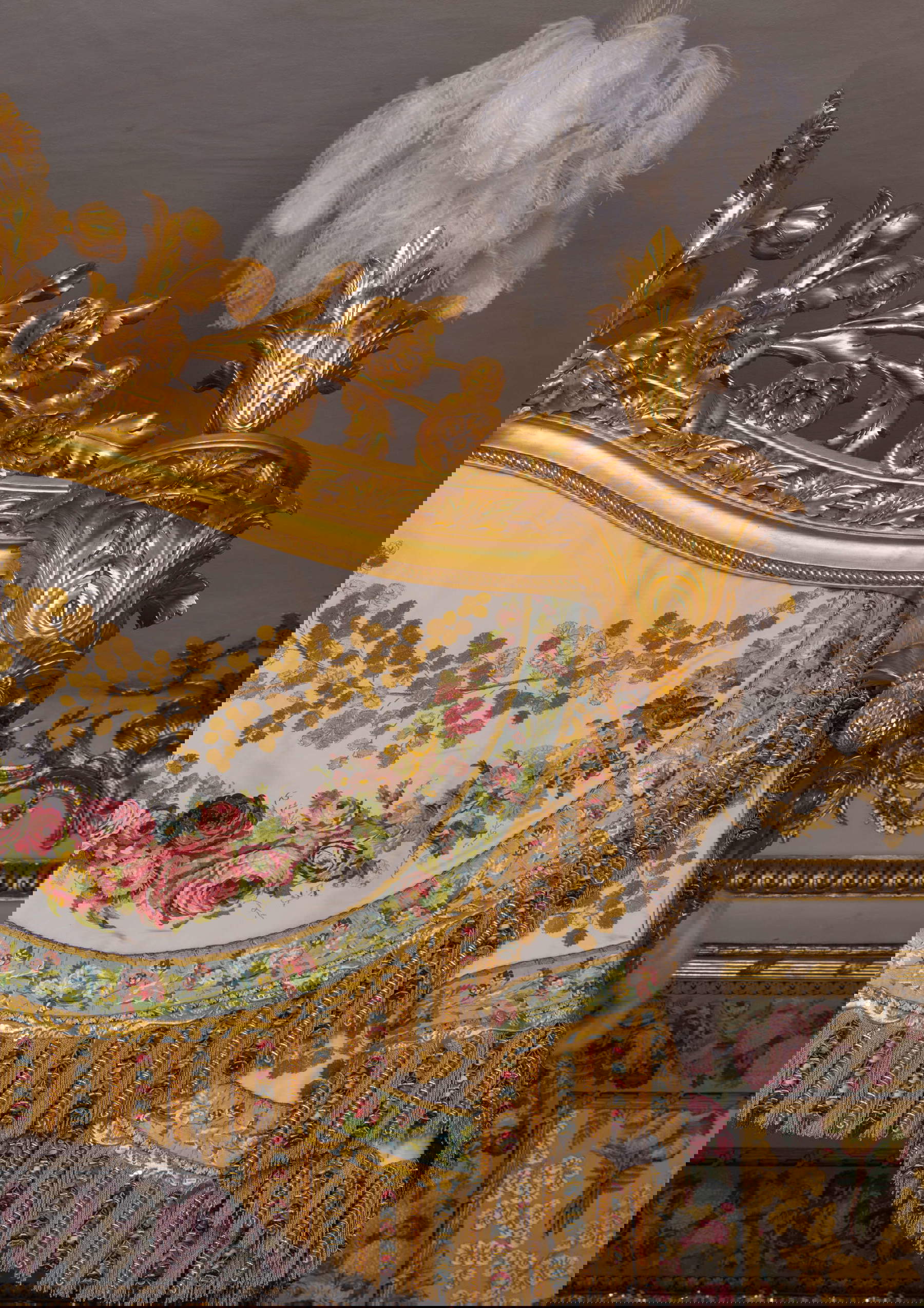
The restoration, which began in the mid-1980s, aimed to reconstruct the last documented state of the room, that of October 6, 1789, the day of the royal family’s final departure from Versailles. The project was based on close collaboration between historians, conservators and craftsmen, who were committed to recreating 18th-century rooms and decorations as faithfully as possible. Particular attention has been paid to textiles, reconstructed from original fragments using traditional weaving techniques.
Despite the progress, one key element was missing for a long time: the bed. Its absence compromised the understanding of the entire space. Therefore, starting in the 2000s, a specific construction site was initiated to reconstruct it. In the absence of preparatory drawings, craftsmen relied on extremely detailed archival descriptions to restore the shapes, proportions and decoration of the furniture lost during the Revolution.
The reconstruction work required a major interpretive effort. Five sculptors, led by Charles Boulnois and François Gilles, devoted some 2,500 hours to making the structures from basswood, a material traditionally used for its fineness. The decorations were then gilded according to the gouache technique used in the chateau workshops and handed down through the centuries. The gilding involved numerous steps, from the preparation of the wood to the application of gold leaf and the final patination to give an appearance consistent with the period. This process, performed entirely within the castle, testifies to the continuity of excellent craftsmanship.
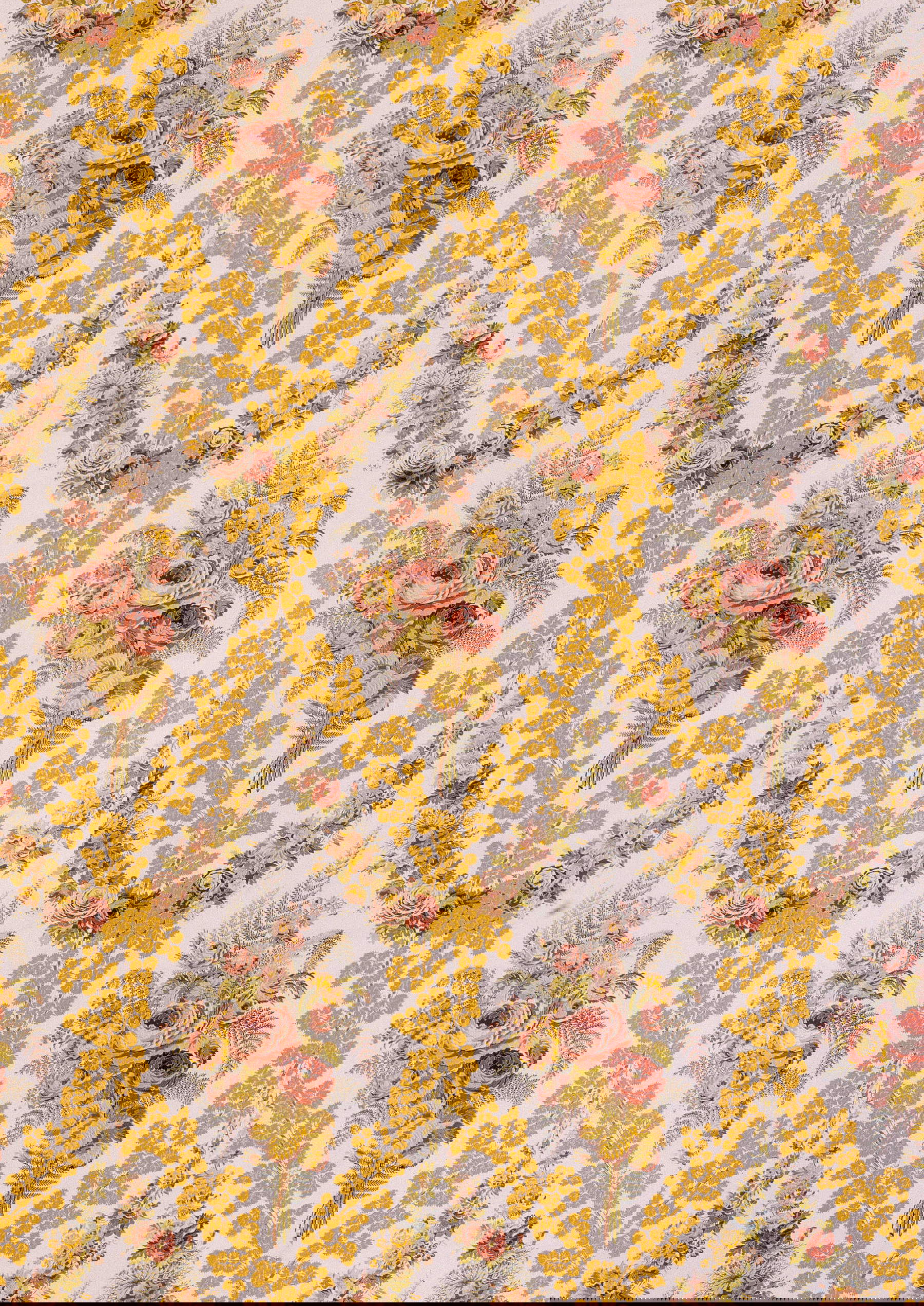
At the same time, the complex work of reweaving the fabrics was tackled. The main fabric, a gros de Tours brocade with silk and gold threads, features extremely intricate floral motifs made with dozens of colors. The production, entrusted to the Tassinari & Chatel manufactory, required years of work and the adaptation of traditional techniques to contemporary needs, while maintaining visual fidelity to the original pattern.
Further intervention involved the bed’s embroidery, made by the Lesage Intérieurs maison. The work, which lasted about 30,000 hours, involved the recomposition of motifs from existing fabrics, adapting them to the complex shapes of the furniture through hand appliqué and embroidery techniques. The trimmings, entrusted to the Declercq maison, were also reconstructed on the basis of historical sources and preserved fragments, with work that lasted nearly two years.
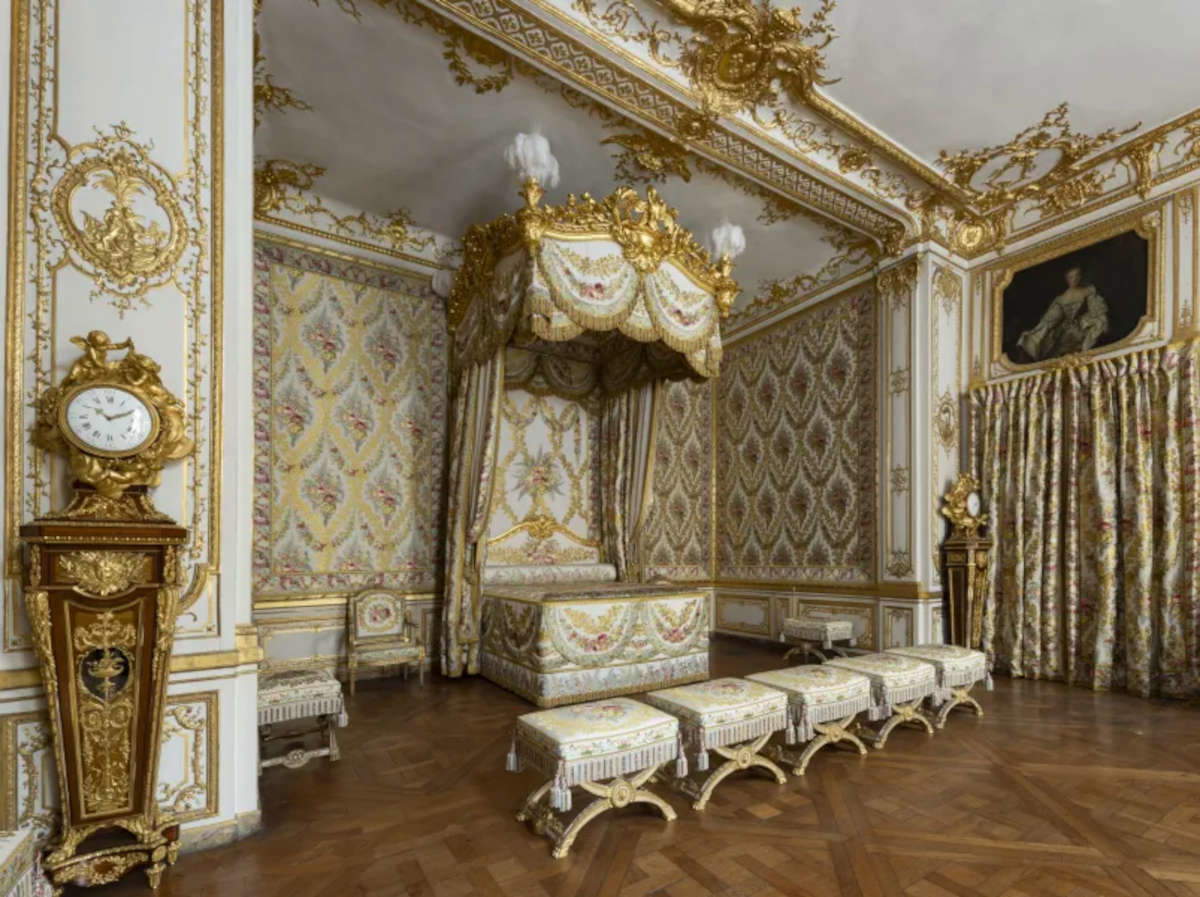
The chamber also reflects the furniture policy adopted at Versailles in recent decades. Because many original furnishings have gone missing or are in inaccessible collections, the curators chose to reconstruct the room through equivalent works from other royal residences, such as Saint-Cloud, the Tuileries, and Compiègne. This approach makes it possible to restore a coherent and credible image of royal interiors on the eve of the Revolution. Among the most significant elements is the commode by Antoine Gaudreaus, now preserved at the Wallace Collection in London and temporarily relocated to the room in 2022 after nearly 250 years of absence. Alongside it, objects such as gold pinwheels, scientific clocks and Sèvres porcelain testify to the exceptional level of luxury achieved.
The bed, rightfully called “the king’s other throne,” now regains its central role in the alcove. Not only a functional element, but a symbol of sovereign power, it organizes the entire space and restores its original meaning. Its reconstruction allows us to fully understand the private and at the same time representative dimension of the sovereign’s life.
The chamber of the king’s inner apartment is now once again accessible to the public on a free or guided tour starting April 14, 2026. The end result is not only the restitution of a room, but the reconstruction of an atmosphere: that of the French monarchy on the eve of the Revolution, suspended between splendor, intimacy and historical transformation.
|
| Versailles, restored the king's chamber: the face of 1789 returns |

Warning: the translation into English of the original Italian article was created using automatic tools. We undertake to review all articles, but we do not guarantee the total absence of inaccuracies in the translation due to the program. You can find the original by clicking on the ITA button. If you find any mistake,please contact us.























 IT
IT FR
FR DE
DE ES
ES CN
CN


