





The latest research campaign conducted at the archaeological site of Fioccaglia, in the municipal territory of Flumeri (in the province of Avellino), has returned results of considerable importance for the reconstruction of the urban layout of the ancient Roman city. The new evidence confirms the strategic role of the settlement along the Appian Way, which has been recognized as a UNESCO World Heritage Site.
The site, which some scholars identify with ancient Forum Aemilii and dated between the 2nd and 1st centuries B.C., constitutes a fundamental reference for understanding the dynamics of the Romanization of Irpinia. Its historical relevance is closely linked both to the passage of the so-called Regina viarum and to the birth of the Via Aemilia, commissioned by the consul Marcus Aemilius Lepidus in 126 BC. As early as the 1980s, research had unearthed a paved decumanus and a fine domus decorated in early Pompeian style, indications of the presence of high-ranking figures within the urban center.
The most recent campaign of investigations, directed by Professor Giuseppe Ceraudo of theUniversity of Salento in close collaboration with the Soprintendenza Archeologia, Belle Arti e Paesaggio for the provinces of Salerno and Avellino and with theFlumeri municipal administration, has made it possible to define more precisely the orthogonal structure of the city. Regular street axes and blocks organized according to a plan consistent with the model of newly founded cities have emerged.
Particularly significant is the identification of the Forum, the fulcrum of the public and economic life of the settlement, with its large central square and the perimeter of the public buildings that bordered it. Also of great significance is the discovery of a hitherto unknown monumental theater. The new discoveries thus confirm that Fioccaglia was a fully structured city with impressive public architecture, reinforcing its historical value and strategic role in the Roman road system.
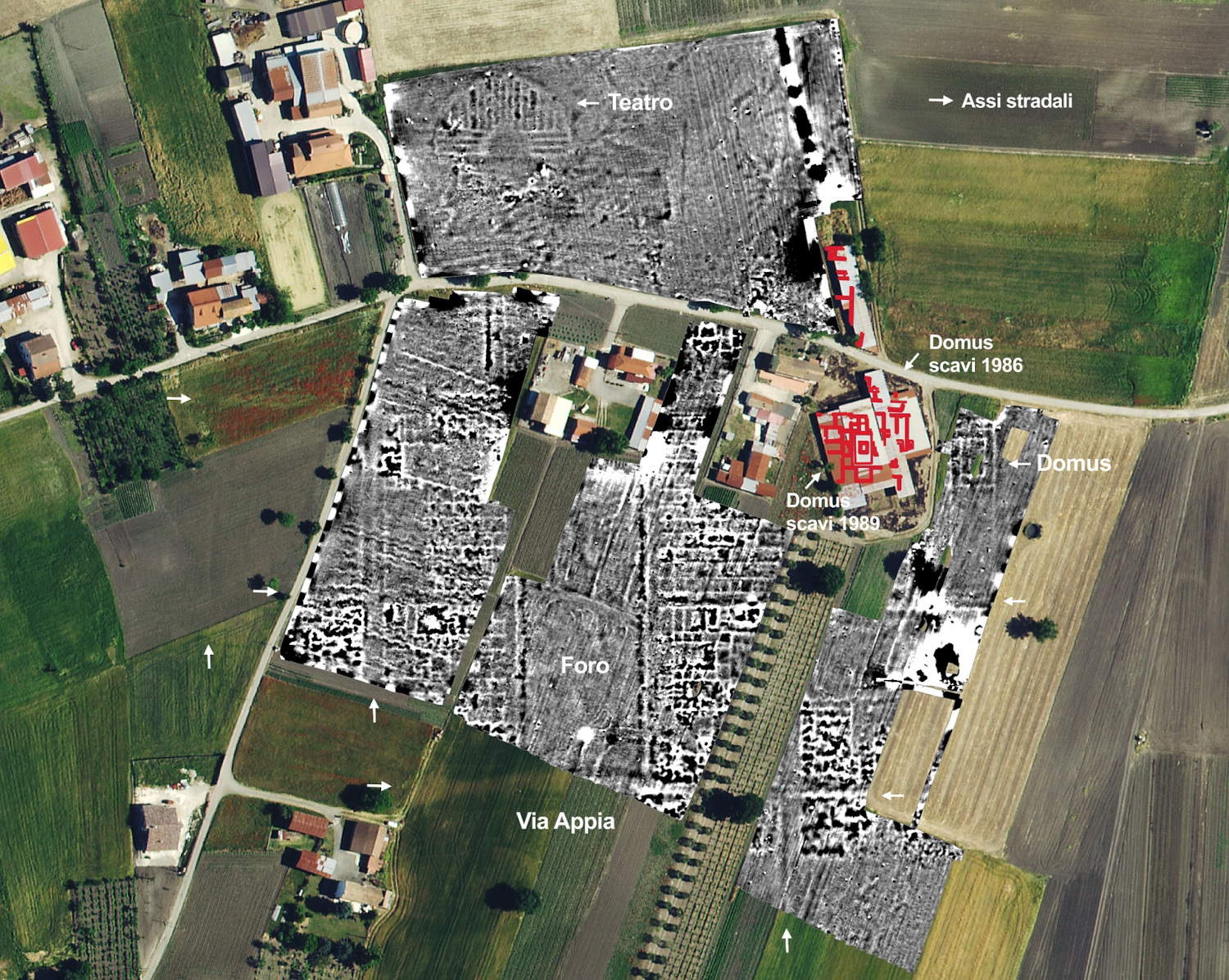
“The combination of geophysical prospecting and remote sensing surveys using drones equipped with thermal and multispectral sensors made it possible to obtain a true X-ray of the ancient center still buried, identifying structures through variations in the growth of vegetation and the magnetic composition of the subsoil,” explained Professor Giuseppe Ceraudo, emphasizing the contribution of innovative technologies. “The multidisciplinary approach provided a solid scientific basis for planning future protection and enhancement activities.”
ABAP Superintendent for the provinces of Salerno and Avellino, Anna Onesti, highlighted “how the synergy between academic research and protection has produced fundamental results for the elaboration of a new management and enhancement plan for the identified areas.” “The area at the confluence of the Ufita River and the Fiumarella stream is confirmed among the areas of greatest archaeological interest in Irpinia,” said archaeological officer Lorenzo Mancini, “also in relation to the investigations related to the construction of the Hirpinia Station of the High Speed Railway.”
The Municipality of Flumeri reiterated its willingness to collaborate with the University and the Superintendence in order to transform the site into a landmark of the historical-cultural offerings of inland Campania, also seizing development opportunities related to the ongoing infrastructure in the Ufita Valley. “This discovery is a source of great pride and a development opportunity for our territory,” said Mayor Angelo Lanza. “The municipality is ready to work closely with the University and the Superintendence to ensure that Fioccaglia, a strategic road junction of the Appian Way, becomes a landmark in the historical and cultural offerings of inland Campania.”
In the coming months, non-invasive investigations will continue to confirm the evidence that has emerged, with the aim of consolidating protection strategies and launching a structured path to enhance the site.
|
| Spotted with drones at the archaeological site of Fioccaglia (Avellino) the Forum and a hitherto unknown monumental theater |

Warning: the translation into English of the original Italian article was created using automatic tools. We undertake to review all articles, but we do not guarantee the total absence of inaccuracies in the translation due to the program. You can find the original by clicking on the ITA button. If you find any mistake,please contact us.

























 IT
IT FR
FR DE
DE ES
ES CN
CN


