




by Redazione 09/05/2026



Categories: Contemporary art / Disclaimer
Roman fashion house Bvlgari inaugurates its role as exclusive partner of the Venice Biennale until 2030 with two projects between the Giardini and Biblioteca Marciana dedicated to contemporary art: exhibiting Lotus L. Kang, Lara Favaretto and Monia Ben Hamouda.


Bvlgari inaugurates its role asexclusive partner of the Biennale Arte 2026 with a double initiative aimed at strengthening the Roman fashion house’s link with the world of contemporary art and international cultural production. The debut of the collaboration with the Venice Biennale, destined to continue until 2030, takes shape through two distinct but complementary projects: the Bvlgari Pavilion at the Giardini della Biennale, entrusted to Canadian artist Lotus L. Kang, and the first exhibition promoted by Fondazione Bvlgari at the Biblioteca Nazionale Marciana, featuring Italian artists Lara Favaretto and Monia Ben Hamouda.

The first of the two interventions takes shape in the Bvlgari Pavilion inside the Giardini della Biennale, where Lotus L. Kang (Toronto, 1985) presents The Face of Desire is Loss, an immersive installation that explores the relationship between time, transformation and the body. Born in Canada and active in New York, the artist develops research centered on organic materials and processes of mutation, constructing environments that change over time and react to the conditions of space. In the Venetian project, long strips of unfixed photographic film hang from a metal structure that recalls the shape of a lotus root. The films, referred to as “skins” by the artist, remain constantly sensitive to their surroundings and gradually change throughout the duration of the Biennale in response to the light and humidity of the pavilion.


Around these changing surfaces, Kang arranges a series of sculptural elements that use tatami mats as a structural and symbolic base. The mattresses become body wrappings and memory devices, associated with liminal states such as sleep, dreaming, recovery or death. The entire installation unfolds as an unstable structure that rejects a definitive form and remains suspended in a condition of continuous transformation.


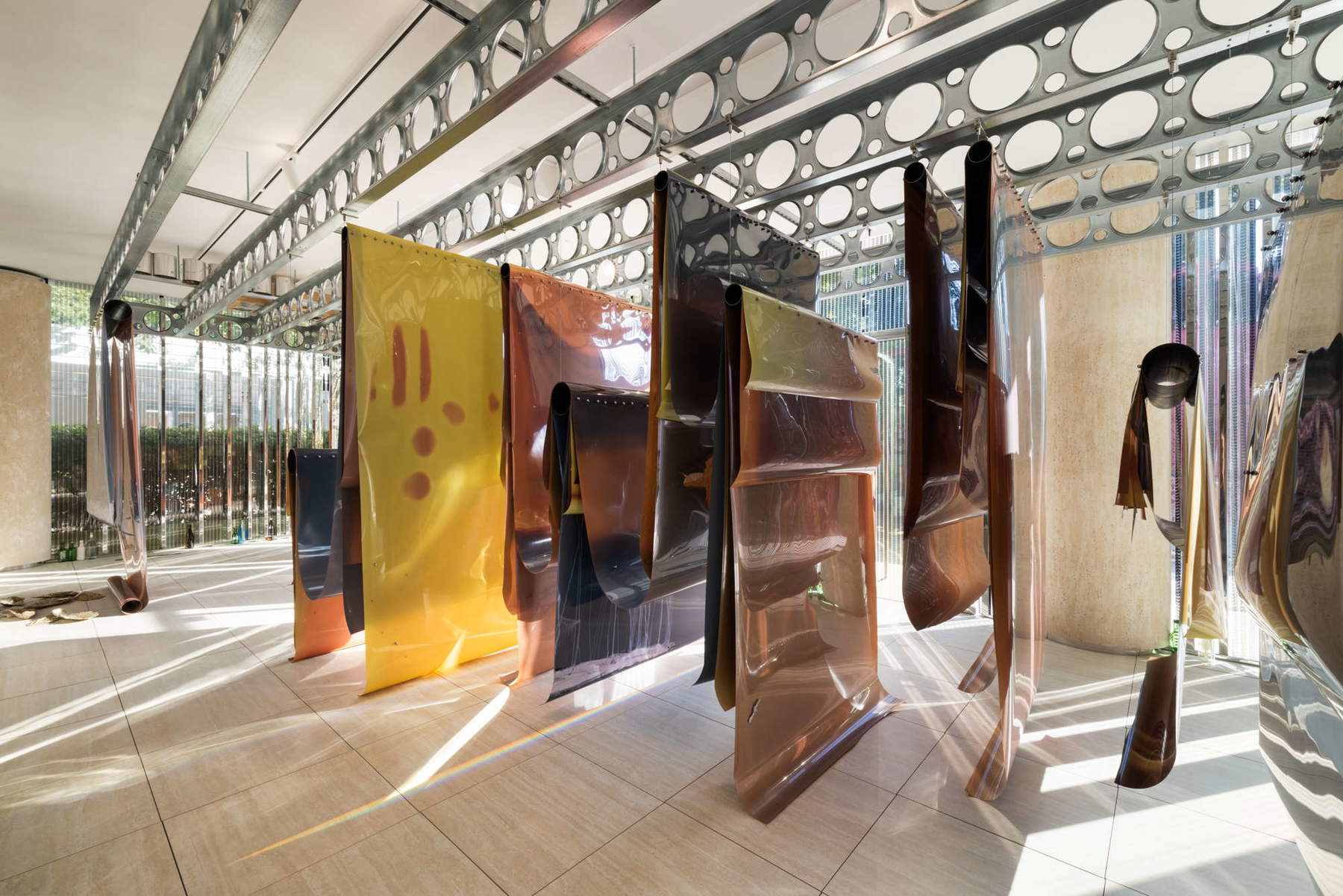
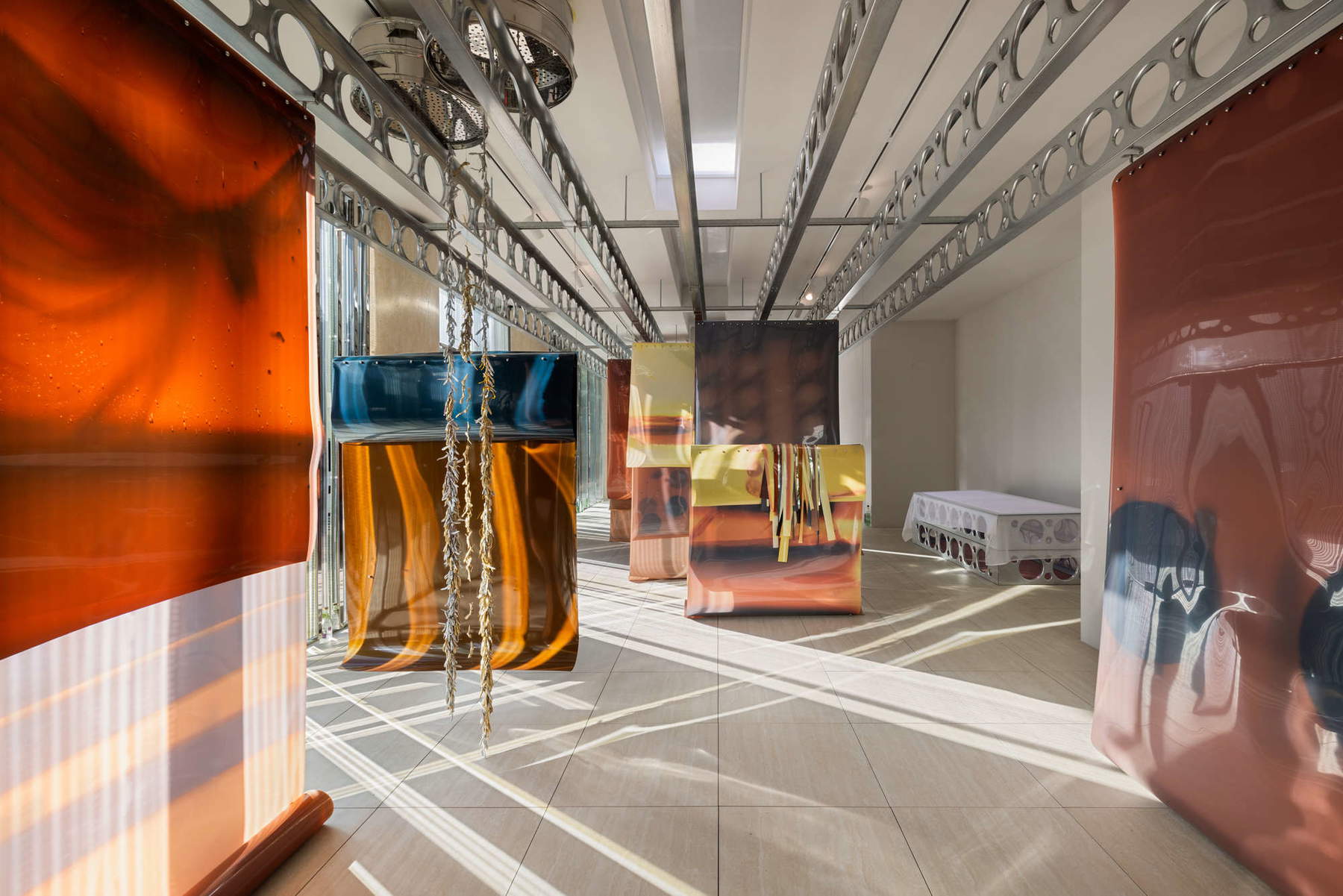
The work also extends to the pavilion’s windows, which are covered in 35-millimeter film stock imprinted with images of mudflats created by tides in South Korea’s Jeolla province. These transitional landscapes, where marine and terrestrial ecosystems meet, are accompanied by spectrograms that transform bird calls and other natural sounds into visual forms. Theatrical lights installed in the space project continuous color variation onto the surfaces of the work, transforming the pavilion into a device that is simultaneously projector and projection. The project also dialogues with contemporary poetry: in fact, the title comes from the collection Thresholes by Lara Mimosa Montes, while the rhythmic structure of the installation recalls the poem Already by Kim Hyesoon.
Forty-nine spirit bottles also appear along the exhibition route, a symbolic reference to the forty-nine-day period that, according to Buddhist tradition, separates death from rebirth. In another section of the space, a rectilinear structure covered in pink silicone and crossed by a taut wire constantly reacts to the movement of air and visitors, accentuating the organic and unstable dimension of the intervention.
Parallel to the project at the Giardini, Fondazione Bvlgari inaugurates its first institutional exhibition in the Biblioteca Nazionale Marciana, a place symbolic of the preservation and transmission of Venetian knowledge. Here two site-specific installations are presented that dialogue directly with the institution’s historic spaces.
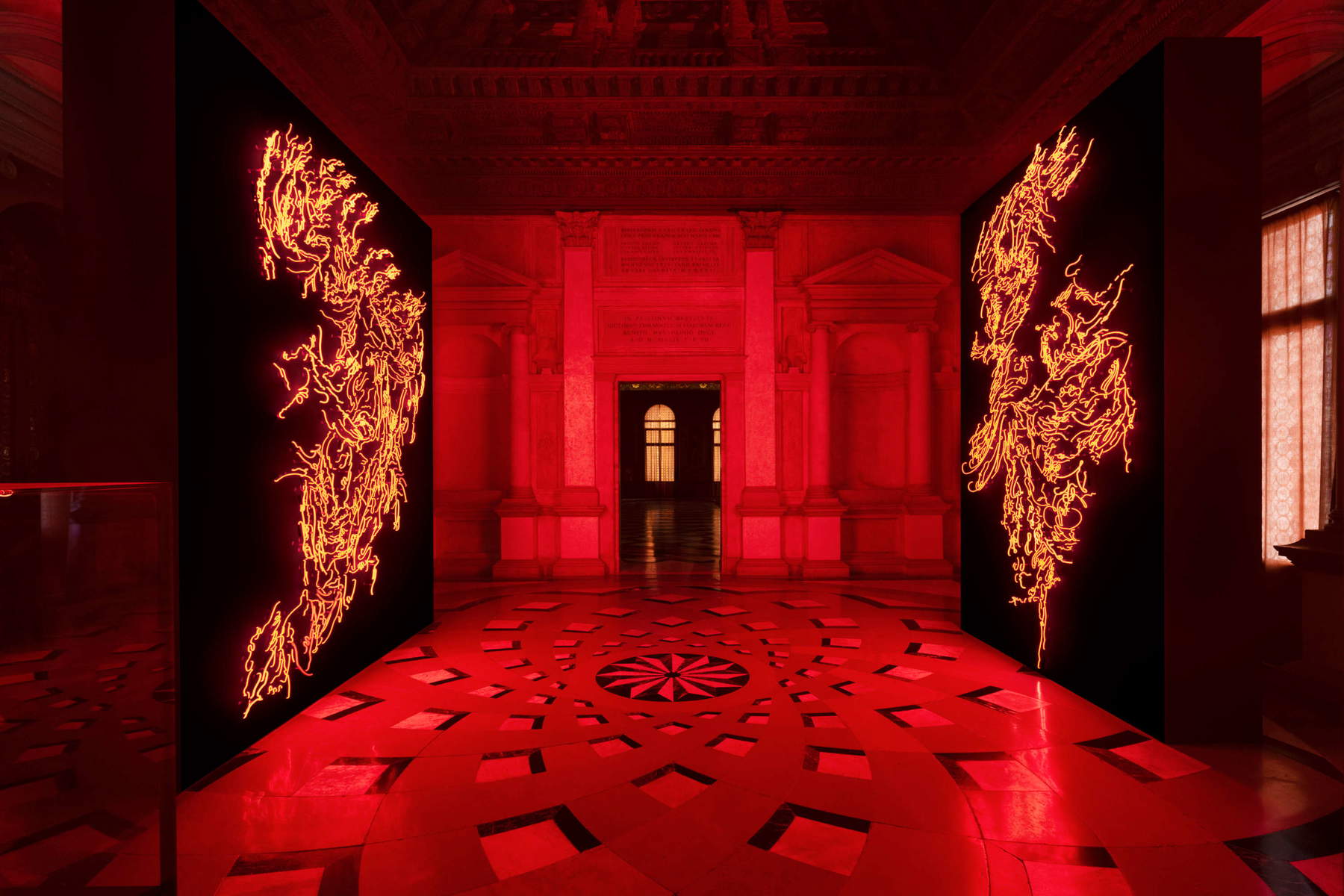
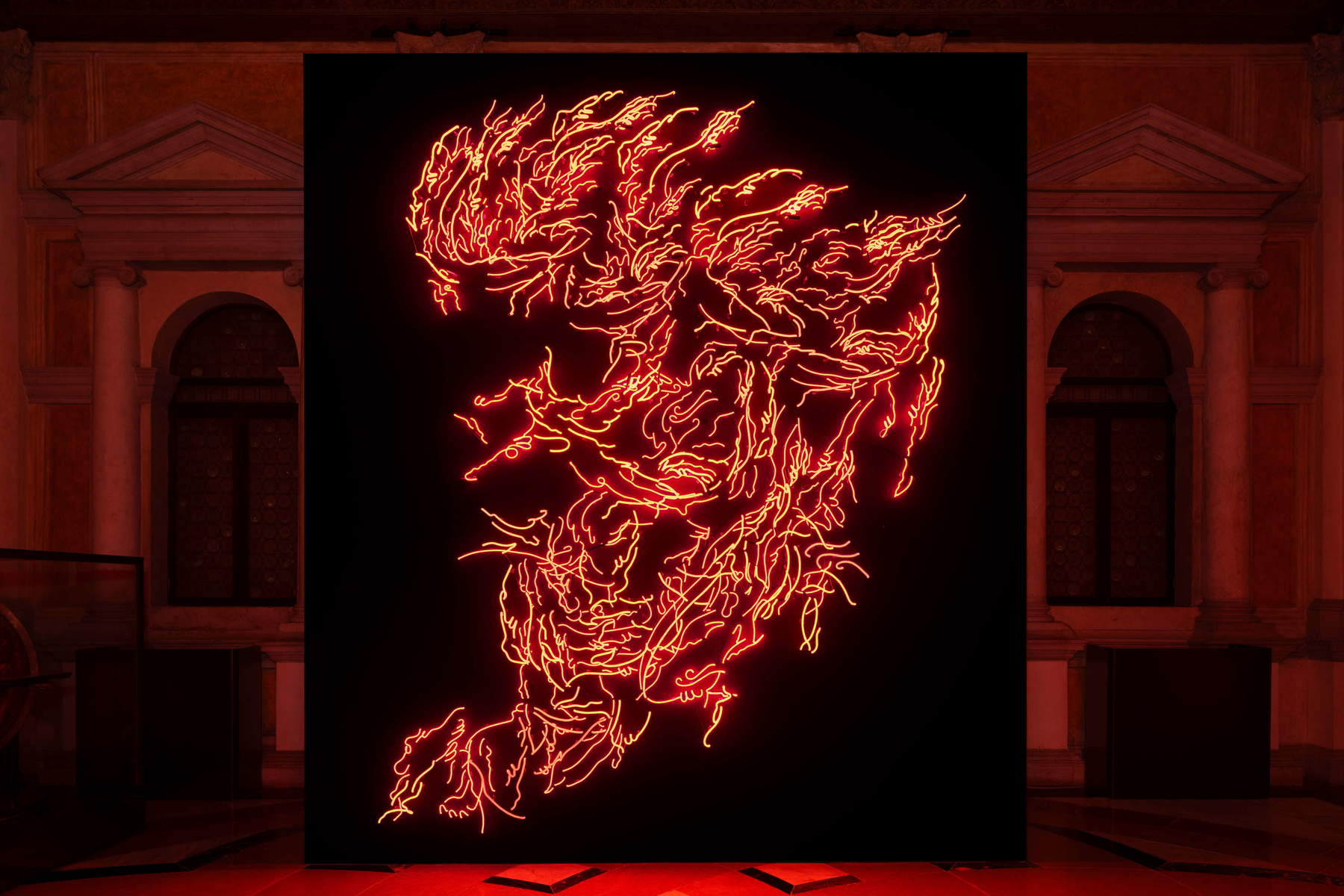
In the vestibule of the library, Monia Ben Hamouda (Milan, 1991) presents Fragments of Fire Worship, an installation composed of two neon sculptures that address the theme of language, memory and cultural transmission. The daughter of an Islamic calligrapher, the artist transforms her cultural heritage into fragmentary and indecipherable writing, where the luminous sign loses its communicative function to become gesture, trace and scar. The fire evoked by neon takes on an ambivalent value of revelation and destruction, recalling Arab and Islamic history, in which fire has been at once an instrument of knowledge, censorship, revolution and oblivion. Placed in a place historically devoted to the archiving of knowledge, the work challenges the idea of knowledge as a neutral and ordered system, highlighting the processes of selection, exclusion and loss that any archive inevitably entails.
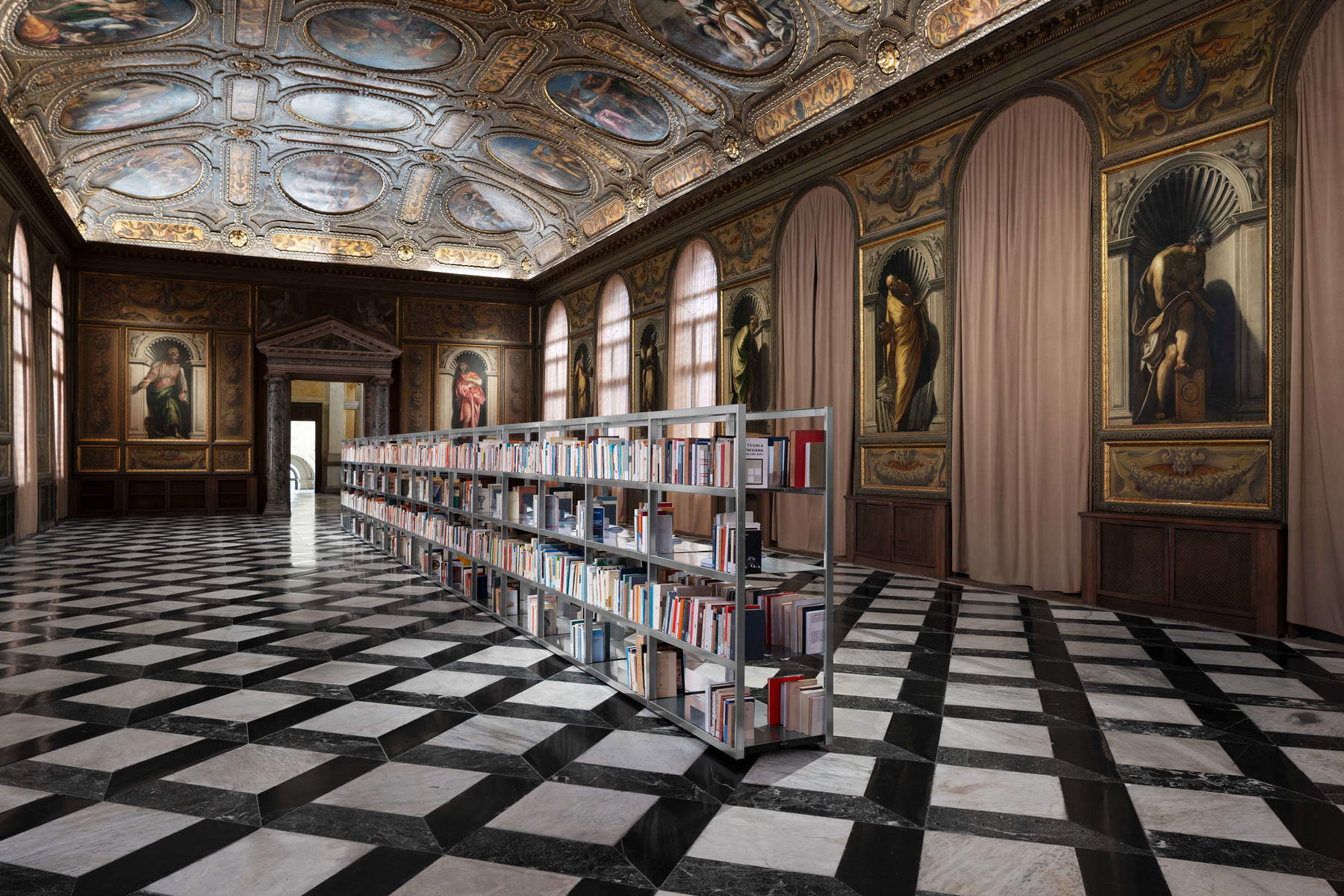
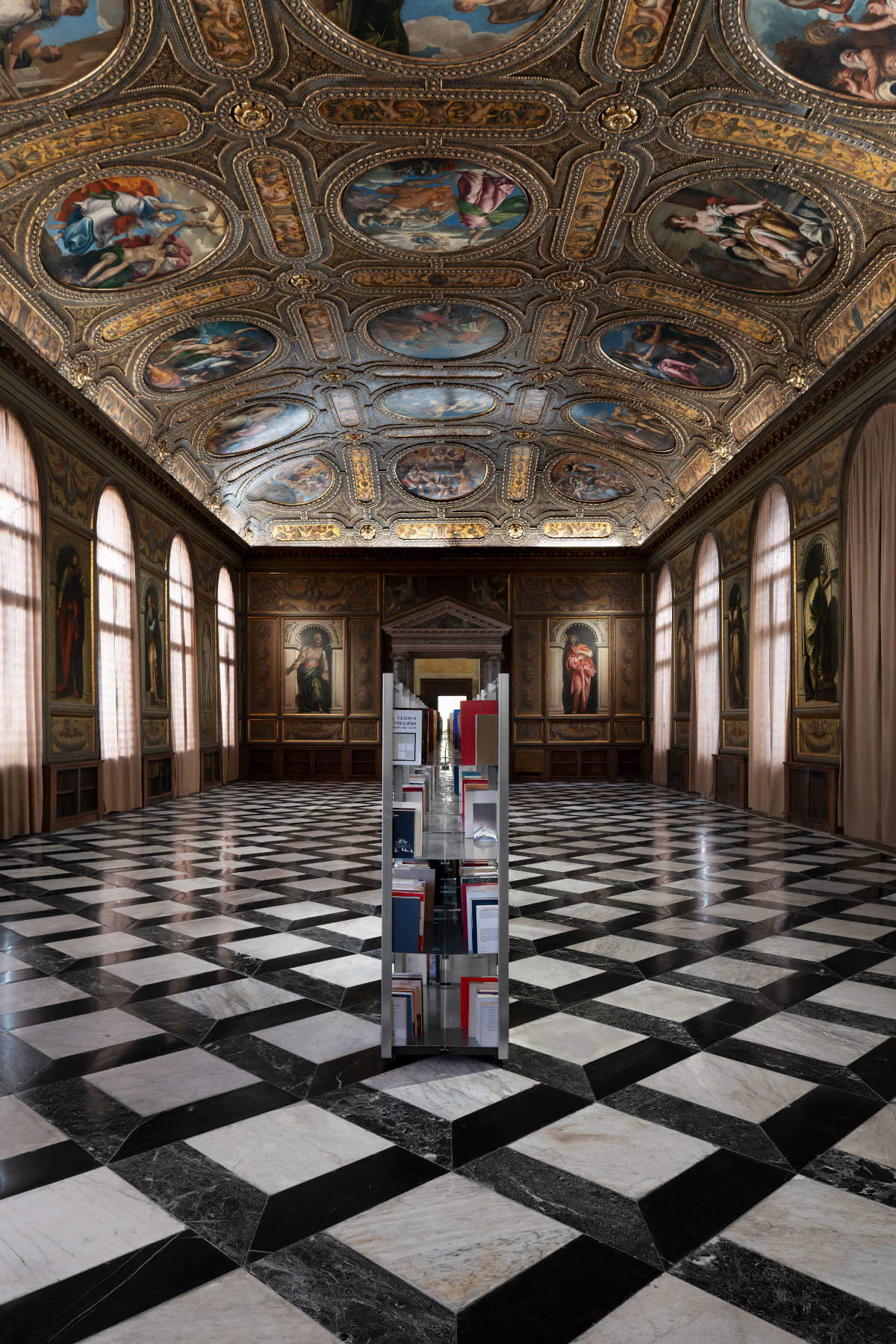
In the Salone Sansovino, Lara Favaretto (Treviso, 1973) instead presents Momentary Monument - The Library, the final chapter of a project developed over time around the themes of memory, dispersion and the transmission of knowledge. The installation brings together volumes from university libraries, academies, archives and private collections, each modified through the random insertion of images from the artist’s personal archive.
The books preserve signs of use, annotations and traces of their material history, becoming not only containers of knowledge but true documents of the circulation of knowledge. The public is invited to freely consult the volumes and even take them away, temporarily taking custody of them. In this way, the work gradually changes during the exhibition, transforming the emptying of the shelves into a form of active transmission.
Fondazione Bvlgari’s Venetian project is part of a larger program of support for Italian and international contemporary art. Monia Ben Hamouda had been awarded as part of the recognition promoted by the Maison in collaboration with MAXXI - Museo nazionale delle arti del XXI secolo, while Lara Favaretto had been awarded the Premio per la Giovane Arte Italiana 2004-2005 and participated several times in the Venice Biennale.
The Foundation’s presence extends beyond Venice. In fact, Ya’aburnee (Untranslated Fragment I and II), a new work by Monia Ben Hamouda set up in the garden of the Bvlgari Hotel Milano for the duration of the Biennale Arte 2026, is presented in Milan. Made of Tunisian thela stone, the work reflects on the possibility of constructing a language resistant to translation and semantic closure. The title comes from the Arabic-Lebanese expression “ya’aburnee,” which can be translated as “you bury me,” a formula that interweaves love, death and affective continuity.
The Venetian initiative thus confirms Bvlgari’s dual cultural orientation: on the one hand, the protection of historical and artistic heritage, and on the other, support for contemporary experimentation. Over the years, the Maison has been involved in numerous restoration projects, from the recovery of the Golden Staircase of the Doge’s Palace to Paolo Veronese’s paintings from the church of San Pietro Martire in Murano, to the major Roman projects dedicated to the Spanish Steps of Trinità dei Monti, the Baths of Caracalla and the Torlonia Collection.
On the contemporary side, the Maison has developed international collaborations such as the MAXXI BVLGARI Prize and the partnership with the Whitney Biennial launched in 2024. The agreement with the Venice Biennale now represents the most advanced point of this cultural strategy, which through Fondazione Bvlgari aims to combine patronage, education, support for the arts and heritage enhancement in a long-term perspective.
|
| Bvlgari debuts at the Biennale with Lotus L. Kang, Lara Favaretto and Monia Ben Hamouda |
Warning: the translation into English of the original Italian article was created using automatic tools. We undertake to review all articles, but we do not guarantee the total absence of inaccuracies in the translation due to the program. You can find the original by clicking on the ITA button. If you find any mistake,please contact us.