





Galleria Giovanni Bonelli in Milan, welcomes the first solo exhibition in Italy of Chinese artist Liu Ke (Ning Xiang, 1976). The exhibition, titled Ecce Homo and curated by Fabio Cavallucci, opens from March 5 to April 11, 2026, and presents a selection of recent pictorial works, made between 2022 and 2025, to offer an articulate and mature look at a now fully consolidated research. A lecturer and Deputy Director of the School of Painting at the Guangzhou Academy of Fine Arts, Liu Ke is a widely recognized figure in China andEast Asia. He is part of the patrol of artists represented by the Whitestone Gallery in Hong Kong and in recent years has embarked on a path of progressive presentation within the European art system, with exhibitions already held at Kunsthalle Kempten and Munich. Ecce Homo thus represents a significant stage in this process of cultural and symbolic crossing, marking a moment of direct confrontation with the Italian public.
The title of the exhibition, read from an Eastern perspective, dilutes and transforms the Gospel reference to the Christ presented by Pilate. In this declension, the man evoked is not only a religious or symbolic figure, but Liu Ke himself, who metaphorically offers himself naked, armed only with his own works, to a world still partly unknown. Ecce Homo is also a broader reminder of the human being as such, of the men and women who inhabit his canvases and who hide behind only seemingly abstract geometries.
At first glance, the works in the exhibition seem aniconic, dominated by intense color fields, bright reds, emerald greens, ultramarine blues saturating the surface. Looking more closely, however, one discovers that those surfaces are actually impressions of landscapes, vespertine lights, sunrises with suns emerging behind mountains, seas and skies condensing into visual syntheses. As the curves become more intricate and twisted, allusions to bodies and figures engaged in the sexual act emerge. Synthetic signs and color condensations do not directly reveal the image, but distill its perception, activating a mental and sensitive space in the viewer’s gaze.
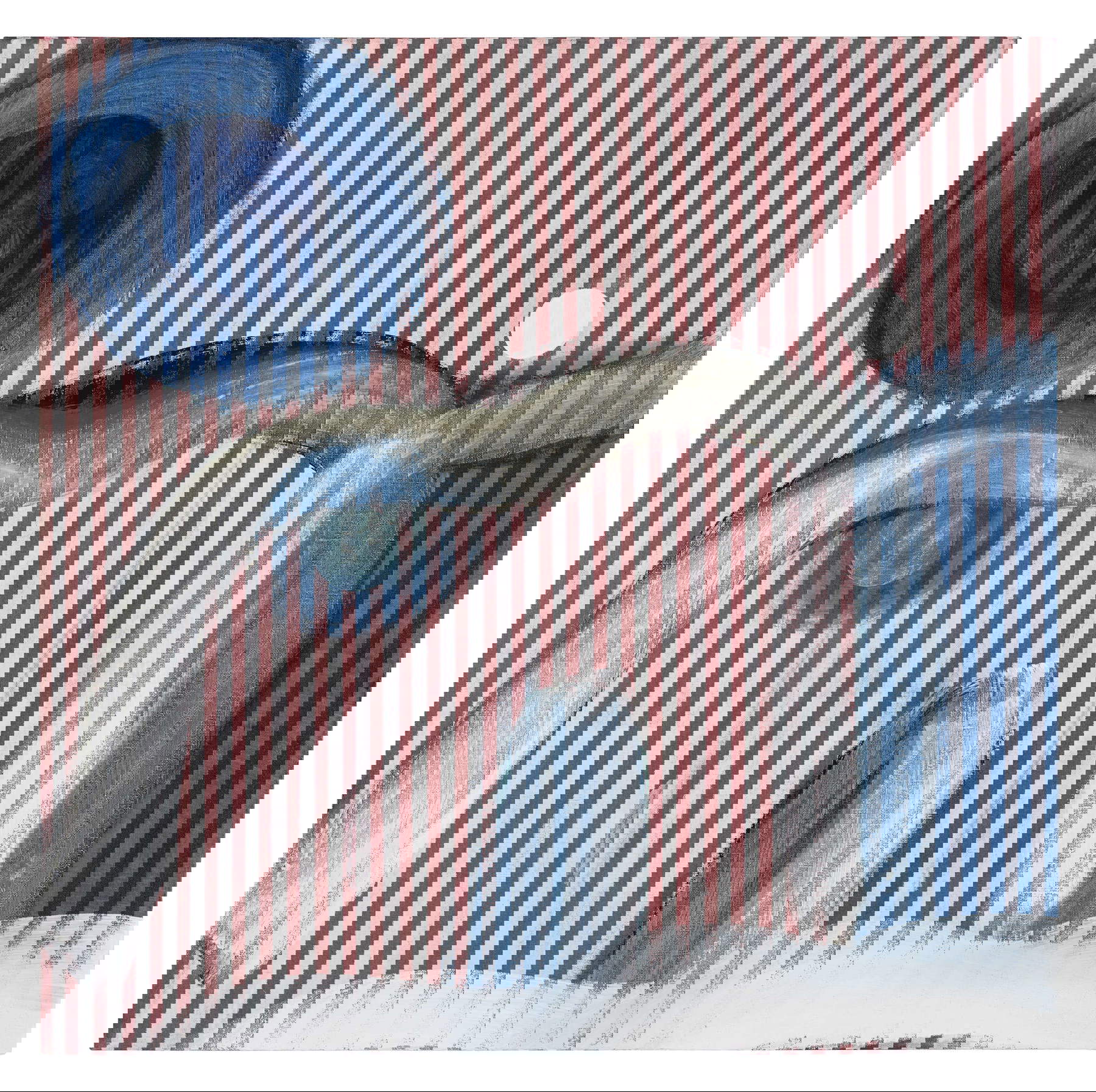
Abstraction, in Liu Ke’s painting, is not an escape from reality, but a process of perceptual synthesis and intensification of visual experience. His is a painting that constantly moves between thought and sensation, image and concept, in a balance that also reflects his role as a teacher and intellectual within the Chinese academic context. The artist’s solid philosophical training translates into a practice that never separates the pictorial gesture from theoretical reflection, but weaves them into a single path.
The Milan exhibition is also an opportunity for a high-profile meeting between the Guangzhou Academy of Fine Arts and young Italian artists who are students at the Brera Academy. Liu Ke brings to Milan a selection of very young artists from Guangzhou, Chen Jiachen, Gong Xuyao, Huang Zile, Lao Jiahhui, Yang Yifan and Yang Xinyu, while on the Italian side, Matteo Bianchi, Tommaso Frattini, Elisa Pini, Mattia Riccardo and Matteo Roversi, who attend the Milanese academy, have been selected. The dialogue between the two academic institutions is part of a cultural exchange that goes beyond the exhibition dimension, configuring itself as a platform for comparison between different generations and contexts.
In the gallery’s studio space, Liu Ke also presents the history of the exhibition spaces he founded and directed. In addition to being an artist and lecturer, in fact, he has been pursuing a significant curatorial activity for some time. Sabaku was the first space opened in the ancient city of Guangzhou, initiating an autonomous reflection on institutional models, emerging art production and the role of art in contemporary society. It was followed by the Boxes Museum, at the center of Shunfeng Mountain Park, and finally, just over a year ago, the Songshan Lake Boxes Museum.
The project to expand and reinvent art spaces does not end there. Liu Ke is carrying out an extensive renovation in his native area in Ning Xiang, Hunan Province, transforming a former coal mine into a new center dedicated to artistic production and reflection. An intervention that interweaves territorial recovery and cultural planning, inscribing itself in a vision of art as an engine of regeneration and a critical device.
In this interweaving of painting practice, theoretical research and institutional construction, Ecce Homo restores the complex portrait of an artist who conceives art not only as an image, but as an active form of thought and intervention in public space. Born in 1976 in Ningxiang, Hunan Province, Liu Ke lives and works between Guangzhou and Ningxiang. He is a professor at the Guangzhou Academy of Fine Arts, Vice Dean of the School of Painting and Director of the Department of Oil Painting; he is also Deputy Director of the Mixed Technique Painting Committee of the Association of Chinese Artists and serves as Executive Director of Songshan Lake Art Museum and Boxes Art Museum.
|
| Ecce Homo, first Italian solo exhibition of Chinese artist Liu Ke at Galleria Giovanni Bonelli in Milan |

Warning: the translation into English of the original Italian article was created using automatic tools. We undertake to review all articles, but we do not guarantee the total absence of inaccuracies in the translation due to the program. You can find the original by clicking on the ITA button. If you find any mistake,please contact us.



















 IT
IT FR
FR DE
DE ES
ES CN
CN


