



by Redazione 07/03/2026



Categories: Exhibitions / Disclaimer
About twenty sculptures by Leandro Erlich, including some previously unseen, will be exhibited in the historic Negozio Olivetti in Venice from May 9 to Nov. 22, 2026 as part of the Biennale Arte. The project, curated by Marcello Dantas, investigates hybrid forms between nature, architecture and the body.
On the occasion of the 61st International Art Exhibition - La Biennale di Venezia, theAssociazione Arte Continua presents the exhibition Hybrids. Leandro Erlich at the Negozio Olivetti, curated by Marcello Dantas and included among the collateral events of the event. The exhibition project will be hosted in the historic Negozio Olivetti in St. Mark’s Square, a space designed by Carlo Scarpa and considered one of the most important examples of 20th-century Venetian commercial architecture. The exhibition will be open to the public from May 9 to November 22, 2026.
The exhibition, produced in collaboration with FAI - Fondo per l’Ambiente Italiano ETS and with the support of Galleria Continua, brings together about twenty sculptures by Leandro Erlich, some of them previously unseen. The project presents a series of hybrid organisms that combine elements belonging to different worlds: butterflies with wings that take the shape of ears, cabbages transformed into architecture, corals that recall urban morphologies or trees that end in human feet. The works relate natural and artificial forms, suggesting a reflection on art as a process capable of producing new configurations of reality.


The initiative is part of the Arte all’Arte program, promoted by Associazione Arte Continua with the aim of developing connections between contemporary art, architecture and landscape. The exhibition project aims to propose a reflection on the role of artistic forms in the construction of the urban imaginary and the perception of shared spaces. The intervention in the Negozio Olivetti also aims to establish a direct dialogue with the architecture designed by Carlo Scarpa, a space that since its origin has welcomed works of art as an integral part of its identity.
The presence of art in the Olivetti Store also relates to the cultural vision of the company founded by Adriano Olivetti, which throughout the 20th century promoted a close relationship between industrial production, aesthetic design and cultural responsibility. This approach finds a point of contact with the enhancement project carried out by FAI, which is committed to the protection and preservation of the space.
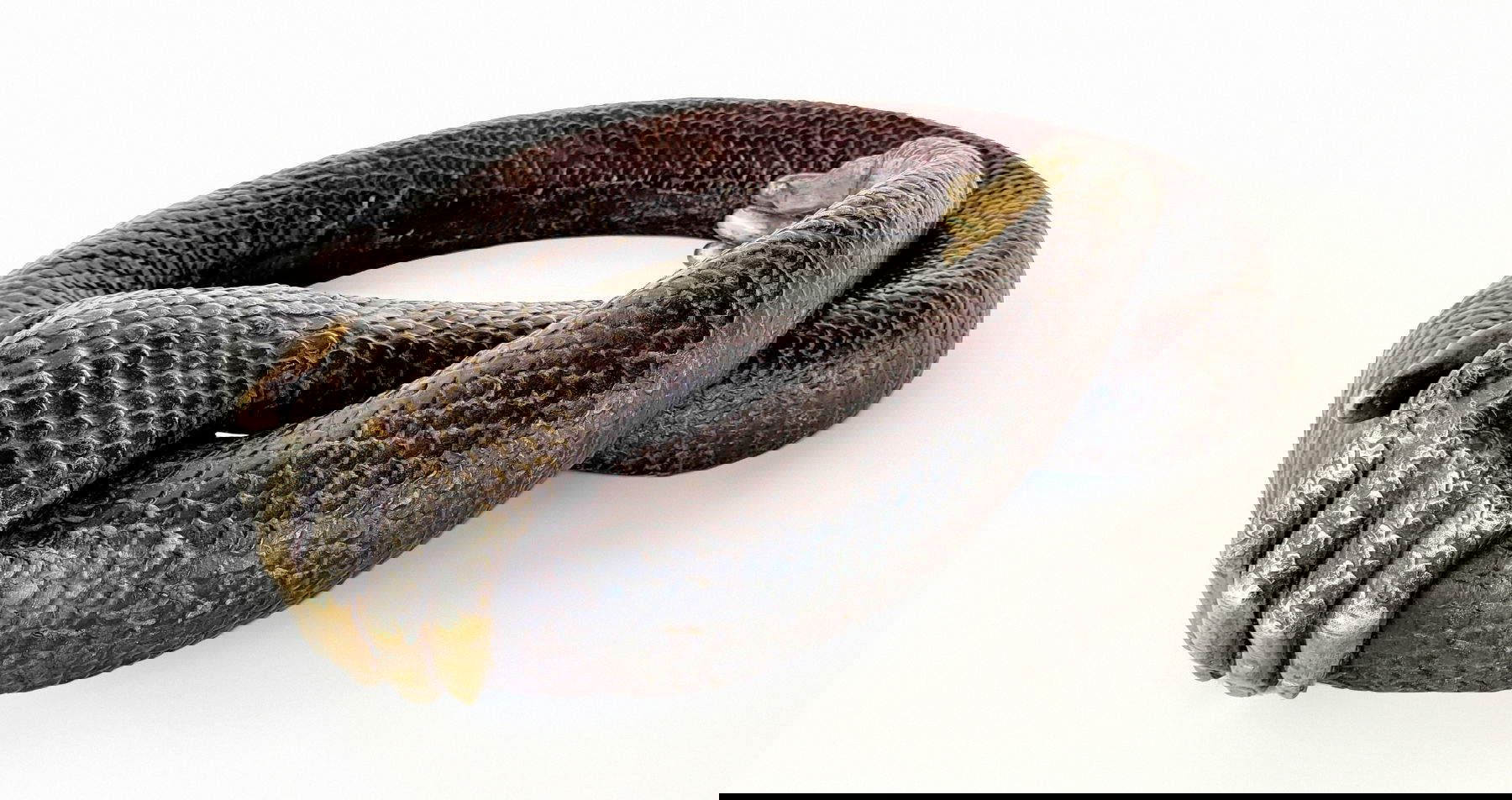
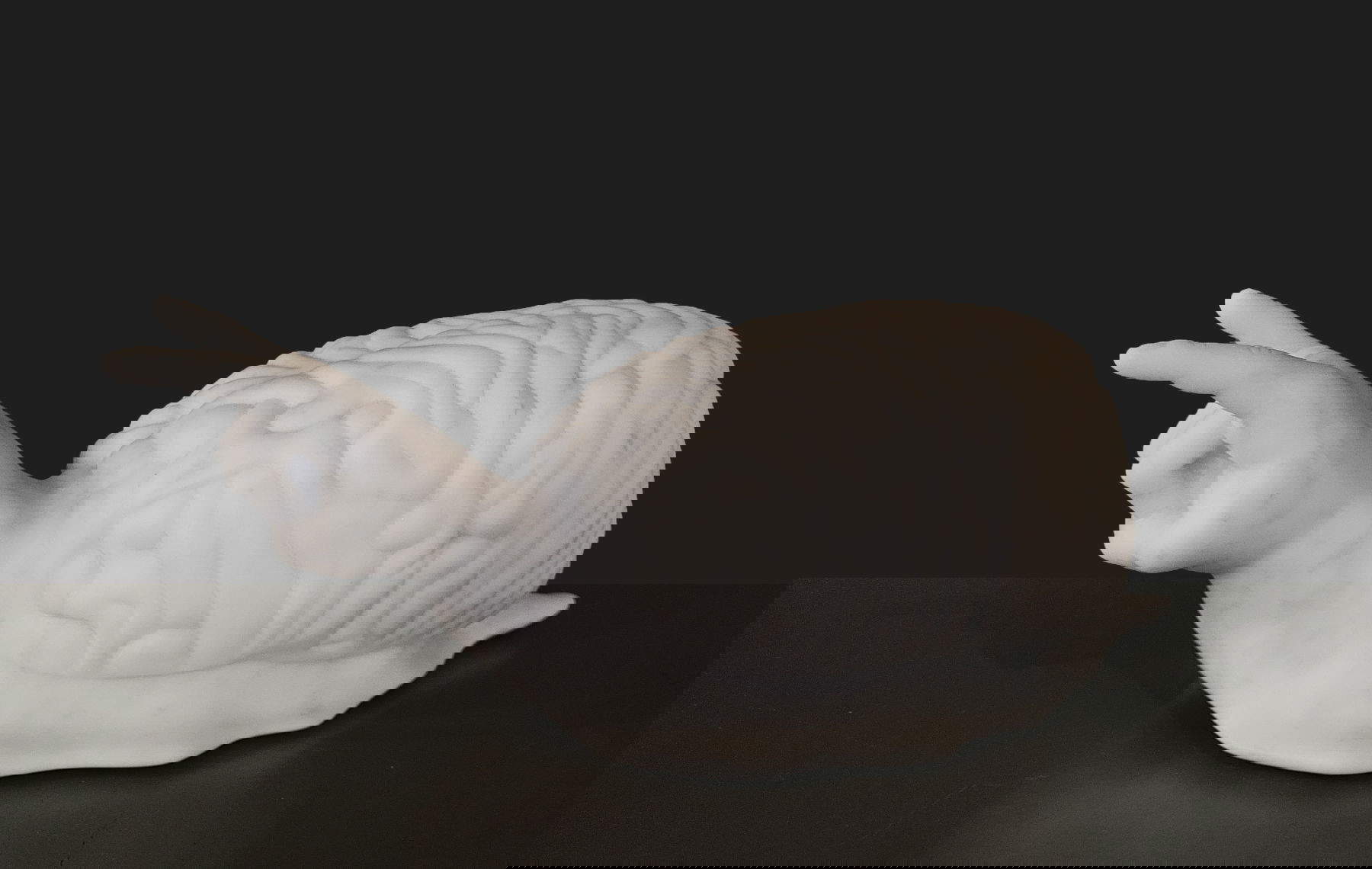
Among the works exhibited on the ground floor appears Papillon (2021), a bronze sculpture depicting a butterfly whose wings take the shape of ears. The image introduces a reflection on communication understood as a biological before technological phenomenon. In Caracol - The pace of evolution (2021), sculpted in white Carrara marble, a brain is transformed into the shape of a snail. The work invokes the idea of slow, layered evolution, far from a linear model of development. The sculpture Chou (2023), made of ceramic, combines a plant element with an architectural structure, relating agriculture, nature and living space. White Coral (2025), made of resin, on the other hand, establishes a parallelism between the growth of coral structures and the morphology of metropolises, juxtaposing geological processes and urban construction. A further example of formal transformation appears in Serpent (2021), a bronze work that introduces a plastic twist associated with the theme of metamorphosis.
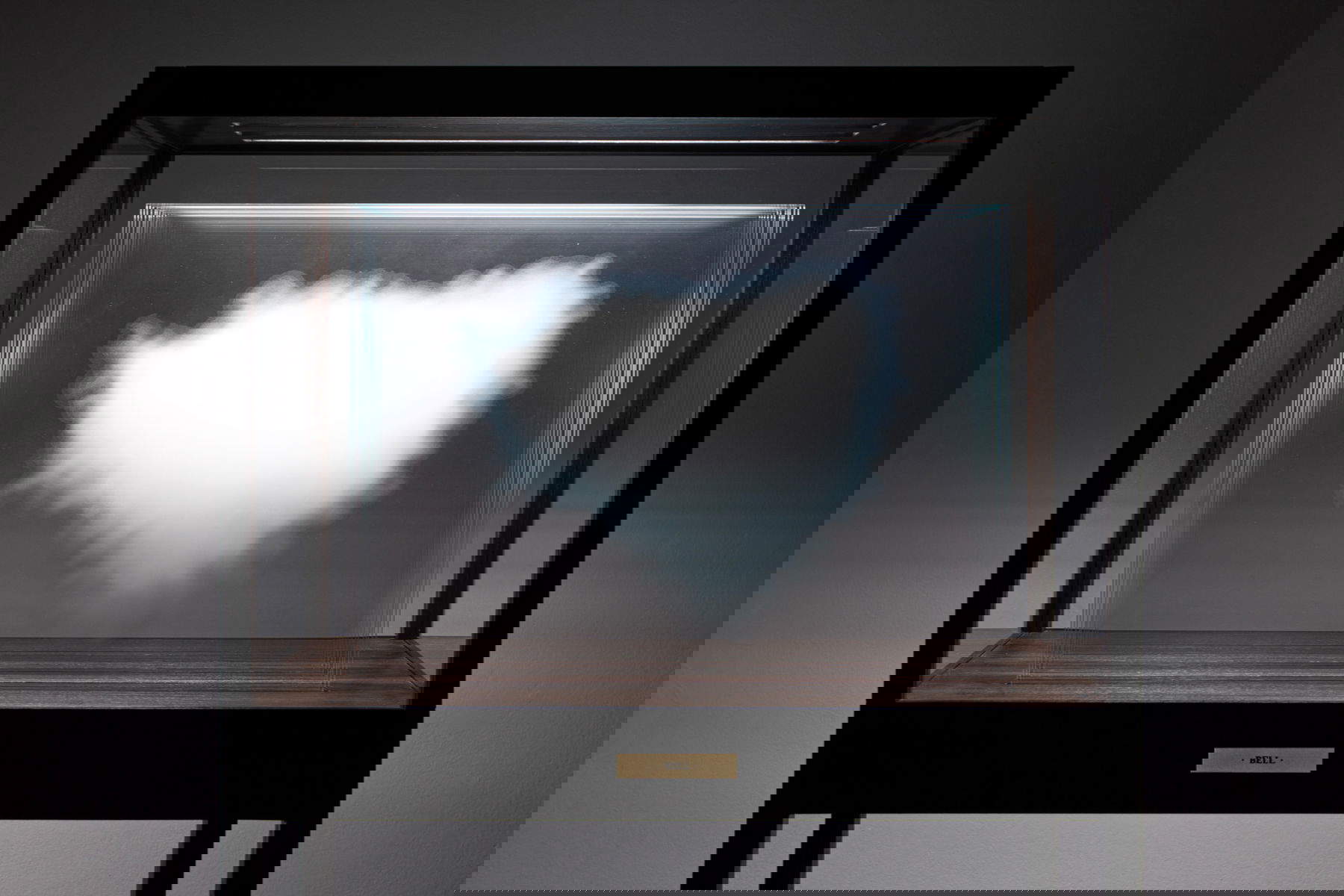
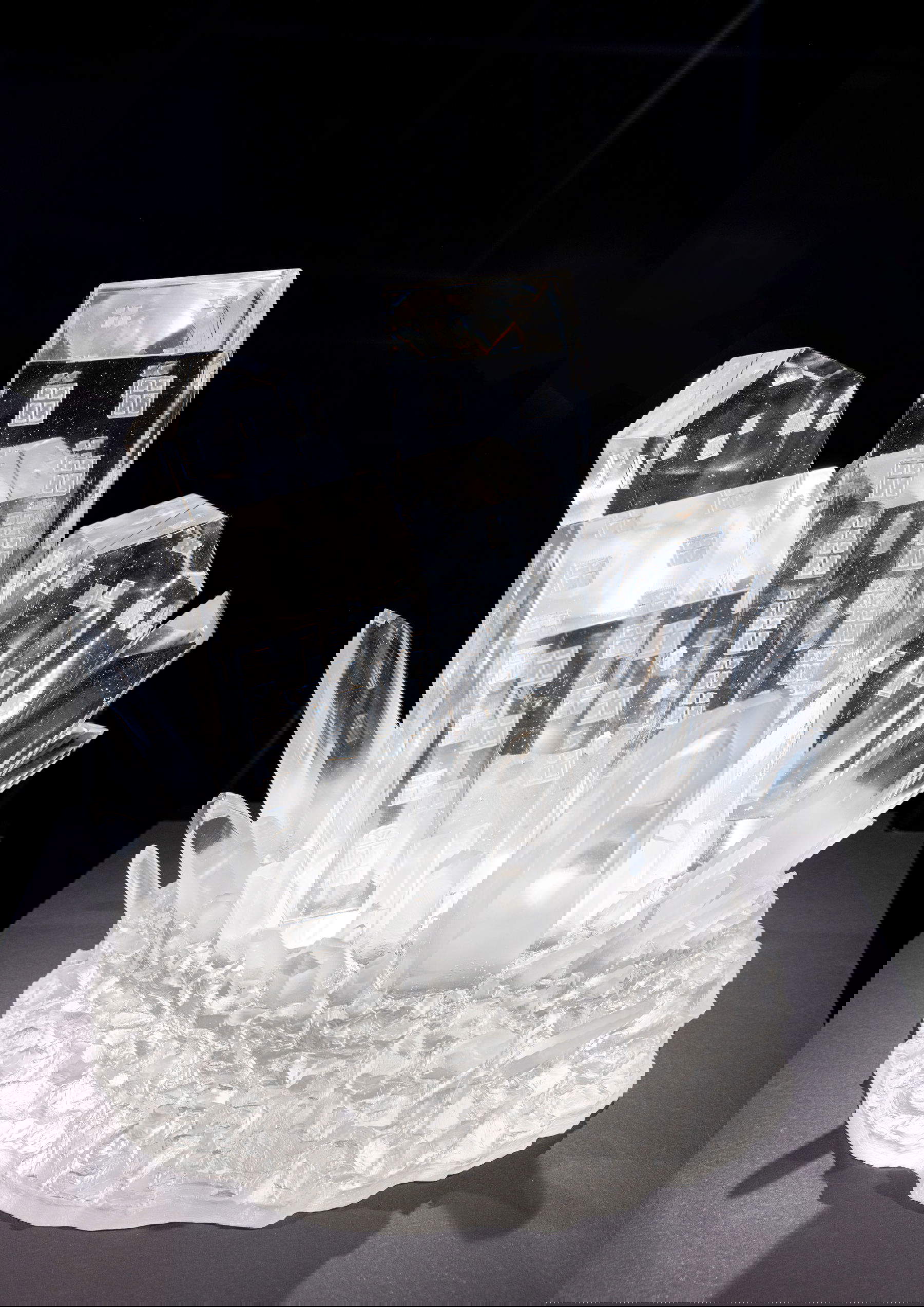
Other sculptures address the mineral and temporal dimensions of matter. In Quartz (2023), made of glass, crystalline growth becomes a form of natural architecture. Pies Tronco (2021), on the other hand, presents a tree trunk that ends in human stockinged feet, generating an unexpected encounter between plant organism and anthropomorphic presence. In Draft - Draft (2026), composed of resin and sand, the artist focuses attention on the intermediate stage between idea and realization, highlighting the process dimension of sculpture. The exhibition continues with works that expand the investigation of the relationship between nature and artifice. The Cloud - Bell (2024), made of extra-clear glass with digital printing on ceramic and a wenge wood case, transforms the image of the cloud into an exhibition object with an architectural dimension. Concrete Coral (2025) relates industrial material and organic form, while Maison Fond (2022), carved from Carrara marble, suggests the image of architecture that melts or transforms, questioning the idea of stability in living.
The work Pulled by the Roots (2015) introduces the theme of uprooting, understood in both a physical and conceptual sense. With Pixel Tree (2026), a bronze sculpture, the figure of the tree fragments into pixel-like units, evoking the intersection of nature and digital language. Carte (2026), made of steel, resin, and light, on the other hand, introduces a cartographic and luminous dimension that suggests an unstable and transformable geography. The project also includes Above All (2020), a large textile work in wool that extends the artist’s research to the dimension of surface and texture. Complementing the exhibition is a selection of photographs that further explore the theme of hybridizations between space, perception and the construction of reality.
Emanuele Coccia’s text, included in the project, emphasizes how art can intervene in the essence of things through the combination of different identities, allowing forms to inhabit one within the other. Erlich’s works outline a continuously adapting system in which nature, architecture, body and culture enter into relationship through processes of formal transformation.
Notes on the artist
Leandro Erlich, born in Argentina in 1973, lives and works between Paris, Buenos Aires and Montevideo. Over the past two decades he has exhibited internationally and his works have entered the permanent collections of numerous museum institutions and private collections, including the Museo de Arte Moderno de Buenos Aires, the Museum of Fine Arts in Houston, the Tate Modern in London, the Musée National d’Art Moderne - Centre Georges Pompidou in Paris, the 21st Century Museum of Contemporary Art in Kanazawa (Japan), MACRO in Rome, and the Israel Museum.
Throughout his career he has also made numerous public interventions. These include La Democracia del Símbolo at the Obelisco in Buenos Aires and at MALBA, Maison Fond presented during the United Nations Climate Change Conference in Paris, Bâtiment for the Parisian Nuit Blanche, Ball Game on the occasion of the Youth Olympic Games in Buenos Aires, Port of Reflections exhibited at the MMCA in Seoul, and Palimpsest for the Echigo-Tsumari Art Triennale in Japan. His monumental installation La Carte, À l’ombre de la ville is now a permanent part of the urban landscape of Bordeaux.
In recent years, the artist has had solo exhibitions at several international institutions, including the Mori Art Museum in Tokyo, Palazzo Reale in Milan, Kunstmuseum Wolfsburg, CAFA Art Museum in Beijing, MALBA in Buenos Aires, CCBB in various cities in Brazil, and Pérez Art Museum Miami. More recently he has also participated in group exhibitions at Centre Pompidou-Metz, Forest Festival of the Arts in Okayama, Ennova Art Museum and Nanhai Art Center in China. His conceptual work questions the mechanisms through which perception of reality is constructed and uses visual language to raise questions. His works also seek to reduce the distance between exhibition space and everyday experience, inviting the audience to take part in the construction of meaning.
|
| Leandro Erlich at the historic Negozio Olivetti in Venice: twenty sculptures on display, some previously unseen |
Warning: the translation into English of the original Italian article was created using automatic tools. We undertake to review all articles, but we do not guarantee the total absence of inaccuracies in the translation due to the program. You can find the original by clicking on the ITA button. If you find any mistake,please contact us.