





On the occasion of the Biennale Arte 2026 and his first solo exhibition in the city, the Palazzo Cini Gallery in Venice is hosting an exhibition dedicated to David Salle, in which the New York-based artist explores the use of artificial intelligence as a tool to analyze and redefine the mechanisms of painting. The exhibition David Salle. Painting in the Present Tense, curated by Luca Massimo Barbero, director of the Giorgio Cini Foundation’s Institute of Art History, and on view from May 5 to Sept. 27, 2026, is supported by Thaddaeus Ropac Gallery.
To develop the project, Salle trained an artificial intelligence model using as a basis his Tapestry Paintings (1989-1991), a series of works inspired by 18th-century Russian imperial tapestries that, in turn, reinterpreted 16th- and 17th-century Italian paintings. This process gave rise to new pictorial works in which different time, languages and places overlapped and merged. Despite his strong ties to the tradition of painting on canvas, the artist has integrated digital technologies into his practice. The collaboration with AI is also a form of critical response to the idea that machines can replace human creativity. As the artist himself states, “One way to subvert a hegemonic technology is to co-opt it for one’s own ends.”
Since 2022 Salle has been actively experimenting with image generation through artificial intelligence, developing a custom model trained primarily on the materials of his own work. The intent is not to delegate the creative role to the machine, but to introduce an element of discontinuity capable of challenging his own artistic modes. “It’s a way out of myself,” he explains. AI does not directly produce drawings or paintings: rather it breaks down and alters the structure of compositional space, recombining its elements into new configurations. The result is a series of works that address a central question of our time: what part of human expression will survive the emergence of increasingly autonomous artificial intelligence?
The original Tapestry Paintings reflected a fundamental feature of Salle’s poetics: the simultaneity of images. Sixteenth- and seventeenth-century Italian paintings, with subjects ranging from biblical scenes to court portraits, still lifes and genre depictions, had been transformed into tapestries by Russian weavers through complex wool and silk workings. Salle brought these textile compositions back into the language of canvas painting, creating layered and lyrical images typical of his output. In many works he also introduced separate panels inserted into the surface of the canvas, designed to interrupt the compositional structure and generate contrasts of rhythm and meaning. All visual elements (the tapestry-inspired background, the overlapping painting and the additional images) must be perceived together in their simultaneous presence.
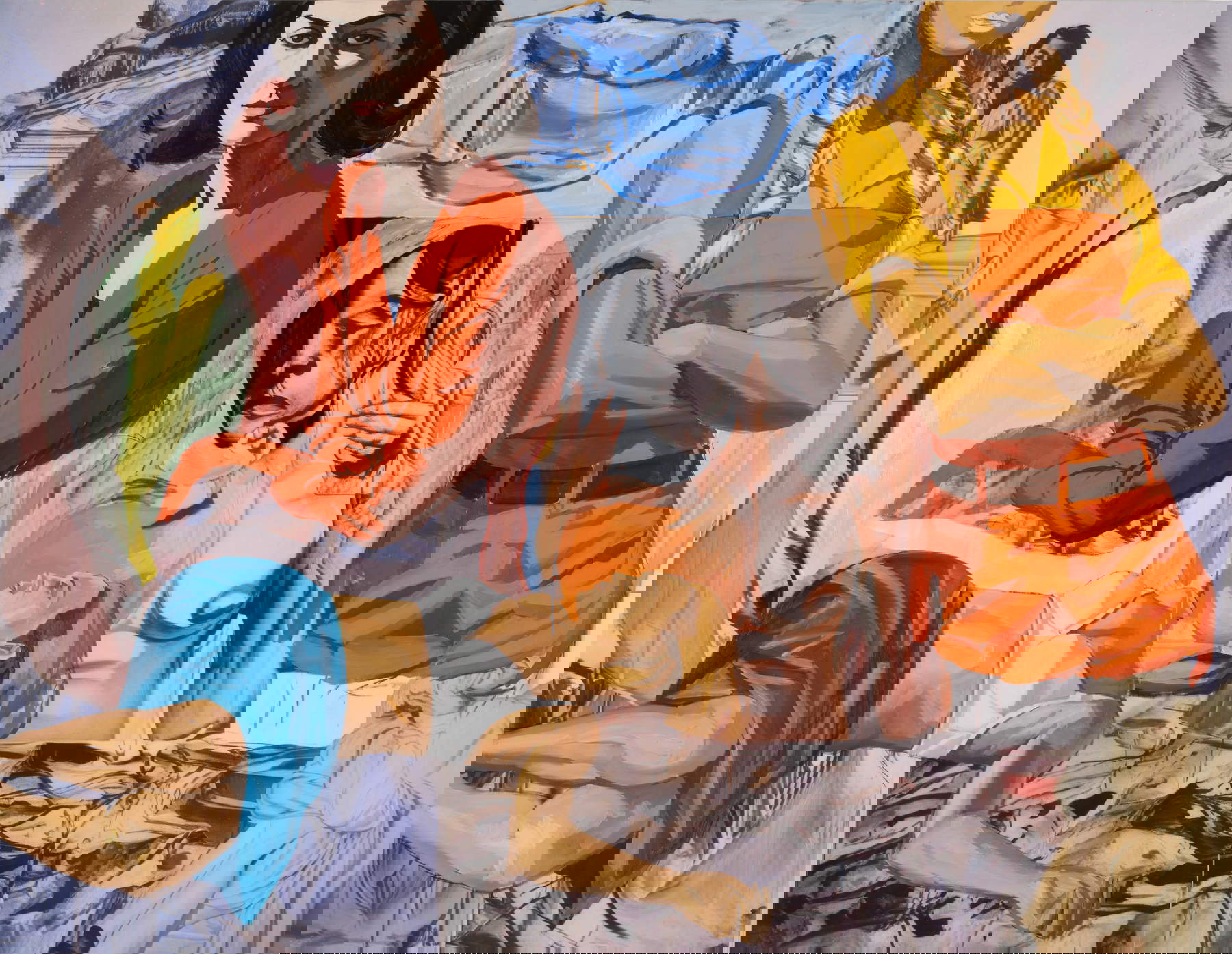
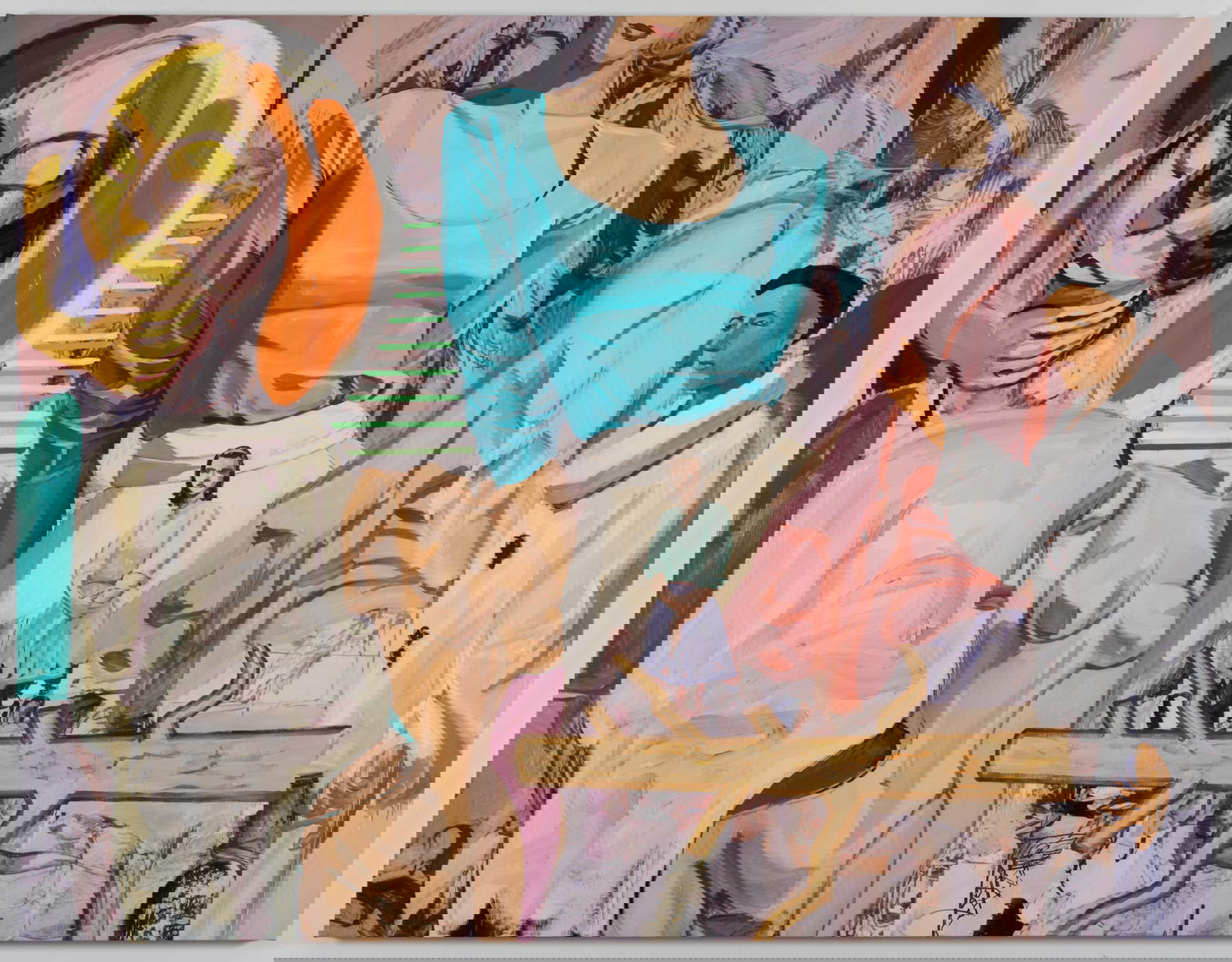
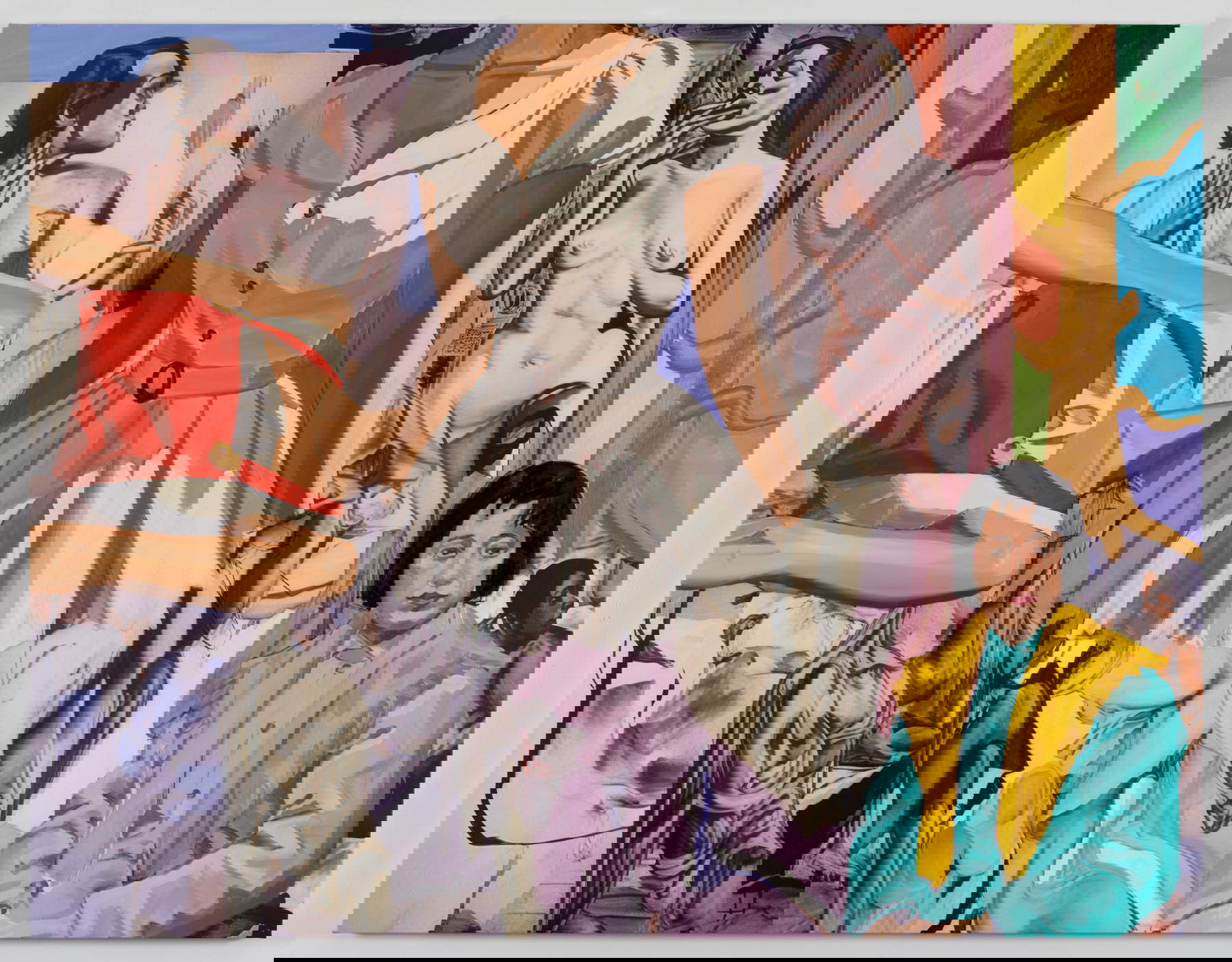
In the Palazzo Cini exhibition in Venice, this process of transformation is further expanded. Passing through the IA model developed by Salle, the figures and scenes, already reinterpreted several times from their original Italian models, are deformed until they become dynamic and diffuse abstractions. While radically changed, they retain recognizable traces of both the artist’s original paintings and the historical heritage from which they are derived. The images generated are printed on canvas and form the basis on which Salle intervenes pictorially. The artist reacts intuitively: he corrects, emphasizes or alters the pixels printed with the brush and adds additional painted elements, characterized by intense colors and marked contrasts. In this way, a technique as old as oil painting coexists with contemporary digital technology.
Courtesans, nudes, kings and knights in armor transformed by artificial intelligence distortions appear in the final result, confronting on the pictorial surface fragments of fashion advertisements, stacks of teacups and other typical still life objects. Painted reality and simulated reality intertwine, generating fluid compositions that elude any precise location in time or space.
While artificial intelligence is capable of analyzing and synthesizing enormous quantities of images (a process similar to what Salle has practiced in painting throughout his career) initially the machine did not possess an understanding of the basic principles of painting, such as contours, margins, or tonal relationships. The artist then provided the AI with digital equivalents of these values, explaining to it, for example, how a brushstroke can simultaneously define an edge and act as an autonomous expressive element. In this way the machine takes on the role of a “junior” creative partner, capable of reworking the artist’s work by moving freely between past and present, real and imaginary, with sometimes surprising, alienating or even provocative results.
In these works centuries of art history seem to chase each other as artificial intelligence enters the circular logic of Salle’s painting. Mimesis, which underlies both AI and painting practice, is taken to its limits as a creative force. The artist describes this process as a form of “ventriloquism”: an inquiry into how far imitation can go before the relationship between reality and representation dissolves into paradox or nonsense.
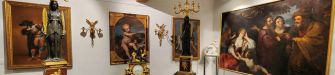
The context of Palazzo Cini adds another layer of meaning to this journey. The lower rooms of the palace hold Italian Renaissance paintings and decorative art objects, including tapestries dating back to the 15th century, while the upper floors are devoted to contemporary art. This dialogue between different eras reflects and amplifies the historical and layered approach of Salle’s works, creating a kind of mise en abyme, a continuous cross-reference between past and present.
The collaboration with artificial intelligence becomes a challenge: to reclaim creative control and, as the artist puts it, “wrest meaning from the direction in which artificial intelligence is leading it, bringing it back into human hands.”
|
| Palazzo Cini hosts David Salle's first Venetian solo exhibition: explores the use of AI in painting |

Warning: the translation into English of the original Italian article was created using automatic tools. We undertake to review all articles, but we do not guarantee the total absence of inaccuracies in the translation due to the program. You can find the original by clicking on the ITA button. If you find any mistake,please contact us.


























 IT
IT FR
FR DE
DE ES
ES CN
CN


