



by Redazione 26/03/2026



Categories: Exhibitions / Disclaimer
From March 28 to May 2, 2026, the Cardelli & Fontana artecontemporanea gallery in Sarzana will host Luca Lupi's fourth solo exhibition. On display is a selection of recent photographic works from the Untitled project, an investigation into the relationship between image, time and perception, accompanied by a critical text by Davide Daninos.
Cardelli & Fontana arte contemporanea gallery in Sarzana presents Luca Lupi ’s (Fucecchio, 1970) fourth solo exhibition, Fotografia, scheduled from March 28 to May 2, 2026. The exhibition opens Saturday, March 28 at 6 p.m. and features a selection of recent photographic works belonging to the Untitled project, a research that investigates the relationship between image, time and perception. The exhibition is accompanied by a critical text by Davide Daninos.
Central to Lupi’s research is a reflection on the duration of the photographic act. The images arise from very extended exposure times, during which the camera stands still and observes the movement of the sun and the sea for hours. In this process, the coastal landscape flows before the lens without any specific moment being privileged: the entire temporal development is recorded by the sensor, which accommodates the succession of events continuously. In fact, the images in the exhibition arise from a gesture as simple as it is unusual in its duration: the camera is fixed on a tripod and allowed to observe for long intervals of time, never less than twenty minutes and often extended up to two hours. During this time, the lens remains open, recording without interruption the movement of the Sun and the sea, without selecting a privileged moment, without establishing hierarchies between instants.


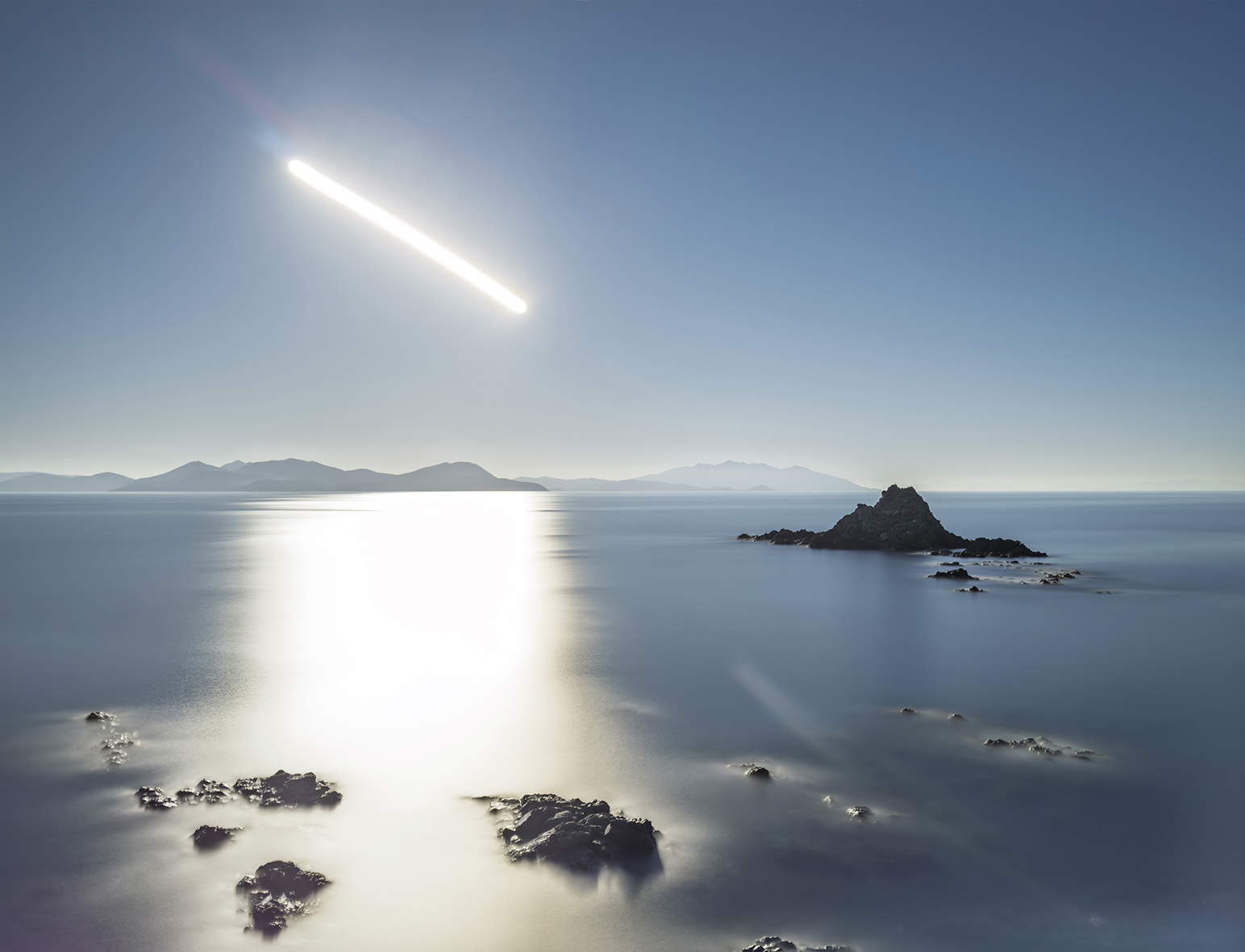
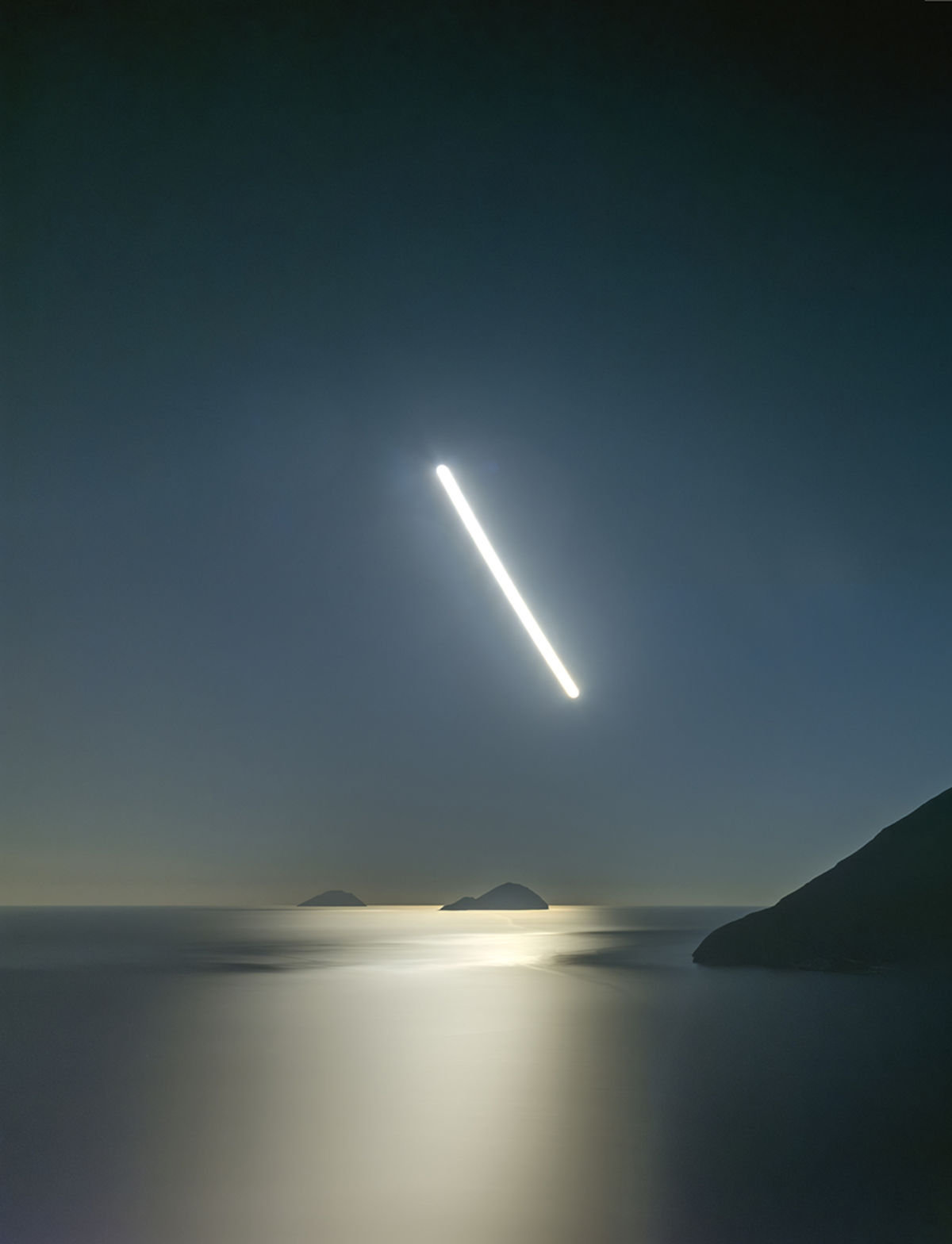
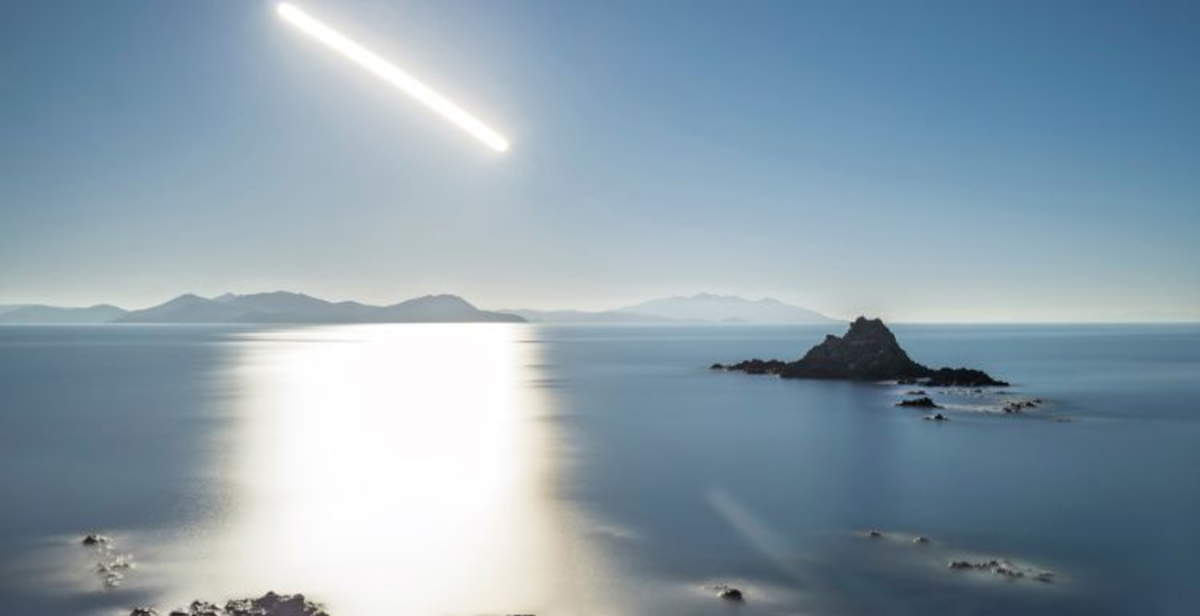
The result is a landscape that no longer coincides with the one perceived by the human eye. The sea, crossed by a continuous succession of waves, loses its definition to become a smooth surface, similar to a mirror of light. The Sun, instead of appearing as a precise point in the sky, becomes a luminous trajectory that etches the image, a kind of wound that crosses pure color fields, almost never disturbed by the presence of clouds, which are too fleeting to be clearly recorded by such a dilated gaze. These images do not document a place, but recompose it. They do not restore a portion of reality, but the duration of an experience. It is precisely in this temporal extension that lies the theoretical core of Lupi’s work, as highlighted by Davide Daninos’ critical text accompanying the exhibition. Photography, freed from the pressure of capturing the moment, becomes a space of meditation, a device capable of questioning itself and its own limits.


Daninos places this reflection in a broader historical perspective, going back to the origins of photography. The first photographic image of a water basin, made by Louis-Jacques-Mandé Daguerre between 1836 and 1839, already showed a similar tension: while the architectural elements turned out to be defined, the movement of the Seine eluded registration, dissolving into an opaque surface. The exposure time, between three and six minutes, was sufficient to erase the dynamism of the water and the human presence, returning a motionless, suspended city. In that first experiment, a paradox is manifested that runs through the entire history of photography: the ability to record the real coexists with the impossibility of capturing it in its entirety. It is precisely this limit that Lupi decides to explore, pushing the technique to a point where the camera no longer merely records, but seems almost to “imagine.”
Indeed, the prolonged use of exposure tests the sensor, subjecting it to continuous stress. Even with the help of filters and technical devices, the device enters a stress condition that can generate distortions, refractions, and chromatic alterations. These effects, far from being considered errors, become an integral part of the artist’s language. The images thus become populated with shading, smearing, and light interference that are more reminiscent of painting than photography. In this slippage, a broader question opens up concerning the supposed objectivity of the photographic medium. If each machine is defined by its technical characteristics-optics, sensors, processors-then each image is inevitably the result of mediation, interpretation. In Lupi’s work, this awareness becomes explicit: photography is no longer a neutral recording tool, but an active subject, capable of producing autonomous visions.
The artist’s research thus fits into a contemporary debate that questions the relationship between technology and perception. In an age dominated by speed and the incessant production of images, choosing to slow down means introducing a rupture, creating a critical space. It is in this space that is situated what Daninos calls a “contemplative photography,” in which the act of seeing is transformed into an experience of duration. The explicit theoretical reference is to the thought of philosopher Byung-Chul Han, who in his reflection on contemplation identifies inactivity as a necessary condition for the birth of the new. Stopping the gaze, suspending action, interrupting repetition: these are gestures that allow access to a different dimension, in which things can emerge in a new way.
The exhibition at Cardelli & Fontana thus offers an opportunity to confront an approach to photography that eschews the dominant logics. These are not immediate images, nor are they works that are exhausted in a quick fruition. They require time, attention, willingness to allow themselves to be traversed. In an increasingly saturated visual context, the choice to work on duration takes on a definite value. It is not just a technical matter, but a stance. Slowing down the gaze also means questioning the way we look, and perhaps restoring to photography a dimension that seemed lost: that of contemplation.
Luca Lupi, born in Pontedera in 1970, lives and works in Fucecchio, in the province of Florence. The exhibition can be visited in the spaces of Cardelli & Fontana artecontemporanea from Monday to Saturday with hours 10 a.m.-12:30 p.m. and 5-7:30 p.m. During the opening weekend, Saturday, March 28 and Sunday, March 29, it will be open from 10:30 a.m. to 12:30 p.m. and 4:30 p.m. to 8 p.m.
 |
| Sarzana, from Cardelli & Fontana the new solo exhibition of Luca Lupi dedicated to the project Untitled |
Warning: the translation into English of the original Italian article was created using automatic tools. We undertake to review all articles, but we do not guarantee the total absence of inaccuracies in the translation due to the program. You can find the original by clicking on the ITA button. If you find any mistake,please contact us.