





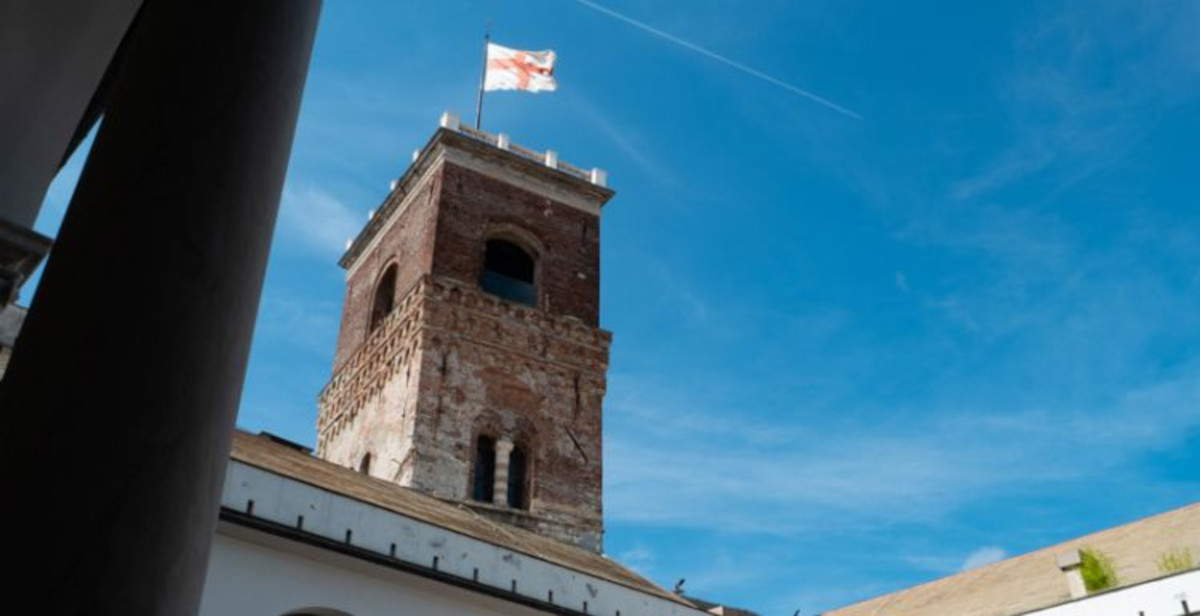
As of April 18, 2026, the Grimaldina Tower of the Doge ’s Palace will be accessible to the public again after a restoration and enhancement project that lasted more than a year. The opening marks the return to the city of one of the most recognizable landmarks of the Genoese monumental complex in the historic center. The reopening is part of the Palazzo Ducale project . Making a Palace Accessible to Make a City Accessible, developed under the National Recovery and Resilience Plan funds earmarked for non-state museums.
The project, presented in 2022 by the then Board of Directors of Palazzo Ducale Fondazione per la Cultura, was funded through the Public Notice for the Removal of Physical, Cognitive and Sensory Barriers in Museums and Places of Culture not belonging to the Ministry of Culture. The intervention falls under PNRR’s Mission 1 on digitization, innovation, competitiveness and culture, Component 3 “Culture 4.0,” Investment 1.2, and is supported by European Union funds under the NextGenerationEU program. The official presentation of the project was scheduled for April 17, 2026 at 11:30 a.m. in the Sala del Minor Consiglio of the Ducal Palace. On the occasion, the overall outcomes of the intervention plan were presented, which not only involved the Grimaldina Tower, but also a series of actions on ticketing, bookshop, public services and visitor tools, including digital ones, with the renewal of the website and signage.
The stated goal of the project is to systematically address the issue of accessibility, understood in its broadest sense. Not only the elimination of architectural barriers, but also the overcoming of sensory, cognitive and cultural obstacles, through an integrated design involving spaces, tools and modes of use. According to data reported in the annual report on the management of services for the public in state-owned cultural venues by MiBACT’s General Directorate of Museums, accessibility is one of the main critical issues in the Italian museum system. ISTAT data for 2019 also confirm a still partial picture: only 53 percent of museums, monuments and archaeological areas would have carried out interventions to remove physical barriers, while just 12 percent would have fully addressed perceptual, cultural and cognitive barriers.
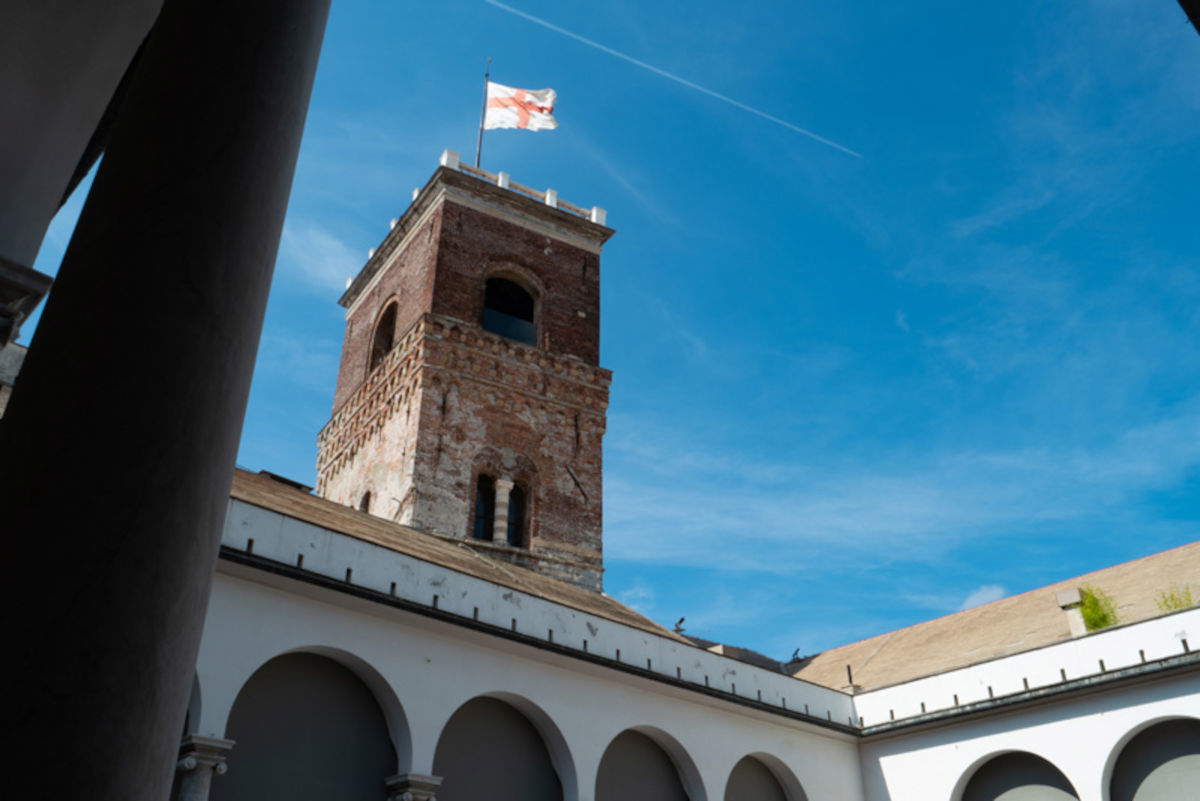
This is the context for the Ducal Palace plan, which is divided into several areas of intervention. On the front of accessibility from the outside, a new website conforming to international standards was developed, as well as a digital system for reservations and ticket purchases. On the level of vertical and horizontal routes, one of the main interventions concerned precisely the Grimaldina Tower, which until 2022 was only minimally visitable and with access limited to small groups. With the new project, the path was extended to the terrace. The intervention was carried out in collaboration with the University of Genoa.
Work was also carried out on the accessibility and access to the services, with the toilets being adapted to make them usable by people with reduced mobility or disabilities. On the museum tour side, a series of technological tools were introduced, including interactive three-dimensional maps designed to promote inclusion and interaction. A multisensory system has also been developed that allows for the integration of tactile components on certain portions of the 3D map, for dissemination purposes. In parallel, a digital application was designed to make information accessible to audiences with visual, hearing, language and motor disabilities. Further intervention involved interior signage, designed in an inclusive form with differentiated visual aids, and the installation of induction systems for the hearing impaired in the Palace’s conference rooms to improve sound perception by those using hearing aids.
All interventions were carried out respecting the historical structure of the building, with particular attention to the reversibility of the adopted solutions, so as to allow for possible future modifications without compromising the architectural integrity of the complex. The coordination of the works took place in accordance with the Superintendence of Archaeology, Fine Arts and Landscape. The project is part of the Ducal Palace’s strategy to make the entire complex progressively more accessible as a civic and cultural place. Accessibility is therefore interpreted as a structural process, with planning that includes monitoring, programming and coordination of future interventions.
Alongside the material and digital interventions, the project is also accompanied by a parallel cultural production. In fact, the podcast Grimaldina. A Tower to Discover, produced by Chora Media for Palazzo Ducale Fondazione per la Cultura. The podcast, written and narrated by Davide Savelli, with the participation of Antonio Musarra, Gaia Leandri and Franco Melis, is divided into four episodes and offers an account of the Grimaldina Tower through a narrative that interweaves urban history, architecture and events related to the tower’s prison function. Through an informative narrative structure, the podcast traces some passages of Genoese history, from the medieval city to the tower’s transformation into a place of detention, to the vicissitudes of the prisoners who passed through it over the centuries. The overall layout alternates historical elements, testimonies and reconstructions, with the aim of restoring the complexity of the monument within the city’s history.
“For months,” says architect Roberto Segattini, “the Tower was hidden behind scaffolding while it underwent careful conservation and restoration work, involving both the interior and exterior. The work required a delicate balance between protection and enjoyment. The insertion of a new internal metal staircase, which now allows visits up to the top, involved several design challenges: each solution was designed to ensure safety, functionality and accessibility without altering the Tower’s historical identity. Some small surprises also emerged during the restoration: cleaning operations have restored an unexpected legibility of surfaces and traces of the past, bringing to light details and signs that tell the long history of this place. Today the Tower is accessible again: small groups will be able to climb up to the terrace and enjoy an extraordinary view of the city and the Old Port. The result was made possible thanks to a great team effort involving the staff of the Foundation, the contracting station with the RUP, designers and construction management, the safety manager, the contractor with restorers and specialized workers, under the supervision of the Superintendence: a shared commitment in which everyone gave their best to offer new possibilities, with a view not only to properly preserve but also to properly enhance an important fragment of our cultural heritage.”
 |
| Grimaldina Tower in Genoa reopens after renovations PNRR on accessibility of Ducal Palace |

Warning: the translation into English of the original Italian article was created using automatic tools. We undertake to review all articles, but we do not guarantee the total absence of inaccuracies in the translation due to the program. You can find the original by clicking on the ITA button. If you find any mistake,please contact us.




















 IT
IT FR
FR DE
DE ES
ES CN
CN


