





A portion of the installation by Edoardo Tresoldi (Milan, 1987) being set up in St. Peter’s Square, in the center of Bari’s old city, collapsed on the morning of Dec. 4 due to the severe weather that hit the Apulian capital. The work, which is still being assembled, is designed as a reconstruction in wire mesh of the volumes of the church and convent once present in the area. The project is part of an intervention to enhance the site, a historically significant place characterized by a long archaeological stratification. According to initial reconstructions and as written by Repubblica, a section of the structure gave way under the pressure of wind and heavy rain. Municipal technicians, together with the site team, immediately intervened by cordoning off the area and starting safety operations to prevent further subsidence. No injuries were reported and damage was found to be confined to the collapsed portion. Currently, the Superintendency, together with the artist’s staff, is evaluating the timing and manner of the restoration to allow for the continuation of the work planned for the following months.
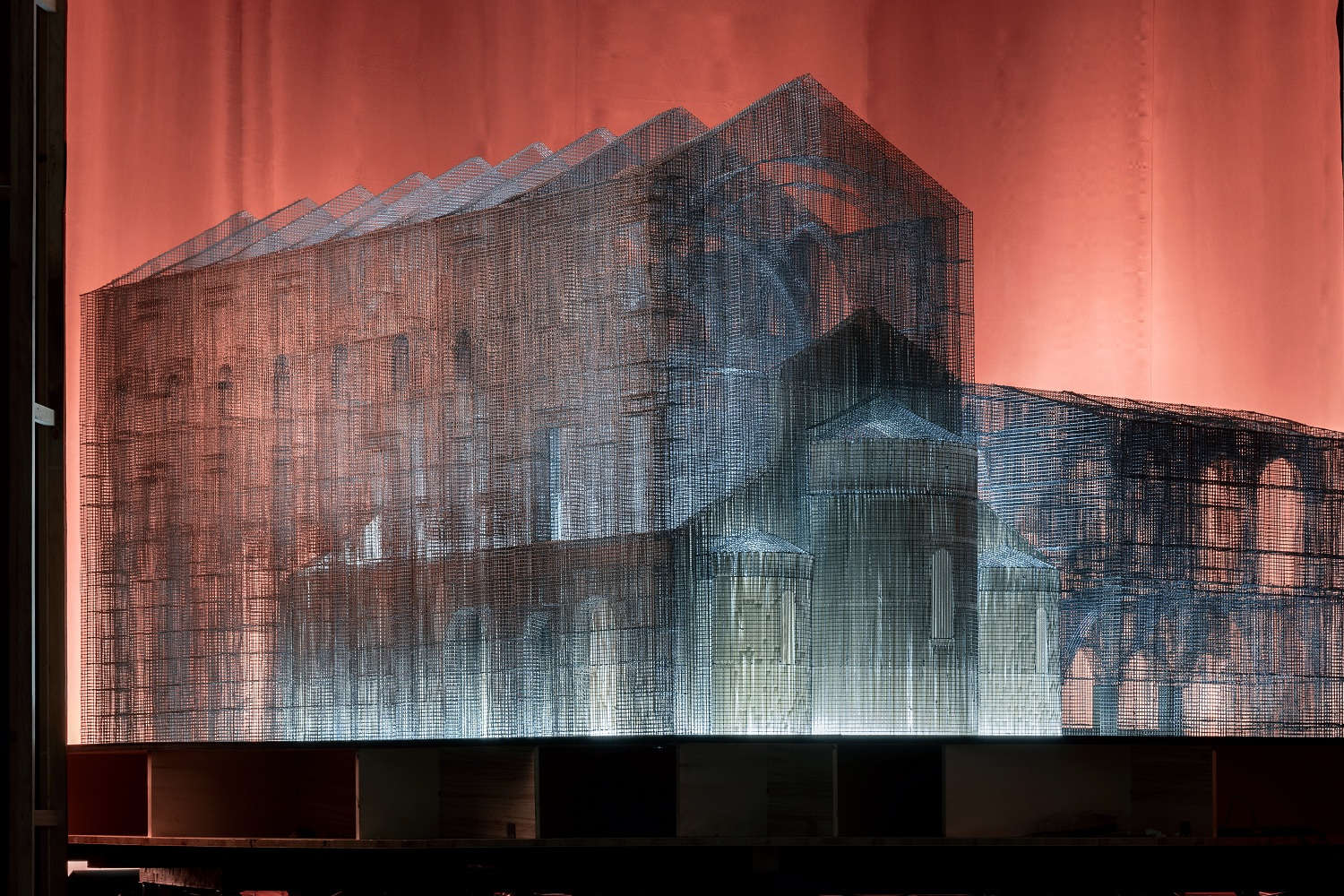
The artist’s architecture, elaborated over the course of four years, takes the form of an architectural reflection on the relationship between time and memory, inspired by the well-known installation Tresoldi created in Siponto (Foggia) in 2016. The artist once again uses wire mesh and the play of transparencies to evoke what no longer exists and to reinterpret what remains, inserting the intervention into the material and immaterial history of the place. The St. Peter’s area, considered one of the city’s points of origin, has in fact undergone transformations and changes of destination over the centuries that have altered its physiognomy. The design proposal therefore aims to visually restore the stratigraphic complexity of the site, representing the successive buildings through intersecting and overlapping volumes. Indeed, the goal is to make legible the variety of construction phases, presenting architectures enclosed within each other as in a spatial narrative.
The project also takes on a specific material dimension: the walls of the oldest church are made using aggregates and waste materials from the demolition of contemporary buildings in the city. The choice intends to reinsert elements of the recent urban fabric into a new construction cycle, giving the modern remains an interpretive and symbolic function. This approach reflects the idea of a memory that does not remain static, but can be re-read and reworked through contemporary architecture. Since the early twentieth century, the site of St. Peter’s has been the subject of numerous archaeological campaigns conducted by the Ministry of Culture. The excavations have revealed a settlement continuity of nearly four thousand years, from the Bronze Age to the twentieth century. The latest campaign, completed in May 2024, has provided additional data useful in guiding reconstruction, which will not take place as a faithful replication of historic structures, but as an artistic interpretation in dialogue with available archaeological information.
The historical complexity of the site exceeds that of the Siponto intervention, as St. Peter’s went through many phases: an early medieval church, then reworked in the Romanesque period between the 11th and 12th centuries, further modifications in the 15th century with the construction of the Franciscan monastery, and extensions in the 17th century. In the 19th century, the entire complex was reused for civilian purposes and became the Consortial Hospital, a structure severely damaged during the 1943 bombing and by the explosion of the steamer Charles Henderson in 1945. The building was finally demolished in 1969. Despite the physical disappearance of the architecture, the memory of the place has remained present through oral testimonies, family stories and toponymic references. Intangible heritage was a major component in the research conducted by Tresoldi, who consulted surveys, maps, archival documents and excavation reports, as well as information gathered from the local community. Thus, at the center of the investigations re-emerges the persistent trace of the church of San Pietro, still recognizable in the perception of the inhabitants.
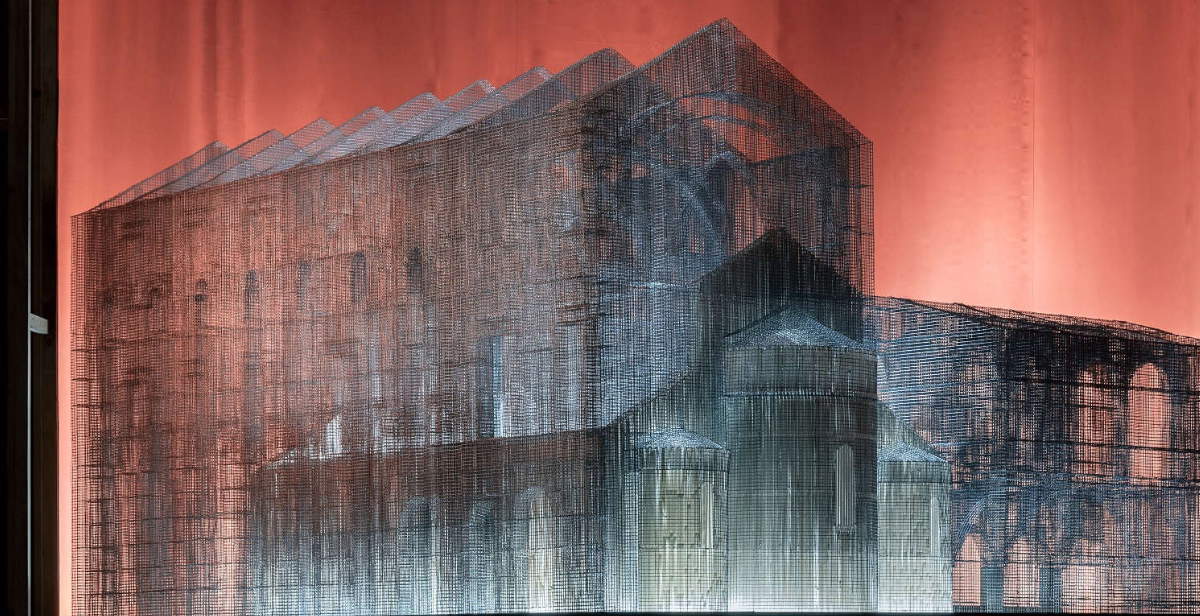 |
| Part of Edoardo Tresoldi's work in Bari collapses during bad weather |

Warning: the translation into English of the original Italian article was created using automatic tools. We undertake to review all articles, but we do not guarantee the total absence of inaccuracies in the translation due to the program. You can find the original by clicking on the ITA button. If you find any mistake,please contact us.


























 IT
IT FR
FR DE
DE ES
ES CN
CN


