









A new front of confrontation has opened up in the delicate sector of the protection of Italy’s artistic heritage, following the presentation of an amendment to the Cultural Heritage Code, which was approved and became law last Dec. 2 (it will come into effect as of Dec. 18) that threatens to alter the balance achieved in the system of training restoration professionals. At the center of the debate is amendment number 14.0.7 to Bill 1184, proposed by Leghist senators Romeo, Pirovano, Spelgatti and Tosato (which was later approved and became Law 182 of Dec. 2, 2025). The new law introduced a new article 182-bis, within the Code of Cultural Heritage and Landscape, effectively reopening the terms for acquiring the qualification of restorer through mechanisms of recognition of prior experience. In essence, with this amendment, it will also be possible to become a restorer by demonstrating sufficient knowledge of the subject matter, regardless of one’s educational background.
The proposed rule establishes that, on a transitional basis and with a time window extending until June 30, 2028, those who demonstrate adequate professional competence in the field may acquire the title of cultural heritage restorer. This recognition would take place at the end of a public selection procedure, the implementing modalities of which would be left to a subsequent decree of the Minister of Culture. This legislative initiative stands in stark contrast to the current regulatory framework, which, after years of complex procedures, had declared the transitional phase over to make way for a system of access to the profession based exclusively on university paths of higher education.
To understand the extent of the criticism raised by professionals, it is necessary to analyze the evolution of the figure of the restorer in Italy. The Cultural Heritage Code, in Article 29, defines restoration as the direct intervention on the good through a complex of operations aimed at the material integrity and recovery of the good itself, the protection and transmission of its cultural values. Current regulations stipulate that heritage conservation is ensured through consistent study and prevention activities, and that interventions on movable property and decorated surfaces must be carried out exclusively by qualified restorers. To ensure a high standard of quality, the state has identified schools of higher education and universities as the places appointed to teach restoration, providing a final exam with qualifying value.
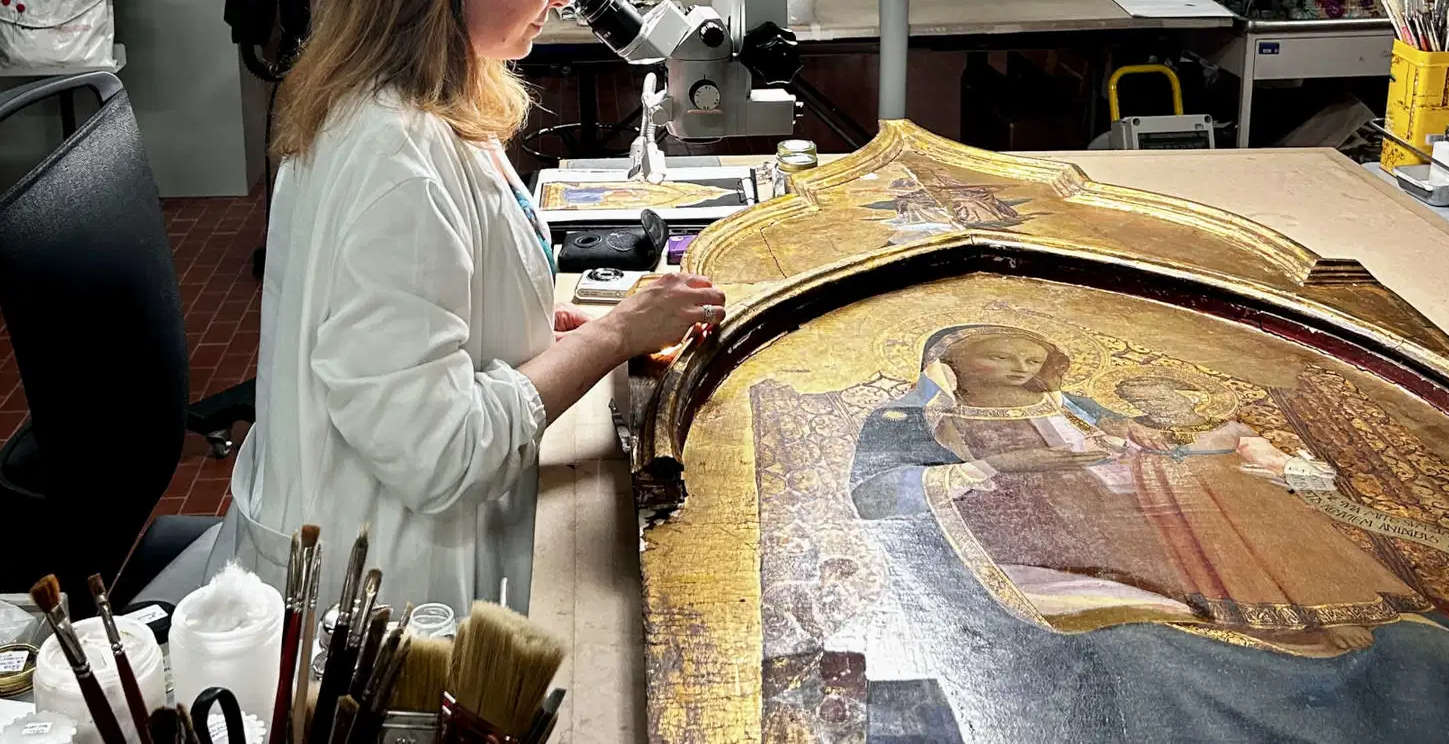
The system in place today provides for a five-year, single-cycle master’s degree program, identified by the LMR/02 class, which confers 300 training credits and includes as many as 1,500 hours of compulsory practical internship. This is a multidisciplinary education that blends scientific, historical and technical knowledge, ranging from materials chemistry and applied physics to art history and archaeology. This training model, consolidated by Ministerial Decree 87 of 2009, is considered one of the most rigorous in Europe and has enabled Italian professionals to hold prestigious positions in museums around the world.
TheAssociation of Italian Restorers (ARI), in an open letter sent last October to the heads of the Ministry of Culture and the Ministry of Education, expressed firm opposition to the Leghist amendment, calling it incomprehensible and potentially illegitimate. The association recalled that the transitional regime, regulated by Article 182 of the Code, was nearing its final conclusion after qualifying more than six thousand professionals through the procedures held between 2015 and 2018. The reopening of this amnesty, more than two decades after the enactment of the 2004 Code, was perceived by restorers as an attempt to diminish the value of the qualification and to lower the threshold of skills required to work on property of historical and artistic interest.
Professor Giuliano Volpe, an archaeologist and former president of the Higher Council of Cultural Heritage, also harshly criticized the initiative in an op-ed in theHuffington Post, pointing out that this regulatory change calls into question two decades of work employed to build a university training system of excellence. According to Volpe, the prospect of a transition lasting twenty-four years, from 2004 to 2028, responds to the same logic of permanent pardons, ending up rewarding improvisation at the expense of those who have invested years in study and academic training. The frightened risk is that the reopening of the terms will allow access to the qualification to practitioners from the construction sector, lacking the theoretical and methodological preparation that is essential to deal with the complexities of scientific restoration.
The issue is not only about the formal recognition of a qualification, but touches the very substance of heritage protection. Article 9 of the Constitution entrusts the Republic with the task of protecting the nation’s landscape and historical and artistic heritage, and the figure of the restorer is the operational tool through which this mandate is carried out. It is not, as ARI points out, a mere manual skill, but rather an intellectual profession that requires analytical, diagnostic and planning skills. The modern restorer is called upon to define the state of conservation of artifacts, interpret data on constituent materials, and design interventions that ensure chemical and physical compatibility and reversibility of operations.
Recent regulatory developments, in fact, have further strengthened the role of the restorer, giving him or her precise responsibilities in the field of public contracts as well. The new Procurement Code (Legislative Decree 36/2023) requires that the technical data sheet for interventions on cultural property be drawn up by a qualified restorer and that this professional can take on the role of designer of the entire intervention. In addition, within the Public Administration, the restorer performs key managerial and directive functions, dealing with investigations for authorizations, supervising the execution of works, and often assuming the function of Single Project Manager (RUP). Entrusting such responsibilities to individuals without structured training would, according to critics, risk depowering the effectiveness of state protective action.
Academic and professional concerns would also be reflected in administrative jurisprudence. The Restorers’ Association of Italy cited in its October letter a January 2020 Lazio Regional Administrative Court ruling and Council of State pronouncements that would already confirm the non-reactivability of amnesty procedures once the transitional period provided for by the law is over. Even the General Directorate of Education, Research and Cultural Institutes of the Ministry of Culture, in a recent parliamentary hearing, had clarified that access to the qualification is now routinely regulated by the possession of academic qualifications, excluding new amnesties based on experience alone.
The inclusion of Article 182-bis, according to critics, would attempt to circumvent these legal obstacles by creating a new time window for the evaluation of prior qualifications and activities performed. However, critics note that the criteria for such evaluation, based on the generic concept of “adequate professional competence,” appear vague compared to the rigor of university credits and certified internship hours required of students in degree programs. It is feared that this could lead to a downward leveling of the quality of interventions, with potential irreversible damage to unique and unrepeatable works of art.
Comparison with the international context further highlights the critical nature of the proposal. While there are discussions in Italy about reopening the doors to nonacademic paths, in Europe the standard of reference for access to the profession has settled on level 7 of the European Qualifications Framework (EQF), corresponding to the university master’s degree. Different choices, such as that of the United Kingdom to focus on three-year courses and non-university accreditations, have paradoxically led to a situation in which the top positions in large British museums are often occupied by professionals trained in Italy, France or the Netherlands, precisely because of their superior academic preparation. Italy, with its institutes of excellence such as the Istituto Centrale per il Restauro (ICR) and the Opificio delle Pietre Dure (OPD), has exported a training model that combines theory and practice, science and art history. Weakening this system would mean losing a globally recognized cultural and scientific primacy.
A relevant technical aspect, often overlooked in policy debate, concerns the division of expertise by specific fields. The current university pathway provides a specialization in one of twelve Professionalizing Training Pathways (PFPs), ranging from stone materials to paintings on canvas, from musical instruments to textile artifacts. The final exam qualifies specifically for the chosen field, ensuring that someone who works on a historic violin has different skills than someone who restores a fresco. The reopening of an amnesty based on less stringent criteria risks creating confusion about the true operational capabilities of the newly qualified, undermining the principle of specialization that underlies modern restoration.
Trade associations also point out how this regulatory change has ignored the efforts made by thousands of students and families who, believing in institutions, invested in a long and demanding course of study. Currently, there are nearly 8,000 restorers already licensed and registered in the Ministry’s lists, a number that experts say makes the need to bring new professionals onto the market through extraordinary channels unjustified. The hypothesis is that the push for this reopening comes from pressure from some business categories that see the obligation to employ qualified restorers as an economic or bureaucratic obstacle in the execution of works, especially in the historic building sector.
However, as reiterated by Giuliano Volpe, heritage protection cannot be subjected to simplification logics that compromise its quality. “Who would let themselves be operated on or treated,” says Volpe, “by a guru lacking proper academic training and high specialization? Why then put the cultural heritage in the hands of someone who may have a number of construction sites behind him but has never studied the theories and methods of restoration and perhaps does not even know who Giulio Carlo Argan, Cesare Brandi and Giovanni Urbani are?” The provocation serves as a reminder that cultural heritage is a fragile and precious “body” whose care requires rigorous science and not just site practice.
The new legislation will also affect public spending and administrative organization, according to critics. The administration of a new public selection procedure, to be completed by 2028, would require human and instrumental resources on the part of the Ministry, which would have to verify thousands of applications and certifications, taking staff away from other protection activities. Although the text of the amendment provides for financial invariance, the experience of previous amnesties suggests that the organizational impact would be substantial.
Now that the legislation is in place, however, the game shifts to another plane: the criteria for evaluating the experience of aspiring restorers and the formation of a serious commission. The students of theBrera Academy, who have mobilized in the same way as many of their colleagues, suggest: “it is necessary to fight so that the procedure envisaged until 2028 is: defined by a representative commission, specially established; reserved exclusively for those enrolled in the list of technicians/collaborators drawn up in the first application of art. 182, excluding new entrants ex post. A request based not on corporate interests, but on the effective protection of the Italian cultural heritage and respect for the laws of the State.”
|
| Restorers "by experience": new law causes debate and puts Italian excellence at risk |

Warning: the translation into English of the original Italian article was created using automatic tools. We undertake to review all articles, but we do not guarantee the total absence of inaccuracies in the translation due to the program. You can find the original by clicking on the ITA button. If you find any mistake,please contact us.


























 IT
IT FR
FR DE
DE ES
ES CN
CN